
Skip to product information
1 of 3

Vintage and Antique Gifts

Vintage 1940s Big John Plug Cut Tobacco Label and Tag Set 🚬 John Weisert Tobacco Co St Louis Missouri USA Ephemera Collectible

Vintage 1940s Big John Plug Cut Tobacco Label and Tag Set 🚬 John Weisert Tobacco Co St Louis Missouri USA Ephemera Collectible

Regular price $9.00 USD
Regular price Sale price $9.00 USD
Sale Sold out
Shipping calculated at checkout.

Size: 2 3/4" x 1 3/4"

🚚 Free US Shipping — ships within one business day. International shipping calculated at checkout.

Quantity

Who Was Big John — and Why Did He Never Let Go of His Pipe? 🚬

Size: 2 3/4" x 1 3/4"

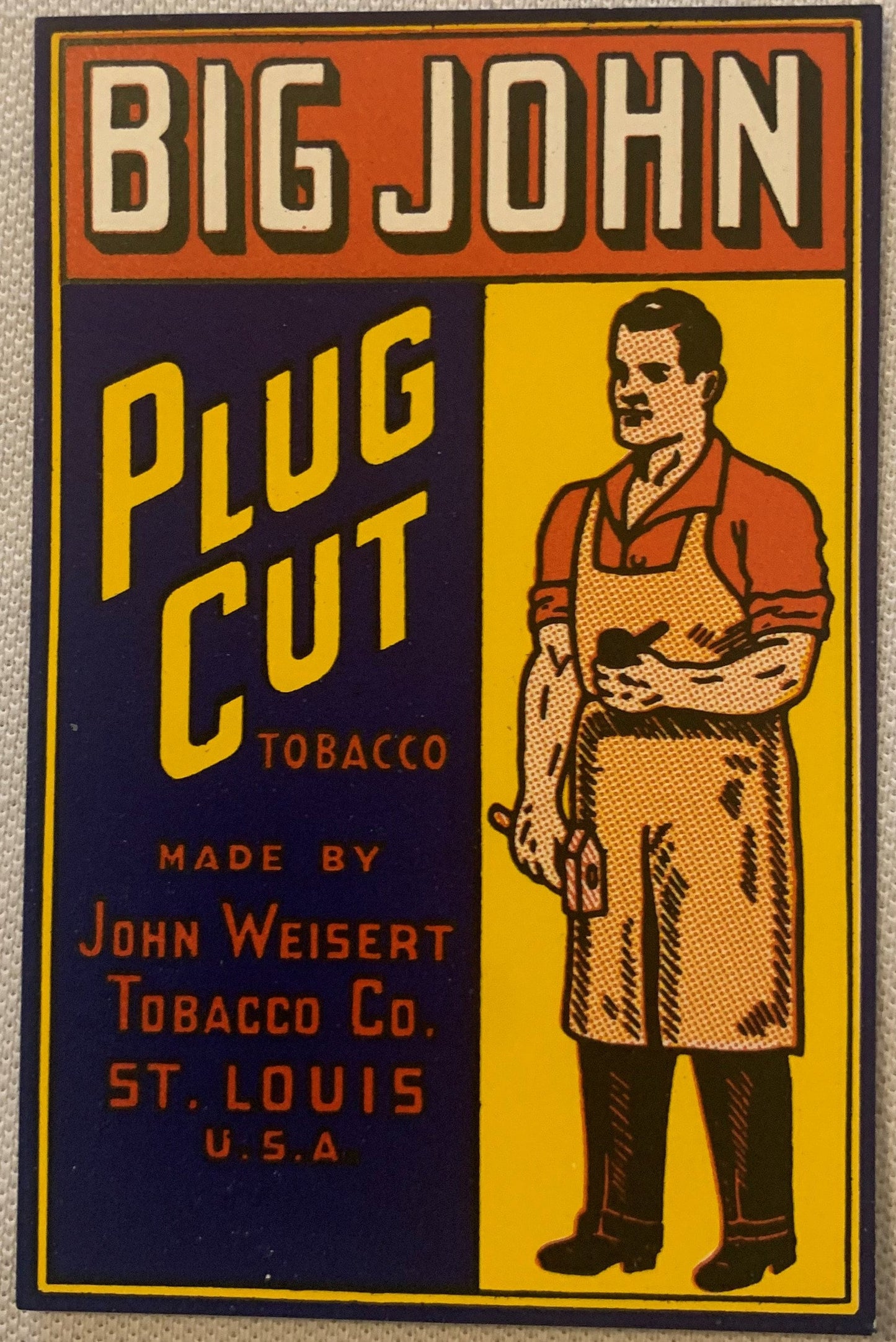
Big John never says a word. He just stands there in his work apron, arms folded, pipe in hand, like he already knows you're going home with his tobacco. I love this guy. Each set is a pair: a Big John Plug Cut label made by St. Louis's own John Weisert Tobacco Co., and the matching BIG JOHN TOBACCO tag. Both are 1940s new old stock - printed for Weisert and never put on a package - with little to no wear.

🤝 Why the pair matters

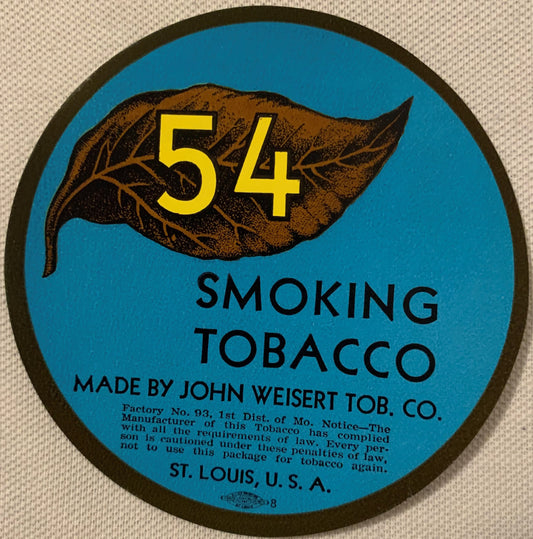
Plenty of collectors already have a Big John label on the wall. The tag is another story. I haven't seen another one offered alongside its label, and that's what I like about these sets - the label and its tag, kept together. Frame them side by side and the whole brand is right there in one glance.

📅 When these were printed

These are 1940s labels, from the years Big John was still going out the door in St. Louis. One spare Big John wrapper has even turned up with an order for Big John and a few other Weisert brands penciled on the back and a July 28, 1942 date stamp on it. What a find. The brand itself goes back further than these labels: when the firm's W. A. Weisert worked the tobacco show in Philadelphia in January 1911, Big John plug cut was already one of the company's leading brands. And the Hagley Museum and Library in Delaware keeps a Weisert Big John Plug Cut label in its Fingerman ephemera collection.

🏭 The Weiserts

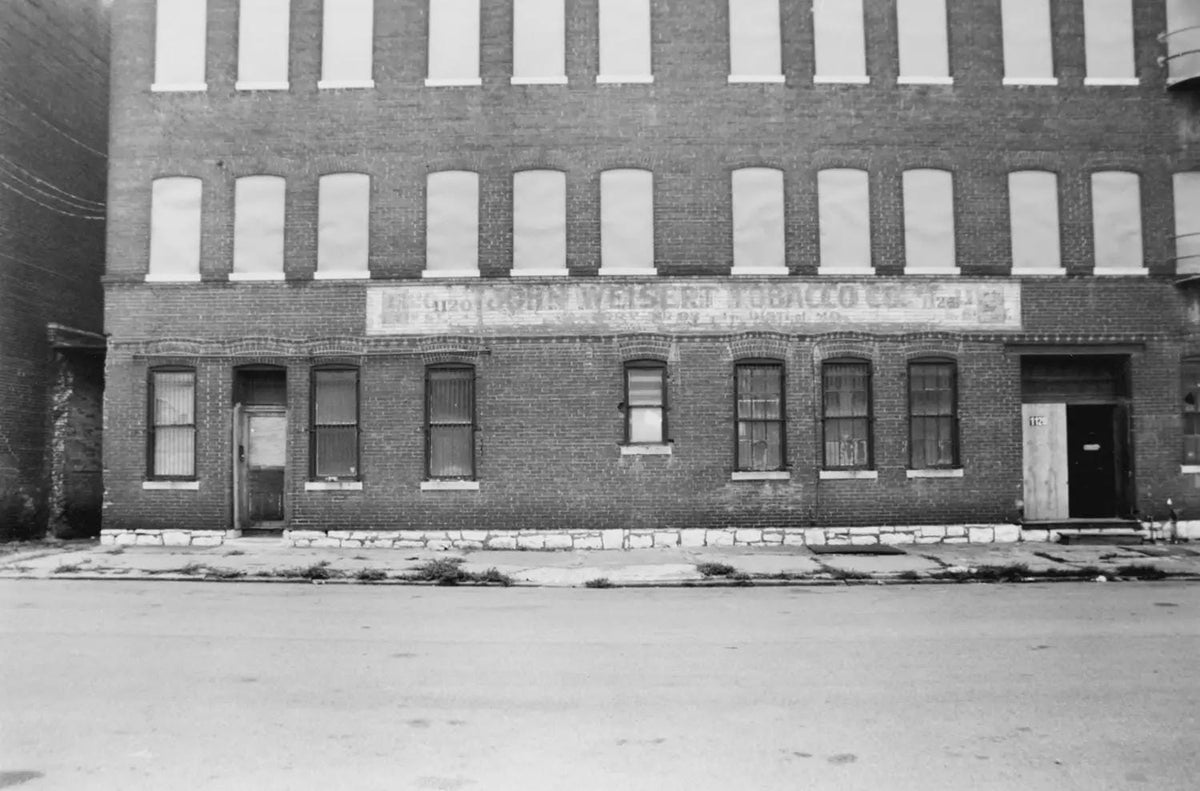
The family story starts in 1855, when John Weisert, a German immigrant, opened a tobacco company in Virginia. By 1880 the business was in St. Louis as the Weisert Brothers Tobacco Company, with his sons John Jr. and Albert as its officers. In 1902 John Jr. struck out on his own and opened the John Weisert Tobacco Company in an old building at 214 Pine Street - ground that was later cleared for the Jefferson National Expansion Memorial, the Gateway Arch grounds today. A year later he moved into a brand new factory at 1120 South Sixth Street, designed by Anton Rieve. In 1922 a warehouse went up on its south side, drawn by Edward Lantz, the same architect who did the Post-Dispatch Building. Fine cut and plug chew, roll-your-own, snuff and hand-rolled cigars all came out of that building.

Here's the part I admire. In 1893 James B. Duke's American Tobacco Company went after the plug business and started swallowing St. Louis makers one after another - Drummond, Brown, Catlin and a long line of smaller shops. Weisert didn't sell. It came through the trust years still locally owned, and when Duke's price-cutting put other companies under, Weisert bought up their brand names. At its peak it had over 100 brands of chewing tobacco and cigars: Orphan Boy, Drummer Boy, Joysmoke "the Happy Smoke," Blood plug cut ("Blood Will Tell"), Screamer, a Fraternity Pipe Mixture packed for Sigma Pi, Tau Kappa Epsilon and other fraternities, a Delmar Smoking Tobacco made just for the Delmar Tobacco Shop at Delmar and Euclid, and a Cherry Diamond Club Special for the Missouri Athletic Club. Weisert even blended by region - sweet and heavy on the licorice for chewers up north, light and close to the natural leaf for Missouri and the South, and strong, nearly black, for the rivermen and sailors.

🌿 Plug, and where it came from

Plug was invented just up the road from St. Louis - in St. Charles County and Pike County, Missouri, in the middle of the 1800s. The first ones were made in a log. You bored out the center of a green maple or hickory log, packed it with tobacco mixed with honey and homemade peach or apple brandy, plugged the hole and let it dry, then split the log and there was your plug, cured and flavored. Once the factories took it over they flavored it with licorice, rum, honey, sugar and wintergreen, and from the end of the Civil War right up to World War I it was the most popular way Americans used tobacco. Plug cut is that same pressed tobacco sliced up for the pipe or the cheek - a working man's tobacco, which suits Big John in his apron just fine.

St. Louis was the capital of all of it. By 1879 the city led the world in tobacco manufacturing and turned out more than a fifth of the country's tobacco, and by 1890 it was making over twice as much as the next city in America. In 1914 Missouri's factories produced almost 40 percent of all the tobacco products made in the United States.

🕰️ The long goodbye

The cigarette is what finally did St. Louis in. World War I soldiers got tobacco with rolling papers and cheap cigarettes at the commissary, and they came home smokers. A Liggett & Myers manager summed it up in 1914: "you can't chew and spit in a car." St. Louis kept making chew, plug and cigars while that market slowly drained away, and Weisert hung on longer than anybody. When Liggett & Myers closed its St. Louis factory late in 1972, Weisert was the last tobacco maker left in the city. In 1976 Louis Applestein, the last man in the city who could roll a cigar by hand, died at 83, and Weisert had to quit making its own cigars. By the end, Walter Weisert, the founder's grandson, was flavoring the tobacco with his own hands - president, staff and the whole production crew rolled into one man. The doors closed for good in the late 1980s, after 133 years in the tobacco business, and with them went the last of tobacco making in St. Louis.

The factory on South Sixth is still standing. It's one of only four tobacco company complexes known to survive in St. Louis, and in 2004 it was listed on the National Register. When it was written up for the Register, the upper floors still had the two-level drying kiln, the signs and posters pasted on the walls, and the smell of tobacco. I love that it still smelled like work.

🗣️ Stories they tell

Who was Big John? Local legend among St. Louis tobacco collectors says he was drawn from a real man in the Weisert operation, and I'd like to think so - he looks like somebody you'd have known down the block. There's a story about the Weisert floor, too: that long after the founder was gone, the old hands still invoked his name whenever they set somebody's work straight. And dealers who handle this stock will tell you the unused Big John labels came out of the old Weisert building itself.

🖼️ Showing them off

I'd frame the two together in a small shadowbox with a dark mat, the tag running under the label. They look great in a den, a bar or a study, or on a shelf with old tobacco tins and tags. Put them behind UV glass and they'll stay just as bright. Everything here is kept in the dark at under 40% humidity and a steady 72 degrees, climate controlled, so they'll reach you as described. They make a great gift for anyone with St. Louis roots, a pipe smoker, or the tobacciana collector who has the tins but not the paper.

  • Brand: Big John Plug Cut
  • Maker: John Weisert Tobacco Co., St. Louis, Missouri
  • Era: 1940s
  • Pieces: label and matching tag
  • Condition: New old stock, unused - little to no wear

Shipping

🚚 Shipping & Handling

  • Shipping costs and timing are calculated at checkout.
  • Items curated and shipped directly by me include U.S. shipping at no additional cost, professionally packed to ensure safe arrival of your artifact.

Items from Vetted Pro Collectors
Shipping for items offered by vetted Pro Collectors is determined at checkout. All Pro Collector listings are reviewed to ensure fair, reasonable shipping practices.

For full details, please refer to our Shipping Policy.

Returns & Exchange

Take your time — you've got a full six months. If a piece isn't right for you, send it back the way it reached you and we're good.

In the first 30 days your money goes straight back the way you paid. After that it's store credit, so you can put it toward something you'd rather have.

Return shipping we sort out between us, case by case. I don't make this difficult.

If something arrives damaged, or it isn't what I said it was, send me a photo within 48 hours and I'll make it right.

Email info@vintageantiquesgifts.com or call 802-356-9872 — that's me answering, not a call center.

The only things I can't take back are custom or special-order pieces and gift cards.

View full details
  • 5 stars: 2 (100%)
  • 4 stars: 0 (0%)
  • 3 stars: 0 (0%)
  • 2 stars: 0 (0%)
  • 1 star: 0 (0%)
4
4***_ (49)

Item arrived quickly and in perfect condition packaged very well exact to sellers pictures at a good price very good quality will look great framed. Very appreciative seller and it is awesome that his children are involved in his business A+

p
pinyanj

Great shipping, great tobacciana, one of my favorites

Thank you so much! We appreciate it. Keep your eye out as I have 100's more tobacciana to list that I haven't gotten to yet.

Preserving History: Authentic Objects Across Eras

— Curated by Travis Weigel