Skip to product information
1 of 5

Vintage and Antique Gifts

Retro 2000s Red & White Porcelain Peace Sign Hinged Trinket Box Ornament ☮️ Bandwagon Surprise Ornament Keepsake with Gold Clasp, Ornament Decorations

Retro 2000s Red & White Porcelain Peace Sign Hinged Trinket Box Ornament ☮️ Bandwagon Surprise Ornament Keepsake with Gold Clasp, Ornament Decorations

Regular price $17.00 USD
Regular price Sale price $17.00 USD
Sale Sold out
Shipping calculated at checkout.

Size: 2" x 3/4"

🚚 Free US Shipping — ships within one business day. International shipping calculated at checkout.

Quantity

What Hides Inside This Peace Sign? ☮️ Retro 2000s Red & White Porcelain Hinged Trinket Box Ornament, a Bandwagon Surprise Ornament

Size: 2" x 3/4" ~ New Old Stock, with its SURPRISE ORNAMENTS box.

Peace on earth, with a secret inside.

From across the room it is a Christmas ornament: a glossy red and white peace sign hanging from a gold cord. Pick it up and it opens on a little gold hinge into a white porcelain box, just the size for a ring, a pair of small earrings, a folded note, a pinch of potpourri or a tiny gift. Call it a keepsake box, a pill box or, in the spirit of the symbol on the lid, a stash box. That symbol began in 1958 as a British designer's drawing of his own despair about the bomb. Twelve years later an American magazine was telling readers it was an anti-Christian "broken cross." Hanging a peace sign on the Christmas tree answers that argument without saying a word.

The Ornament

  • Type: hinged porcelain trinket box ornament, from Bandwagon's Surprise Ornaments line
  • Design: peace sign
  • Hardware: gold-tone hinge, star-shaped clasp and rims, with a gold cord to hang it
  • Inside: one open porcelain well
  • Size: 2 x 0.75 inches
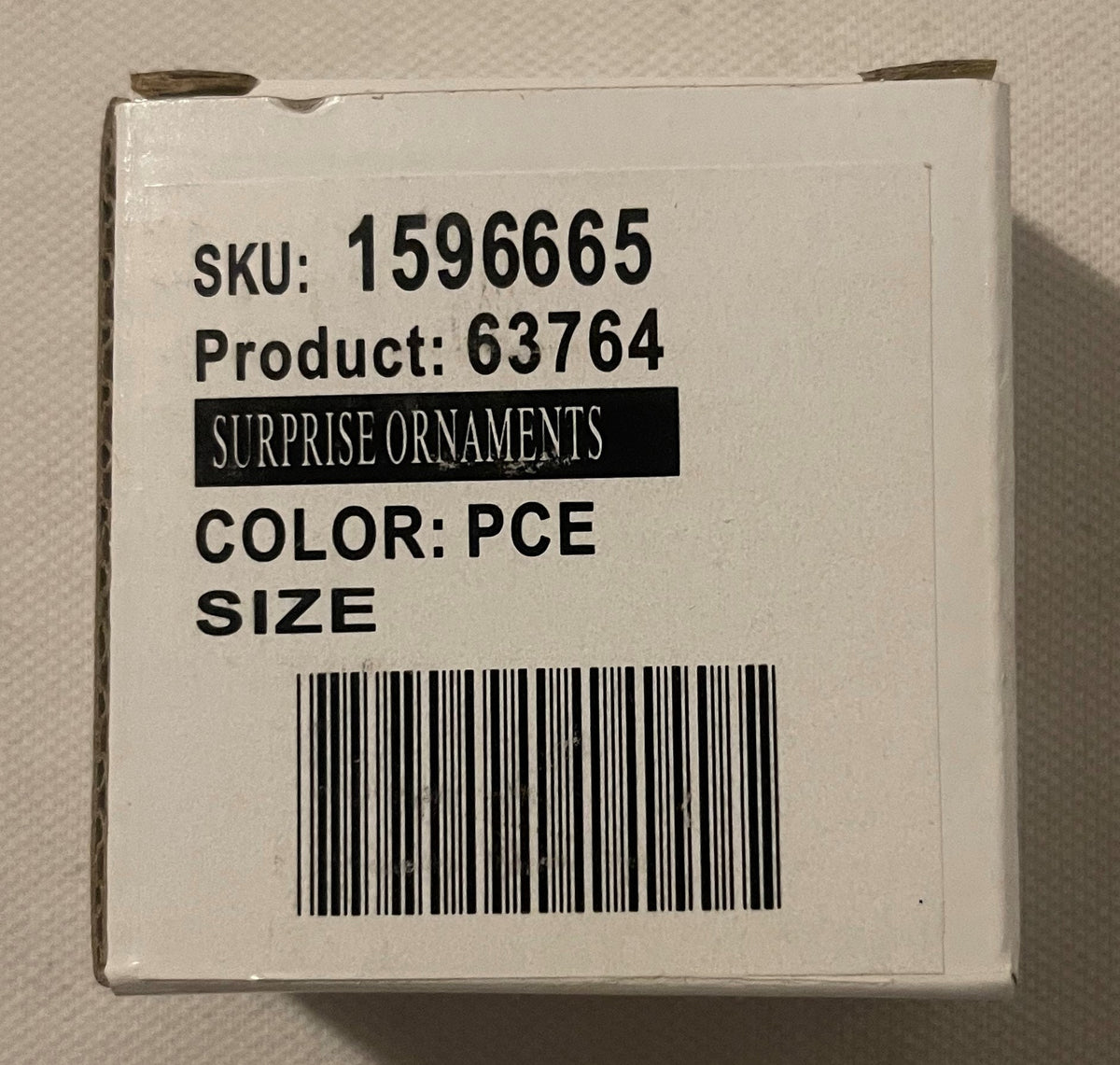
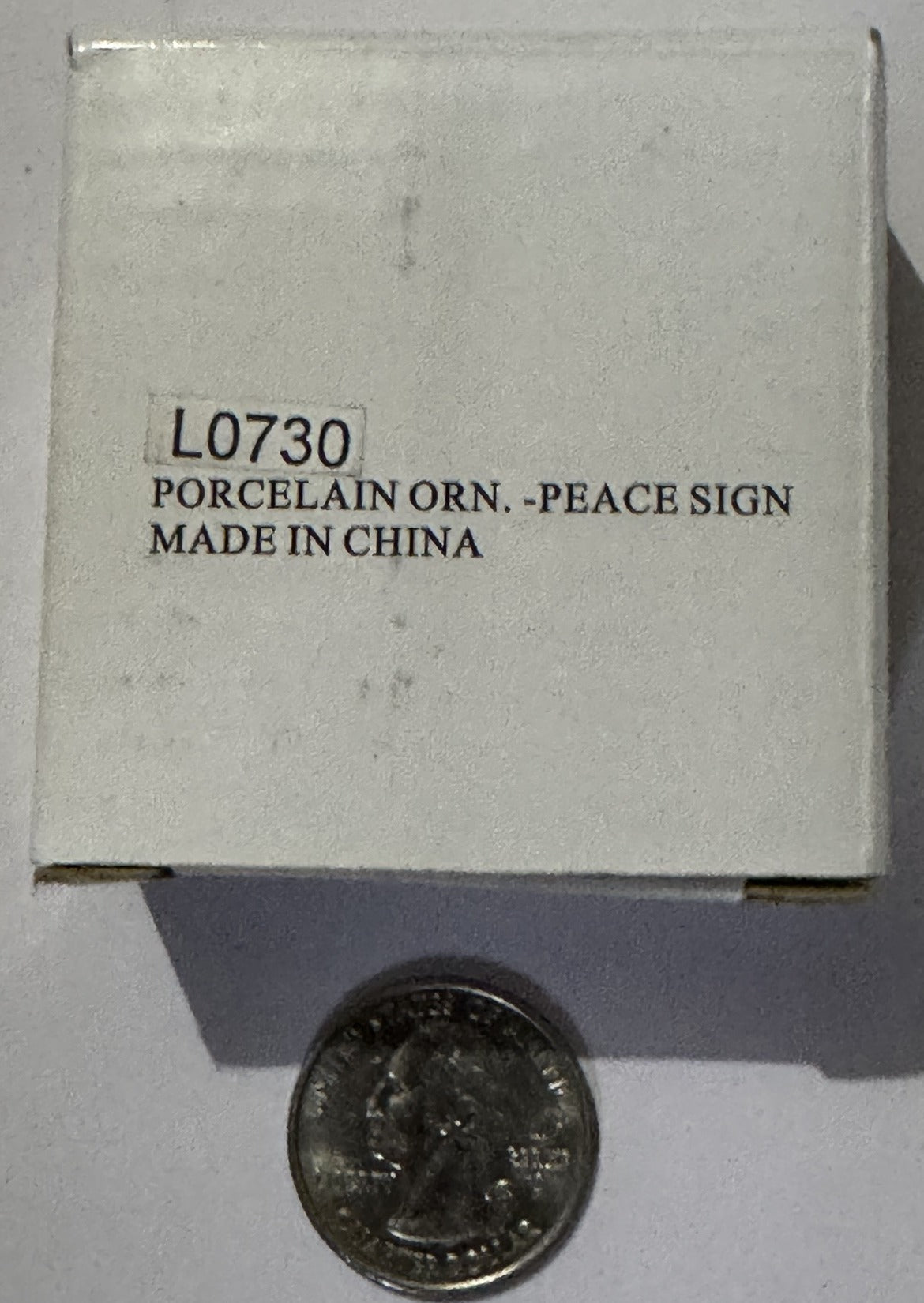
  • Marked: MADE IN CHINA sticker, and a carton printed SURPRISE ORNAMENTS, COLOR: PCE on one side and L0730, PORCELAIN ORN. -PEACE SIGN, MADE IN CHINA on another
  • Maker: Bandwagon, Inc., Wilmington, Massachusetts
  • Era: 2000s
  • Condition: New Old Stock

Bandwagon, Inc., and a Semi-Truck From Massachusetts

I bought these in 2007, straight off a semi-truck load of Bandwagon's unsold stock out of Massachusetts, so they are 2000s ornaments through and through. Most of the rest of that load is long gone. Every one of mine is New Old Stock, never hung, still with its box, just the way it came off that truck. Bandwagon, Inc. is a gifts-and-novelties importer, a Massachusetts corporation working out of 54 Industrial Way in Wilmington, and it claims the BANDWAGON name as far back as 1969, according to its 2022 trademark filing. Its earliest registered mark is CEDAR SCENTER, aromatic wood chips, first used in 1983, and it filed for others along the way, DENTAPICKS toothpicks among them. A lot of what it sold came in from China and Taiwan, and that is the story behind the little MADE IN CHINA sticker on the side of these. That sticker has its own bit of history: the United States and China restored relations in January 1979, signed a trade agreement on July 7 of that year, and on January 24, 1980 Congress voted China most-favored-nation trade status. Trade between the two countries went from about $1.1 billion in 1978 to some $4.8 billion by 1980 and about $63.5 billion by 1996, and within a generation little Chinese-made gifts like this one were on every American gift-shop shelf. Bandwagon numbers its own goods with a letter and four digits and prints that number on its cartons, and this one's carton reads L0730, PORCELAIN ORN. -PEACE SIGN.

The Surprise Ornaments Line

SURPRISE ORNAMENTS is Bandwagon's name for a whole family of little hinged porcelain boxes dressed up as Christmas ornaments: Santas, snowmen, sock monkeys, a cat in a bag and a church among them. The line stayed in Bandwagon's range for many years after my truck pulled out. Signals and Daedalus Books carried the porcelain Surprise Ornaments as their item HT6102, and their catalog pages run from 2017 to 2024, with around forty styles by the end. Bits and Pieces sells them to this day. Daedalus calls the hinges "Limoges-style," a nod to the French boxes below, and between them the catalogs list the peace sign in a blue round and as a dove. A red one is a hard one to find.

Gerald Holtom Draws Despair

Gerald Holtom was born on January 20, 1914, studied at the Royal College of Art in London and spent the Second World War as a conscientious objector. On February 21, 1958, he designed a badge for the first march of the new Campaign for Nuclear Disarmament, the Easter walk from London to the Atomic Weapons Establishment at Aldermaston, April 4 to 7, 1958. He built it from two semaphore signals: N, two flags held down and out at an angle, and D, one flag straight up and one straight down, for Nuclear Disarmament. Then he drew a circle around them.

Holtom said the shape was also a picture of himself. "I was in despair. Deep despair," he explained, and he drew a figure with palms stretched outward and downward, like Goya's peasant facing the firing squad. Five hundred cardboard lollipop placards carried it on that first march, half black on white and half white on green. Holtom died on September 18, 1985.

The first peace sign keepsakes were ceramic too. Eric Austen of Kensington CND made the earliest badges from white clay with the symbol painted on in black, and he read the despairing gesture as the death of man and the circle as the unborn child. The symbol has deliberately never been copyrighted. No one has to pay or ask permission to use it, which is exactly how it ended up on everything from protest banners to a porcelain ornament.

Across the Atlantic

How the peace sign reached America is its own small mystery. The story most often told credits Bayard Rustin, the civil rights organizer and close collaborator of Martin Luther King Jr., who had taken part in the 1958 march in Britain. The peace activist Philip Altbach said he brought CND buttons home from England to his colleagues. Either way, the civil rights movement used it first in the United States, and the anti-war movement and the counterculture carried it everywhere after that. As the Vietnam War protests grew through the 1960s it turned up on placards everywhere - it was there in October 1967 at the March on the Pentagon, and in 1968 it went up on the walls of Prague when the Soviet tanks rolled in - and it became the badge of the whole counterculture. Collectors of 1970s gift ware like to say peace-sign Christmas ornaments had their first heyday between 1971 and 1976, while the war was still on. Mine came a generation later, but it carries the same idea onto the tree.

Lore: The Broken Cross

Not everyone welcomed it. In 1970 American Opinion, the magazine of John Birch Society founder Robert Welch, ran an article called "Peace Symbols: The Truth About Those Strange Designs" that compared the sign to an anti-Christian "broken cross" carried by the Moors into Spain in the 8th century and tied it to Communism and Satanism. That October Ezra Taft Benson, the former U.S. Secretary of Agriculture and later president of the Latter-day Saints church, repeated the charge from the pulpit at the church's General Conference. The rumor still circulates. Its designer's own sketches say otherwise: two flag signals and a man in despair. A peace sign on a Christmas tree, among the angels and the stars, sits comfortably with the old carol line, peace on earth.

A Hinged Box With French Ancestors

The hinged porcelain trinket box goes back to France. The discovery of fine kaolin clay near Limoges in 1768 made that city a center of porcelain, and its small hinged boxes began as long, narrow cases for costly needles before growing into boxes for scissors, thimbles, powder and snuff. Later makers turned the form into a gift of its own, and the Surprise Ornaments idea puts it on the tree: a figure that looks like any ornament until it opens to hold something small inside. Collectors call little boxes like this PHBs, short for porcelain hinged box - the name comes from the PHB line that Midwest of Cannon Falls, Minnesota made famous with its tiny ketchup bottles, bananas and gum packs that open on a brass hinge.

🖼️ Ways to Show It Off

  • 🎄 Hang it on the Christmas tree - or a Yule or winter-holiday tree - and let the gold cord do the job it was made for.
  • 🎁 Make it the gift box: tuck a folded note, a tiny photograph or a ring into the porcelain well before you give it, so the ornament is the wrapping and the present at once.
  • ☮️ Build a little peace-movement shelf around it - an old protest button, a period photograph, a paperback from the era, a bit of macramé or a concert ticket stub.
  • 📚 Stand it in a bookcase or curio cabinet among peace-movement books and other mid-century pieces.
  • 🔍 Set it in a small glass bowl or on a velvet square where guests can pick it up, find the star clasp and get the surprise themselves.
  • 🌲 Hang it from a bookshelf hook or a lamp arm, or on a small tabletop tree, where a single graphic ornament stops the eye.

🎫 Who Collects These

Peace-movement collectors come first - people who have spent years gathering the buttons, posters, pamphlets and ephemera of the anti-nuclear and anti-war movements. For them the Holtom drawing and the CND origin matter, and a symbol that made it all the way from an Aldermaston placard onto a porcelain Christmas ornament is exactly the kind of evidence of how far it traveled. Porcelain hinged box collectors come at it from the other side: the glaze, the gold-tone hinge and star clasp, and the original SURPRISE ORNAMENTS box. Christmas ornament collectors like it because it's a real working ornament that hides a secret. And then there's everybody who grew up with a peace sign somewhere in the house - for them it isn't history, it's memory.

Shipping

🚚 Shipping & Handling

  • Shipping costs and timing are calculated at checkout.
  • Items curated and shipped directly by me include U.S. shipping at no additional cost, professionally packed to ensure safe arrival of your artifact.

Items from Vetted Pro Collectors
Shipping for items offered by vetted Pro Collectors is determined at checkout. All Pro Collector listings are reviewed to ensure fair, reasonable shipping practices.

For full details, please refer to our Shipping Policy.

Returns & Exchange

Take your time — you've got a full six months. If a piece isn't right for you, send it back the way it reached you and we're good.

In the first 30 days your money goes straight back the way you paid. After that it's store credit, so you can put it toward something you'd rather have.

Return shipping we sort out between us, case by case. I don't make this difficult.

If something arrives damaged, or it isn't what I said it was, send me a photo within 48 hours and I'll make it right.

Email info@vintageantiquesgifts.com or call 802-356-9872 — that's me answering, not a call center.

The only things I can't take back are custom or special-order pieces and gift cards.

View full details
  • 5 stars: 6 (100%)
  • 4 stars: 0 (0%)
  • 3 stars: 0 (0%)
  • 2 stars: 0 (0%)
  • 1 star: 0 (0%)
C
CAMILLE ZALONE

Makes a unique gift! Great experience with the seller

e
e***c (707)

Super cute ornament. It arrived quickly and it was safely packed for shipping

8
8***5 (68)

Great condition..very happy with purchase! Fast shipping.Thanks.

l
l***3 (200)

Great item! Fast service! Loved the personal letter!

h
h***n (2348)

The perfect gift for our Hippie"

d
ddtil

Super fast shipping, I love the ornament, would buy from again.

We are so happy you love it and we hope we do see you again soon!!

Rescuing American History Since 2007

— Travis & the Kids