Skip to product information
1 of 7

Vintage and Antique Gifts

Vintage 1980s Happy Home Clear Imitation Vanilla Bottle 🍦 Southern Flavoring Co. Bedford Virginia

Vintage 1980s Happy Home Clear Imitation Vanilla Bottle 🍦 Southern Flavoring Co. Bedford Virginia

Regular price $16.00 USD
Regular price Sale price $16.00 USD
Sale Sold out
Shipping calculated at checkout.

Size: 6 1/4" x 2 3/4"

🚚 Free US Shipping — ships within one business day. International shipping calculated at checkout.

Quantity

🍦 Why Does This Vintage Happy Home Clear Imitation Vanilla Bottle Say "Made Especially For Sale By Organizations"?

Size: 6 1/4" x 2 3/4" ~ a nicely aged label with plenty of character

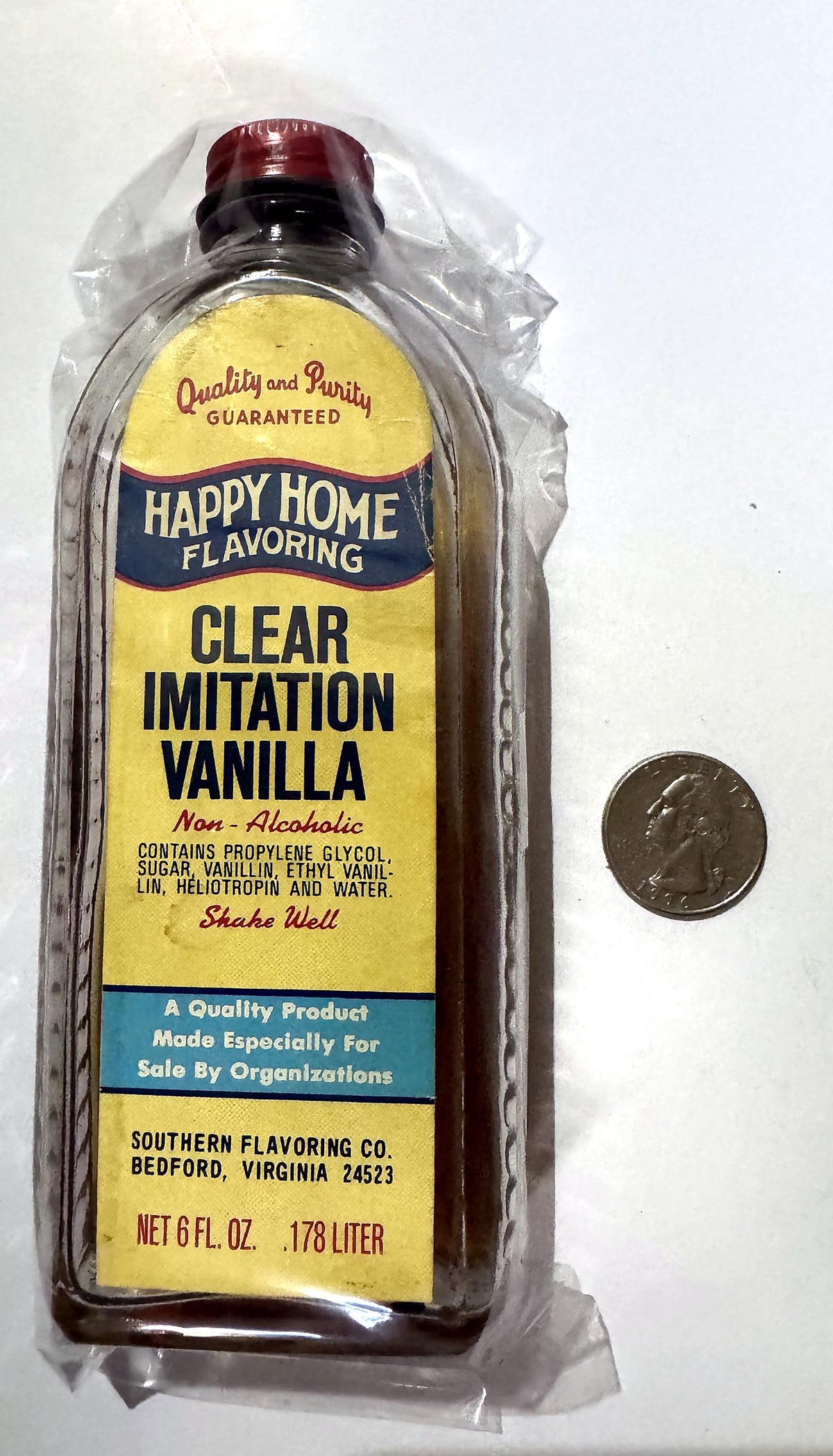
If your grandmother bought her vanilla from the church ladies instead of the grocery store, it may well have come in a bottle like this one. This is a vintage Happy Home Flavoring Clear Imitation Vanilla, a 6 fl oz glass bottle from the Southern Flavoring Co. of Bedford, Virginia, with its red Happy Home screw cap still on top. It dates to the 1980s and it still holds its original contents. It is sold as a vintage advertising collectible for display only, not for use or consumption.

That blue band across the label is not a slogan somebody dreamed up in an ad agency. It is the whole business plan of a Bedford family company, and it goes back to a handshake deal made in 1929. Pull up a chair.


🛏️ A Vanilla Company Run From a Sickroom

The story starts in the Claytor family house in Bedford. William Graham Claytor, Bill to everybody, had been left paralyzed from the waist down by an accident (the company still tells it as a mining accident). His sister Katherine had given her life over to caring for him, their elderly parents lived in the same house, and there was no money coming in. Then 1929 arrived, and things got harder for everybody in America.

So the Claytors went to work right there at home. One room became the factory. Katherine mixed the vanilla and lemon flavoring and bottled it. Bill sat up with a typewriter on a bed table and wrote sales letters to church groups, and his bedroom was the office by day; the business files got rolled out of the way every evening. Their young nephew Boyd earned his keep putting the tops on the bottles. Everything was done by hand, because there was neither the volume nor the money for machines. Their sister, Miss Mary Fred Claytor, is the third founder, and a photograph of all three comes from the Bedford Museum & Genealogical Library.

☕ It Was Supposed to Be a Coffee Company

Here is the part I love. Happy Home was never meant to be about vanilla. Bill's brother, A. Boyd Claytor Jr., sat on the vestry of St. John's Church in Lynchburg alongside a man named John Morton, whose company supplied goods to door-to-door salesmen. Morton suggested a mail-order coffee business. A little advertisement for sales agents went into Good Housekeeping, the Southern Coffee Company was born, and vanilla went out as a free bonus for customers who ordered enough coffee.

Then a funny thing happened. The way the family tells it, people wanted the vanilla more than the coffee. Morton agreed to help them switch to flavoring on one condition: they would sell only through organizations, so they would never compete with his own door-to-door agents. In the nephew's words, "So, the Southern Coffee Company became the Southern Flavoring Company." That promise is the reason the label on this bottle reads the way it does, fifty-odd years later.

The company adds its own chapter to the legend: an alcohol-free vanilla was an instant success in the dry years of Prohibition. Happy Home has been the brand name ever since; the federal trademark registration gives 1930 as its first use.


⛪ How the Church Circle Sold It

For decades this is how Happy Home reached kitchens all over the country, one club treasurer at a time. The old magazine ads tell it best:

  • 1932: Happy Home vanilla and lemon in Good Housekeeping, with low wholesale prices for women's clubs, church circles and parent-teacher associations.
  • 1955: a club could earn a 48-cup coffee urn if sixteen members each sold three bottles of Happy Home Vanilla.
  • 1956: church readers of Presbyterian Life were promised the vanilla on credit, nothing out of the treasury up front, shipping prepaid, and a silver service as the prize.
  • 1959 to 1961: home economics teachers ordered it for their classes, a dollar bottle held twelve full ounces, and the premium was a covered sugar bowl.
  • The 1970s: Southern Flavoring's "time-tested fund raising plan" ran in Scouting, National 4-H Club News, Ebony and House & Garden, with Happy Home dish cloths joining the vanilla.

Churches have always liked selling these non-alcoholic flavorings, and they still do. When the Roanoke Times visited the company in 2015, it called Happy Home popular for church fundraisers.


👪 The Claytors and the Messiers

Bill Claytor (1898-1968) was running the company in 1940 and was its president when it was incorporated in 1949. In 1948 the operation moved out of the house to a building a few blocks away, and Southern Flavoring is still on Norfolk Avenue in Bedford today. Katherine Claytor lived to 97. Mary Fred Claytor had a career of her own: a home demonstration agent in Rockingham and Amherst counties and later in Ohio, nutritionist for the Bedford chapter of the Red Cross in 1945, and a Governor's appointee to the Board of Visitors of Virginia Tech.

The nephew who put tops on bottles, A. Boyd Claytor III (1925-2009), flew in the Pacific as a Navy air bomber with squadron VPB-120 in the Second World War, came home, designed the company's first real factory and became its president in the 1950s. He started the Holiday Company to sell greeting cards to the same church groups, then a dish cloth mill, Claytor Mills, and in his own words they sold millions of dishcloths. His Cloverlea Farm went to Lynchburg College and is now the Claytor Nature Study Center.

In 1974 he hired Tom Messier, a New Hampshire man with twenty-one years in the greeting card business, as general manager. When Tom arrived the line was just two flavors, imitation vanilla and lemon. He is the one credited with developing the clear vanilla, which became the company's top seller in the gallon size. Tom bought the company in 1990, served nineteen years on the Bedford City Council and several terms as mayor, was president of the Rotary Club, and by every account loved a good practical joke. Tom died in 2016, and the company put up a historical marker downtown in his memory, the one that tells the story of the Bedford Boys. His son John Messier joined in 1994 and has owned Southern Flavoring since 2009. It is still a family business, and the company says today's plastic Happy Home bottles were designed from the mold of the original 1929 glass bottle.


📅 Why This Bottle Belongs to the 1980s

Nothing on the bottle prints a year, but it gives you plenty to go on:

  • The ZIP code. BEDFORD, VIRGINIA 24523 means the label went to press after July 1, 1963, the day ZIP codes began.
  • The word CLEAR. When Tom Messier came aboard in 1974 there was no clear vanilla in the line yet. This label had to come after that.
  • The glass. The P in a circle on the bottom is the mark of the Pierce Glass Company, and Pierce stopped being Pierce in 1987, when it was folded into Ball-InCon. So the bottle was made by then.
  • The metric line. ".178 LITER" writes the metric amount as a decimal of a liter, the older way of doing it, before the trade moved to milliliters in the mid-1980s.

Put those together and they point to the 1980s, after the clear vanilla came along and before Pierce became part of Ball-InCon in 1987. Which also means this bottle was filled while Bedford was officially a city, since it held independent city status from 1968 until 2013.

🔍 The P in a Circle on the Bottom

Turn the bottle over and you will find a P in a circle and the number 5, ringed by the same beading that runs down both sides of the glass. The circled P belongs to the Pierce Glass Company, which used it for its whole life, from 1905 to 1987. Pierce was started by Dr. V. Mott Pierce, son of the famous Buffalo patent-medicine man Dr. Ray V. Pierce, to make bottles for his father's remedies. It moved to Port Allegany, Pennsylvania, in 1917, and by the 1980s it was making food, medicine, cosmetic and beverage containers. The plant is still making glass in Port Allegany today. The lone 5 is most likely the mold cavity number, which tells the glassworks which cavity of the machine the bottle came out of.


🧁 What Is Clear Imitation Vanilla, Anyway?

The label lists propylene glycol, sugar, vanillin, ethyl vanillin, heliotropin and water, and every one of those has a story:

  • Vanillin is the main flavor in real vanilla. Two German chemists, Tiemann and Haarmann, worked out how to make it in 1874. It was made from clove oil for decades, then from the leftovers of paper mills starting in the 1930s, and by 1981 one paper mill in Thorold, Ontario was supplying 60 percent of the world's vanillin.
  • Ethyl vanillin is its stronger cousin, about three times as potent. Perfumers love it too; it sits at the heart of Guerlain's Shalimar.
  • Heliotropin is named for the heliotrope flower, whose scent people call cherry pie. It smells of vanilla and cherry, and flavor makers used it in French vanilla, partly in place of coumarin, which was banned from American food in 1954.
  • Propylene glycol is the carrier that let Happy Home skip the alcohol entirely. That is what Non-Alcoholic on the label is all about.

And the clear part? Bakers want vanilla that will not tint their batter or icing. Regular brown vanilla can tint a white cake or frosting; clear vanilla keeps it white, which is why it shows up in white wedding cakes. A Bedford baker told the Roanoke Times the same thing in 2015, and it is still the reason bakers reach for it.


🏔️ Bedford, Virginia

Bedford sits at the foot of the Blue Ridge, with the Peaks of Otter standing over it. It was founded in 1782 as Liberty, named for the victory at Yorktown, and it served as the seat of Bedford County, which was formed in 1753 and named for John Russell, the 4th Duke of Bedford. After a fire in 1884 the town rebuilt in brick and took the name Bedford City in 1890. Thomas Jefferson kept his retreat, Poplar Forest, in the county. Around 1781 he wrote that the Peaks of Otter were thought to be higher from their base than any mountains in the country, and in 1815 he set out from Poplar Forest to measure them himself by trigonometry.

Bedford also carries a heavy piece of American history. Company A of the 116th Infantry, 29th Division, the hometown National Guard unit, left the Bedford depot in February 1941. On D-Day, nineteen men of Company A and another Bedford boy from Company F died on the beaches of Normandy, the highest loss for its size of any community in the United States. That is why the National D-Day Memorial stands in Bedford, dedicated on June 6, 2001. Bedford was a factory town too: the Piedmont Label Company, founded on Depot Street in 1919, is called Bedford's oldest factory in continuous operation.


🖼️ Display Ideas

  • 🧁 On an open kitchen shelf beside a vintage cake stand, a recipe box or an old church cookbook.
  • ⛪ With church and community fundraiser pieces, the bake-sale and potluck side of small-town life.
  • 🏪 In a general store or pantry display with old spice tins and extract bottles.
  • 🗺️ On a Virginia shelf next to Bedford, Lynchburg and Blue Ridge pieces.
  • 🎂 For the baker in your life who already swears by clear vanilla for white frosting.

🎁 Who Collects These

Kitchen and advertising collectors look for the old fund-raiser brands, and Happy Home has been at it since 1929. Bottle collectors go for the Pierce circled P and the beaded glass. Virginia and Bedford folks love a piece from home, and bakers who grew up with Happy Home recognize that label in a heartbeat. Plenty of the brown 8 oz Happy Home vanilla bottles turn up, but this clear 6 oz in the beaded glass is one I have not come across anywhere else, and once the limited supply of these old glass bottles is gone, they will be very difficult to find.

Shipping

🚚 Shipping & Handling

  • Shipping costs and timing are calculated at checkout.
  • Items curated and shipped directly by me include U.S. shipping at no additional cost, professionally packed to ensure safe arrival of your artifact.

Items from Vetted Pro Collectors
Shipping for items offered by vetted Pro Collectors is determined at checkout. All Pro Collector listings are reviewed to ensure fair, reasonable shipping practices.

For full details, please refer to our Shipping Policy.

Returns & Exchange

Take your time — you've got a full six months. If a piece isn't right for you, send it back the way it reached you and we're good.

In the first 30 days your money goes straight back the way you paid. After that it's store credit, so you can put it toward something you'd rather have.

Return shipping we sort out between us, case by case. I don't make this difficult.

If something arrives damaged, or it isn't what I said it was, send me a photo within 48 hours and I'll make it right.

Email info@vintageantiquesgifts.com or call 802-356-9872 — that's me answering, not a call center.

The only things I can't take back are custom or special-order pieces and gift cards.

View full details

Preserving History: Authentic Objects Across Eras

— Curated by Travis Weigel