Skip to product information
1 of 6

Vintage and Antique Gifts

Antique OG-NA Brand Tomatoes Label 🪶 Fabius NY Native American Chief Gold Embossed Can Label

Antique OG-NA Brand Tomatoes Label 🪶 Fabius NY Native American Chief Gold Embossed Can Label

Regular price 11.00 USD
Regular price Sale price 11.00 USD
Sale Sold out
Shipping calculated at checkout.
Quantity

🪶 What Stories Still Cling to a Hundred-Year-Old Vegetable Label?

Long before supermarket shelves were lined with shrink-wrapped uniformity, a can of tomatoes had to earn its place in a shopper's basket with nothing but a strip of paper wrapped around a tin. That paper had one job: stop a busy hand mid-reach in a country grocery in upstate New York and say this can is worth carrying home. The OG-NA Brand Tomatoes label did exactly that with a proud Native American chief rendered in gold foil and full color, a name that rolled off the tongue like something half-remembered from the land itself, and a level of printing craft that most modern packaging doesn't even attempt anymore. Labels like this one were never meant to survive — they were pasted on, the tomatoes were eaten, and the tin went to the scrap pile. Finding one intact, in its original printer's colors, is already a small miracle. Finding one paired with its own blank, embossed proof — the raised gold lettering and chief's portrait before a drop of ink ever touched it — is the kind of thing that turns a label collector's head clear across a show floor.

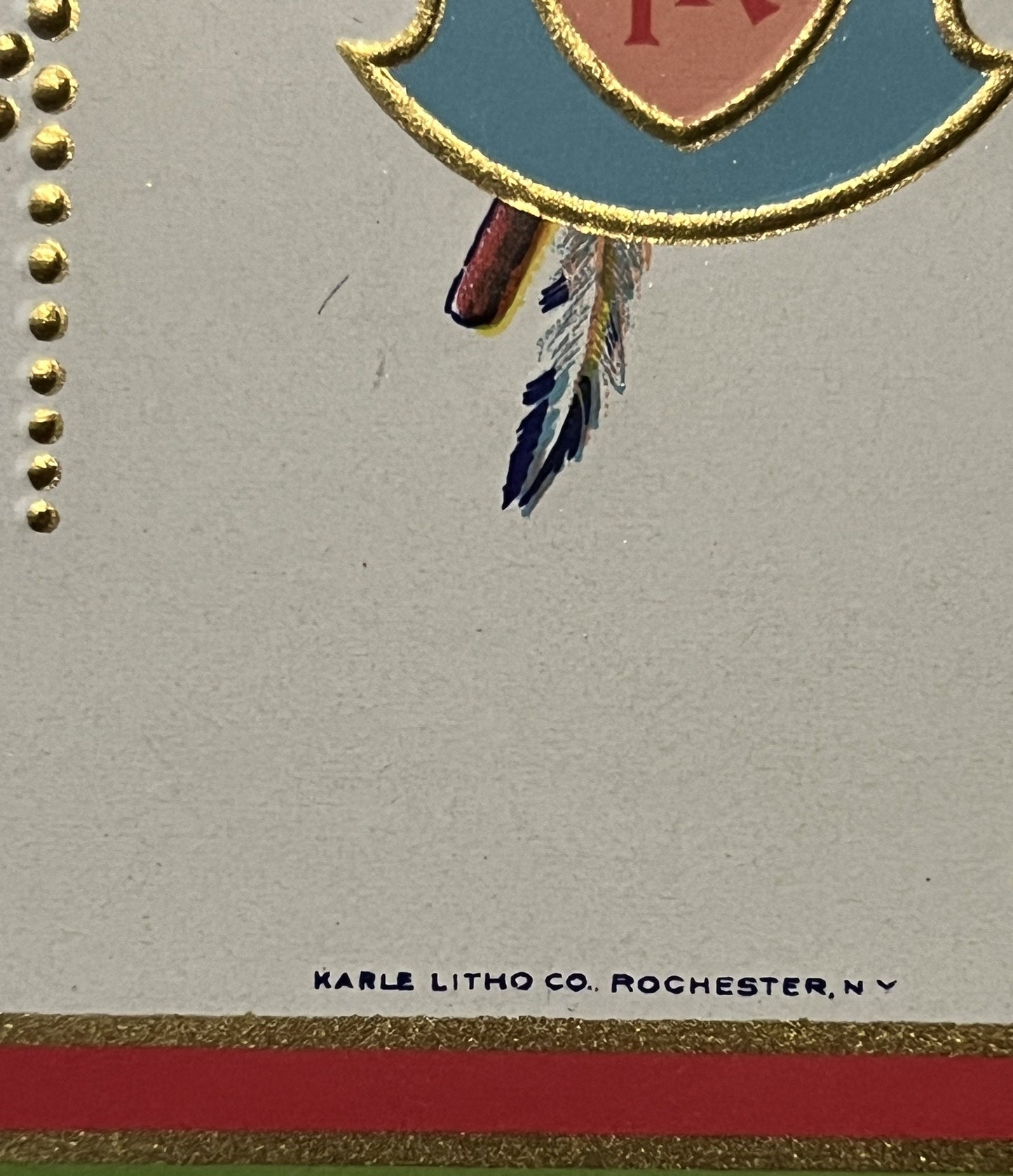
This is an antique OG-NA Brand Tomatoes can label, chromolithographed with gold foil embossed lettering, produced by Earle Litho Co. of Rochester, N.Y. and packed for E.H. Rowley of Fabius, N.Y. The printed text reads, exactly as it appears: OG-NA BRAND / OG-NA BRAND TOMATOES / CONTENTS 2 LBS.

1 OZ. / PACKED FOR E.H. ROWLEY, FABIUS, N.Y. / EARLE LITHO CO. ROCHESTER, N.Y., with the printer's plate code R-118-30 LG tucked along the edge. The artwork centers on a Native American chief in profile, wearing a full feathered headdress accented in red, white, and blue, a gold disc earring, a pair of crossed arrows beneath his portrait, and a small blue shield bearing an "EHR" monogram — Rowley's own initials, repeated twice across the label's length.

The palette is a striking mix of gold, navy blue, red, cream, yellow, light blue, and white, with the OG-NA brand name rendered in raised, gold-foil-embossed lettering that catches light the way only true embossing can. This is a wraparound can label, long and narrow at 14 by 4.5 inches, sized to circle a can's full circumference — which is why the OG-NA name, the chief's portrait, and the EHR shield each appear twice, so the brand faced outward no matter how the tin sat on a shelf.

This listing includes the finished, fully colored label alongside its blank embossed proof — the same design pressed into the paper in raised relief before any ink or gold was applied, letting you see the printer's stonework and the chief's portrait in pure sculpted paper. The piece is offered as New Old Stock (NOS) — original, unused stock that never made it onto a can, carried in inventory and never sold as packaging.


🖨️ Rochester's Lithography Legacy and the Hand of Earle Litho Co.

By the turn of the twentieth century, Rochester, New York had become one of the most important printing and imaging towns in the country — a city that had already reinvented itself once from "Flour City," powered by its Genesee River mills, into "Flower City," famous for its nurseries and seed houses, before reinventing itself again as a center of optics and photographic industry. Eastman Kodak, founded in 1888 right there in Rochester, had turned the city into a magnet for skilled engravers, colorists, and lithographic printers who understood how to turn a flat sheet of paper into something that looked alive. Commercial lithography houses grew up around that same expertise, supplying crate labels, cigar bands, and can labels to fruit packers, tobacco warehouses, and vegetable canneries across the Northeast. Earle Litho Co. was one of those Rochester print houses, producing exactly this kind of label work for regional packers who needed their own brand to stand out on a grocer's shelf.

The process behind a label like this one was genuinely painstaking. Chromolithography built up a full-color image one stone or plate at a time, each color laid down in careful register so the chief's headdress, the red accents, the navy lettering, and the cream background all lined up into a single crisp picture. Gold foil embossing came as a separate, later step — the paper was pressed under a heated die that raised the OG-NA lettering and portions of the design right up off the surface, giving the brand name its dimensional, sculpted feel. That's precisely what the blank proof included with this label preserves: the raised chief's portrait and lettering, stamped in relief with no ink or gold laid down yet, a rare glimpse at the printer's die work in its purest form before the color pass turned it into the finished advertisement. Very few surviving can labels come paired with their own uninked proof — most collections hold only the finished, printed version, which makes seeing both stages side by side a genuine treat for anyone who appreciates the mechanics behind the art.


🍅 E.H. Rowley and the Packing Houses of Fabius, N.Y.

Fabius is a small town in Onondaga County, New York, tucked into the rolling hill country south of Syracuse where the Finger Lakes region begins to fold upward into higher ground. Its name is a leftover from the state's old Military Tract survey, laid out after the Revolutionary War, when New York's land commissioners handed out classical Greek and Roman names to dozens of new townships across central New York — neighbors of Fabius still carry names like Pompey, Manlius, and Cato from that same naming spree. It made for good farm country: rich soil, cool nights, and enough local water to support the kind of small-scale vegetable growing and packing that fed nearby Syracuse and the surrounding villages.

E.H. Rowley was the man whose name appears on this label as the packer — the local businessman who took Fabius-grown tomatoes and put his own house brand on the can before they went out to grocers. Packing houses like Rowley's were a fixture of small-town Central New York in this period: a modest operation, often family-run, that processed the harvest from surrounding farms during the short window when tomatoes were ripe and put them up in tins under a brand that was entirely their own. That brand didn't need to compete on a national stage — it needed to be recognized by the grocer down the street and the housewives who came back season after season because Rowley's tomatoes tasted like the ones grown just up the road. The OG-NA name, dressed up with gold foil and a proud chief's portrait, gave that small local operation the same visual weight as any big-city cannery, right there on the grocer's shelf.


🪶 The Chief on the Label — A Name Rooted in the Land

Fabius sits within Onondaga County — land that takes its name directly from the Onondaga Nation, one of the founding Six Nations of the Haudenosaunee, or Iroquois, Confederacy, whose historic council fire is still kept near Syracuse to this day. Looking at a brand name like OG-NA, sitting proudly beneath a chief's portrait on tomatoes grown in the very county that carries the Onondaga name, it's hard not to wonder whether Rowley or his lithographer meant the brand as a direct nod to that word — a shortened, stylized echo of "Onondaga" itself, tying the tomatoes to the land they came from. That's a connection worth sitting with rather than a documented fact, but it's the kind of thread that gives an old label like this its own personality beyond just being pretty package art.

The chief's portrait itself follows a visual language that was everywhere in American food and tobacco advertising of this era — a dignified profile in a feathered headdress, meant to signal authenticity, strength, and a connection to American soil at a time when advertisers reached for exactly that kind of imagery again and again across cigar boxes, produce crates, and canned goods labels nationwide. The crossed arrows beneath the chief and the small blue EHR shield repeated on either side of the design tie the whole composition back to Rowley's own house mark, blending a broadly recognized period motif with the packer's personal brand identity in one tight, symmetrical layout.


🖼️ Two Labels, One Story: The Proof and the Print

What sets this particular piece apart from most surviving can labels is that it doesn't just show you the finished result — it shows you the process. Alongside the fully colored OG-NA label sits its blank embossed proof, the same design pressed into the paper in raised relief with no ink, no gold, and no color at all. Held up to the light, the chief's headdress, the crossed arrows, and the OG-NA lettering all stand out in pure sculpted paper, exactly as they would have looked to a printer at Earle Litho Co. checking the die work before the color run began. Seeing the two side by side turns this from a single piece of advertising art into a small window on how early twentieth-century package printing actually happened, stage by stage, long before a single can of Fabius tomatoes ever reached a shelf.


🏺 From Pantry Shelf to Wall Art: Why These Labels Matter Now

Can and crate labels from this era occupy a strange, wonderful place in the collecting world — they were never meant to be kept, which is exactly why they're treasured now. Museums and art institutes have dedicated whole gallery space to this kind of commercial lithography, recognizing what collectors have known for decades: this was mass-market advertising art produced with a level of color, craft, and printing skill that simply isn't replicated today. A label like this OG-NA piece carries the full weight of a specific place and a specific moment — a small packer in a small Central New York town, competing for shelf space with nothing but ink, gold foil, and a striking piece of artwork. That combination of local history, genuine artistry, and sheer scarcity is exactly what has pulled this corner of the ephemera world into serious Americana and folk-art collecting circles, right alongside cigar labels, tobacco tins, and early advertising posters.


🖼️ Display Ideas

  • 🖼️ Framed on its own under glass as a horizontal piece above a sideboard or buffet, letting the full 14-inch length and gold embossing catch the light
  • 🪶 Paired in a shadow box with the blank embossed proof beside the finished color version, showing the printer's process in one display
  • 🍽️ Hung in a farmhouse kitchen or dining nook alongside other vintage food advertising for a warm, collected-over-time look
  • 🏛️ Added to a Native American imagery or Americana collection as a striking, colorful centerpiece
  • 📚 Displayed in a home office or study as a conversation-starting piece of regional New York history
  • 🎁 Given as a gift to a collector of vintage advertising, canning history, or Central New York memorabilia

🎁 Who Collects These

Vintage can and crate label collectors are drawn to this piece for the gold embossing and the rare inclusion of the printer's blank proof alongside the finished color label. Americana and folk-art collectors seek it out for the bold, dignified chief portrait and the striking color palette. Anyone building a collection tied to Native American imagery in American advertising, or specifically to Onondaga County and Central New York history, will find this an especially meaningful piece given its ties to Fabius and the Onondaga name itself. Fans of early advertising lithography and printing history value it as a hands-on example of how Rochester's print houses turned a simple can label into genuine commercial art. And collectors simply furnishing a farmhouse, sideboard, or country kitchen with real period character reach for pieces exactly like this one, gold foil and all.


❓ FAQ

How old is this OG-NA label?
No manufacture date is legible on the piece itself, so its exact age can't be pinned to a single year. Based on the printing style, the chromolithography, and the gold foil embossing technique used, it fits comfortably within the early 1900s through the 1930s — the height of this style of American can label production.

What size is this label, and will it fit standard framing?
It measures 14 by 4.5 inches, a long wraparound strip sized to circle a can's full circumference. A custom or panoramic-style frame suits its proportions well, though it also displays beautifully unframed, laid flat or mounted in a shadow box.

What does "New Old Stock" mean for a piece like this?
NOS means this label was produced but never used on an actual can — it comes from original printer's stock that sat unused rather than from a can that was steamed off and salvaged. It's an original, uncirculated example of early American advertising art rather than a piece removed from a tin.

Who was E.H. Rowley, and where is Fabius, N.Y.?
E.H. Rowley was the local packer whose name appears on the label, running a tomato-packing operation in Fabius, a small farming town in Onondaga County, New York, south of Syracuse. Rowley's own house brand, OG-NA, was created specifically to sell his packed tomatoes to regional grocers.

What does the chief and shield artwork represent?
The label features a Native American chief in profile wearing a feathered headdress, alongside a blue shield bearing Rowley's own "EHR" monogram. Chief portraits like this were a common and widely used motif in American food and tobacco advertising of the era, often meant to evoke authenticity and a connection to the American land — a theme that carries added resonance here, given that Fabius sits within Onondaga County itself.

Why does this listing include two versions of the label?
It pairs the finished, fully colored printed label with its blank embossed proof — the same design pressed into the paper in raised relief before any ink or gold foil was applied. Seeing both together shows the printer's process from raw die work to finished, full-color advertisement.

What made Earle Litho Co.'s printing distinctive?
Earle Litho Co. operated out of Rochester, N.Y., a city that had become a major hub for commercial lithography and photographic printing in this era. Their multi-stone chromolithography process, combined with gold foil embossing, gave labels like this one a dimensional, richly colored finish that set them apart from simpler, flat-printed packaging of the same period.

Shipping

🚚 Shipping & Handling

  • Shipping costs and timing are calculated at checkout.
  • Items curated and shipped directly by me include U.S. shipping at no additional cost, professionally packed to ensure safe arrival of your artifact.

Items from Vetted Pro Collectors
Shipping for items offered by vetted Pro Collectors is determined at checkout. All Pro Collector listings are reviewed to ensure fair, reasonable shipping practices.

For full details, please refer to our Shipping Policy.

Returns & Exchange

Take your time — you've got a full six months. If a piece isn't right for you, send it back the way it reached you and we're good.

In the first 30 days your money goes straight back the way you paid. After that it's store credit, so you can put it toward something you'd rather have.

Return shipping we sort out between us, case by case. I don't make this difficult.

If something arrives damaged, or it isn't what I said it was, send me a photo within 48 hours and I'll make it right.

Email info@vintageantiquesgifts.com or call 802-356-9872 — that's me answering, not a call center.

The only things I can't take back are custom or special-order pieces and gift cards.

View full details
  • 5 stars: 5 (100%)
  • 4 stars: 0 (0%)
  • 3 stars: 0 (0%)
  • 2 stars: 0 (0%)
  • 1 star: 0 (0%)
e
e***8 (216)

Awesome seller! Package arrived in great shape!! Timely and excellent communication!

t
t***p (783)

Hi. Sorry 4 the delay. Honorable dealer*Fast delivery*No surprises*WDBA*. Thank you & God bless you.

a
a***w (1126)

USPS lost first one, not his fault, he replaced it. Good job. Would buy from again

N
No Name

Nice piece for my Indian collection

M
Marthe

The item met my expectations. The seller was very helpful.