Skip to product information
1 of 11

Vintage and Antique Gifts

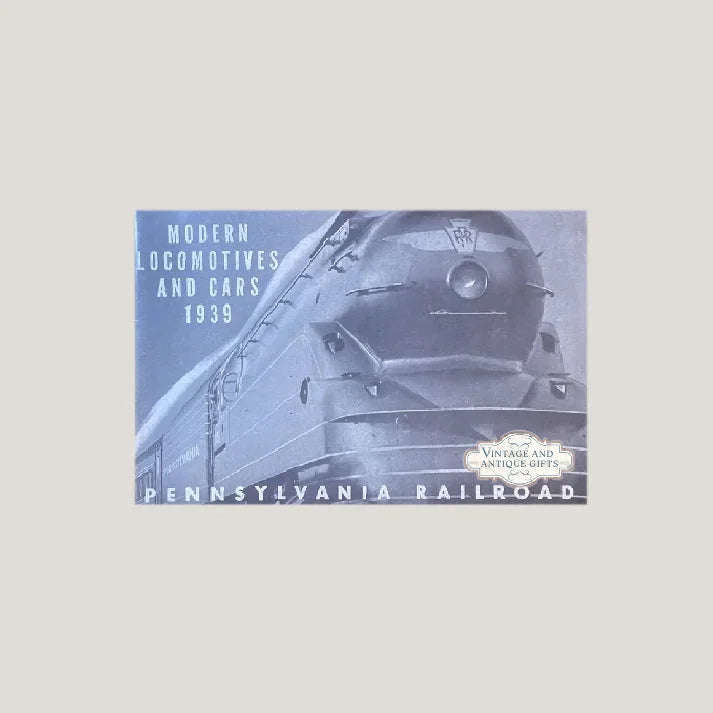
Vintage 1939 Pennsylvania Railroad Brochure 🚂 "Modern Locomotives and Cars" S-1 Duplex, GG1, Decapod NOS Card

Vintage 1939 Pennsylvania Railroad Brochure 🚂 "Modern Locomotives and Cars" S-1 Duplex, GG1, Decapod NOS Card

Regular price 26.00 USD
Regular price Sale price 26.00 USD
Sale Sold out
Shipping calculated at checkout.
Quantity

🚂 What Did the Future Look Like the Year the World Held Its Breath?

Picture the summer of 1939. Out at Flushing Meadows in New York, more than forty million visitors are streaming through the gates of a fairground promising "The World of Tomorrow" — streamlined cars, talking robots, a glimpse of the superhighway age. In Detroit, designers are sketching the first hints of tailfins nobody has a name for yet. And across the Atlantic, armies are massing for a war that will begin before the year is out. It is, in other words, one of the strangest, most electric moments in the American century — equal parts dread and wide-eyed optimism. Sitting right in the middle of that optimism was the Pennsylvania Railroad, the biggest transportation company on the planet, quietly printing up a modest little booklet to show the public exactly how far modern engineering had come. That booklet is Modern Locomotives and Cars 1939, and what you're looking at here is a genuine, unused survivor of that moment.

This is an original Pennsylvania Railroad promotional brochure, issued in 1939 under the railroad's own name, presenting its newest and most advanced motive power to the public — the sleek, experimental S-1 duplex passenger locomotive on the cover, and inside, detailed spec pages on the S-1 again, the rugged M-1a Mountain type, and the heavy-hauling I-1s Decapod, each pictured in profile with its own technical data table of cylinders, steam pressure, driving wheel diameter, and tractive effort.

This example measures 0.5 x 5 inches (about 1.3 x 12.7 cm), and it is new old stock — genuine unused inventory from the Pennsylvania Railroad's own 1939 print run, never mailed, never thumbed through as working sales literature, simply held back and preserved. The cover artwork is a striking piece of period design work in its own right: a dramatic, nose-on halftone photograph of the S-1's bullet-shaped streamlined shroud bearing straight at the viewer, the PRR keystone emblem mounted high on its rounded prow, with bold sans-serif lettering in silvery blue-gray tones announcing MODERN LOCOMOTIVES AND CARS 1939 across the upper left in a style that could hang comfortably on a World's Fair pavilion wall.

Turn the cover and the booklet shifts into the crisp, matter-of-fact language of a railroad engineering department — halftone photographs of each locomotive in full profile, paired with letterpress text blocks laying out exact specifications the way only a company genuinely proud of its hardware would bother to print them.


🚋 The Pennsylvania Railroad: When "Standard Railroad of the World" Wasn't Just a Slogan

The Pennsylvania Railroad Company was chartered by the Pennsylvania state legislature on April 13, 1846, built originally to connect Harrisburg to Pittsburgh, with Samuel Vaughan Merrick serving as its first president. What followed over the next century is one of the great growth stories in American industrial history. By 1882, the PRR had become the largest railroad by traffic and revenue on Earth — not simply the largest railroad, but the largest transportation enterprise and the largest corporation of any kind, anywhere. By 1910 it operated some 10,000 route-miles spread across thirteen states, owned more than 260,000 passenger and freight cars, and employed over 215,000 people. Along the way it absorbed, merged with, or held partial ownership in more than 800 other rail lines. The company took to calling itself "the Standard Railroad of the World," and for decades, nobody seriously argued the point.

By the time this brochure came off the press, the PRR was at the peak of its power and its public image — a company that didn't just move freight and passengers, but shaped how Americans thought about speed, engineering, and progress itself. A brochure like this one wasn't idle marketing filler; it was the railroad's way of putting its own name behind the biggest promise of the era — that American industry could out-engineer anyone, on rails as much as anywhere else.


🌎 1939 and the World of Tomorrow

There's a particular kind of optimism baked into 1939 that's hard to find anywhere else in the century. The New York World's Fair had risen out of a former ash dump in Queens with the theme "The World of Tomorrow," its centerpiece the towering white Trylon and Perisphere, its exhibits full of televisions, air conditioning, and streamlined everything.

Streamlining wasn't just an engineering choice by then — it was a whole visual language, applied to toasters, radios, cars, and, most dramatically, to locomotives. The Pennsylvania Railroad brought its own contribution to that stage: the one-of-a-kind S-1 duplex locomotive, pictured right on this brochure's cover, put on public display as a working piece of the Fair's own transportation exhibits.

Railroad lore holds that the S-1's shrouding — those long, unbroken horizontal lines sweeping back from the nose — came out of the era's booming industrial design movement, the same design culture associated with names like Raymond Loewy, who worked extensively with the PRR's public image during these years. Whether or not every detail of that design credit can be nailed down to the letter, the S-1's styling is unmistakably a product of that streamline-moderne moment — the same aesthetic instinct that gave Detroit its early curves and gave diners their chrome.

It's worth sitting with the contrast for a moment: the same year this little brochure was celebrating "power, speed and economy of operation to a degree never before achieved," German troops crossed into Poland and the world tipped into war. The Pennsylvania Railroad's engineers had no way of knowing that within a few short years their shops would be running around the clock hauling troops and war materiel instead of showing off experimental show-locomotives at a World's Fair. That tension — a nation captivated by its own gleaming future just as the ground shifted beneath it — is part of what makes a piece like this worth holding onto. It's a snapshot of American confidence taken in the last calm moment before everything changed.


🔧 The Locomotives on These Pages

The star of the cover, PRR's Class S-1, is one of the more fascinating dead ends in American locomotive history. It was an experimental, fully streamlined 6-4-4-6 duplex-drive passenger engine — meaning it carried four cylinders instead of the usual two, each pair powering its own set of driving wheels rather than one long connected set, a configuration meant to deliver enormous power at sustained high speed without the wear of a conventional design.

On paper the numbers were staggering for their day: four 22-inch cylinders with a 26-inch stroke, 300 pounds of boiler pressure, 84-inch driving wheels, and a locomotive-and-tender working weight over a million pounds, all capable of sustained speeds over 100 miles per hour. Only one was ever built. It proved too long and too rigid for the tight curves and turntables of most of the PRR system, and it found its real home instead running the flatter, straighter stretches out west, before it was retired well before the more successful streamlined classes that followed it.

Collectors of railroad history often point to the S-1 as the most beautiful engineering dead end the Pennsylvania Railroad ever built — a locomotive too specialized and too singular to last, but unforgettable enough to end up on the cover of the company's own sales literature.

Beside it in these pages sit two locomotives built for a very different job — the daily, unglamorous work of actually running a railroad. The M-1a Mountain type, a 4-8-2 wheel arrangement, was PRR's dual-purpose workhorse, built to haul both heavy through passenger trains and fast freight over the same grades — including the punishing climbs of the Alleghenies near the railroad's famous Horseshoe Curve.

And the I-1s Decapod, a 2-10-0 with ten massive driving wheels and no leading truck to speak of, was built purely for brute strength — the heaviest freight power the railroad had to offer, with 90,000 pounds of tractive effort packed into a squat, big-boilered frame. Railroaders of the era are remembered to have nicknamed these Decapods "Hippos," a fitting bit of shop-floor humor for a locomotive built entirely around hauling tonnage rather than turning heads.

Together, these three engines told a complete story on one small brochure: the dream machine built for speed and headlines, and the two steady, muscular classes that actually kept the freight and passenger trains of the Standard Railroad of the World running on time. Company lore also holds that this brochure's original run carried images further still — the streamlined K4 Pacific and the art-deco GG1 electric among them — giving the full booklet a sweep from the earliest days of steam right up to the electrified, high-speed present of 1939.


🏭 Altoona and the Shops Behind the Steel

Locomotives like these weren't designed in a boardroom and forgotten — they were built, tested, and rebuilt at the Pennsylvania Railroad's own shop complex in Altoona, Pennsylvania, a company town in the truest sense, its identity and its economy bound up entirely with the railroad that ran through it. Generations of Altoona families worked the shop floors there, and old-timers from the region still speak of the town's rail yards and roundhouses as a kind of engineering university in their own right — a place where PRR's engineers tested ideas like the S-1's duplex drive against the punishing reality of mountain grades and winter ice. It's a piece of American industrial geography that rarely gets its due outside railroad circles, but it's impossible to separate from a brochure like this one. Every locomotive pictured on these pages passed through shops like Altoona's before it ever turned a wheel in revenue service.


📬 Why This Still Matters Today

Brochures like this one were never meant to survive. They were handed to prospective shippers, curious travelers, and railroad enthusiasts, read once or twice, and tossed. That so few made it through the decades intact — let alone in unused, never-circulated condition — is exactly what makes an original example like this one worth seeking out today. It sits at the crossroads of several collecting worlds at once: railroadiana enthusiasts chasing anything connected to the PRR's golden era; industrial design collectors drawn to the streamline-moderne look that swept the country in these years; and anyone drawn to 1939 itself as a hinge point in American history, that last bright, uneasy summer before the world went to war. The Pennsylvania Railroad is gone now, folded into Penn Central and then Conrail decades ago, its once-vast physical empire scattered among successor railroads. But paper survives where steel doesn't — and a brochure like this one is one of the few honest, unfiltered windows left into how a company at the absolute height of its power chose to present itself to the public, in its own words, on its own terms, the year everything changed.


🖼️ Display Ideas

  • 🚂 Frame it open to the S-1 spec page for a home office or den with a railroading or engineering theme
  • 🏛️ Pair it with other 1939 World's Fair ephemera for a "World of Tomorrow" themed vignette
  • 📐 Display alongside vintage drafting tools or engineering instruments for an industrial design corner
  • 🖋️ Group with other Pennsylvania Railroad or regional railroadiana for a dedicated PRR collection shelf
  • 🎞️ Set beside streamline-moderne collectibles — chrome, Bakelite, art-deco design pieces from the same years
  • 🗺️ Combine with a period Pennsylvania or Northeast rail map for a geography-and-history display

🎁 Who Collects These

This piece tends to find its way to a particular kind of collector — the railfan who already owns a shelf of PRR timetables and locomotive photographs and is always hunting for the next authentic piece of the company's own printed voice. It also appeals to industrial design and streamline-moderne collectors who care as much about the S-1's sculpted, aerodynamic cover photo as they do about its tractive effort. History-minded gift buyers reach for it too — for a father, grandfather, or lifelong train enthusiast who grew up around the Pennsylvania Railroad's tracks, or for anyone drawn to 1939 as a turning point worth marking on paper. And because it's compact, genuinely scarce in unused condition, and rich with real technical detail, it holds real appeal for archivists and researchers building out a documented picture of American railroading at its industrial peak.


❓ FAQ

Is this an original 1939 Pennsylvania Railroad piece, or a modern reprint?

This is a genuine original brochure printed and issued by the Pennsylvania Railroad in 1939, presented here as new old stock — unused inventory from that original printing, not a later reproduction.

What's the difference between the S-1, the M-1a, and the I-1s pictured inside?

They represent three very different jobs. The S-1 was an experimental, one-of-a-kind streamlined duplex built purely for high-speed passenger runs. The M-1a Mountain type was a dual-purpose engine for heavy passenger or fast freight service. The I-1s Decapod was built for the heaviest freight hauling the railroad had, prioritizing brute tractive effort over speed.

Why did the Pennsylvania Railroad only build one S-1?

Its duplex-drive design and long rigid frame made it powerful at speed but poorly suited to sharp curves and standard turntables, which limited where it could run and led the railroad to explore other streamlined designs instead.

What does "new old stock" mean for a paper item like this?

It means this is unused original inventory from the Pennsylvania Railroad's own 1939 distribution — never circulated or read through as working promotional literature, simply held back over the years.

Does this brochure include the GG1 electric and the K4 Pacific too?

Yes — company records for this booklet describe it covering the full sweep of PRR power of the era, from the earliest steam designs through the streamlined K4 Pacific and art-deco GG1 electric alongside the S-1, M-1a, and I-1s pictured here.

Where was the Pennsylvania Railroad based, and where were these locomotives built?

The Pennsylvania Railroad was headquartered in Philadelphia, while its principal locomotive shops were located in Altoona, Pennsylvania — the shop town most closely tied to the engines described on these pages.

Is this a good gift for a railroad enthusiast?

It's a strong choice for anyone who collects Pennsylvania Railroad history, streamline-era design, or 1939 Americana — a genuine period document rather than a modern souvenir, with real technical detail printed straight from the source.

Shipping

🚚 Shipping & Handling

  • Shipping costs and timing are calculated at checkout.
  • Items curated and shipped directly by me include U.S. shipping at no additional cost, professionally packed to ensure safe arrival of your artifact.

Items from Vetted Pro Collectors
Shipping for items offered by vetted Pro Collectors is determined at checkout. All Pro Collector listings are reviewed to ensure fair, reasonable shipping practices.

For full details, please refer to our Shipping Policy.

Returns & Exchange

Take your time — you've got a full six months. If a piece isn't right for you, send it back the way it reached you and we're good.

In the first 30 days your money goes straight back the way you paid. After that it's store credit, so you can put it toward something you'd rather have.

Return shipping we sort out between us, case by case. I don't make this difficult.

If something arrives damaged, or it isn't what I said it was, send me a photo within 48 hours and I'll make it right.

Email info@vintageantiquesgifts.com or call 802-356-9872 — that's me answering, not a call center.

The only things I can't take back are custom or special-order pieces and gift cards.

View full details
  • 5 stars: 3 (100%)
  • 4 stars: 0 (0%)
  • 3 stars: 0 (0%)
  • 2 stars: 0 (0%)
  • 1 star: 0 (0%)
t
t***k (2254)

As described and great price and condition. Fast, friendly service. Smooth transaction.

C
Charles

This booklet is very interesting with lots of facts and photos. I love it. I would highly recommend this seller.

Hello Charles! Thank you for choo-choo-choosing us and giving this 1939 Railroad Sales Brochure a perfect score! Your raving review has stoked the fires of our vintage passion! Your support is the fuel to our steam engine, and your satisfaction is our destination. All aboard for more vintage adventures together!

D
Dennis Winger

This item was FAR better than described, and was an excellent value! The item was well-packaged, and the personal note from the seller was very nice! Thanks also to Charlie and ... danged if I didn't get the other name. Anyhow -- GREAT seller. I'll be back!