Skip to product information
1 of 3

Vintage and Antique Gifts

Vintage 1995 George Petty Girl II 🎨 Sealed Pinup Trading Box Set – 21st Century Archives

Vintage 1995 George Petty Girl II 🎨 Sealed Pinup Trading Box Set – 21st Century Archives

Regular price 17.00 USD
Regular price Sale price 17.00 USD
Sale Sold out
Shipping calculated at checkout.
Quantity

🎨 What Was It Like to Be the Most Famous Illustrator in America — and Still Have Your Name Left Off the Best Part of the Job?

That's the George Petty story in a nutshell, and it's a story this sealed little box has been quietly holding since 1995. Long before "pin-up" was a nostalgia category at all, George Petty was the man who invented the centerfold as we know it, judged Miss America pageants, painted swimsuit ads that outsold the swimsuits themselves, and then watched a younger artist named Vargas take over his page in Esquire. Collectors who grew up seeing his work on calendars, on the nose of a B-17, or tucked in a grandfather's desk drawer tend to get a little misty-eyed over a box like this one — because it's not just a card set, it's the whole arc of American glamour illustration, condensed and sealed in cardboard, still waiting to be opened.

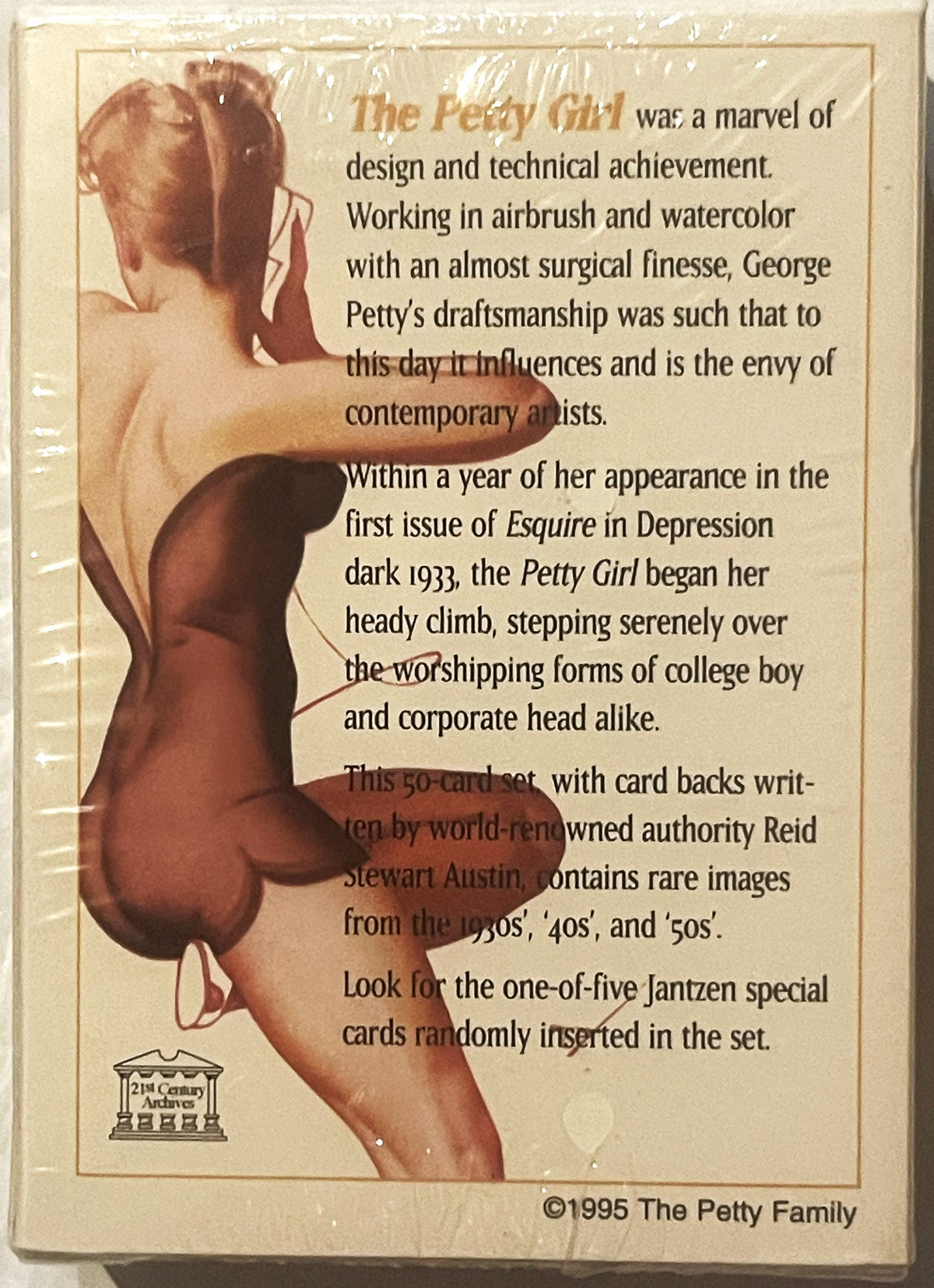
This is The Petty Girl II — Classic Pinup Art By George Petty, a factory-sealed, New Old Stock (NOS) premium collectible trading card set issued by 21st Century Archives in 1995, with a copyright line reading "©1995 The Petty Family" printed right on the box. It's an offset-lithographed cardboard box in warm cream, sepia-brown, tan, black, and gold, wrapped around a 50-card set devoted entirely to George Petty's pin-up art of the 1930s, '40s, and '50s. The cover art shows a classic Petty pose — a strapless-gown figure seen from behind, hair swept up, one hand raised, balanced on high heels — rendered in that unmistakable airbrushed, watercolor-smooth Petty style. It's Series II of a two-part release (Series I having come out the year before), and this example remains sealed exactly as it left the factory, never opened, never broken into.


🖌️ The Boy From Louisiana Who Learned to Paint With Air

George Brown Petty IV was born in 1894 in Abbeville, down in Vermilion Parish, Louisiana — a small bayou town about as far removed from Manhattan magazine culture as you could get. His family moved north to Chicago just before the turn of the century, where his father, George Petty III, ran a photography studio known for portraits of young women, madonnas, and nudes. It was in that studio that young George first picked up an airbrush — not to paint, but to retouch photographs, smoothing skin, softening shadows, learning to render the human form with an almost surgical precision that no brush could match. He studied art briefly in Paris, then came home to Chicago and went to work as an airbrush retoucher for a local printing house before striking out as a freelance commercial artist. It was a craftsman's education, not an art-school one, and it shows in every card in a set like this — that airbrushed, glass-smooth finish that made Petty's women look less like paintings and more like living light.

Everything changed in October of 1933. A brand-new magazine called Esquire hit the newsstands in the depth of the Depression, and George Petty was in it. Within a year, his illustrated women — soon simply called "Petty Girls" — had become the device that made the gatefold famous. Before Petty, there had been girls on magazine covers. Petty gave magazines the girl inside the magazine, unfolding across the pages, and the format he originated became a fixture of American publishing for decades afterward. Old-timers in the collecting world still call the Esquire gatefold "the format Petty built," and it's not an exaggeration — it's documented history.


🎓 The Artist Who Judged Miss America and Charmed Princeton

By the back half of the 1930s, Petty wasn't just an illustrator — he was a cultural fixture. From 1936 through 1941 he sat as a celebrity judge at the Miss America pageant, presumably the only judge on the panel who'd already painted more idealized American beauties than anyone alive. In 1939, students at Princeton University voted him their favorite artist — ahead, one imagines, of quite a few painters with considerably more formal pedigree. Collectors and fans have long enjoyed the image of buttoned-up Ivy League men in 1939 casting their vote for the guy behind the Esquire gatefold; it says everything about how thoroughly the Petty Girl had colonized the American imagination by the eve of the Second World War.


🏊 The Jantzen Connection — and the Chase Cards Hidden in This Very Box

Here's where this particular card set gets its own hook, and it's a true one. Petty's fame wasn't confined to magazine pages — advertisers wanted a piece of it, and none more famously than Jantzen. In 1940, Jantzen created an actual swimsuit line named "the Petty Girl" swimsuit, built entirely around the cachet of his name and image. Jantzen itself was already a titan of American sportswear by then — founded in 1910 in Portland, Oregon, the company had built its reputation on knit swimwear and, most famously, on the "Jantzen Girl" diving figure that became one of the most recognizable trademarks in American retail advertising, showing up on storefronts, billboards, and magazine pages nationwide for generations. Pairing that established red-diving-girl brand with the reigning king of American pin-up art was, by any measure, an advertising marriage made in heaven.

That real commercial history is exactly what the set's label refers to when it promises "one-of-five Jantzen special cards randomly inserted in the set." These are chase cards — inserts not guaranteed in every box — built entirely around Petty's commissioned Jantzen artwork, and they're one of the reasons serious Petty collectors go looking for sealed, unopened boxes of Series II specifically: a factory-sealed set is the only way to know the Jantzen chase possibility is still intact and untouched inside.


✈️ From Magazine Gatefold to Bomber Fuselage

Petty's reach went well beyond Esquire's readership. During the Second World War, reproductions of his pin-ups were painted by hand onto the noses of American warplanes — nose art, as it's known — carried into combat by young men half a world from home. The most famous example still remembered today is the B-17 Memphis Belle, whose nose art drew directly from the Petty style that had, by then, become shorthand for the American ideal of glamour and home. It's a detail that collectors of both pin-up art and military history return to again and again: a commercial illustrator working out of a Chicago studio ended up, quite literally, riding into battle on the fuselage of American bombers.


🎬 The Split From Esquire — and Hollywood's Version of the Story

Success has its costs. Demand for Petty's work — advertising paid far better than magazine editorial — grew so heavy that he began missing Esquire's deadlines, working himself toward exhaustion trying to satisfy both the magazine and its commercial suitors. Esquire's patience wore thin, and by 1941 the magazine had begun using its own letter pages to voice frustration while quietly introducing his eventual successor, a young artist named Alberto Vargas. It's one of the great "what ifs" of American illustration history: had Petty kept pace, would we be talking about "Petty Girls" today the way we talk about "Vargas Girls"? What we do know for certain, and what makes sets like this one possible at all, is that Petty was sharp enough a businessman to insist on keeping the secondary rights to his images and the return of his original paintings when he and Esquire parted ways — which is precisely why, decades later, it was "The Petty Family" holding the copyright that licensed this very 1995 card set, rather than the magazine that made him famous.

The Petty Girl's cultural footprint was durable enough that in 1950, Columbia Pictures made a film literally titled The Petty Girl, starring Robert Cummings as a thinly fictionalized version of the artist himself. It's remembered today for one more reason collectors love to repeat: it marked the film debut of Tippi Hedren, cast as one of the Petty Girls on screen, years before she'd go on to star for Alfred Hitchcock. Petty lived until 1975, passing away in San Pedro, California, not long after seeing a small revival of interest in his work — including a new commission for Esquire's 40th anniversary issue, a full circle moment for the man who'd helped make that magazine's reputation forty years earlier.


📖 The Historian Behind Every Card Back

The card backs in this set weren't written by a hired copywriter — they were written by Reid Stewart Austin, one of the genuine authorities on American pin-up art. Austin authored the authorized biography of Alberto Vargas, wrote Varga: The Esquire Years, and later published The Classic Pin-Up Art of George Petty. He brought that same scholarly hand to 21st Century Archives' companion Gil Elvgren card set as well, and pin-up collectors generally credit him with drawing the line that matters most in this field: that only a small handful of American artists — Vargas, Petty, Rolf Armstrong, Zoe Mozert, Earl Moran, and Gil Elvgren — ever truly lifted the pin-up calendar into the realm of fine commercial art. Having Austin's actual historical research on the back of every card, rather than generic trivia, is part of what made this release feel less like a novelty and more like a genuine archive — which is exactly the promise in the publisher's own name.


🏛️ 21st Century Archives and the Mid-'90s Pin-Up Revival

The mid-1990s saw a real wave of nostalgia for classic American pin-up and glamour art, and 21st Century Archives was one of the small specialty publishers riding it. This Petty Girl II set followed a 1994 Series I release of the same subject, and the company went on to issue a Gil Elvgren Pin-Ups collection and a Bunny Yeager's Bettie Page in Black Lace set as well, all built on the same formula: licensed, historically researched reproductions of an era's finest glamour illustration, packaged as premium collectible trading cards rather than as mere novelty items. Collectors who've handled both the Petty and Elvgren releases from this publisher often note that the Petty cards carry a notably glossy, well-finished card stock — a small but telling sign of the care put into reproducing Petty's airbrushed originals faithfully. Exact print-run numbers and the company's later history are the kind of detail that time has quietly swallowed, the way it does with so many small specialty publishers from that decade — but the cards themselves, and the story of the man they honor, remain very much intact.


🖼️ Display Ideas

  • 🖼️ Keep the box sealed and stand it upright on a shelf as a self-contained piece of pin-up history — the cover art alone is a display-worthy Petty illustration.
  • 🛋️ Pair it with other mid-century Americana or barware for a den or "man cave" styled around 1940s-50s glamour and nostalgia.
  • 🎞️ Group it alongside WWII memorabilia or nose-art prints for a display that tells the story of pin-up art's journey from magazine page to battlefield.
  • 🏊 Display it near vintage swimwear advertising or Jantzen memorabilia to spotlight the Petty–Jantzen commercial art connection.
  • 🎨 Set it beside other pin-up artist sets — Vargas, Elvgren, Mozert — to build out a collection tracing the full lineage of American glamour illustration.
  • 🎁 Present it as a conversation-piece gift for a collector who already appreciates classic Esquire-era artwork.

🎁 Who Collects These

The natural audience is anyone drawn to classic American pin-up and illustration art — Petty, Vargas, and Elvgren collectors who chase complete card sets from this specific mid-1990s wave of licensed releases. Esquire magazine historians and Golden Age illustration enthusiasts value it for the Reid Stewart Austin research on the card backs. WWII aviation and nose-art collectors appreciate the direct link between Petty's imagery and wartime plane art. Jantzen and vintage advertising collectors seek it out specifically for the chase-card possibility. And sealed, unopened trading card set collectors — the NOS crowd — prize it simply for having survived intact since 1995, unopened and complete as issued.


❓ FAQ

Is this the original 1930s Petty artwork, or a reproduction?

This is a 1995 trading card set reproducing George Petty's pin-up illustrations, which were originally created between the 1930s and 1950s for Esquire and commercial clients like Jantzen. The card set itself was manufactured in 1995 by 21st Century Archives, with licensing confirmed by the "©1995 The Petty Family" copyright printed on the box.

What does "The Petty Girl II" mean — is there a Series I?

Yes. 21st Century Archives released the original Petty Girl set (cards 1–50) in 1994, followed by this Petty Girl II set (cards 51–100) in 1995, continuing the numbering as a true second series of the same subject.

What are the Jantzen chase cards?

Five special insert cards featuring Petty's commissioned artwork for Jantzen swimwear were randomly seeded into sealed sets rather than guaranteed in every box — a nod to the real "Petty Girl" swimsuit line Jantzen produced in 1940 using Petty's name and image.

Who wrote the historical text on the card backs?

Reid Stewart Austin, a recognized authority on pin-up art history who also authored the authorized biography of Alberto Vargas and later published a dedicated book on George Petty's classic pin-up art.

Is this set factory sealed?

Yes — this is New Old Stock (NOS), meaning it remains sealed exactly as it left the factory in 1995, never opened.

Why is George Petty significant in American illustration history?

Petty originated the magazine gatefold format at Esquire beginning in 1933, became a celebrity judge at Miss America, saw his work reproduced as WWII nose art on planes like the Memphis Belle, and was portrayed on film in Columbia's 1950 feature The Petty Girl — making him one of the foundational figures of American pin-up and commercial glamour illustration.

Shipping

🚚 Shipping & Handling

  • Shipping costs and timing are calculated at checkout.
  • Items curated and shipped directly by me include U.S. shipping at no additional cost, professionally packed to ensure safe arrival of your artifact.

Items from Vetted Pro Collectors
Shipping for items offered by vetted Pro Collectors is determined at checkout. All Pro Collector listings are reviewed to ensure fair, reasonable shipping practices.

For full details, please refer to our Shipping Policy.

Returns & Exchange

Take your time — you've got a full six months. If a piece isn't right for you, send it back the way it reached you and we're good.

In the first 30 days your money goes straight back the way you paid. After that it's store credit, so you can put it toward something you'd rather have.

Return shipping we sort out between us, case by case. I don't make this difficult.

If something arrives damaged, or it isn't what I said it was, send me a photo within 48 hours and I'll make it right.

Email info@vintageantiquesgifts.com or call 802-356-9872 — that's me answering, not a call center.

The only things I can't take back are custom or special-order pieces and gift cards.

View full details
  • 5 stars: 4 (100%)
  • 4 stars: 0 (0%)
  • 3 stars: 0 (0%)
  • 2 stars: 0 (0%)
  • 1 star: 0 (0%)
s
s***_ (1169)

Quality service.Excellent condition. Thanks for the item and service the personal touch is appreciated.Will buy from you again.

-
-***9 (3)

Cards came quickly and in perfect condition

m
m***. (575)

Buy with confidence. One of eBay's best.

z
z***c (17)

Outstanding!! fast delivery..thank you so much. top quality!