




Skip to product information
1 of 4

Vintage and Antique Gifts

Vintage George Petty Pin-Up 🎨 Trading Card Set, Factory-Sealed 1990s Box by 21st Century Archives

Vintage George Petty Pin-Up 🎨 Trading Card Set, Factory-Sealed 1990s Box by 21st Century Archives

Regular price 16.00 USD
Regular price Sale price 16.00 USD
Sale Sold out
Shipping calculated at checkout.
Quantity

Remember When One Painted Woman Could Sell Swimsuits, Cigarettes, and a Whole Magazine — Before a Camera Ever Got the Chance? 🎨

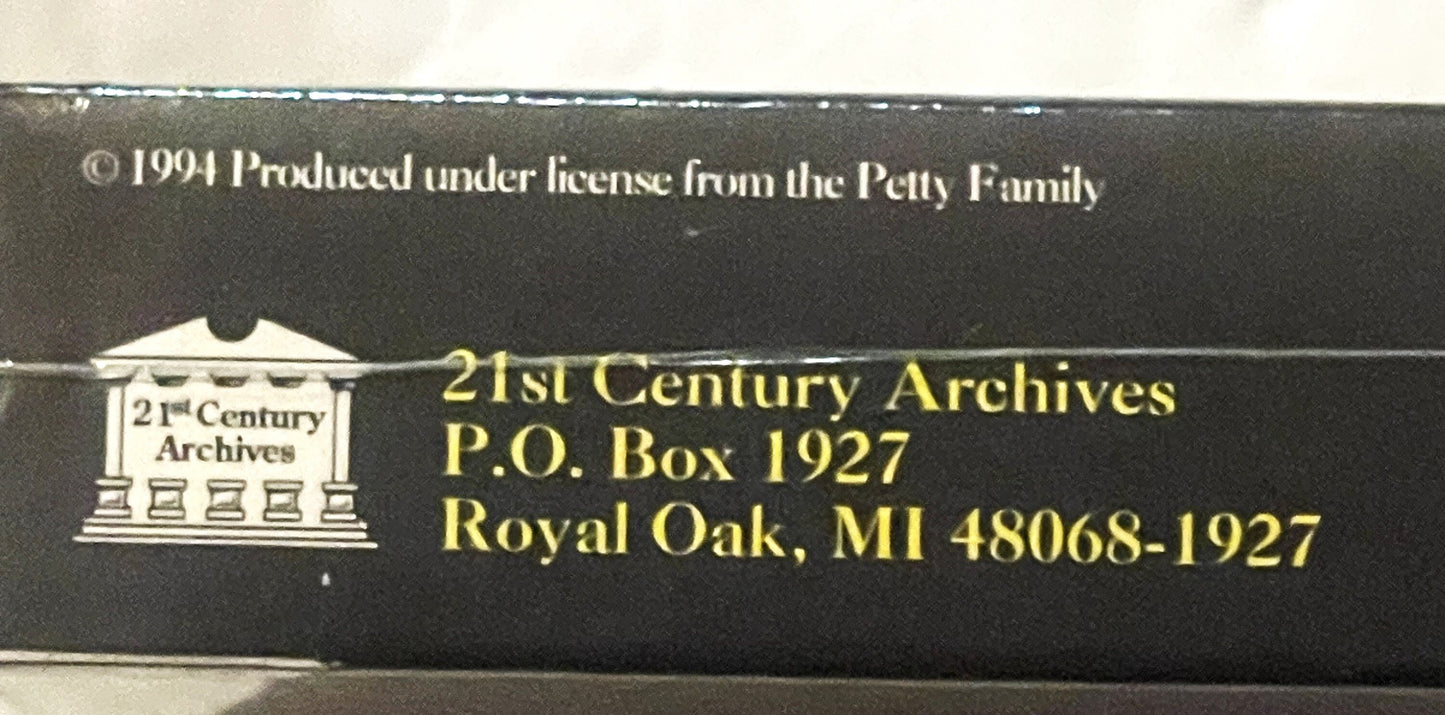
There was a stretch of American print, running roughly from the early 1930s into the 1950s, when the most talked-about woman on the newsstand wasn't a photograph at all — she was painted, airbrushed, impossibly leggy, and folded into the middle of a magazine where a reader had to actually open the pages to find her. Drugstore counters, barbershops, soda fountains, train depots — she turned up everywhere a magazine rack did, and for a solid quarter-century one artist's name was attached to nearly all of her. Collectors today still say it with a little reverence: the Petty Girl. What you're looking at here is a sealed, unopened tribute to that whole era — a full 50-card boxed set built entirely around George Petty's original pin-up art, still wrapped exactly as it left the manufacturer, having never been broken open, sorted, or thumbed through by a single collector.

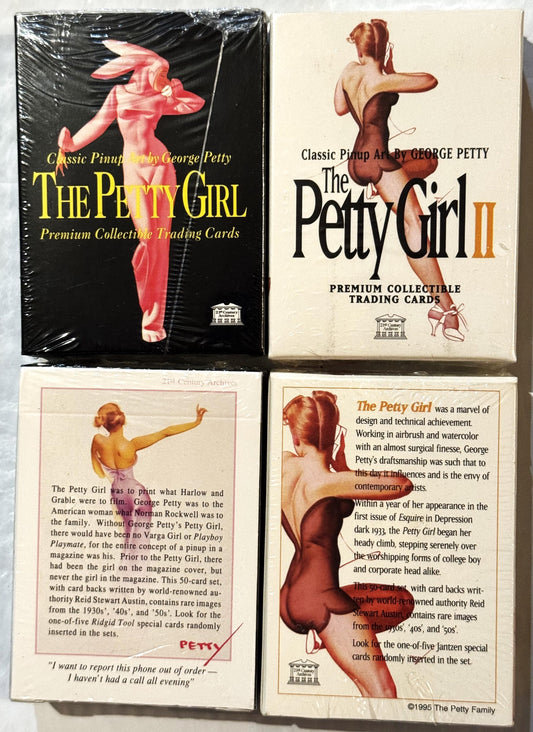
This is The Petty Girl — Classic Pinup Art by George Petty, Premium Collectible Trading Cards, produced by 21st Century Archives in the 1990s and offered here as New Old Stock: factory-sealed in its original shrink-wrap, never opened. The box front carries one Petty image blown up large across a field of solid black — a pin-up girl wrapped head to toe in a soft pink bunny costume, ears flopped back, one gloved hand raised in that off-balance, mid-turn pose that was Petty's whole visual signature: the impossibly long leg, the tiny cinched waist, the playful over-the-shoulder glance.

The title climbs the page in glowing gold-toned lettering — Classic Pinup Art by George Petty in flowing script above the bold block capitals of THE PETTY GIRL, with Premium Collectible Trading Cards beneath it — and a small stamped 21st Century Archives emblem anchors the corner like a mint mark.

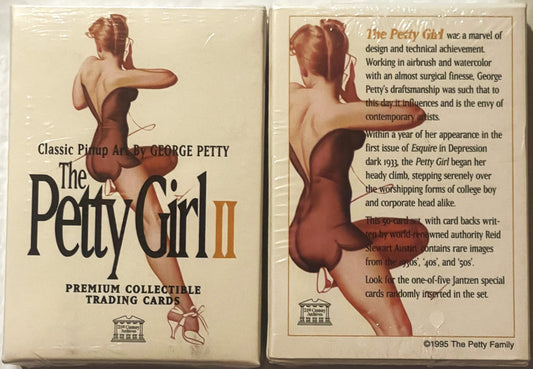
The packaging also previews one of the fifty images waiting inside: a Petty beauty caught mid-turn in a flowing lavender gown, her back bare, one arm reaching skyward, rendered in the same warm cream, gold, and rose palette. Alongside her runs a block of promotional text describing the set — fifty cards pulling "rare images from the 1930s–1950s', '40s, and '50s'," card backs penned by Petty historian Reid Stewart Austin, and word that one-of-five special "Ridgid Tool" insert cards are seeded randomly through the sets.

A classic gag caption runs along the bottom in the same dry wit Petty's original magazine cartoons always carried — "I want to report this phone out of order — I haven't had a call all evening" — beside Petty's own bold red signature mark. Every card in the set was produced by offset lithography, printed in rich pink, black, cream, and yellow with metallic gold-toned type, a fitting throwback to the glossy print quality of the magazines Petty's original art first appeared in.


🖌️ The Man Who Put Her Inside the Magazine, Not Just on the Cover

George Brown Petty IV came up a long way from the glossy Manhattan magazine world he'd eventually define. He was born down in Abbeville, seat of Vermilion Parish in south Louisiana, before his family relocated north to Chicago, where his father worked as a photographer — a household, in other words, already steeped in the business of capturing a likeness for print. Petty trained formally at the School of the Art Institute of Chicago under Ruth Van Sickle Ford, then crossed the Atlantic for a stint at the Académie Julian in Paris, the same rigorous academic training ground that shaped a generation of American illustrators. Back in Chicago by the late 1920s, he opened his own studio and built a solid regional reputation doing commercial illustration for accounts like Marshall Field's and Atlas Beer — respectable work, the kind that pays the rent, but nothing that hinted at what was coming.

Then came the debut issue of Esquire in October of 1933, and almost overnight a competent regional commercial artist became the man setting the visual standard for American feminine glamour in print. The Petty Girl ran in Esquire from that first issue onward, and it was Petty who is credited with essentially inventing the magazine gatefold — the fold-out page that let his figure stretch, full-length, across an extra panel of paper that a reader had to physically unfold to see whole. Before Petty, a magazine put a pretty woman on the cover to sell the issue. Petty put her inside, running for pages, and the entire concept of the pin-up living inside a mass-circulation magazine — rather than just fronting it — traces straight back to him. It's the same structural idea, collectors like to point out, that every glossy centerfold format since has quietly borrowed.


💄 The Girl Who Sold Everything From Swimsuits to Cigarettes

The Petty Girl didn't stay confined to Esquire's pages for long. Jantzen built an entire swimsuit line around her likeness, and Old Gold cigarettes leaned on that same Petty glamour to move product in an era when a painted woman could carry an ad campaign the way a celebrity endorsement would decades later. Her proportions — the elongated leg, the impossibly narrow waist, the playful, almost cartoonish exaggeration paired with a knowing wink rather than anything explicit — became shorthand for a kind of wholesome, mischievous American glamour that magazines, advertisers, and eventually Hollywood studios all wanted a piece of. Wristwatches, department stores, beer, cigarettes — if a brand wanted a jolt of pin-up sparkle in the 1930s and '40s, more often than not it went looking for a Petty.

The card set's own text draws a direct line from that legacy forward: without George Petty's Petty Girl, it argues, there would have been no Varga Girl and, further down the chain, no Playboy Playmate — because the entire idea of a pin-up living inside a magazine, rather than merely fronting it, was Petty's to begin with. Alberto Vargas took over the Esquire pin-up pages from Petty in the early 1940s, carrying the torch under his own "Varga Girl" banner, and it's well documented that a young Hugh Hefner grew up thumbing through exactly those Esquire gatefolds before he ever founded a magazine of his own. Trace the lineage back far enough — through Vargas, through Playboy's early centerfolds — and it runs straight through a Chicago illustrator's studio and a Louisiana parish most readers had never heard of.


🖋️ The Historian Who Gave These Cards Their Voice

What sets this particular boxed set apart from a simple reprint calendar is the scholarship behind it. Each of the fifty card backs was written by Reid Stewart Austin, credited on the packaging as a world-renowned authority on Petty's work, and the goal was clearly to turn a stack of trading cards into something closer to a compact reference guide — identifying, card by card, the original publication and era each image first appeared in, from the 1930s through the 1950s. That's a meaningful distinction for anyone building out a Petty collection: rather than a generic reproduction print with no context, each card arrives already footnoted, tying the image back to its place in Petty's own working history rather than leaving it floating, anonymous, decades removed from the magazine page it once lived on.

21st Century Archives issued the set in the 1990s, a decade when non-sport trading cards built around classic illustration, pin-up art, and vintage glamour photography enjoyed a real boom among collectors who'd grown up on the originals and wanted a tangible, affordable way to hold a piece of that history. Collectors of this particular set also note it rolled out across two separate waves during that run — and this factory-sealed box reflects that same premium card-stock production standard throughout, regardless of which wave it came from.


🔧 The Ridgid Tool Legend Hiding in the Box

Buried in the fine print on the packaging is a detail that tool collectors and vintage advertising hunters will recognize instantly: one-of-five special "Ridgid Tool" cards, randomly seeded into the sets. That's not a random licensing tie-in — it's a nod to a long-running piece of American shop-floor folklore. Ridgid, the pipe wrench and tool maker out of Ohio, became legendary among plumbers, machinists, and hardware men for decades of shop calendars that leaned hard on exactly this style of pin-up glamour art, the kind of calendar that hung in garages and tool cribs from coast to coast and got passed down, dog-eared, from one generation of tradesmen to the next. Old-timers in the trade still talk about scrounging up a full year's run of those calendars, and vintage advertising collectors chase them today with the same fervor illustration collectors chase an original Petty. Whether or not you land one of the five Ridgid inserts inside this particular sealed box is part of the fun of a factory-sealed set — the chase card is baked right into the format, the same way it always has been for card collectors of any era.


📺 Why the Petty Girl Still Turns Heads Today

The card back copy itself makes the comparison plainly, and it's not an exaggeration: George Petty was to the American woman roughly what Norman Rockwell was to the American family — a single illustrator whose version of a familiar subject became, for a generation, the version everyone recognized. What keeps that appeal alive today isn't nostalgia alone. It's the craft — the confident line work from Petty's academic training in Chicago and Paris, the airbrushed color, the playful captions borrowed straight from the gag-cartoon tradition of the magazines that ran them. Illustration art collectors value Petty as a genuine bridge figure between old-school commercial art and the golden age of American pin-up glamour; pop-culture historians value him as the missing link between Esquire's gatefold and Playboy's centerfold; and tool-trade collectors value him for that unlikely, decades-long crossover into shop calendar advertising. A sealed 1990s tribute set like this one gathers all three threads into a single box — fifty documented images, a historian's own captions, and a five-card chase tucked in among them, all still wrapped exactly as it came off the line.


🖼️ Display Ideas

  • 🗄️ Keep it sealed and stand the box upright on a bookshelf or display cabinet — the black-and-pink cover art reads beautifully as a stand-alone piece even before a single card comes out.
  • 🖼️ If you do break the seal, slip a favorite card or two into a small frame or card sleeve for a rotating gallery wall in a home bar, den, or workshop.
  • 🔧 Pair it alongside vintage tool advertising or a Ridgid shop calendar for a themed display that plays up the pin-up-meets-hardware-store crossover.

Shipping

🚚 Shipping & Handling

  • Shipping costs and timing are calculated at checkout.
  • Items curated and shipped directly by me include U.S. shipping at no additional cost, professionally packed to ensure safe arrival of your artifact.

Items from Vetted Pro Collectors
Shipping for items offered by vetted Pro Collectors is determined at checkout. All Pro Collector listings are reviewed to ensure fair, reasonable shipping practices.

For full details, please refer to our Shipping Policy.

Returns & Exchange

Take your time — you've got a full six months. If a piece isn't right for you, send it back the way it reached you and we're good.

In the first 30 days your money goes straight back the way you paid. After that it's store credit, so you can put it toward something you'd rather have.

Return shipping we sort out between us, case by case. I don't make this difficult.

If something arrives damaged, or it isn't what I said it was, send me a photo within 48 hours and I'll make it right.

Email info@vintageantiquesgifts.com or call 802-356-9872 — that's me answering, not a call center.

The only things I can't take back are custom or special-order pieces and gift cards.

View full details
  • 5 stars: 4 (100%)
  • 4 stars: 0 (0%)
  • 3 stars: 0 (0%)
  • 2 stars: 0 (0%)
  • 1 star: 0 (0%)
-
-***9 (3)

Good quality and value

5
5***y (3859)

wonderful

m
m***. (575)

One of e-bay's best. Buy with confidence. The entire transaction was the highest rating from start to finish.

M
Miguel Lopez

Amazing shopping experience and an even better hand written letter, such a beautiful family <3