

Skip to product information
1 of 8

Vintage and Antique Gifts

Vintage Petty Girl I & II Trading Card Sets 1994–1995 George Petty Pinup Art Sealed NOS 21st Century Archives Complete 100-Card Collector Box 🎨

Vintage Petty Girl I & II Trading Card Sets 1994–1995 George Petty Pinup Art Sealed NOS 21st Century Archives Complete 100-Card Collector Box 🎨

Regular price 31.00 USD
Regular price Sale price 31.00 USD
Sale Sold out
Shipping calculated at checkout.
Quantity

What if one illustrator's paintbrush could invent the magazine centerfold, judge Miss America, ride into battle painted on a bomber's nose, and still get voted more popular than Rembrandt on an Ivy League campus? 🎨

That illustrator was George Petty, and the girl he painted became a household name before "pin-up" was even a common word. Long before Alberto Vargas, long before Playboy, there was the Petty Girl — sleek, airbrushed, impossibly poised, and printed by the millions inside the pages of Esquire magazine. Holding a sealed set like this one is a little like opening a time capsule back to the golden age of American illustration, when a single artist's vision could shape how an entire generation pictured glamour. I've always found something almost magical about that — a whole era of American style, distilled down to one man's brushstrokes, still sealed in the wrapper decades later.

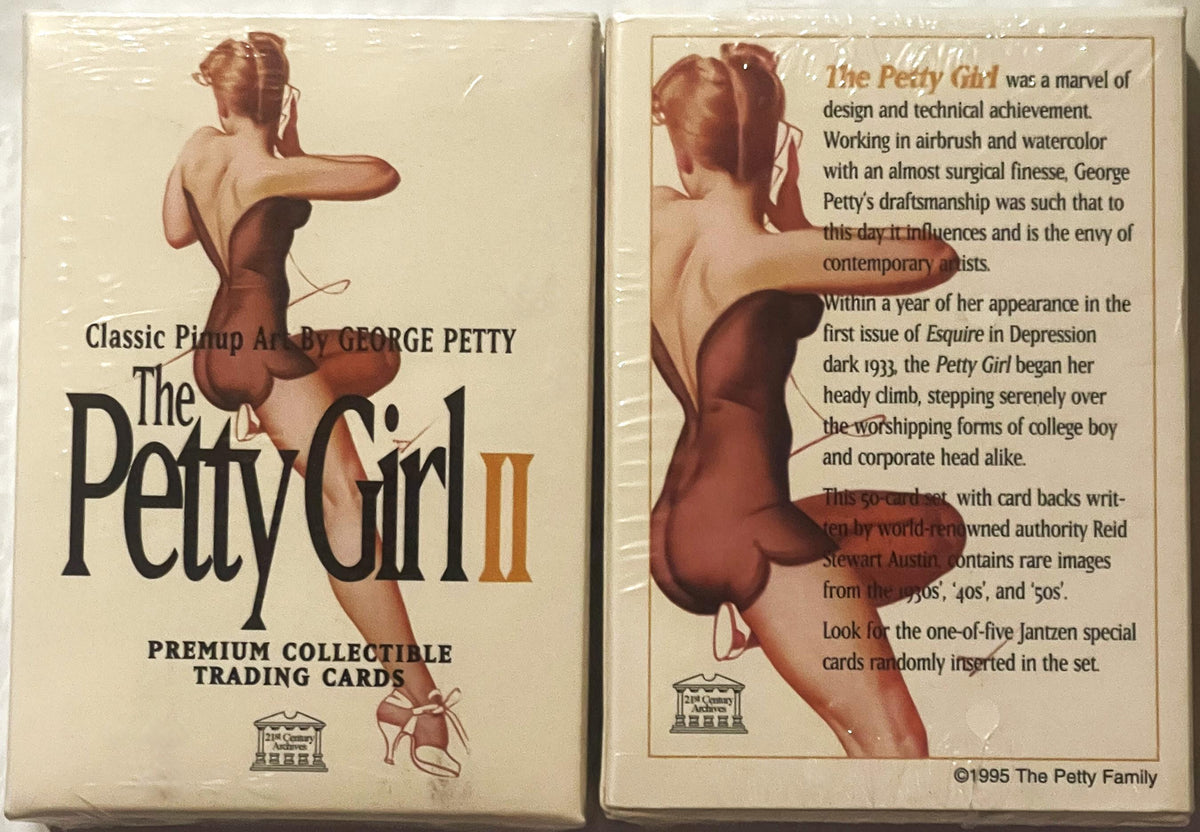
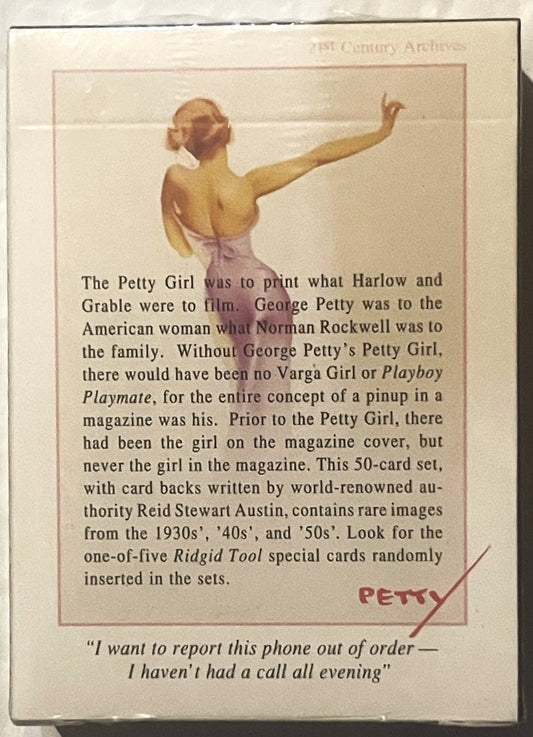
What you're looking at here is The Petty Girl and The Petty Girl II — two factory-sealed, New Old Stock boxed sets of premium collectible trading cards issued by 21st Century Archives, each carrying a copyright date of 1995 from The Petty Family estate. The first box, wrapped in glossy black with bold yellow lettering, features Petty's iconic pink-clad figure in a floppy bunny-eared bonnet, one gloved hand raised in a coquettish wave. The companion box, in soft cream, shows a different Petty Girl entirely — bare-shouldered, glancing back over a rich brown gown, one high-heeled foot kicked up behind her. Each is a complete 50-card set — 100 cards between the two boxes — reproducing "rare images from the 1930s, '40s, and '50s," with card backs written by pin-up historian Reid Stewart Austin. Both sets carry the promise of special insert cards randomly seeded into the packs: a one-of-five Ridgid Tool card in Series I, and a one-of-five Jantzen card in Series II — tie-ins to two real American companies that once put the Petty Girl to commercial work. Both boxes remain sealed exactly as they left the factory, never opened as a working set.


🎨 The Man Who Invented the Petty Girl

George Petty got his start as an advertising illustrator working out of Chicago, and it was there, when a brash new men's magazine called Esquire launched its very first issue in October of 1933, that his artwork landed on the pages that would make his name. Petty worked in airbrush and watercolor with what admirers have called an almost surgical precision — every curve, every fold of fabric rendered with a technical finesse that still draws the eye of illustrators today. The comparison collectors and historians reach for again and again is Norman Rockwell: if Rockwell painted the American family, Petty painted the American glamour girl. Prior to Petty, magazine covers had pretty faces on them, but nobody had put a girl inside the magazine as a recurring, anticipated feature. That was Petty's innovation, and it's one of the reasons his name still carries weight with pin-up collectors decades later.

It's Petty who is generally credited with pioneering the fold-out centerfold format in American magazine publishing — the very device that every pin-up magazine that followed, Playboy very much included, would borrow and build an empire around. At the height of his fame, the story goes that Petty served as a celebrity judge at the Miss America pageant through the back half of the 1930s into the early 1940s, and in 1939, undergraduates at Princeton University are said to have voted him their favorite living artist — edging out Rembrandt himself for the honor. Whether you take that campus poll as gospel or as one of those irresistible bits of collector lore passed down over the decades, it captures something true: for a stretch of years, George Petty wasn't just an illustrator, he was a genuine cultural phenomenon, as recognizable in his day as any actor or bandleader.


📇 Two Series, One Continuous Story

Each of these boxed sets holds a complete run of 50 cards, and together they trace Petty's career across three decades of American illustration — the Depression-era beginnings, the wartime years, and on into the postwar boom of the 1950s. The card backs weren't tossed off as filler; they were written by Reid Stewart Austin, a name that carries real authority in pin-up art circles as a historian and author on the subject. That's a detail worth pausing on, because it means these aren't just pretty reprints shuffled into a pack — the text accompanying each image was researched and written by someone who has spent a career studying this exact corner of American illustration, giving the set a reference-book quality that a lot of 1990s nostalgia cards never bothered to reach for.

The design language across both boxes leans into the era it's celebrating — that black-and-yellow Series I box has the punchy, theatrical contrast of a classic Esquire cover line, while the cream-and-brown Series II box feels softer, almost like a vintage powder compact or a page torn from a ladies' fashion annual. Both carry the small "21st Century Archives" emblem, styled like a museum or archive seal, a nice touch that signals exactly what the company was going for: not a novelty card gimmick, but a genuine archival presentation of a serious American illustrator's body of work.


🔧 The Ridgid Tool Girl & the Jantzen Diving Girl

Here's where the story gets especially fun for collectors, because those randomly inserted chase cards — one-of-five Ridgid Tool cards in Series I, one-of-five Jantzen cards in Series II — point straight back to two real companies that once commissioned Petty's pin-up art for their own advertising, and both of those tie-ins have their own devoted following completely apart from the Esquire connection.

The Ridgid Tool Company, headquartered in Elyria, Ohio and famous the country over for its heavy-duty pipe wrenches and plumbing tools, ran promotional calendars for decades that hung in garages, machine shops, and hardware stores from coast to coast — and George Petty's pin-up art was part of that calendar tradition. Old-timers in the trade still talk about the "shop calendar girl" as practically a rite of passage in American blue-collar culture, the one splash of glamour tacked to the wall next to the parts bins and the grease-stained workbench. A Ridgid calendar page turning up loose at a swap meet or tool auction is still a genuine find for collectors who cross over between tool memorabilia and pin-up art — and having a dedicated Ridgid insert card in this set is a direct nod to that crossover appeal.

Jantzen tells a parallel story from the other coast. Founded in Portland, Oregon and known worldwide by its little red "Diving Girl" logo, Jantzen built its name on swimwear advertising that leaned hard into the same airbrushed glamour Petty was known for — sleek figures, impossible poise, the same visual vocabulary that made the Petty Girl a sensation in print. Petty's association with Jantzen's advertising put his work on beach towels, catalog pages, and department store displays for a whole different audience than the Esquire crowd, and the Series II insert card honors that side of his career. Between the two, these chase cards quietly tell you that Petty wasn't only a magazine man — he was a working commercial illustrator whose girl sold everything from pipe wrenches to swimsuits.


✈️ From Bomber Nose Art to the Miss America Stage

Pin-up art didn't stay confined to magazine racks and shop calendars for long. By the time the Second World War arrived, the Petty Girl — along with her rival, the Vargas Girl — had become part of the visual language of the American home front and the front lines both. Bomber crews overseas painted their aircraft noses with pin-up figures modeled after the magazine glamour girls back home, a tradition that's become one of the most collected and photographed aspects of WWII Americana; squadron after squadron chose a Petty- or Vargas-style figure to ride into battle painted just below the cockpit, a little piece of stateside glamour carried across the Atlantic and the Pacific both. It's one of the more remarkable arcs an illustrator's work can take — from a Chicago ad studio, to a magazine centerfold, to the nose of a B-17.

Back home, Petty's celebrity ran in more genteel circles too. As a judge at the Miss America pageant through the late 1930s and into the early 1940s, he was, in effect, a working authority on American beauty standards of the day — the man whose brush had already defined glamour being asked to judge it in the flesh. And that Princeton poll, whatever the exact particulars, has become one of those stories collectors love to repeat precisely because it's so wonderfully unlikely: a commercial illustrator, working in a men's magazine still finding its feet, outpolling one of history's most revered painters among a room full of Ivy League students. That's the kind of cultural footprint most illustrators only ever dream of.


🏛️ 21st Century Archives and the 1990s Nostalgia Card Boom

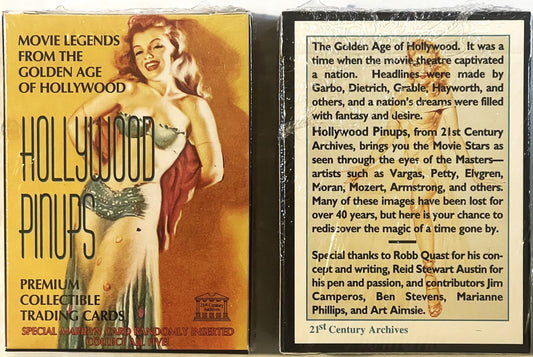
By the mid-1990s, a wave of nostalgia-driven trading card companies had sprung up to license vintage American art and photography for a new generation of collectors who'd grown up on baseball cards but had money now to chase something with a little more romance to it. 21st Century Archives carved out its own niche squarely in that space, building sets around classic American pin-up illustration and pairing each image with substantive, researched card-back text rather than throwaway trivia. The Petty Girl and Petty Girl II sets sit alongside the company's companion release built around Alberto Vargas — Petty's great rival and eventual successor at Esquire — giving 1990s collectors a way to build out the whole pin-up family tree, one pack at a time.

What makes these sets stand apart from a lot of the era's cardboard nostalgia is that a real historian was brought in to write the backs, and the source material was genuinely rare — pulled from decades of Petty's original commercial work rather than a handful of overexposed greatest hits. That's a meaningful distinction for anyone building a pin-up or illustration-art collection: these weren't quickie reprints, they were closer to a boxed retrospective, assembled with an archivist's care and issued under license from The Petty Family estate itself.


🎞️ The Legacy: Vargas, Playboy, and the Pin-Up Family Tree

Without George Petty, there's a strong case that there's no Vargas Girl and no Playboy Playmate as we know them — the entire concept of a recurring, anticipated pin-up figure inside a magazine was his invention before it was anyone else's. When Alberto Vargas took over the Esquire centerfold in the early 1940s, he inherited a format and an audience Petty had spent the better part of a decade building. Decades later, when Hugh Hefner built an empire on the monthly centerfold, he was working squarely within the tradition Petty had started in a Chicago studio back in 1933. That through-line — from Petty, to Vargas, to the Playmate of the Month — is one of the great unbroken chains in twentieth-century American commercial art, and it's a big part of why collectors treat original Petty material, including sealed sets like this one, with the kind of respect usually reserved for fine-art prints rather than trading cards.

Today, pin-up illustration from this golden era commands real respect in vintage advertising and Americana circles, hung in man-caves and garages the same way it was hung in shops and dorm rooms eighty and ninety years ago, and studied seriously by design historians tracing the roots of modern commercial illustration. A sealed, unopened box like this one is a rarer thing than a loose card here or there — it represents the complete intended presentation, exactly as 21st Century Archives packaged it back when the trading card boom was at its peak.


🖼️ Display Ideas

  • 🖤 Stand the sealed Series I black box on a shelf beside a framed Esquire cover reproduction for an instant golden-age-of-illustration vignette
  • 🍸 Pair both boxes together on a home bar cart or in a den for a classic mid-century "gentleman's study" look
  • 🔧 Display the Series I box near vintage tool memorabilia or a garage workbench display, playing up the Ridgid Tool connection
  • 🏖️ Set the Series II cream box alongside vintage swimwear or beach-themed decor for a nod to the Jantzen tie-in
  • 🎁 Present the pair as a boxed gift set for a collector of pin-up art, illustration history, or 1990s trading cards
  • 📚 Shelve both boxes spine-out next to books on Esquire, Vargas, or the history of American magazine illustration for a curated collector's corner

🎁 Who Collects These

These sets tend to land with a wonderfully broad range of collectors. Pin-up and vintage illustration enthusiasts want them for the sheer volume of Petty artwork packed into a single boxed release, especially with Reid Stewart Austin's researched card backs adding real reference value. Trading card collectors from the 1990s nostalgia-card boom seek them out as a complete, factory-sealed example of a niche release that a lot of casual collectors from that decade never even knew existed. Advertising and brand historians are drawn to the Ridgid Tool and Jantzen insert cards specifically, since those bridge pin-up art collecting with vintage American tool and swimwear advertising. And then there are the George Petty completists and Esquire magazine collectors, for whom a sealed set like this represents a tidy, well-documented way to hold a meaningful slice of the artist's career without chasing down individual magazine issues from the 1930s and '40s.


❓ FAQ

Are these sets factory sealed?

Yes — both The Petty Girl and The Petty Girl II boxed sets offered here are New Old Stock, sealed exactly as they left the factory, never opened as a working card set.

How many cards are in each set?

Each boxed set is a complete 50-card release, for 100 cards total across the two series.

What years does the artwork span?

The card sets draw on George Petty's original commercial illustration work from the 1930s, 1940s, and 1950s, though the trading card sets themselves were issued in 1995 under license from The Petty Family.

What are the Ridgid Tool and Jantzen cards?

Each set carries a one-of-five special insert card randomly seeded into the packs — a Ridgid Tool card in Series I and a Jantzen card in Series II — honoring two real American companies that once commissioned Petty's pin-up art for their own advertising and calendars.

Who wrote the historical text on the cards?

The card backs were written by Reid Stewart Austin, a recognized authority on pin-up illustration history, lending the set genuine reference value beyond a typical novelty card release.

Is George Petty the same artist connected to Playboy's pin-up tradition?

Petty predates Playboy by decades — he originated the fold-out magazine centerfold at Esquire in the 1930s, a format that influenced Alberto Vargas' later Esquire work and, eventually, the Playboy Playmate tradition itself.

Were these two sets sold separately or as a pair?

The Petty Girl (Series I) and The Petty Girl II are two distinct boxed releases from 21st Century Archives, each a complete 50-card set, offered here together as a matched pair.

Shipping

🚚 Shipping & Handling

  • Shipping costs and timing are calculated at checkout.
  • Items curated and shipped directly by me include U.S. shipping at no additional cost, professionally packed to ensure safe arrival of your artifact.

Items from Vetted Pro Collectors
Shipping for items offered by vetted Pro Collectors is determined at checkout. All Pro Collector listings are reviewed to ensure fair, reasonable shipping practices.

For full details, please refer to our Shipping Policy.

Returns & Exchange

Take your time — you've got a full six months. If a piece isn't right for you, send it back the way it reached you and we're good.

In the first 30 days your money goes straight back the way you paid. After that it's store credit, so you can put it toward something you'd rather have.

Return shipping we sort out between us, case by case. I don't make this difficult.

If something arrives damaged, or it isn't what I said it was, send me a photo within 48 hours and I'll make it right.

Email info@vintageantiquesgifts.com or call 802-356-9872 — that's me answering, not a call center.

The only things I can't take back are custom or special-order pieces and gift cards.

View full details
  • 5 stars: 3 (100%)
  • 4 stars: 0 (0%)
  • 3 stars: 0 (0%)
  • 2 stars: 0 (0%)
  • 1 star: 0 (0%)
a
a***5 (4286)

Happy Happy Happy sweet love it well made fast shipping great seller

e
e***r (23)

Items arrive quickly in great condition as described

b
b***b (1153)

Great seller. Items as described and shipped fast and safe. Thanks 👍