Skip to product information
1 of 3

Vintage and Antique Gifts

Vintage 1995 George Petty Girl II 🎨 Sealed Pinup Trading Box Set – 21st Century Archives

Vintage 1995 George Petty Girl II 🎨 Sealed Pinup Trading Box Set – 21st Century Archives

Regular price 13.00 USD
Regular price Sale price 13.00 USD
Sale Sold out
Shipping calculated at checkout.
Quantity

Factory-sealed and shrink-wrapped exactly as it left the factory in 1995 — never opened. They vary a little one to the next.


🎨 A Sealed Box of George Petty's Pin-Up Art

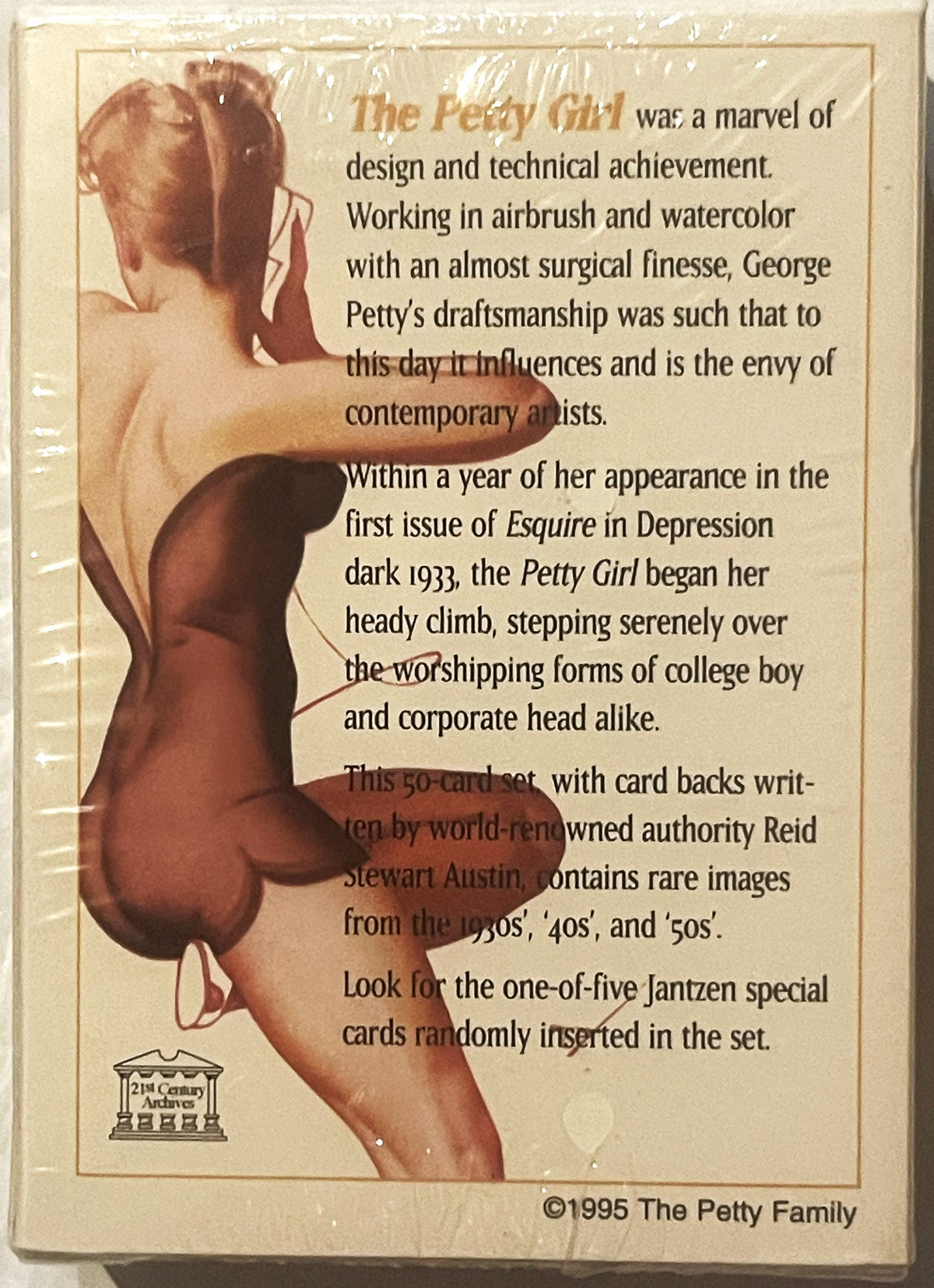
I love a box like this: sealed, untouched, still the way it left the printer thirty years ago. This is The Petty Girl II — Classic Pinup Art By George Petty, a factory-sealed 50-card set issued by 21st Century Archives in 1995, with "©1995 The Petty Family" printed right on the box. The cream cardboard box is finished in sepia-brown, tan, black and gold, wrapped around one striking image front and back: a Petty Girl seen from behind in a backless brown one-piece swimsuit, one knee raised. The set is Series II of a two-part release — Series I came out the year before — and every factory set holds all fifty numbered cards plus one of the five Jantzen chase cards; which of the five you get is the only thing left to chance.

The box's own back-panel text tells you what you're getting before you ever break the seal: "The Petty Girl was a marvel of design and technical achievement. Working in airbrush and watercolor with an almost surgical finesse, George Petty's draftsmanship was such that to this day it influences and is the envy of contemporary artists." And a line I'm fond of: "Within a year of her appearance in the first issue of Esquire in Depression dark 1933, the Petty Girl began her heady climb, stepping serenely over the worshipping forms of college boy and corporate head alike." The set's own promise is "rare images from the 1930s', '40s', and '50s'," with card backs written by Reid Stewart Austin.


🖌️ George Petty and the Birth of a Look

George Brown Petty IV was born in 1894 in Abbeville, down in Vermilion Parish, Louisiana, and moved north to Chicago with his family around the turn of the century. His father was a Chicago photographer whose own work included portraits of young women, madonnas and nudes, and it was in that studio that young George first picked up an airbrush — not to paint, but to retouch photographs, smoothing and softening in a way no brush could match. He studied art in Paris, then came home to Chicago and worked as an airbrush retoucher for a printing company before going out on his own as a commercial illustrator. His first published work was a 1920 Marshall Field's catalogue cover.

Esquire's very first issue hit newsstands in October 1933, in the depths of the Depression, selling out a run of 100,000 copies — and Petty was in it with a cartoon. Within two years he was doing monthly ad work for Old Gold cigarettes and Jantzen, and it was the magazine's Christmas 1939 issue, with a thirty-inch fold-out, that gave the world the first real Petty gatefold — the format that made the centerfold famous. Old-timers in the collecting world still call it "the format Petty built," and there's truth to the boast: before Petty there had been the girl on the magazine cover, but never the girl in the magazine.


🎓 Miss America, Princeton, and a Decade at the Top

By the back half of the 1930s Petty was a genuine cultural fixture. From 1936 through 1941 he sat as a celebrity judge at the Miss America pageant, and in 1939 the students of Princeton University voted him their favorite artist in America — Rembrandt came in second. Three years later, in 1942, a poll of 3,700 Chicago high school art students put him first again, this time as a write-in.


🏊 Jantzen and the Chase Card in This Box

Jantzen was already a titan of American swimwear by the time it came calling on Petty. Founded in 1910 in Portland, Oregon — first as the Portland Knitting Company, by Carl Jantzen and John and Roy Zehntbauer — the firm took the Jantzen name around 1916 and built its reputation on the Red Diving Girl, drawn by Frank and Florenz Clark, in ads from 1920 and on the suits themselves from 1923. In 1940 Jantzen created a "Petty Girl" swimsuit. The box nods to that side of his career with its line "Look for the one-of-five Jantzen special cards randomly inserted in the set," and every factory set carries one of those five; you just don't know which until you open it.


✈️ From the Magazine Page to a Bomber's Nose

Petty's reach went well past Esquire's readership. During the Second World War, his pin-ups were copied by hand onto the noses of American warplanes as nose art, and the most famous example still remembered today is the B-17 Memphis Belle — drawn from Petty's own April 1941 Esquire illustration. That April 1941 image is card 79 in this set. The story goes that crews would paint on a Petty Girl, or their own best hand-copied version of one, as a good-luck charm riding into combat.


🎬 The Split From Esquire, and a Movie Named After Her

Success has its costs. Advertising paid better than magazine work, and by 1941 Esquire was airing its frustration in its own letter pages while quietly bringing in a younger artist named Alberto Vargas. After about a year of uneasy coexistence, the Petty Girl made way for the Varga Girl in 1942. Petty was a sharp businessman, too: he kept the secondary rights to his images and got his original paintings back — which is exactly why it's "The Petty Family" holding the copyright on this 1995 box, not the magazine that made him famous.

The Petty Girl's pull was durable enough that in 1950, Columbia Pictures made a film called The Petty Girl, directed by Henry Levin and starring Robert Cummings as a fictionalized version of the artist — remembered today as the film debut of Tippi Hedren, cast as one of the Petty Girls on screen. Petty kept working into the 1950s, and in 1973 he came back to paint one more pin-up for Esquire's 40th-anniversary issue. He died in 1975 in San Pedro, California, and in 2017 was inducted into the Society of Illustrators Hall of Fame.


📖 What's Inside the Box

By the published checklist, the fifty numbered cards trace Petty's whole career in order. Card 51 opens the set with "Come! Chicago World's Fair" — the poster that won him first prize in the 1933 Chicago World's Fair poster contest, before Esquire ever came calling. Cards 52 through 78 reprint his Esquire gag pages from January 1934 through November 1941. Card 79, as above, is the April 1941 Esquire image tied to the Memphis Belle's nose art. Cards 80 through 93 come from his three years at True magazine, 1945 to 1947 — a run credited with helping that magazine double its circulation. Three cards, 90, 94 and 95, reproduce his 1952 calendar work for the Ridge Tool Company, and the last five, 96 through 100, are drawn from his 1956 Esquire calendar comeback.


📚 Reid Stewart Austin, Behind Every Card Back

The historical text on the cards was written by the pin-up historian Reid Stewart Austin, who co-wrote "Vargas" (1978) with Alberto Vargas himself and later wrote a 1997 book on Petty. Having his actual research on the back of every card, instead of generic trivia, is part of what made a release like this one feel like an archive rather than a novelty — which is exactly the promise in the publisher's own name.


🏛️ 21st Century Archives and the Mid-'90s Pin-Up Revival

21st Century Archives was a small specialty publisher of pin-up card sets. This Petty Girl II set followed the 1994 Series I, and its other sets included Vargas Pin-Up Girls II (1993), Hollywood Pin-Ups (1994), Elvgren Pin-Ups (1995) and two Bettie Page sets. The story goes that the company folded not long after these releases. What survives is the cards themselves, and the story of the man they honor.

Shipping

🚚 Shipping & Handling

  • Shipping costs and timing are calculated at checkout.
  • Items curated and shipped directly by me include U.S. shipping at no additional cost, professionally packed to ensure safe arrival of your artifact.

Items from Vetted Pro Collectors
Shipping for items offered by vetted Pro Collectors is determined at checkout. All Pro Collector listings are reviewed to ensure fair, reasonable shipping practices.

For full details, please refer to our Shipping Policy.

Returns & Exchange

Take your time — you've got a full six months. If a piece isn't right for you, send it back the way it reached you and we're good.

In the first 30 days your money goes straight back the way you paid. After that it's store credit, so you can put it toward something you'd rather have.

Return shipping we sort out between us, case by case. I don't make this difficult.

If something arrives damaged, or it isn't what I said it was, send me a photo within 48 hours and I'll make it right.

Email info@vintageantiquesgifts.com or call 802-356-9872 — that's me answering, not a call center.

The only things I can't take back are custom or special-order pieces and gift cards.

View full details
  • 5 stars: 4 (100%)
  • 4 stars: 0 (0%)
  • 3 stars: 0 (0%)
  • 2 stars: 0 (0%)
  • 1 star: 0 (0%)
s
s***_ (1169)

Quality service.Excellent condition. Thanks for the item and service the personal touch is appreciated.Will buy from you again.

-
-***9 (3)

Cards came quickly and in perfect condition

m
m***. (575)

Buy with confidence. One of eBay's best.

z
z***c (17)

Outstanding!! fast delivery..thank you so much. top quality!