Skip to product information
1 of 5

Vintage and Antique Gifts

Antique American Bank Note Co 🦅 Preferred Stock Certificate, Brown Eagle Vignette, NYC

Antique American Bank Note Co 🦅 Preferred Stock Certificate, Brown Eagle Vignette, NYC

Regular price 9.00 USD
Regular price Sale price 9.00 USD
Sale Sold out
Shipping calculated at checkout.
Quantity

🦅 What Does It Feel Like to Hold Stock in the Company That Printed America's Trust?

There's something quietly thrilling about owning a stock certificate issued by the very firm that engraved the paper money, the postage stamps, and the securities that everyone else trusted. Most old stock certificates ask you to believe in a railroad, a mine, or a manufacturing concern you've never heard of. This one asks you to believe in the company that made belief itself printable — the American Bank Note Company, selling shares in its own name, on its own presses, using the same hand-cut engraving skill it lent to governments around the world. Collectors call this the "meta" certificate of the scripophily hobby, and once you've seen one in person, you understand why.

This is an original American Bank Note Company Six Per Cent Cumulative Preferred Stock certificate, issued by the company for itself, out of New York, New York, dating to the 1920s through the 1960s — the decades when dealer records and surviving populations of this design place the bulk of these certificates, with the 1930s turning up most often and the 1940s a rarer find.

The face carries a richly engraved brown vignette of a bald eagle perched on a rocky outcrop, wings thrown open, head turned skyward, with a stand of pines at its feet — flanked by ornate lathe-work guilloche borders and cartouche corners of the exact intaglio style ABN was famous for producing on behalf of banks and governments worldwide.

An arched banner across the top spells out the company's authorized capital structure: six per cent cumulative preferred stock at $5,000,000 par value, common stock at $10,000,000 par value, denominated at $50 and $10 per share respectively. The certificate measures approximately 12" x 8", printed on the same quality banknote-grade stock the company used for currency work, and is offered as a genuine issued certificate — made out to a holder, ink-signed by the Treasurer and President, registrar-stamped and heavily punch-cancelled — never a reproduction.


🏛️ A Company That Printed Trust Itself

The American Bank Note Company came into being on April 29, 1858, when seven of the young republic's largest security-engraving firms — Toppan, Carpenter & Co.; Rawdon, Wright, Hatch & Edson; Danforth, Perkins & Co.; Jocelyn, Draper, Welch & Co.; Wellstood, Hay & Whitney; Bald, Cousland & Co.; and John E. Gavit — merged into a single enterprise in the shaky aftermath of the Panic of 1857. Consolidation, the founders reasoned, was safer than competition when the nation's banking system itself was under strain. But the company's roots reach back further still, to 1795 and a firm called Murray, Draper, Fairman & Company, founded by Robert Scot — the very first official engraver of the United States Mint. Few companies can trace an unbroken engraving lineage back to the Mint's founding generation; ABN could, and it never let anyone forget it.

During the Civil War, the company (working alongside the National Bank Note Company) printed the federal government's "Demand Notes" under Treasury contract — the original greenbacks that first proved paper currency could carry the government's full faith and credit. Decades later, from 1879 to 1894, ABN held the contract to print United States postage stamps, closing out that chapter with the beloved 1892–93 Columbian Exposition commemoratives, still among the most collected stamp issues in American philately. When the federal Bureau of Engraving and Printing eventually took over currency and stamp production domestically, ABN didn't shrink — it went global, supplying banknotes and secure documents to more than one hundred countries across the twentieth century.


🏙️ Wall Street's Engraving Powerhouse

ABN's headquarters were placed deliberately close to the pulse of American finance. The company started out at 55 Wall Street in the Merchants Exchange Building, then moved through 142 Broadway in 1867, 78–86 Trinity Place in 1882, and finally settled at 70 Broad Street in 1908 — always a short walk from the brokerages, banks, and stock exchanges whose paper it engraved. That same year, 1908, the company opened its legendary printing plant in the Bronx, and by the decades this certificate spans, that plant was running at a scale hard to picture today: in its peak years it processed more than five million pieces of paper a day and printed roughly half of all securities traded on the New York Stock Exchange. Its presses turned out bank notes, postage and revenue stamps, stock and bond certificates, checks, traveler's checks, letters of credit, lottery tickets, and eventually food stamps — for 115 countries at its height, though it became especially known for the currencies of Mexico, Brazil, Costa Rica, Ecuador, Haiti, and Cuba.


🕵️ The Locked Office in the Tower

Collectors passing this certificate down through the hobby have kept alive a piece of workplace lore worth preserving here: it's said the company employed its own in-house "counterfeiter" — an engraver whose actual job was to try to copy ABN's own banknotes and securities from a locked office high in the plant's tower.

Whenever he succeeded, the story goes, it wasn't treated as a failure but as free intelligence: the design, the ink, or the paper stock in question would simply be made harder to fake. Old-timers in the trade also recall that every single sheet of paper was counted no fewer than thirty-three separate times between raw material and finished certificate, with any reject sheet destroyed in an on-site furnace rather than risk it leaving the building.

Whether myth polished by repetition or workroom fact, it captures something true about the culture of a company whose entire business rested on nobody being able to fake what it made — including, presumably, its own stock certificates. Engraver-president Albert Gallatin Goodall, who personally traveled Europe from 1858 onward securing the company's earliest foreign contracts, set the tone of craftsmanship-as-salesmanship that carried the firm for a century afterward.


📉 From Engraved Paper to Digital Trust

This certificate is a document from a business built on the assumption that trust needed to be engraved, watermarked, and hand-checked — and its own history is the story of that assumption finally running its course. In 1977 the Bronx plant was the target of a bombing, chosen specifically because of the Latin American currency it printed there — a stark reminder of how much geopolitical weight passed through that building's presses.

ABN kept using the plant until roughly 1984, after which it changed hands and was eventually restored; both the original American Bank Note Company Building at 70 Broad Street and the 1908 Bronx Printing Plant are now designated New York City landmarks, with the Bronx facility also listed on the National Register of Historic Places.

As stock ownership itself moved from engraved paper into electronic ledger entries through the 1980s and '90s, the market for physical securities collapsed; by 1999 the company filed for Chapter 11 bankruptcy. Its successor, American Banknote Corporation, emerged from reorganization in 2002 and continues today as ABCorp, headquartered in Boston and focused on secure payment cards and authentication technology — a direct descendant of the firm that once engraved greenbacks by hand.

What survives from those glory decades, pieces like this one, are among the last tangible artifacts of a company whose entire reputation was built on making paper impossible to fake.


🖼️ Display Ideas

  • 🖋️ Frame it solo in a narrow black or gilt frame to let the brown eagle vignette and engraved borders carry the whole wall
  • 💼 Hang it in a home office or study as a quiet nod to the history of American finance and engraving craft
  • 📈 Pair it with green or orange American Bank Note Company common stock certificates for a full Wall Street color set across a gallery wall
  • 🦅 Group it with other eagle-vignette Americana — old currency, postage stamps, or period prints — for a themed collection
  • 🏦 Display it near a banking, brokerage, or trading-desk setup as a genuine artifact of the company that once printed the paper for that world
  • 🎁 Gift it to a collector, financial history buff, or anyone drawn to the story of American engraving and security printing

🎁 Who Collects These

Scripophily collectors — people who collect old stock and bond certificates for their artistry and history rather than any surviving monetary value — actively seek out ABN's own stock precisely because it's the company printing shares in itself. Americana and ephemera collectors are drawn to the eagle vignette and engraving quality alone. Financial history enthusiasts, bank and Wall Street buffs, and anyone building a collection around American engraving, currency history, or New York City industrial heritage tend to gravitate toward this piece. It also makes a genuinely meaningful gift for someone who loves the idea of owning a literal piece of American financial history — a certificate from the company that made trust itself printable.


❓ FAQ

Is this an authentic American Bank Note Company certificate, or a reproduction?

It's an original, genuine issued certificate from the American Bank Note Company's own printing, not a modern reprint or reproduction.

What's the significance of a bank note company issuing stock in itself?

American Bank Note Company was the very firm engraving currency, stamps, and securities for banks, corporations, and governments worldwide, so its own stock carries the same design pedigree and engraving craftsmanship as the money and documents it made for everyone else — a rare instance of a security printer's product and its own corporate shares being one and the same.

What does "cumulative preferred stock" mean on this certificate?

Preferred shareholders were entitled to receive their six per cent dividend before any dividend could be paid to common stockholders, and "cumulative" meant that if a dividend was skipped in a given year, it accrued and had to be paid in full before common shareholders received anything — a stronger, more protected position than ordinary common stock.

How old is this certificate?

Surviving examples of this design are documented from the 1920s through the 1960s, with the largest share of known certificates dating to the 1930s and rarer examples turning up from the 1940s.

Can these certificates still be redeemed for shares?

No — American Bank Note Company's original corporate structure no longer exists in this form, and certificates like this one are collected purely as historical and decorative artifacts of American engraving and financial history.

Why is the eagle vignette significant?

The bald eagle vignette reflects the patriotic engraving style ABN used across its currency, stamp, and security work — the same caliber of hand-engraved artistry the company lent to governments and banks around the world, here turned toward its own stock.

What size is the certificate and how is it best displayed?

It measures approximately 12" x 8", a substantial size that frames beautifully on its own or alongside other American Bank Note Company certificates in complementary colors for a themed Wall Street display.

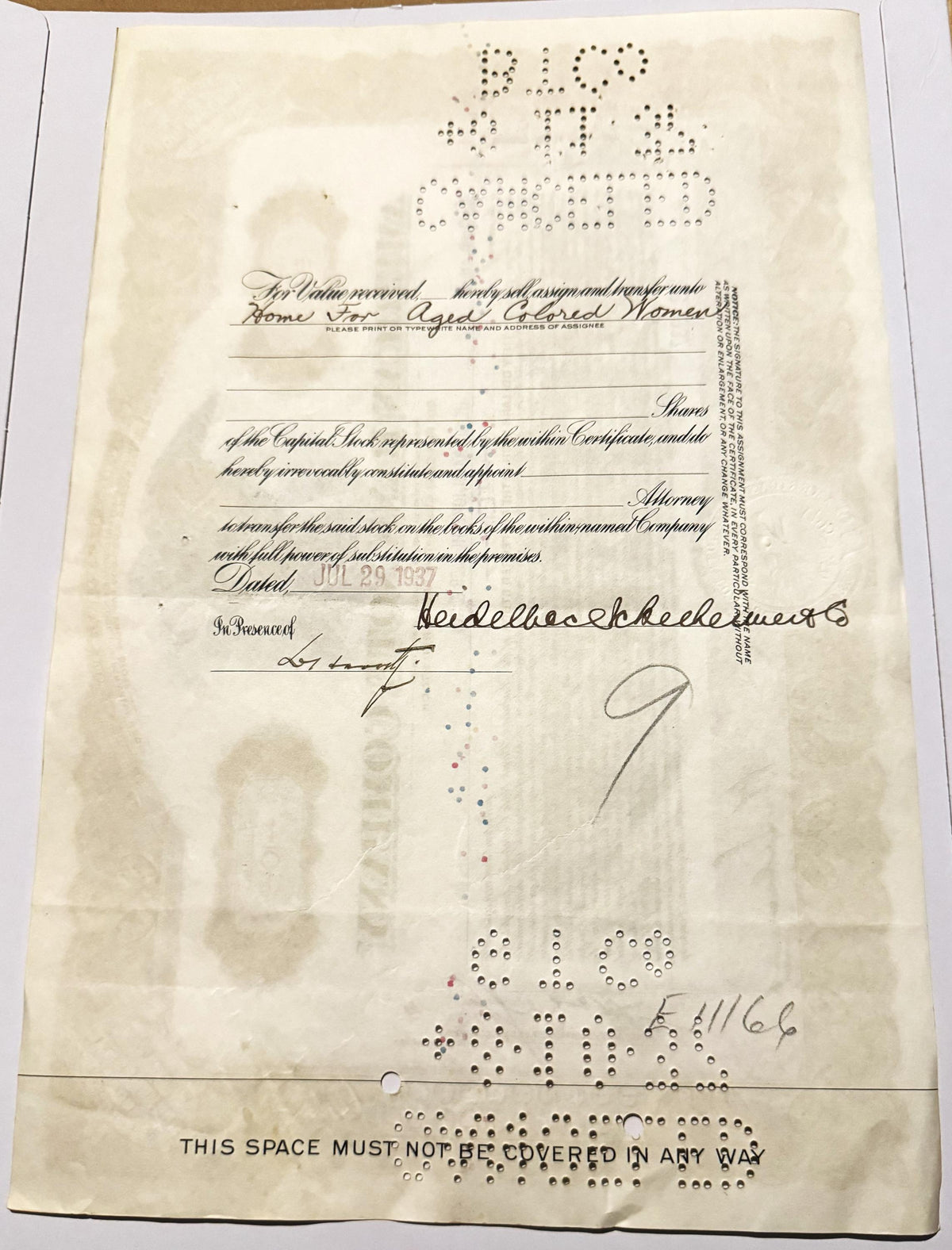
These are issued instruments rather than blanks. Certificates of this type were filled in for a holder in ink, countersigned by the transfer agent and registered by the registrar, then punch- or cut-cancelled when they were redeemed and retired. Expect financial writings, markings, stamps, hole punches and staple holes as part of the life of the instrument: endorsements and signatures, transfer-agent and registrar stamps, revenue or documentary tax stamps, cancellation punches, staple holes from being bound into a transfer book, pencil ledger notations. That is the paper trail of a security that actually did its job, and it is what separates a document that lived from a blank that never did. No two are alike: holder details, serial numbers, dates, signatures, stamps and punch patterns vary from example to example, so the photographs show the type rather than the exact sheet that ships.

Shipping

🚚 Shipping & Handling

  • Shipping costs and timing are calculated at checkout.
  • Items curated and shipped directly by me include U.S. shipping at no additional cost, professionally packed to ensure safe arrival of your artifact.

Items from Vetted Pro Collectors
Shipping for items offered by vetted Pro Collectors is determined at checkout. All Pro Collector listings are reviewed to ensure fair, reasonable shipping practices.

For full details, please refer to our Shipping Policy.

Returns & Exchange

Take your time — you've got a full six months. If a piece isn't right for you, send it back the way it reached you and we're good.

In the first 30 days your money goes straight back the way you paid. After that it's store credit, so you can put it toward something you'd rather have.

Return shipping we sort out between us, case by case. I don't make this difficult.

If something arrives damaged, or it isn't what I said it was, send me a photo within 48 hours and I'll make it right.

Email info@vintageantiquesgifts.com or call 802-356-9872 — that's me answering, not a call center.

The only things I can't take back are custom or special-order pieces and gift cards.

View full details
  • 5 stars: 2 (100%)
  • 4 stars: 0 (0%)
  • 3 stars: 0 (0%)
  • 2 stars: 0 (0%)
  • 1 star: 0 (0%)
n
n***e (1234)

Super FAST shipping ! Item arrived as described. Stock note was well packaged and arrived securely intact. A++

a
a***a (387)

Hi my friends I received my order my vintage company stock certificate and am very excited to see it . I love it great collection and right on time. I’m very proud to support you and your family keep up your great work I’ll be back for more stay safe and healthy my friends 👍