Skip to product information
1 of 2

Vintage and Antique Gifts

1941 Hein Brothers Plumbing Advertising Washer Card ๐Ÿ”ง Manitowoc Wisconsin

1941 Hein Brothers Plumbing Advertising Washer Card ๐Ÿ”ง Manitowoc Wisconsin

Regular price 26.00 USD
Regular price Sale price 26.00 USD
Sale Sold out
Shipping calculated at checkout.
Quantity

Size: 6.5 x 3.5 inches

๐Ÿ”ง A Small-Town Plumber's Clever 1941 Giveaway

Some old things survive because they were beautiful, and some survive because they were too useful and too clever to throw away. This one is both. It is a 1941 advertising washer card, a piece of heavy printed cardstock about six and a half inches wide and three and a half inches tall, handed out more than eighty years ago by Hein Brothers, the plumbing shop at 1315 South 10th Street in Manitowoc, Wisconsin. Across the front, printed in the warm, confident style of prewar American advertising, rolls a little service truck. And where that truck's tires ought to be, three real rubber hose washers are mounted right onto the card. That is the whole trick, and it is a wonderful one.

The card explains itself in plain print: "Save this card and remove a tire when you need a washer for your hose." In other words, keep this by the sink or tacked near the back door, and the next time your garden hose starts weeping at the coupling, peel one of the little rubber "tires" off the truck and slip it onto your hose. The washers were never meant for any vehicle at all; the truck is just the joke that holds them. Every one of the three washers is still here, still on the card, still waiting for a leaky hose that never came. It is a small, honest, ingenious object, and this description tells its whole story straight from the card itself, with nothing invented.

๐Ÿš› How the Little Truck Actually Worked

Picture the everyday problem this card was built to solve. A garden hose in 1941 was rubber, it lived out in the sun, and sooner or later the flat rubber washer inside the coupling would harden, crack, and start to drip. A homeowner who wanted to stop that drip needed a spare washer, which meant a trip downtown to the plumbing or hardware man. Hein Brothers turned that small annoyance into a stroke of marketing. They gave you the spare washers for free, mounted on a card, disguised as the tires of a friendly delivery truck, with their name and telephone number printed right beside them.

So the card did three things at once. It solved a real household problem before you even had it. It kept the Hein Brothers name and number sitting in your kitchen for months or years, exactly where you would look the day something bigger went wrong with the pipes. And it made you smile every time you noticed the truck rolling along on its little rubber tires. A free tool, a standing advertisement, and a bit of cleverness folded into one piece of cardboard. That is prewar small-business promotion at its most charming, the kind of grassroots ingenuity that a hometown plumber dreamed up to compete with the shop across the street.

๐Ÿ“ž The Four-Digit Phone Number That Dates the World It Came From

Look at the telephone number on the card and you fall straight through into another era. It reads simply "5866." Four digits, no area code, no exchange name spelled out in front of it, nothing more. That is not a mistake or a fragment; that is how you reached a business in a city the size of Manitowoc in 1941. You picked up the receiver, an operator answered, and you asked for five-eight-six-six, and a moment later the phone rang inside the Hein Brothers shop. A whole town could be reached in four digits because a whole town knew one another. That tiny number tells you more about 1941 than a paragraph of history could: it was a smaller, closer, more personal America, and this card was printed for it.

The date is not a guess, either. "Copyright 1941" is printed right on the card. The year is a fact set in ink on the object itself, not an estimate pulled from a style or a hunch. When you hold it you are holding something that was designed, printed, and given away in 1941, and it says so in its own words.

๐Ÿญ Manitowoc, Wisconsin, in 1941

Manitowoc sits right on the Lake Michigan shore, a hardworking manufacturing and shipbuilding city that had been building fine Great Lakes vessels since the turn of the century. In the very year this card was printed, 1941, the Manitowoc Shipbuilding Company laid down its first submarine and began the wartime run that would send twenty-eight boats down the ways and out to the Pacific before it was over. That was the backdrop: a busy lakeshore town of shipyards, foundries, and family trades, full of working people who owned their homes, watered their gardens, and called the local plumber by his first name.

Hein Brothers was one of those family trades, tucked into that world at 1315 South 10th Street. The card is a little window onto the Manitowoc of that moment, the everyday commercial life going on quietly alongside the famous shipyards. For anyone who loves Wisconsin history, Great Lakes history, or the story of America's small hometown businesses, that street address and that four-digit phone number root the piece to a real place at a real time in a way few advertisements ever manage.

๐Ÿ—‚๏ธ The Ross Manufacturing Stock-Design System

Here is the part that turns a cute giveaway into a genuine piece of advertising history. Hein Brothers did not design this little truck themselves. It came from Ross Manufacturing Company of Kansas City, Missouri, a specialty-advertising house that created the artwork as a stock design and then imprinted it to order for local tradesmen all over the country. A plumber or hardware dealer in any town could order the same clever washer-truck card and have his own name, address, and telephone number printed onto it. That is exactly how a small shop in a small city got advertising this polished: a national design house did the creative work once, and Main Street businesses everywhere bought it by the box and made it their own.

That means the same friendly truck rolled through kitchens far beyond Manitowoc, carrying different names in different towns, and knowing that only makes this example more interesting, not less. It is a working artifact of the prewar advertising-specialty trade, the whole system by which the little guy could advertise like the big guy. This card is one honest survivor of that clever, nationwide, grassroots industry, imprinted for one particular Wisconsin plumbing family and kept safe ever since.

๐Ÿ‘Œ The Condition, Honestly

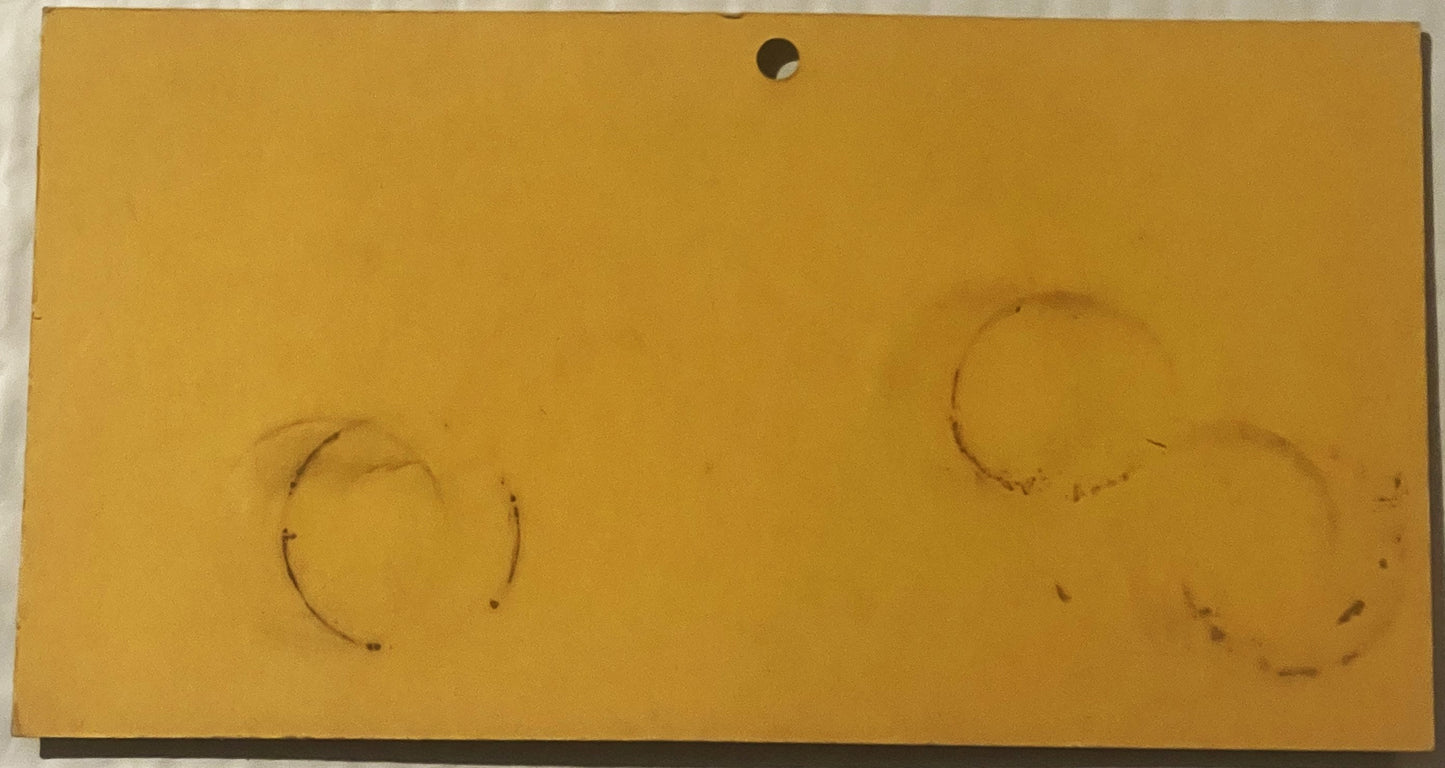
This card has come through more than eight decades in genuinely lovely shape, and the best part is the trick is still complete. All three rubber hose washers are present and still mounted where the truck's tires belong, which is the single most important thing about a washer card and the first thing that is usually missing after all this time. The printing is bright and easy to read, the little truck and the Hein Brothers name and the four-digit number all crisp and clear. There is a punched hang hole at the top, the way these cards were meant to dangle on a nail or a rack. The back is plain, and it carries faint rings where the rubber washers have quietly kissed the cardstock over the years, the soft honest shadow that only real time leaves.

Because every washer is still in place and the card shows so little handling, it has the feel of old shop stock that was set aside and never actually given out to a customer, an unused survivor from the counter rather than one that lived on somebody's kitchen wall. It is offered exactly as pictured, and the photographs are the true record of it. The word for a piece like this is simply well-kept: a small advertisement that did its waiting somewhere safe and came out the other side of the twentieth century intact.

โณ Why So Few Live On

Here is the quiet irony that makes an intact example like this genuinely uncommon. The card was built to be used up. Hein Brothers wanted you to tear the rubber "tires" off the truck and fit them to your hose, and most people, sooner or later, did exactly that. A card that did its job lost its washers one by one and then, its usefulness spent, went into the bin like any empty box or burnt-down matchbook. That is the fate of nearly every promotional giveaway ever printed: doing its work meant its own destruction. The cards that survive today with all three washers still mounted are the ones that, by pure luck, nobody ever happened to need a washer from, tucked in a drawer, forgotten in a shop, spared the very use they were made for. Only a handful are known to exist anywhere now, a bare half-dozen or so complete survivors of a card that was designed to disappear. So it did not begin life as something rare; it became rare by outliving its own purpose while still whole. That is exactly what you are looking at. Others do turn up from time to time, so this is not the only one in the world, but a complete, all-washers-intact example is a real survivor against the odds.

๐Ÿก Wonderful Ways to Live With It

A card like this deserves to be seen, not shut in a drawer. A few favorite ways to enjoy it:

  • Frame it and hang it in a kitchen, a laundry room, a workshop, or a garage, where the little truck and its rubber tires start every conversation.
  • Stand it in a small easel on a shelf or a desk among other prewar advertising and Americana, a piece of real 1941 marketing in miniature.
  • Add it to a plumbing, hardware, or trade-history collection, or to a gathering of advertising-specialty and premium giveaways where its cleverness truly shines.
  • Keep it with Wisconsin or Manitowoc local history, tied as it is to one named family shop at one real street address.
  • Give it to the plumber, the tinkerer, the collector, or the hometown-history lover in your life, a gift with a genuine story folded right into it.

๐Ÿ‡บ๐Ÿ‡ธ Who Will Love This

This one is for the person who delights in American ingenuity, in the small clever ideas that ordinary businesses came up with to be remembered. It is for the collector of prewar advertising and premium giveaways, who knows how uncommon it is to find one of these with every washer still on the card. It is for the lover of Wisconsin and Great Lakes history, the fan of old telephone-era Americana, and the tradesperson who appreciates that a plumber once solved a customer's problem and advertised his shop in the very same stroke. The Hein family carried on serving Manitowoc's plumbing needs for generations after this card was printed, so it is also a warm little handshake from a hometown business that stuck around and did right by its neighbors.

๐Ÿ“ฎ A Few Honest Answers

What exactly is it? A 1941 advertising washer card, a heavy cardstock giveaway roughly six and a half by three and a half inches, imprinted for Hein Brothers plumbing of Manitowoc, Wisconsin, with three real rubber hose washers mounted on it as the tires of a printed service truck.

How do we know the year? "Copyright 1941" is printed right on the card, so the date is a fact on the paper rather than an estimate.

Are the washers meant for a tire? No. They are hose washers, the little rubber rings that seal a garden hose at the coupling. The truck and its "tires" are simply the clever visual that holds them; the printed line tells you to take a tire off when you need a washer for your hose.

Are all the washers still there? Yes. All three are present and mounted, which is exactly what you hope to find and what usually goes missing first.

Who made the design? Ross Manufacturing Company of Kansas City, Missouri produced it as a stock advertising design that local plumbers and hardware dealers across the country ordered imprinted with their own name and number.


Shipping

๐Ÿšš Shipping & Handling

  • Shipping costs and timing are calculated at checkout.
  • Items curated and shipped directly by me include U.S. shipping at no additional cost, professionally packed to ensure safe arrival of your artifact.

Items from Vetted Pro Collectors
Shipping for items offered by vetted Pro Collectors is determined at checkout. All Pro Collector listings are reviewed to ensure fair, reasonable shipping practices.

For full details, please refer to our Shipping Policy.

Returns & Exchange

Take your time โ€” you've got a full six months. If a piece isn't right for you, send it back the way it reached you and we're good.

In the first 30 days your money goes straight back the way you paid. After that it's store credit, so you can put it toward something you'd rather have.

Return shipping we sort out between us, case by case. I don't make this difficult.

If something arrives damaged, or it isn't what I said it was, send me a photo within 48 hours and I'll make it right.

Email info@vintageantiquesgifts.com or call 802-356-9872 โ€” that's me answering, not a call center.

The only things I can't take back are custom or special-order pieces and gift cards.

View full details