Skip to product information
1 of 4

Vintage and Antique Gifts

Vintage Large 1950s Tin Special Police Toy Badge 🚔 Memorabilia

Vintage Large 1950s Tin Special Police Toy Badge 🚔 Memorabilia

Regular price 9.00 USD
Regular price Sale price 9.00 USD
Sale Sold out
Shipping calculated at checkout.
Quantity

Size: 3.25 x 2.75 inches

What Does It Feel Like to Hold a Piece of Mid-Century American Authority in the Palm of Your Hand?

🦅

There is a particular weight to a badge — even a small one. You pick it up and something shifts. It isn't heavy by any measure of a postal scale, but it carries the unmistakable gravity of civic life, of someone pinning this to their chest and stepping out into the world with a purpose.

That's what stops you when you first turn this one over in your hand. The eagle spreads wide across the top. The officer raises his hand — not in greeting, but in command. Two stars flank him like sentinels. And around the whole scene, embossed in careful relief, the words declare it plainly: SPECIAL POLICE.
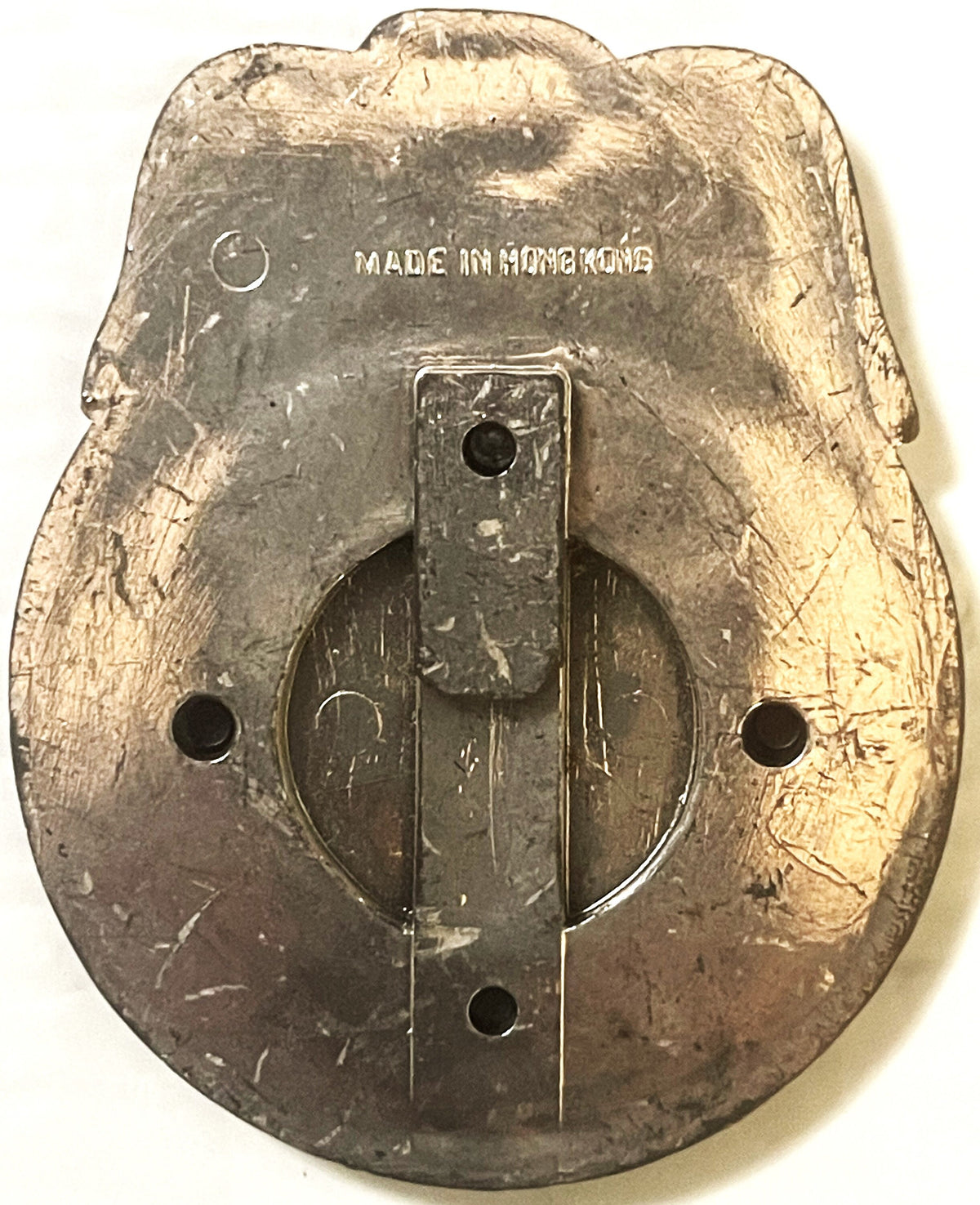
This is a dime-store badge, and it wears that honestly: a stamped tin shell, a folded sheet-metal tab clip on the reverse, MADE IN HONG KONG pressed into the back. What it borrowed was the civic iconography — the eagle, the wreath, the traffic officer's raised hand — rendered in silver, black, and gold for a counter display rather than for a duty belt.
And it has survived. That's the real story here: it survived.

This is a vintage Special Police eagle badge — a stamped and embossed metal pin-back piece bearing the classic American eagle-top shield form, rendered in silver-tone metal with a deep black enamel or lacquered ring and a gold-toned center medallion.

At the top, a spread eagle with deeply detailed wing feathers anchors the whole design. Below it, framed within a rope-and-wreath border and a laurel surround, an embossed officer in a cap raises one hand in the universal point-duty halt gesture, two embossed stars at his flanks. The legend SPECIAL POLICE arcs across the top and bottom of the black ring in raised lettering.
On the reverse, a sturdy pin-and-clip mechanism allows for belt, pocket, or lapel wear — and stamped into that same reverse face is the manufacturer's mark: MADE IN HONG KONG. Shown against a US quarter in the photographs, this badge measures roughly two and a half to three inches tall — a substantial, satisfying piece, not a trinket.
It is an excellent early example of mid-century American civic iconography and collectible law enforcement memorabilia, and it is presented here as New Old Stock (NOS) — a survivor from the era it was made, still carrying all the presence of the piece it always was.

🏛️ What "Special Police" Really Meant — and Why It Matters

People sometimes look at a "Special Police" badge and assume it's a lesser thing — a step below the real article.

That reading misses the history entirely. "Special Police" was never a single department or a single rank. It was a category, and across American civic life through the early and mid twentieth century, it was a genuinely important one. Special police personnel were sworn officers — sometimes holding the full powers and authority of a regular law enforcement officer within their specific jurisdiction, sometimes with narrower commissions covering a hospital campus, a rail yard, a park district, or a housing authority.
They were real people doing real work, and they wore real badges to prove it.

The range of individuals who might have worn a badge exactly like this one is striking when you start to trace it. Welfare fraud investigators. Agricultural inspectors. Child welfare officers.

Security personnel at factories and utilities. Crossing guards elevated to sworn status. Auxiliary officers covering traffic duty on fair days. Civil defense wardens given limited arrest authority during the home-front years. In documented department histories, the term "Special Police" appears again and again tied to exactly those roles — the extra officers, the auxiliary force, the community members sworn in when the regular ranks needed reinforcing.
One published department history notes that its Special Police badge — first issue — was worn by members of an auxiliary police force formed the day after the attack on Pearl Harbor in December 1941, made from chrome and nickel rather than sterling and gold because certain metals had to be preserved for the war effort.
That context is worth sitting with. Across the country, badges that looked very much like this one were being pinned to the chests of ordinary citizens who had raised their hands — much like the officer embossed in the center of this very piece — and said: I'll do what needs doing.

The eagle-top shield form itself is a distinctly American badge tradition, reaching back into the nineteenth century and running forward through the mid-twentieth.

Stock-pattern badges in this style — with the eagle crest, the wreath border, and the generic legend rather than a named department — were produced by catalog and sold to municipalities, institutions, and organizations that needed credentialed insignia without the cost of a custom die. Long-established American badge firms — houses like Irvin H.
Hahn of Baltimore, family-owned and operated for generations and specializing in handcrafted badges and insignia, or firms like Meyer & Wenthe of Chicago and V. H. Blackinton — produced exactly these kinds of stock patterns for the national market across the early and mid-twentieth century. A "Special Police" eagle-top badge with a traffic-officer figure in the center medallion was precisely the kind of design that would have appeared in those catalogs, available for order in quantity for pennies per unit, and sold on through dime stores and catalogue houses by the boxful.

✋ The Officer with the Raised Hand — Iconography and Its Meaning

Look at the center of this badge and you're looking at one of the most recognizable figures in the entire iconography of early American law enforcement: the traffic officer in his cap, one hand raised, commanding the flow of the world around him.

This was the visual shorthand for civic authority in the early-to-mid twentieth century — before traffic signals were universal, before the automated systems we take for granted, there was a man in a uniform at the intersection, and the raised hand was his instrument. It was a gesture of pure, legible authority. It needed no translation.

On a "Special Police" badge, that figure carries particular meaning.

It tells you something about the role this badge was likely issued for: point duty. Traffic control. The kind of assignment given to auxiliary and special officers when regular forces were stretched thin — fair days, parade routes, school crossings, civic events where the orderly movement of people and vehicles required a visible, sworn presence on the corner.
The officer with the raised hand wasn't decorative. He was a job description pressed in metal. Lore passed down among badge collectors holds that the traffic-officer medallion was one of the most commonly specified center designs when municipalities and institutions placed catalog orders for special police insignia — precisely because it communicated the role at a glance, without a word of explanation.
Whether the specific die used for this badge's center figure can ever be traced to a named maker is an open question; what isn't open to question is what that figure meant to the people who wore it.

🏷️ The "Made in Hong Kong" Mark — What It Tells the Collector

The MADE IN HONG KONG stamp on the reverse of this badge is one of the most useful pieces of information it carries, and collectors who know their markings will recognize it immediately.

Hong Kong became a significant manufacturing center for metal novelties, insignia, and commemorative pieces in the mid-twentieth century, producing items for the American and international markets with a high standard of craft in stamped and embossed metalwork. The presence of this mark places the badge firmly within that manufacturing tradition — a piece made to the specifications of the American civic badge market, rendered with the eagle-top form and the special police legend that American buyers recognized and expected, produced by skilled metalworkers in a region that had developed genuine expertise in exactly this kind of precision embossed work.

For collectors, a clear and legible country-of-origin mark is a positive identification feature, not a footnote.

It anchors the piece within a documented manufacturing period and tradition, and it distinguishes this badge as a product of a specific era of international trade in novelty and civic goods. The pin-and-clip mechanism visible on the reverse — a sturdy bar-style clip with mounting holes — is consistent with mid-century hardware of this type, designed for secure wear on a belt, breast pocket, or lapel.
Together, the mark and the hardware tell a coherent story about when and how this piece entered the world.

🔍 The Details That Make This One Worth Owning

What separates a great badge from a merely interesting one is the depth of the work pressed into it, and this piece delivers that depth at every level.

Start with the eagle at the top — the wing feathers are individually articulated, each one rendered with a precision that reflects a well-cut die and careful stamping. The rope-and-wreath border surrounding the black ring is tight and consistent, the individual links and leaves reading cleanly all the way around. The laurel surround on the outer silver ring is equally sharp, the leaves overlapping in proper heraldic fashion.
And at the center, the officer himself — cap, collar, the geometry of a raised arm, the open palm — is rendered with the kind of confident relief that only comes from a die that was made to last and a press that was set correctly.

The two stars flanking the central figure are a detail worth noting — they're small, but they're deliberate, placed symmetrically as rank indicators or decorative honors, depending on how the issuing authority chose to read them.

The black enamel or lacquered ring that carries the SPECIAL POLICE legend creates a strong visual contrast against the silver surround and the gold-toned center, giving this badge the kind of graphic clarity that reads from a distance — which is, of course, exactly what a badge is supposed to do. This is a piece where the design logic and the craft execution are working in complete agreement.

🖼️ Display Ideas

  • 🗂️ Shadow box with period law enforcement ephemera — pair this badge with a vintage patrol whistle, a mid-century traffic citation pad, or a period photograph of an auxiliary officer unit for a complete tableau of mid-century civic life.
  • 🖼️ Framed badge wall — mount alongside other eagle-top shields from the same era, arranged by design variation, to show the full range of the American stock-badge tradition in one visual sweep.
  • 🧲 Museum-mount on archival backing — a single badge on a deep charcoal or navy archival mat, framed under UV glass, lets the silver, black, and gold palette do exactly what it was designed to do: command attention.
  • 🏠 Home office or den display — on a small easel or in a display case alongside books on American law enforcement history, this badge becomes an immediate conversation piece for anyone who notices it.
  • 🎁 Gift presentation — presented in a velvet-lined box with a printed card telling the Special Police history, this makes an exceptional gift for the collector, the history enthusiast, or the law enforcement professional who appreciates what came before.
  • 🧒 Generational heirloom display — this is exactly the kind of piece a grandparent passes to a grandchild with a story attached.
Display it where the story can be told — on a bookshelf, in an entry hall, somewhere it gets seen and asked about.

🎁 Who Collects These — and Why They're Looking

Badge collecting — known formally as exonumia or, in the specialized corner of the hobby, as "batology" (the study of badges and insignia) — is one of the most active and knowledgeable corners of the Americana collecting world.

The people drawn to pieces like this one are not casual browsers. They are researchers, historians, and passionate accumulators of civic material culture who understand that a badge carries social history in a way that a photograph or a document simply cannot replicate. A badge was worn. It was touched by the person who carried its authority.
It mediated between an institution and the public in a way nothing else did.

Within that community, the eagle-top "Special Police" form is a foundational collecting category — common enough to be accessible to new collectors, varied enough in its design details and manufacturing origins to reward deep study.

Collectors pursue these badges for the graphic quality of the eagle die, for the variation in center medallion designs, for the range of manufacturers and eras represented, and for the sheer resonance of the "Special Police" category itself — that broad, American tradition of civic deputization that touches everything from WWII home-front auxiliary forces to hospital security to park rangers.
This badge sits squarely at the center of all of it.

This piece also draws strongly from the gift market — and for good reason. A badge like this one is a perfect gift for a retired or active law enforcement officer, a detective fiction enthusiast, a mid-century Americana collector, or anyone with a deep affection for the visual language of American civic life.

It's dimensional, it's tactile, it's historically grounded, and it tells a story the moment it's seen. Those qualities make it the kind of gift that gets kept.

❓ Collector FAQ — Your Questions About This Badge, Answered

Is this a real police badge or a novelty piece?

That's exactly the right question, and the honest answer is the plain one: it is a novelty piece — a dime-store badge, not police issue.

The phrase "Special Police" did belong to real auxiliaries, institutional officers, civil defense personnel and traffic special deputies in American civic life — which is precisely why the dime-store trade borrowed it for the counter racks. But the stock-pattern form of this badge (eagle top, generic "Special Police" legend, no named department or jurisdiction) means it was produced as a catalog item rather than a custom departmental order.
It is an authentic piece of mid-century dime-store badge production — a novelty piece sold over a counter, not a department-issued badge traceable to any town. It belongs to the well-documented tradition of stock special police insignia that served real civic purposes across American institutions and communities.

What does "MADE IN HONG KONG" tell us about when this was made?

The "MADE IN HONG KONG" mark is one of the most useful dating and authentication features on this piece.

Hong Kong emerged as a significant manufacturing center for metal novelties, insignia, and decorative goods in the mid-twentieth century, producing items for the American market with genuine craft quality in stamped and embossed metalwork. The presence of a clear, legible country-of-origin mark is consistent with mid-century import trade requirements, and the style of the badge's design — eagle-top shield, embossed relief, enamel or lacquered ring, bar-clip hardware — is fully consistent with the mid-century period.
No confirmed manufacture date exists for this specific badge, and we present it as vintage, mid-century in style, which is the accurate and honest description supported by all the available evidence.

Can this badge be attributed to a specific maker or department?

Not from the evidence visible in the photographs alone, and we won't claim otherwise.

The "MADE IN HONG KONG" mark identifies the country of manufacture but not a specific company. The "SPECIAL POLICE" legend carries no named jurisdiction — no city, county, state, or institution name appears on the face. That's characteristic of stock-pattern badge production: these pieces were made to be issued by whoever ordered them, with the department's authority implied by the issuance rather than engraved into the metal.
Historic American badge firms produced catalog patterns in exactly this form. If a maker's hallmark is present on the reverse beyond the country-of-origin mark, that would be the key to further attribution — but the piece stands as a strong and authentic example of the category regardless.

What is the significance of the officer with the raised hand in the center medallion?

The raised-hand traffic officer is one of the most enduring and legible figures in American law enforcement iconography, and its presence on this badge is meaningful.

Before traffic signals were universal infrastructure, the point-duty officer — standing at an intersection, raising his hand to halt traffic, directing the flow of a city with his body — was the visible face of civic order. That gesture, captured here in embossed relief, was the universal visual language of traffic authority.
On a "Special Police" badge, it strongly suggests this design was associated with traffic or crossing duty assignments — exactly the kind of role that auxiliary and special officers were given when regular forces needed supplementing. Lore among badge collectors holds that the traffic-officer center die was among the most commonly ordered for special police catalog badges, precisely because it communicated the assignment clearly and immediately.

How does this badge wear and display?

The reverse of the badge features a sturdy bar-and-clip pin mechanism with mounting holes — the standard hardware for a badge of this type, designed to attach securely to a belt, breast pocket, or lapel.

The mechanism is intact and functional. For display purposes, this badge presents beautifully in a shadow box, on a velvet-lined badge holder, or mounted on archival backing under glass. The three-color palette — silver, black, and gold — gives it strong visual presence, and the dimensional embossed relief catches light in a way that flat-printed pieces simply cannot match.
It's an excellent piece for display in any collection of law enforcement memorabilia, Americana, or mid-century civic material culture.

Is this a good gift for someone who works in law enforcement or loves police history?

It is an exceptional one.

The combination of genuine historical substance — the documented "Special Police" tradition, the WWII auxiliary connection, the traffic-officer iconography — with the visual authority of the eagle-top shield form makes this a gift that carries real meaning for anyone who understands what it represents. It's dimensional and tactile in a way that a book or a print is not, and it comes with a story that rewards telling.
Whether framed as a display piece, presented in a gift box with a printed history card, or passed down as a generational collectible, this badge delivers the weight of American civic history in the palm of a hand. That's a rare thing to be able to give.

What makes this piece stand out in a collection of badge and law enforcement memorabilia?

Several things, and collectors who have handled a lot of these pieces will recognize them immediately.

The quality of the eagle die — the individual articulation of the wing feathers, the spread and proportion of the wings — is strong. The rope-and-wreath border work on the black ring is tight and consistently struck. The laurel surround on the outer silver ring shows proper heraldic leaf overlap. And the center officer figure, with his cap, collar, and open raised palm, is rendered with confident, clean relief.
These are the marks of a well-cut die and a correctly set press. Beyond the craft, the three-element color composition — silver ground, black ring, gold center — gives this badge an inherent graphic authority that makes it stand out in a drawer, on a display board, or in a frame. It's a piece that announces itself.

Shipping

🚚 Shipping & Handling

  • Shipping costs and timing are calculated at checkout.
  • Items curated and shipped directly by me include U.S. shipping at no additional cost, professionally packed to ensure safe arrival of your artifact.

Items from Vetted Pro Collectors
Shipping for items offered by vetted Pro Collectors is determined at checkout. All Pro Collector listings are reviewed to ensure fair, reasonable shipping practices.

For full details, please refer to our Shipping Policy.

Returns & Exchange

Take your time — you've got a full six months. If a piece isn't right for you, send it back the way it reached you and we're good.

In the first 30 days your money goes straight back the way you paid. After that it's store credit, so you can put it toward something you'd rather have.

Return shipping we sort out between us, case by case. I don't make this difficult.

If something arrives damaged, or it isn't what I said it was, send me a photo within 48 hours and I'll make it right.

Email info@vintageantiquesgifts.com or call 802-356-9872 — that's me answering, not a call center.

The only things I can't take back are custom or special-order pieces and gift cards.

View full details