Skip to product information
1 of 6

Vintage and Antique Gifts

Vintage Tin Toy Badge 🕵️ Private Detective & Special Police on Original Card | 1950s–60s Japan Dime Store

Vintage Tin Toy Badge 🕵️ Private Detective & Special Police on Original Card | 1950s–60s Japan Dime Store

Regular price 11.33 USD
Regular price Sale price 11.33 USD
Sale Sold out
Shipping calculated at checkout.
Style
Quantity

Did You Ever Pin On a Badge and Become Someone Else for the Afternoon? 🕵️

There is a particular kind of magic that belongs entirely to childhood — the moment a small piece of stamped metal hit your shirt pocket and you stopped being a kid on a sidewalk and became Dick Tracy, or a Special Police officer walking a beat in some imagined city of rain-slicked streets and mystery. These badges made that happen. For a dime, or maybe a quarter, pulled from a pocket at the five-and-dime, a child could become anyone brave. That is not a small thing. That is exactly what play is for, and these badges — genuine New Old Stock (NOS) mid-century toy badges, still mounted on their original retail display cards — are a direct, tangible thread back to that world.

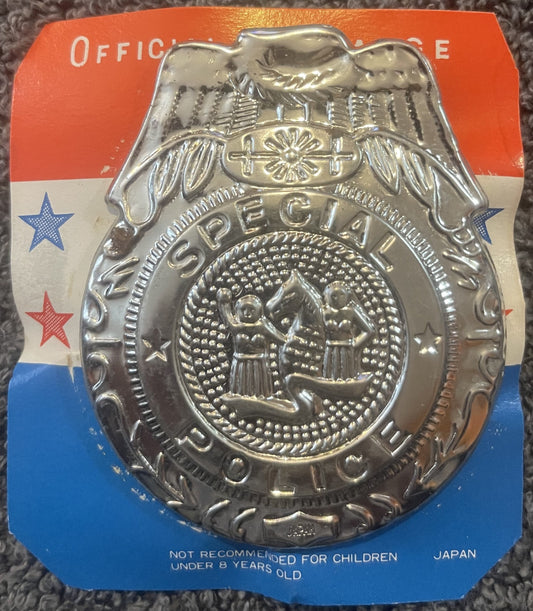
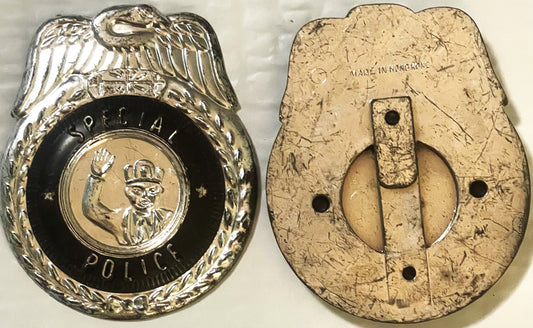
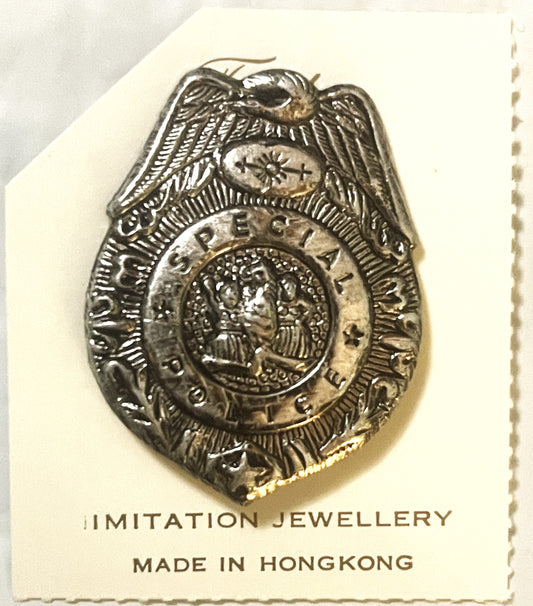
What you are looking at is a set of three original carded toy badges: two labeled Private Detective and one labeled Special Police, each affixed to its dark navy blue retail card with bold gold lettering. The badges themselves are embossed stamped metal — silver-toned shields topped with a spread eagle in classic American law-enforcement heraldry, centered on a gold star medallion that catches the light the way only mid-century metal craft does.

The cards read JAPAN on the reverse, placing these squarely in the golden age of Japanese export toy manufacturing, that remarkable and well-documented window roughly spanning the early 1950s into the early 1960s when Japan rebuilt its economy on a flood of beautifully made, affordable novelties that filled American dime stores from coast to coast.

The card size runs approximately 2″ × 1¾″ — a compact, purposeful retail package designed to hang on a peg or stack in a bin beside the register at Woolworth's, Ben Franklin, McCrory's, or any one of the thousands of five-and-dimes that anchored American Main Streets in those years. These are New Old Stock — shelf survivors, never played with, still on their cards, still exactly as they were the day they arrived in that old rice-paper master case from across the Pacific.


🏭 The Industry Behind the Badge — Japan's Postwar Toy Golden Age

To hold one of these cards is to hold a small chapter of one of the most remarkable economic stories of the twentieth century. After the Second World War, Japan's industrial capacity lay in ruins. The Allied occupation, administered by General Douglas MacArthur, made a deliberate and consequential decision: Japan would be rebuilt as a peaceful manufacturing nation, and toys would help lead the way. The occupation government actively encouraged Japanese factories to pivot toward export goods, and in an almost poetic act of practical policy, American steel — subsidized and redirected — began arriving at Japanese tinplate mills to be pressed and stamped into playthings for American children. Within months of the war's end, production lines were running again, first in Kyoto and then across the country, turning out tin toys that would travel back across the very ocean that had so recently been a battlefield.

By 1948, when international trade formally resumed, Japanese tin toys were moving into American import channels in volume. The five-and-dime stores — Woolworth's, Grants, J.J. Newberry, G.C. Murphy, Ben Franklin, and their kin — were the primary distribution channel for exactly this kind of item: small, affordable, colorful, and irresistible to a child with coins in hand. These were not the elaborate mechanical wind-up automata and battery-operated tin robots that now command serious collector prices. These were the humbler cousins — the carded novelties, the costume jewelry of the toy world, the impulse buys of childhood. They were made in enormous quantities, they were inexpensive, and they were loved to pieces — which is precisely why intact, carded, unplayed NOS examples like these are the ones collectors now search for.

The workforce that produced them is part of the story too. Assembly in Japanese toy factories of this era was substantially the work of women — many of whom had entered the labor force during and after the war, newly enfranchised (Japanese women received the right to vote in 1945) and joining factories and home-assembly networks across the country. Parts were produced in centralized facilities and finished both in the factory and in cottage-industry home settings, a manufacturing web that allowed extraordinary flexibility and volume. The people who made these badges were largely anonymous to the American children who played with them, separated by an ocean and a language — but they were skilled, industrious, and making something that genuinely mattered in the daily imaginative life of postwar American childhood.

The specific factory, printer, and importer behind these particular cards have not been documented — these were anonymous mass-market export novelties, carrying only the country-of-origin mark as required by U.S. customs law. That anonymity is historically normal for this tier of the trade. The great named Japanese tin-toy makers — Alps, M-T Co., TN, TM — are associated with the mechanical and battery-operated end of the market. The carded dime-store novelty end operated through a different, less-documented network of smaller stamping shops, card printers, and American jobbers and importers whose paper trails are largely gone. What we know is that these items moved through that system efficiently and in quantity, and that the system worked because it served a genuine market need at exactly the right moment in American cultural history.


📻 The Culture That Made These Badges Matter

These badges did not exist in a vacuum. They were made to satisfy a specific, burning cultural appetite in mid-century American childhood — the appetite for crime-fighters, lawmen, detectives, and heroes. The golden age of radio drama had filled American living rooms for two decades with the sound of gunshots, squealing tires, and the authoritative voice of the law. Dick Tracy — Chester Gould's square-jawed, two-way-wrist-radio detective — had been running in the funny pages since 1931 and was a household name by the 1950s, inspiring films, radio serials, and an avalanche of licensed merchandise. The Lone Ranger rode across radio airwaves and then television screens, and his silver star was perhaps the most iconic badge in American popular culture. Dragnet brought the flat, procedural dignity of detective work into the living room via radio and then television beginning in 1951, and a whole generation of children watched Jack Webb's Sergeant Joe Friday and decided that carrying a badge was the most serious and important thing a person could do.

Against that backdrop, a Private Detective badge on a dime-store card was not a trivial thing. It was a passport. It connected a child in a backyard in Ohio or a stoop in Brooklyn to every hero they had ever heard on the radio or seen on the screen. The eagle-topped shield design on these badges is not random — it echoes the heraldic language of real law enforcement credentials, the same visual vocabulary that appeared on actual police and detective shields of the era, scaled down and simplified but unmistakably of the same family. The gold star at the center is the universal symbol of authority and legitimacy. Whoever designed these card-mounted badges — and that designer is now unknown to us — understood exactly what a child needed to feel official.

Lore passed down among collectors of dime-store toys holds that the carded badge was one of the most reliably profitable items in the novelty import trade — low cost, high margin, zero assembly required on the retail end, and with a customer base (children between roughly six and twelve) that renewed itself every year. The story goes that importers would order these in master cases of several dozen cards, and that a well-placed peg hook near the checkout at a Woolworth's could turn over an entire case in a single busy Saturday. Whether that exact story is traceable to a documented source or has simply been passed along among collectors and dealers for decades, it rings true to anyone who understands how these stores worked and how reliably children spent their allowances on exactly this kind of thing.

Local legend among collectors of Occupied Japan and post-Occupation Japanese export toys also holds that the transition from "Made in Occupied Japan" to plain "Japan" markings was not merely a legal formality but a matter of commercial pride — that Japanese manufacturers and workers genuinely welcomed the moment when the "Occupied" qualifier disappeared from their goods, and that the items marked simply "JAPAN" from the mid-1950s onward carried a quiet dignity that the earlier mark could not. These badges, marked JAPAN, belong to that post-Occupation chapter — after April 1952, when the Allied Occupation formally ended and Japan stood again as a sovereign nation building its own future through its own craft.


🖼️ Display Ideas

  • 🗂️ Shadow box framing — mount both card styles side by side in a deep shadow box with a period detective novel paperback cover or a vintage Dick Tracy comic strip reprint; the dark navy cards and gold lettering make an immediate, graphic statement.
  • 🪟 Vintage toy store vignette — recreate a dime-store counter scene with a period tin sign, a few other carded novelties, and a small reproduction of a 1950s five-and-dime price card; these badges anchor the display as the centerpiece.
  • 📚 Detective / true crime bookshelf accent — lean the cards against a row of vintage pulp paperbacks, hardboiled detective novels, or original Dragnet tie-in publications; the visual conversation between the badge and the books is immediate and evocative.
  • 🎄 Nostalgic holiday display — tuck these among vintage Christmas ornaments and mid-century holiday ephemera; the gold and silver palette reads beautifully in a seasonal vignette and the era is exactly right for a postwar Christmas-morning memory.
  • 🖼️ Americana gallery wall — group with other mid-century carded novelties, original advertising cards, and tin lithography pieces; the graphic design of the card — gold on dark navy — holds its own against much larger pieces.
  • 🕵️ Themed gift presentation — pair with a vintage detective novel, a period movie lobby card, or a reproduction radio drama program and present as a curated mid-century Americana gift; the intact card makes the whole package feel like something pulled directly from a time capsule.

🎁 Who Collects These

The audience for a piece like this is broader and more passionate than the modest original price point might suggest. Dime-store toy collectors actively seek carded NOS examples precisely because most of these items were played with, separated from their cards, and lost — a badge that survived intact on its original card is genuinely the exception, not the rule. Japanese export toy enthusiasts — a well-organized and knowledgeable collecting community — value the mid-century "JAPAN"-marked tier of the trade as distinct from both the earlier Occupied Japan window and the later Hong Kong and plastic eras; these badges sit exactly in the heart of the golden age they prize. Pop culture and television history collectors seek out items connected to the Dick Tracy, Dragnet, and Lone Ranger cultural moment, and a Private Detective or Special Police badge is an authentic artifact of that world rather than a licensed reproduction. Advertising and graphic design enthusiasts respond to the card itself — the bold gold-on-navy typography, the hand-lettered authority of the printing, the way the whole package communicates its era in a single glance.

And then there is the largest and perhaps most emotionally invested group: people who remember. Anyone who grew up in postwar America, or who grew up with parents or grandparents who did, recognizes something in these badges that goes beyond collectibility. It is the feeling of a Saturday afternoon when anything was possible, when a dime could buy you a new identity, and when being a detective or a special police officer was the most important job in the world.


❓ Frequently Asked Questions

Are these real police badges or official law enforcement items?

These are children's novelty toy badges — dime-store playthings made for imaginative play, not official credentials of any kind. They were designed and sold as costume accessories and toys, inspired by the visual language of real law enforcement badges but never intended to represent actual authority. That said, the design is remarkably faithful to mid-century American police and detective shield heraldry — the eagle-topped shield form, the circular central medallion, the five-pointed star — and that fidelity is part of what makes them so compelling as artifacts of the era. They are collectible as toys, as Americana, and as pop culture objects, not as law enforcement memorabilia.

What does the "JAPAN" mark tell us about when these were made?

The "JAPAN" mark is one of the most useful dating tools in this collecting category. The Allied Occupation of Japan ran from 1945 through April 1952, and export goods made during that window were required to carry "Made in Occupied Japan" or "Occupied Japan" markings. After the Occupation ended, that designation disappeared entirely — items marked simply "JAPAN" or "Made in Japan" are post-Occupation by definition. Collectors and dealers in this field are careful about this distinction: an item marked "JAPAN" alone is not an Occupied Japan collectible and should not be categorized as one. The plain "JAPAN" mark on these badges is consistent with mid-century production in the years after sovereignty was restored, squarely in the heart of what specialists recognize as the golden age of Japanese export tin toys.

Why don't these badges carry a manufacturer's name?

This is entirely normal for this tier of the Japanese export toy trade, and it does not affect authenticity or collectibility. The elaborate mechanical wind-up and battery-operated tin toys of the era — robots, cars, planes — were often marked by their makers because those manufacturers were building brand identities for the American market. The dime-store novelty end of the trade operated differently: these were anonymous mass-market goods moved through import jobbers and wholesalers, and the only marking required by U.S. customs law was the country of origin. The factory, the card printer, the American importer — all of that paperwork has largely not survived. What has survived is the object itself, and its "JAPAN" mark is exactly what it should be.

What are the two variants, and how do I get the one I want?

Three badges are shown across the listing photos: two examples of the Private Detective card and one example of the Special Police card. Both feature the eagle-topped embossed metal shield design with a gold star center, mounted on dark navy blue cards with gold lettering. The Private Detective badge features a six-pointed or wheel-style gold star medallion at center; the Special Police badge features a five-pointed gold star. The cards and badges are visually distinct from each other and both are excellent examples of the genre. If you have a preference for one style over the other, simply leave a note at checkout — inventory is mixed and otherwise selection will be made at random from available stock.

Is this New Old Stock? What does that mean for a piece like this?

Yes — these badges are New Old Stock, meaning they were never sold through to a child, never played with, and have remained on their original retail display cards since they left production. NOS survival is the primary value factor for carded dime-store novelties of this era. The vast majority of these badges were separated from their cards the moment they were purchased — a child pinned on the badge and the card was discarded. A badge that has remained mounted and intact represents the rarest form of survival for the type. The card itself is part of the artifact: its printing, its design, its typography, its country-of-origin mark are all historical documents as much as the badge is. NOS examples like these are what serious collectors of mid-century dime-store toys actively seek.

What were five-and-dime stores, and why do they matter for understanding this piece?

The five-and-dime — or "dime store" — was one of the defining retail institutions of American life from the late nineteenth century through the mid-twentieth. Chains like F.W. Woolworth, Ben Franklin, McCrory's, J.J. Newberry, G.C. Murphy, and Grants operated thousands of locations in towns of every size, selling an enormous range of inexpensive goods — notions, candy, housewares, cosmetics, and toys — at prices working families could afford. The carded novelty peg display near the checkout was a fixture of these stores, and Japanese-import toys like these badges were among the most consistent sellers in that format. Understanding the dime-store context is understanding the entire distribution system that brought these objects into American homes: they were not specialty toy-store items or catalog goods, they were impulse purchases, allowance splurges, the small democratizing luxuries of mid-century childhood. That context is baked into the object — the card size, the price-point design aesthetic, the genre of toy — and it is part of what makes these pieces such resonant artifacts of the era.

Are these appropriate as gifts, or are they primarily for display collectors?

Both, genuinely. As display pieces they are immediate and graphic — the gold-on-navy card, the silver and gold badge, the bold typography all read beautifully on a shelf, in a shadow box, or as part of a mid-century Americana vignette. As gifts they work across a wide range of recipients: anyone with a connection to the Dick Tracy and Dragnet era of American pop culture, anyone who collects dime-store toys or Japanese export novelties, anyone who grew up with five-and-dimes as part of their world, or anyone who simply loves the look and feel of mid-century Americana. The intact original card makes the presentation self-contained — this is already a complete, frameable object. It requires nothing added to it.

👮 Junior Deputies, Safety Patrols, and the World This Badge Lived In

There is a real history standing behind every mid-century toy badge. This was the era of the junior deputy and the school safety patrol: sheriffs' offices swore children in as honorary junior deputies at fairs and school assemblies, safety patrol programs — running strong since the 1920s — pinned badges on generations of schoolchildren, and a visit from an officer with badges to hand out was a fixture of American civic childhood. A carded Private Detective badge belonged to that world. When a child pinned one on, the game borrowed its seriousness from programs that were entirely real — and that is part of the history a survivor like this one still carries.

Shipping

🚚 Shipping & Handling

  • Shipping costs and timing are calculated at checkout.
  • Items curated and shipped directly by me include U.S. shipping at no additional cost, professionally packed to ensure safe arrival of your artifact.

Items from Vetted Pro Collectors
Shipping for items offered by vetted Pro Collectors is determined at checkout. All Pro Collector listings are reviewed to ensure fair, reasonable shipping practices.

For full details, please refer to our Shipping Policy.

Returns & Exchange

Take your time — you've got a full six months. If a piece isn't right for you, send it back the way it reached you and we're good.

In the first 30 days your money goes straight back the way you paid. After that it's store credit, so you can put it toward something you'd rather have.

Return shipping we sort out between us, case by case. I don't make this difficult.

If something arrives damaged, or it isn't what I said it was, send me a photo within 48 hours and I'll make it right.

Email info@vintageantiquesgifts.com or call 802-356-9872 — that's me answering, not a call center.

The only things I can't take back are custom or special-order pieces and gift cards.

View full details
  • 5 stars: 8 (89%)
  • 4 stars: 0 (0%)
  • 3 stars: 1 (11%)
  • 2 stars: 0 (0%)
  • 1 star: 0 (0%)
t
t***y (1561)

Item as described packed nicely shipped fast will you sell her again?

u
u***d (734)

Cool little badge. Great price, Fast shipper, Great packaging

e
e***e (123)

Item as described

e
e***2 (949)

A fantastic transaction with one of the greatest eBayers ever! Thank you, 100% satisfaction, amazing packing, sent pronto with a sweet note signed by the seller and his children! Let's continue this amazing relationship, and I will revisit the store and shop! All the best, - i

p
p***c (63)

Love this seller and will definately buy again! Thank you!

p
p***c (63)

Great seller! Always love the items they have to offer! Thanks again!

a
a***2 (472)

Great seller.

C
Crow

I bought this for a gift for a friend, and unfortunately it didn't come with enough postage so i had to come to the post office to recieve it. When the lady handed it to me, i noticed it was very thin and light The badge was much smaller and cheaper than I expected, which is partially due to me not fully reading the dimensions and description but still very dissapointing. The badge is very small, ane cheap tin. I understand it's from an old dime store or something but still not what I was hoping for. The package came with a nice letter from the seller and his family, they seem very nice and great people but unfortunately this item didn't meet my expectations. It would be good for a small gift for a child

j
j***j (6529)

PERFECT!!!!!!! A++++++++++++++++++++++++++++