Skip to product information
1 of 4

Vintage and Antique Gifts

Vintage Los Angeles County Sheriff 🌟 Special Police Badge Tin Litho Card Japan 1960s-1970s Toy Novelty

Vintage Los Angeles County Sheriff 🌟 Special Police Badge Tin Litho Card Japan 1960s-1970s Toy Novelty

Regular price $18.00 USD
Regular price Sale price $18.00 USD
Sale Sold out
Shipping calculated at checkout.

Size: 4" x 2 1/4"

🚚 Free US Shipping — ships within one business day. International shipping calculated at checkout.

Quantity

Remember Los Angeles County Sheriff Toy Stars? 🌟 A Kid's Sheriff Star From the County That Gave Away Real-Looking Ones by the Thousand

Size: 4" x 2 1/4" ~ New Old Stock, still on its card in its cellophane sleeve.

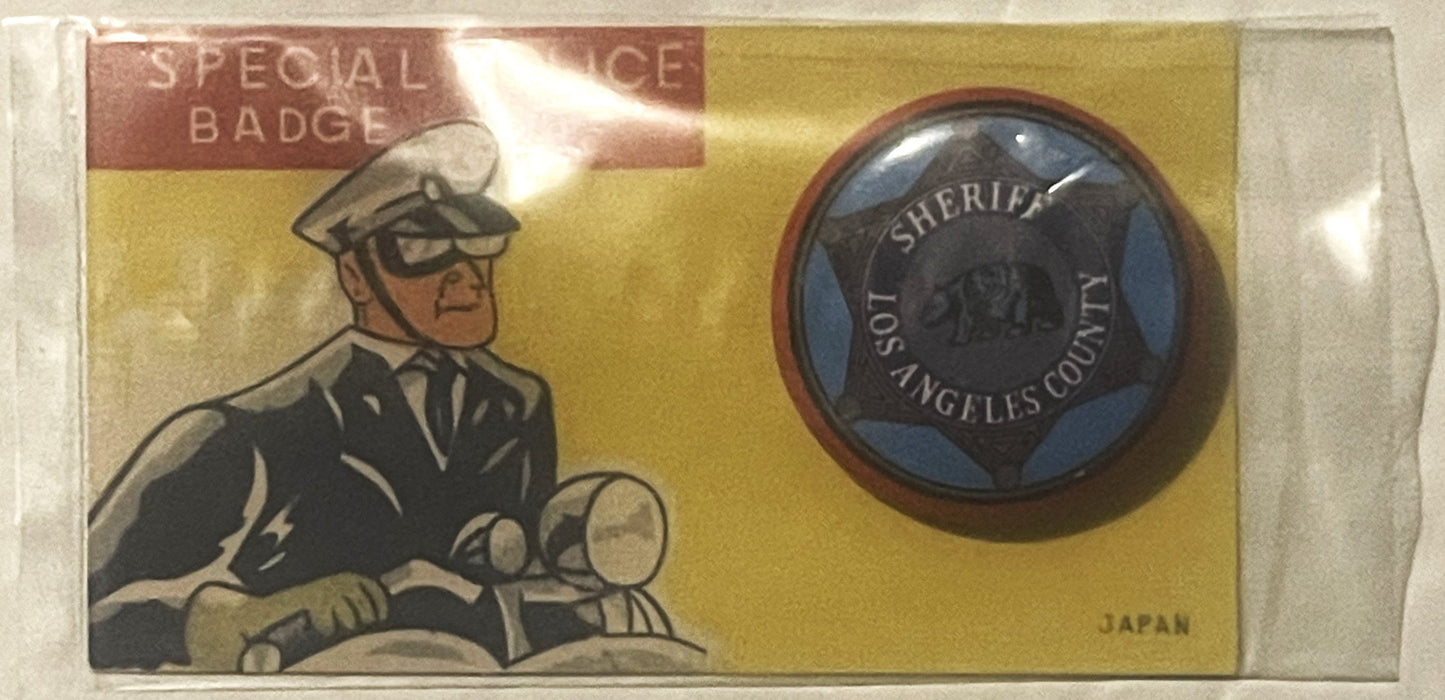
Los Angeles County had a badge problem, and it was a famous one. Sheriff Eugene Biscailuz, who ran the department from 1932 to 1958, gave out thousands of honorary deputy stars that looked like the real thing. In 1963 his successor, Sheriff Peter Pitchess, announced he was recalling every badge the department had issued to people outside law enforcement. This little card is the kind of star a kid could own: a tin litho Los Angeles County Sheriff toy badge on its original yellow Special Police Badge card, made in Japan for the dime-store trade, new old stock in its cellophane sleeve.


🎖️ What Is on the Card

  • The badge: a round domed tin litho button with a red-orange rim. Printed on its light blue face is a dark six-point star with a ball at every tip. At the center, a deep blue disc carries a walking California grizzly, with SHERIFF arched over it and LOS ANGELES COUNTY curving beneath, in white capitals.
  • The card: a yellow ground with a red banner reading SPECIAL POLICE BADGE in white letters. Below it a cartoon motorcycle officer in a white peaked cap, dark goggles, dark uniform and tie leans over his handlebars, gloved hand on the grip, headlight gleaming, with a faint city skyline behind him.
  • Country mark: JAPAN, printed small in the lower right corner of the card.
  • Packaging: card and badge together in a clear cellophane sleeve.
  • Size: 4 x 2.25 inches.

This is a children's novelty. A real Los Angeles County star is die-struck gold-colored metal with a blue enamel band, ordered by the department and never marked JAPAN; the department's current star was manufactured by the Entemann Badge Company. What makes this one worth keeping is how closely a Japanese toy printer copied the look of that star, down to the ball tips and the bear. The bear at its center is the California grizzly, the animal that walks across the state flag the Legislature adopted in 1911.


🐻 The Real Star Behind the Toy

The Los Angeles County Sheriff's Department named on this toy is the largest sheriff's department in the United States. It was formed in April 1850, when California became a state, and its first sheriff, George T. Burrill, had two deputies. Early deputies bought their own badges, usually cut from sheet silver and hand engraved, so no two looked alike. Beginning in late 1906 most carried a shield topped with an eagle. During the tenure of Sheriff John Cline, from 1915 to 1921, the county Board of Supervisors replaced the eagle with a walking bear and ordered badges numbered for the first time, and by the end of that decade the shield was giving way to the six-pointed star. Deputy Bob Brown designed the star worn today, and a county ordinance approved it in 1948. The department's own manual still describes it: a gold six-point star, a blue band lettered for Los Angeles County, and the California bear at its heart. That bear and that star shape are exactly what this toy reproduces.


⭐ Eugene Biscailuz and the Honorary Stars

Eugene W. Biscailuz was born March 12, 1883, in Boyle Heights, Los Angeles, California. His grandfather William Warren was an early Los Angeles city marshal, killed in a gun battle in 1870. Biscailuz joined the sheriff's office as a deputy in 1907. In 1929 Governor C. C. Young asked him to reorganize the old State Motor Patrol, and he became the first superintendent of the new California Highway Patrol. He came back as Sheriff of Los Angeles County in 1932 and stayed twenty-six years.

He changed the department. In 1933 he created one of the first uniformed sheriff's departments in the nation, in forest green. After the 1933 Long Beach earthquake he revamped the aero squadron to include private pilots flying their own planes for searches and rescues, the unit that grew into today's Aero Bureau. His department added a Mounted Posse in 1933, and he formed a Sheriff's Boys Band led by conductor Colonel Vesey Walker, and a Junior Deputy program for young men that later became the department's Explorer program. The Junior Deputy program began at the department's Hollywood Station, and from there it spread to other stations. Department histories say Biscailuz paid for the first group of Junior Deputy badges with his own money.

And he gave away stars. According to badge collector and retired LAPD commander Keith Bushey, Biscailuz handed out thousands of look-alike deputy sheriff badges over his tenure. The practice outlasted him: Peter Pitchess took office on December 1, 1958, and in July 1963 announced the recall of every badge the department had issued to people not directly concerned with law enforcement, most of them Biscailuz's. Biscailuz died in Los Angeles on May 16, 1969. In a county where thousands of grown-ups carried honorary look-alike stars, a kid's star from the five-and-dime was the one badge nobody was ever going to recall.


🧒 The Youth Program Story

Tin litho badges like this one had a second life beyond the toy counter: sheriffs handed them out as prizes to children in youth programs. The AAA School Safety Patrol, begun in 1920, has put belts and badges on millions of schoolchildren. One buyer who wrote in remembered these as the small pins Sheriff Biscailuz's youth citizenship program gave to boys sent out to ranches, and that is a story worth passing along beside the real record of a sheriff who put badges in young people's hands.


🏭 Made in Japan for America's Dime Stores

Japan's tin toy industry came back under the American occupation. From February 1947 the occupation authorities required export goods to be marked "Occupied Japan" or "Made in Occupied Japan"; the requirement was dropped in December 1949, although many makers kept using it until the occupation ended on April 28, 1952, and some goods from those years were simply marked "Japan". Toy exports took off once international trade resumed in 1948, and American buyers became the industry's great market.

The trade peaked from about 1952 to 1962. Many Japanese companies sent preprinted tin sheets out to family workshops, where parents and children stamped, shaped and assembled pieces at home and were paid by the piece. The finished goods usually reached America under an importer's name rather than the factory's, and they sold through five-and-dime chains such as F. W. Woolworth, Grants and Ben Franklin. Rising labor costs, safety rules and cheap plastic eventually ended the tin era, and the export trade in these toys gave a major boost to Japan's recovery after the war. The same yellow Special Police Badge card also carried an NYPD button copying the patch the department adopted on July 1, 1971, and a San Francisco button copying the SFPD patch added in 1970, so this card family was on the racks in the 1970s.


🔎 Why Named Litho Badges Are Scarce

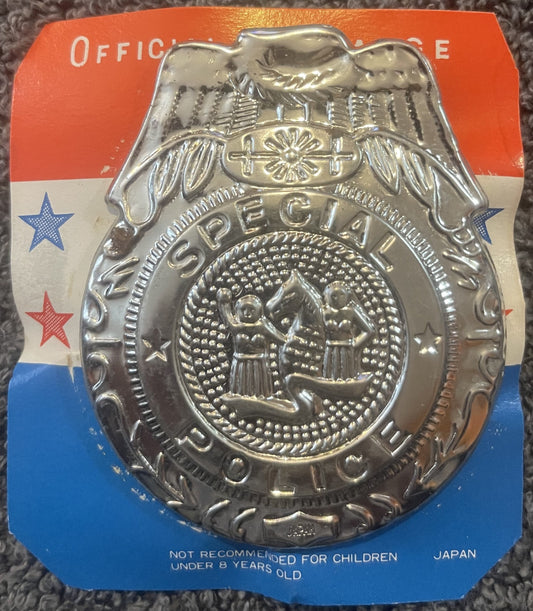
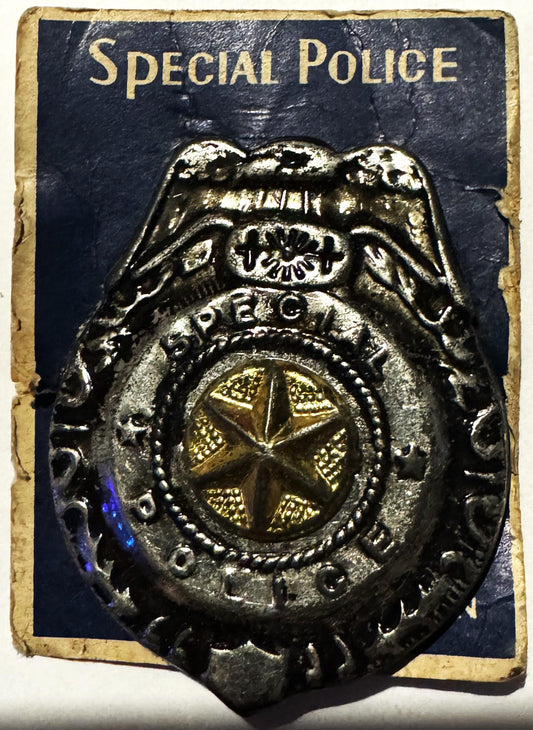
The Special Police Badge cards came with many different badges, and plenty of old toy badges are generic stamped shields with no place name at all. Tin litho badges printed with a real jurisdiction, like this Los Angeles County star, are a separate and much scarcer branch of the family: printed in color on tin rather than pressed, and made to be pinned on, played with and lost. Carded examples still in their cellophane rarely come to market.


Shipping

🚚 Shipping & Handling

  • Shipping costs and timing are calculated at checkout.
  • Items curated and shipped directly by me include U.S. shipping at no additional cost, professionally packed to ensure safe arrival of your artifact.

Items from Vetted Pro Collectors
Shipping for items offered by vetted Pro Collectors is determined at checkout. All Pro Collector listings are reviewed to ensure fair, reasonable shipping practices.

For full details, please refer to our Shipping Policy.

Returns & Exchange

Take your time — you've got a full six months. If a piece isn't right for you, send it back the way it reached you and we're good.

In the first 30 days your money goes straight back the way you paid. After that it's store credit, so you can put it toward something you'd rather have.

Return shipping we sort out between us, case by case. I don't make this difficult.

If something arrives damaged, or it isn't what I said it was, send me a photo within 48 hours and I'll make it right.

Email info@vintageantiquesgifts.com or call 802-356-9872 — that's me answering, not a call center.

The only things I can't take back are custom or special-order pieces and gift cards.

View full details
  • 5 stars: 5 (100%)
  • 4 stars: 0 (0%)
  • 3 stars: 0 (0%)
  • 2 stars: 0 (0%)
  • 1 star: 0 (0%)
m
m***a (16751)

Outstanding! Highly Recommend!

m
m***t (1149)

Thank you, Dad & Kids, for a very nice piece of Los Angeles County Sheriff’s Department history. FYI, Sheriff Eugene Biscaluz used to send boys to ranches to learn citizenship. They would receive small badges or pins as part of their participation. I believe this pin may be one given out. Post Occupied Japan in the 1950s.

a
a***4 (746)

As described and well packaged. A nice letter was inside too. 😀

t
t***t (722)

Packaged up very safe and shipped quick. Buttons just as pictured and described. A+ seller.

3
3***b (196)

Easy fast transaction nicely packaged

Preserving History: Authentic Objects Across Eras

— Curated by Travis Weigel