Skip to product information
1 of 3

Vintage and Antique Gifts

Vintage Special Police 🚔 Toy Badge 1970s Japan Embossed Silver-Tone Shield on Original Card

Vintage Special Police 🚔 Toy Badge 1970s Japan Embossed Silver-Tone Shield on Original Card

Regular price $9.00 USD
Regular price Sale price $9.00 USD
Sale Sold out
Shipping calculated at checkout.

Size: 3" x 2 3/4"

🚚 Free US Shipping — ships within one business day. International shipping calculated at checkout.

Quantity

When Was This Special Police Toy Badge Made? 🚔 The Smallest Type on the Card Tells You When

Size: 3" x 2 3/4"

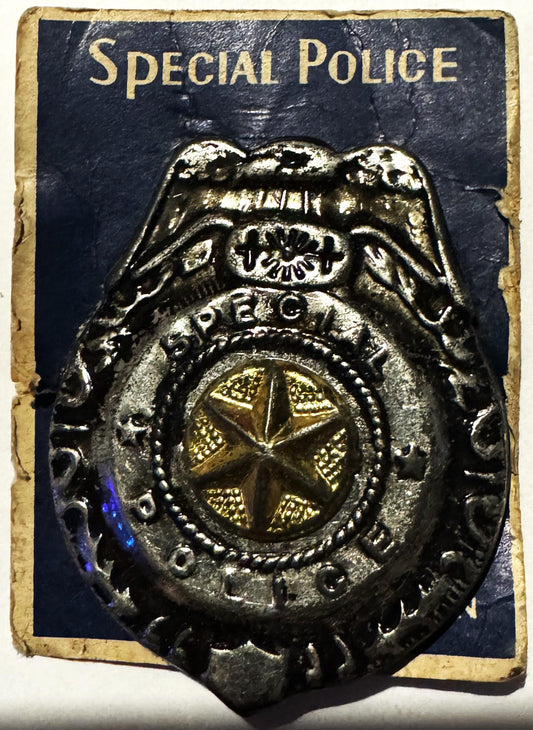
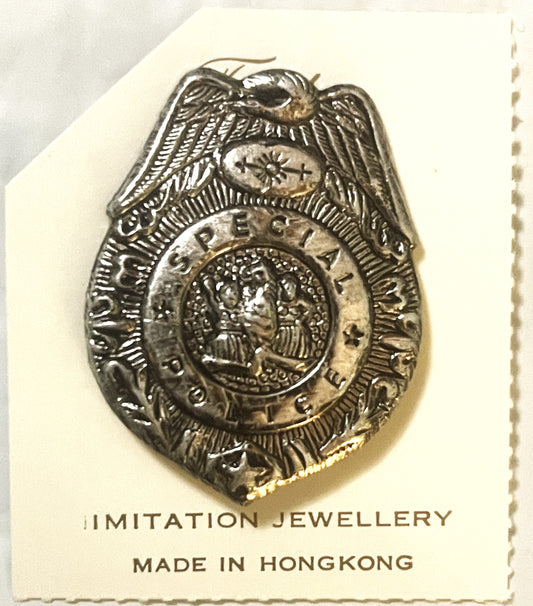
A bright stamped eagle, a Special Police shield, red, white and blue stars: at a glance this carded toy badge could pass for mid-century. The line that dates it is the smallest type on the card, printed in white along the blue band at the bottom: NOT RECOMMENDED FOR CHILDREN UNDER 8 YEARS OLD. Eight is the age the United States wrote into its toy-safety rules in the 1970s, and a pin-back badge carries a sharp point by design. This is a 1970s Japan-made toy badge, New Old Stock, still fastened to its card.


📏 Why Eight

The Consumer Product Safety Commission's use-and-abuse test rules, published in January and April 1975, sorted toys into age groups that topped out at 96 months: eight years old. On August 19, 1977 the Commission proposed technical tests for sharp points and sharp edges on toys intended for children younger than eight, and on December 15, 1977 it announced its sharp-point regulation, which applied to toys entering interstate commerce on or after December 22, 1978. The Commission's injury surveillance had counted an estimated 43,000 toy-related injuries to children under 8 treated in hospital emergency rooms in 1976, more than half of them lacerations and punctures. A badge is a sharp point you fasten to a shirt, and a warning drawn at exactly eight speaks the language of those rules.


🇯🇵 What the JAPAN Mark Does Not Settle

JAPAN appears twice: stamped into a tiny cartouche at the badge's bottom point and printed at the right end of the warning line. That mark alone dates nothing. In February 1947 the occupation headquarters ordered Japanese exports marked "Occupied Japan" or "Made in Occupied Japan," a 1949 directive allowed plain "Japan" where space was limited, and the Occupation ended on April 28, 1952. Plain JAPAN was legal before, during and after, so the age warning, not the country mark, is the clue that counts.


🦅 Reading the Badge and Its Card

The badge is stamped silver-tone metal with a bright finish. An eagle spreads across the top above a small oval holding a starburst between two crosses. A raised ring carries SPECIAL over the top and POLICE along the bottom, with a star at each side. Inside a twisted-rope border and a beaded field, the seal shows two robed women, one with an arm raised, flanking a horse's head that rises from a ribbon. Scrolled leaves run around the outer edge down to the JAPAN cartouche at the point.

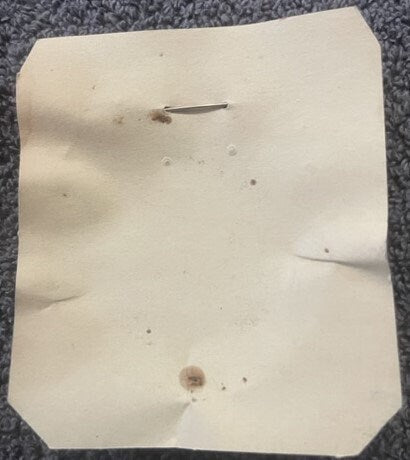
The card is printed in three bands. Across the red top band runs a header in white capitals, most of it hidden behind the eagle. The white middle band carries blue and red stars at the sides. The blue bottom band holds the age warning and the word JAPAN. The back of the card is plain cream paper with the badge's wire fastener showing near the top.


🏭 Japan's Toy Trade, From Tin Cans to the 1970s

Japan's postwar toy industry started with scrap. In 1945, after the surrender, toolmaker Matsuzo Kosuge built small models of the American Jeeps rolling into Japanese cities out of discarded food cans and beer cans from the occupation forces, and his Jeep was one of the first manufactured products of any kind to go on sale in Japan that year. Its success in department stores helped launch an export trade that became a prime source of Japan's economic recovery. Early Japanese tin toys were usually made from recycled American food cans, and by one account tins from Californian canned tomatoes were a particular favorite. In the tin toy trade's heyday, about 1952 to 1962, Japan made by one count 95 percent of the world's battery-operated toys. The big makers of the trade, among them Alps, Nomura, Marusan, Bandai and Yonezawa, turned out battery-operated and wind-up tin toys, robots and cars included. Much of the work was done by women: the parts for Japan's mechanical and battery toys were made mostly by women in factories and assembled there and at home. Japan's tin toys sold mostly through five-and-dime chains such as F. W. Woolworth, Grants, Ben Franklin, J. J. Newberry, G. C. Murphy and McCrory's. Japan stayed the world's largest toy exporter until 1972, when Hong Kong replaced it. A Japan-made toy badge from the 1970s comes from the later years of that trade, when Japanese makers were still stamping dime-store novelties for American children after Hong Kong had taken the lead.


👮 Special Police Was a Real Title

The words on the shield were borrowed from a real job. In Washington, D.C., special policemen guarded property before the Metropolitan Police force existed; the District issued rules for them on June 11, 1878, an Act of March 3, 1899 wrote their commissions into law, and many were posted at federal buildings and agencies. In San Francisco, California, the Patrol Special Police started in 1847, two years before the city had a police department: officers appointed by the Police Commission, paid for privately by the owners of their beats, wearing a silver-toned six-point star. The force shrank from about 250 officers to 18 by 1994, and the last Patrol Special retired on February 29, 2024. The badge on this card borrows the title. It is a toy.


🎖️ The Real Junior Programs Behind Badges Like This

Dime-store tin badges did not live in a vacuum. Sheriffs handed toy badges out as prizes in youth programs, and the AAA School Safety Patrol, begun in 1920, has put belts and badges on millions of schoolchildren who help their classmates cross the street. A carded Special Police badge in a child's hand came from that same world, where a badge from a trusted grown-up could make a kid stand a little straighter.


🖼️ Display Ideas

  • 🧲 Shadow box: keep the badge on its card in a deep frame beside a cap gun or toy handcuffs.
  • 🏪 Five-and-dime wall: pin the card to a pegboard with other carded novelties for a variety-store counter look.
  • 🖼️ Framed flat: the red, white and blue card holds up as a small piece of graphic art behind UV-protective glass.
  • 🦅 Toy badge collection: it dates itself by its warning line, a useful reference piece among undated carded badges.
  • 🎁 Gift: ready to give as it is, still on its card.

❓ Questions People Ask

Is this a real police badge or a toy?

A toy. It is a children's novelty badge stamped JAPAN, sold on a printed display card with an age warning, and it names no department, city or badge number.

How old is it?

The card's NOT RECOMMENDED FOR CHILDREN UNDER 8 YEARS OLD warning matches the under-eight age line in U.S. toy-safety rules of 1975 to 1978, which places it in the 1970s or later.

Why doesn't the JAPAN mark date it?

Plain "Japan" marks were allowed on exports during the 1945-1952 Occupation as well as after it, so the mark by itself does not separate an early piece from a late one.

Is it New Old Stock?

Yes. It is still fastened to its original card.

How big is it?

3 x 2.75 inches.

Who made it?

No maker's or importer's name appears on the badge or the card. Both carry only JAPAN.

What is shown in the center seal?

Two robed women, one with a raised arm, flanking a horse's head above a ribbon, inside a beaded field and a twisted-rope border.

Shipping

🚚 Shipping & Handling

  • Shipping costs and timing are calculated at checkout.
  • Items curated and shipped directly by me include U.S. shipping at no additional cost, professionally packed to ensure safe arrival of your artifact.

Items from Vetted Pro Collectors
Shipping for items offered by vetted Pro Collectors is determined at checkout. All Pro Collector listings are reviewed to ensure fair, reasonable shipping practices.

For full details, please refer to our Shipping Policy.

Returns & Exchange

Take your time — you've got a full six months. If a piece isn't right for you, send it back the way it reached you and we're good.

In the first 30 days your money goes straight back the way you paid. After that it's store credit, so you can put it toward something you'd rather have.

Return shipping we sort out between us, case by case. I don't make this difficult.

If something arrives damaged, or it isn't what I said it was, send me a photo within 48 hours and I'll make it right.

Email info@vintageantiquesgifts.com or call 802-356-9872 — that's me answering, not a call center.

The only things I can't take back are custom or special-order pieces and gift cards.

View full details

Preserving History: Authentic Objects Across Eras

— Curated by Travis Weigel