Skip to product information
1 of 3

Vintage and Antique Gifts

Vintage Sea Captain Tin Litho Clicker Toy NOS Japan Nautical Ship Wheel Noisemaker Mid-Century Token Toy 🧸

Vintage Sea Captain Tin Litho Clicker Toy NOS Japan Nautical Ship Wheel Noisemaker Mid-Century Token Toy 🧸

Regular price 11.00 USD
Regular price Sale price 11.00 USD
Sale Sold out
Shipping calculated at checkout.
Quantity

Still got that click in you, Captain? ⛵

There's a very particular sound that belongs to a certain kind of childhood — not a beep, not a buzz, but a sharp little metallic snap that meant something was about to happen. A quarter clutched in a sweaty palm, a rack of tin trinkets spinning by the register, and that unmistakable click-click that announced you'd found the good stuff. This little Sea Captain tin clicker is a survivor of exactly that world — a pocket-sized noisemaker that asked for nothing but a thumb and gave back a lifetime of grins.

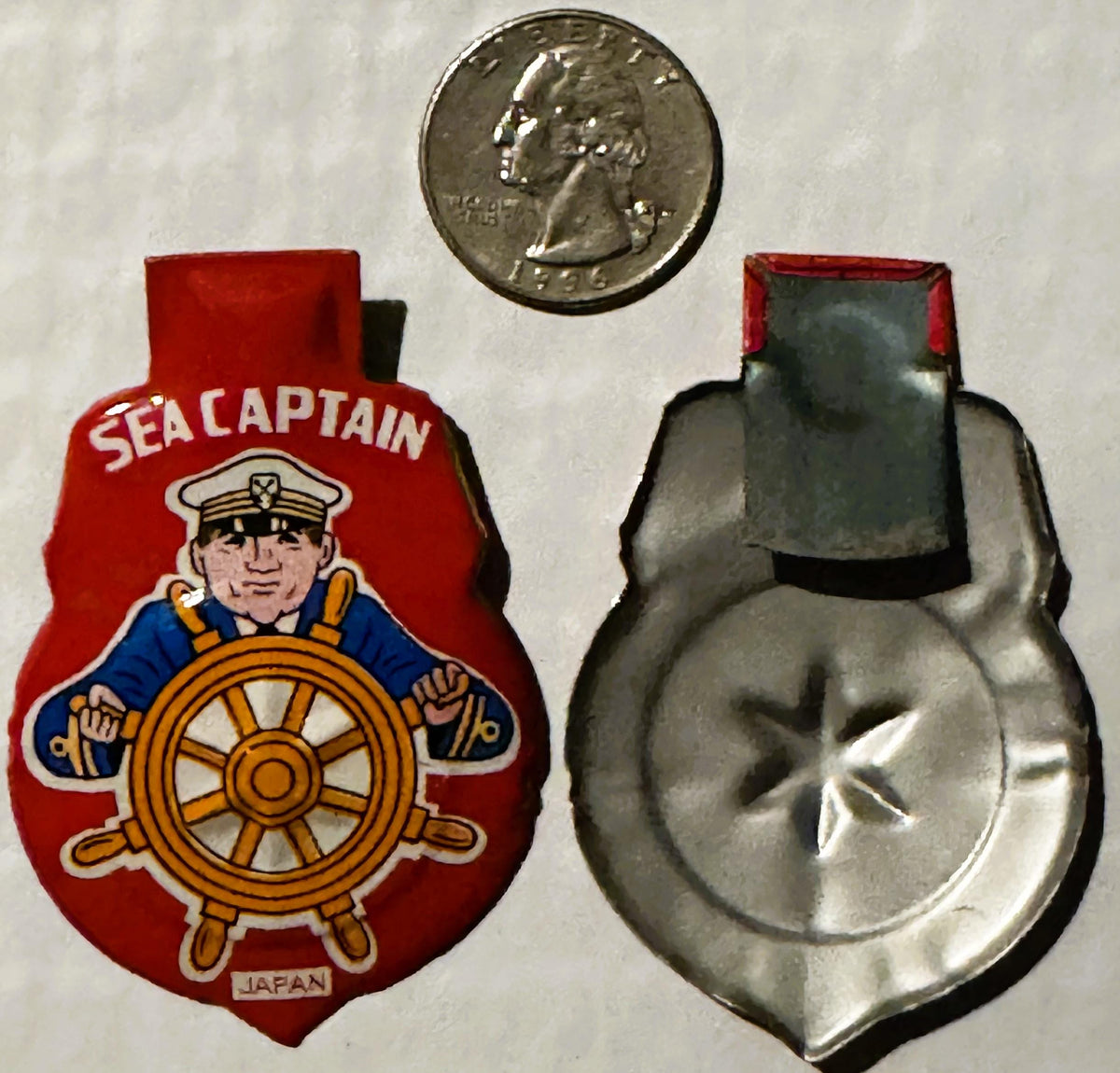
This is a lithographed tin clicker toy, marked simply "JAPAN," its bright surface printed in bold red, ocean blue, golden orange, crisp white, black, and flesh tones. Across the top, "SEA CAPTAIN" arcs in confident white lettering, and beneath it stands our man himself — cap squared away, brass buttons gleaming, hands planted firmly on the spokes of a ship's wheel as if he's just steadied the helm through rough water. The piece measures 2.5 inches by 1.75 inches — small enough to vanish into a coat pocket, which is exactly the point; these were made to travel with a kid, not sit on a shelf. This particular example survives as New Old Stock (NOS), never sold, never played with, a genuine time capsule of a design that once spun on a thousand five-and-dime counters. Press it, and it still delivers the sharp, satisfying snap it was built to make the day it left the factory.


⚓ The Age of the Tin Cricket

Long before "clicker" became the word every collector reaches for, these little noisemakers went by an older, folksier name: the tin cricket. The nickname wasn't poetic license — it described the sound almost perfectly, a metallic chirp produced by a thin strip of spring steel snapping back into place when a curved piece of tin was pressed and released. The mechanism is disarmingly simple, which is exactly why it endured for the better part of a century: no batteries, no gears, no moving parts to lose — just tension and release, over and over, for as long as a child's thumb could stand it.

The cricket clicker has a surprisingly serious pedigree for something that looks so playful. The same spring-lamella principle showed up in bandleaders' timing devices and referee signals well before it became a children's toy, and it took on a far more solemn job during the Second World War, when American paratroopers carried metal crickets into the dark of Normandy as a silent way to identify friend from foe — one click answered by two clicks in the blackness. By the time toys like this Sea Captain were being stamped out in Japan, the clicker had already lived several lives. It had only just settled into its most beloved role: pure, uncomplicated fun.

🇯🇵 Japan's Postwar Toy Miracle

To understand how a Sea Captain ended up clicking away in an American child's pocket, you have to go back to a Japan that had almost nothing left to work with. The war had leveled much of the country's manufacturing base, and the districts of Tokyo that had once hummed with toymakers' workshops had been deliberately targeted for their industrial value. What followed, though, is one of the great quiet comeback stories of the twentieth century. Within months of the surrender, toy production was already restarting on makeshift lines — first in Kyoto, then spreading outward — because toys, of all things, turned out to be one of the fastest paths back to solvency. Workshops famously flattened discarded tin cans left behind by occupying American troops and reshaped them into toy jeeps and novelties, selling them right back to the soldiers who'd thrown the cans away in the first place. It's a detail that sounds almost too good to be true, and yet it's one that's been passed down again and again by the people who lived through that era and by the collectors who've chased its artifacts ever since.

That improvisation opened a door. American soldiers stationed in Japan began buying up these cheerful, cheap tin novelties and shipping them home, and that early curiosity turned into formal export authorization. Within a few short years, Japan had built a genuine foothold in the American toy market, while other prewar toy powerhouses were still years from full recovery. A mark that simply reads "JAPAN" — like the one stamped on this clicker — places it in that window after the American occupation ended in the spring of 1952, when Japanese exports no longer had to carry the "Occupied Japan" stamp and could ship under their own name again. It's a small stamp, but it tells a big story: this little clicker belongs to the era when "Made in Japan" was becoming a phrase every American toy chest knew by heart, roughly the 1950s through the 1960s.

🏙️ The Workshops Behind the Wheel

Unlike the elaborate windup robots and tin automobiles of the same era — the kind proudly stamped with maker initials like "T.N." or "TPS" for collectors to trace back to a named company — a simple novelty like this Sea Captain clicker carries no such signature. That's not an oversight; it's exactly how the cheaper end of the tin toy trade worked. Crickets, clickers, spinning tops, and party favors like this one were turned out by countless small, unnamed workshops scattered through Japan's toymaking districts, workshops that rarely bothered to stamp anything beyond the bare minimum required for export — just "Japan," and nothing more. The finer, pricier tin toys of the age were often assembled by young Japanese women working in small, newly built factories, part of a labor force that had shifted from the countryside into the cities in the scramble to rebuild. The lowly clicker, cheap and disposable by design, was a humbler cousin to those prized windups — made fast, sold cheap, and rarely expected to survive the decade, let alone find its way into a collection seventy years later.

🎪 From Dime-Store Counter to Boardwalk Souvenir Stand

Picture the racks these clickers hung from: spinner cards dangling by the candy counter of a local five-and-dime, a shoebox of loose novelties at a seaside souvenir stand, a prize table at a carnival midway. A clicker like this Sea Captain wasn't bought with allowance saved for something special — it was an impulse, a nickel-and-dime pleasure, the kind of thing a kid grabbed on the way out the door because it was bright and loud and cost almost nothing. That's precisely why nautical designs like this one made such natural sense for the trade: seaside boardwalks and harbor-town gift shops needed cheerful, inexpensive souvenirs by the gross, and a grinning sea captain gripping his wheel was as universally understood a symbol of "the shore" as a lighthouse or a seashell. These toys were built for pockets, not display cases — slipped in alongside a jackknife or a stick of gum, pulled out to startle a sibling or punctuate a joke, clicked absentmindedly during a long car ride home from vacation.

⛵ Why a Sea Captain?

The imagery on this piece taps into one of the most enduring figures in American folk iconography — the weathered, capable ship's captain, cap set at a confident angle, hands locked on the wheel like he's just brought his vessel through a squall. It's the same archetype that graces seafood tins, fish house signs, and nautical trade cards to this day: a stand-in for reliability, adventure, and the romance of the open water, distilled into a single friendly face. For a coastal five-and-dime or a boardwalk gift shop, a captain at the wheel was shorthand the whole family understood at a glance — buy this, and you're bringing a little piece of the harbor home with you.

🌊 What Survives Today

Tin lithography was always meant to be temporary. These toys were pressed from thin tinplate, printed in bright, cheerful colors meant to catch a child's eye from three feet away, and built to be played hard and eventually discarded once the tin dulled, the click wore soft, or the next novelty caught someone's attention. That's exactly why a surviving example — especially one that never left the shelf at all — carries real weight for collectors today. Every Sea Captain clicker that got clicked to death on a playground, tossed in with the loose change at the bottom of a coat pocket, or simply thrown away when the household moved on, is one that isn't around anymore to tell its story. What remains offers a genuinely rare window into the artwork, humor, and postwar optimism of a trade that mostly vanished once tinplate gave way to plastic by the 1970s. This piece is a small, bright fragment of that vanished world, still capable of doing the one thing it was made to do.


🖼️ Display Ideas

  • ⛵ Set it alongside model ships, ship's wheels, or brass nautical instruments for an instant harbor-side vignette
  • 🐚 Tuck it into a shadow box with seashells, sea glass, and an old postcard from a coastal town
  • 🏖️ Perch it on a small stand in a beach-house kitchen or bathroom for a playful pop of vintage color
  • 🧰 Add it to a five-and-dime or dime-store novelty collection alongside other tin party favors and noisemakers
  • 📚 Rest it on a bookshelf or desk where its bright red lithography can stand out against wood or neutral tones
  • 🎁 Give it as a small, story-rich gift to anyone with a soft spot for the sea, old toys, or postwar Americana

🎁 Who Collects These

This little clicker sits comfortably at the crossroads of several collecting worlds, which is part of what makes it such fun to hunt down. Vintage tin toy collectors prize it as an accessible, affordable entry point into the same Japanese export story that produced the far pricier windup robots and cars of the era. Nautical and maritime decor collectors are drawn to the captain-at-the-wheel imagery, a natural fit alongside model ships and harbor memorabilia. Dime-store and five-and-dime nostalgia collectors seek out clickers, crickets, and party favors specifically because they capture a slice of everyday childhood commerce that's largely disappeared. And postwar history buffs — the ones fascinated by how quickly Japan rebuilt its economy on the back of humble goods like this — value pieces exactly like this one as tangible, pocket-sized artifacts of that remarkable recovery.


❓ FAQ

What exactly is a tin clicker or "cricket" toy?

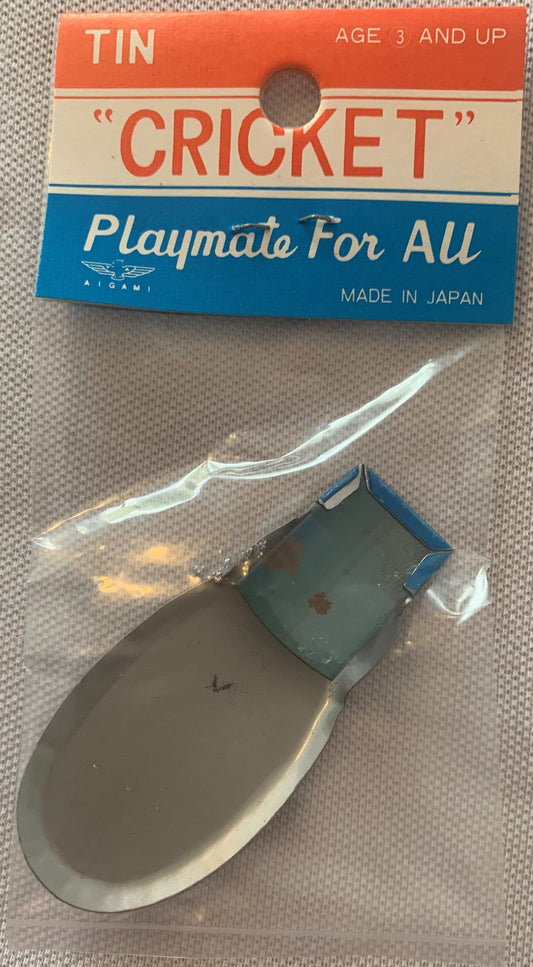
It's a simple noisemaker made from a curved piece of lithographed tin fitted with a strip of spring steel. Press the tin and release it, and the spring snaps back with a sharp click — no batteries, no winding, just tension and release.

How old is this Sea Captain clicker?

The "JAPAN" mark places it in the postwar export era, most consistent with the 1950s through the 1960s, the peak years when Japanese-made tin novelties flooded the American market.

Who manufactured it?

No maker's name survives beyond the "JAPAN" mark. Novelties at this level of the market were typically produced by small, unattributed workshops rather than the larger named toy companies whose windups and cars carried maker's initials.

What does "NOS" mean for a piece like this?

New Old Stock means this clicker was never sold or played with at the time — it's original, unused inventory from decades ago rather than a piece that saw years of pocket duty.

Does it still make noise?

Yes — press it and it still delivers the same sharp click it was designed to make when it first left the factory.

Is this purely a toy, or does it work as a display piece too?

Both. It was made as a child's noisemaker, but the bright lithography and nautical subject make it just as at home displayed among maritime decor or a tin toy collection as it would be clicked away in a pocket.

Why do collectors care so much about postwar Japanese tin toys?

They capture a pivotal, fast-moving chapter of industrial history — a nation rebuilding its economy through cheerful, inexpensive exports that quickly won over the American market, all while carrying artwork with a charm and character all their own.

Shipping

🚚 Shipping & Handling

  • Shipping costs and timing are calculated at checkout.
  • Items curated and shipped directly by me include U.S. shipping at no additional cost, professionally packed to ensure safe arrival of your artifact.

Items from Vetted Pro Collectors
Shipping for items offered by vetted Pro Collectors is determined at checkout. All Pro Collector listings are reviewed to ensure fair, reasonable shipping practices.

For full details, please refer to our Shipping Policy.

Returns & Exchange

Take your time — you've got a full six months. If a piece isn't right for you, send it back the way it reached you and we're good.

In the first 30 days your money goes straight back the way you paid. After that it's store credit, so you can put it toward something you'd rather have.

Return shipping we sort out between us, case by case. I don't make this difficult.

If something arrives damaged, or it isn't what I said it was, send me a photo within 48 hours and I'll make it right.

Email info@vintageantiquesgifts.com or call 802-356-9872 — that's me answering, not a call center.

The only things I can't take back are custom or special-order pieces and gift cards.

View full details
  • 5 stars: 0 (0%)
  • 4 stars: 0 (0%)
  • 3 stars: 0 (0%)
  • 2 stars: 0 (0%)
  • 1 star: 1 (100%)
2
2***a (44)

Never received it

You thought the best way to resolve the issue was to leave a one-star review and not message me? It has been four business days since you purchased the item, so you aren't even delayed. We are over 1500 miles apart. I guarantee your happiness 100%, but I can't do that without communication or response from you to my multiple attempts to reach out. Makes it hard to have a business relationship. No Soup for You!