Skip to product information
1 of 1

Vintage and Antique Gifts

Vintage Oldenberg Brewing Company Outrageous Bock Beer Label Fort Mitchell Kentucky Microbrewed Bock Beer Collector Label 1990s 🍺

Regular price 4.50 USD
Regular price Sale price 4.50 USD
Sale Sold out
Shipping calculated at checkout.

Description

Do You Remember When Fort Mitchell Had Its Own Brewery? 🐐 The Story Behind Oldenberg's Outrageous Bock

There's a particular kind of nostalgia that belongs entirely to the craft beer world of the early 1990s — a time before taprooms were on every corner, before "microbrewery" was a marketing buzzword, and before anyone had fully figured out what American craft beer was going to become. It was a time of genuine experiments, of passionate founders betting everything on the idea that local people deserved something better than the same nationally distributed lager their fathers had drunk. Somewhere in that beautiful, uncertain moment — right across the river from Cincinnati, tucked into the hills of Northern Kentucky — Oldenberg Brewing Company was doing something genuinely outrageous. And this label is a direct, tangible piece of that story.

🏷️ What You're Actually Holding

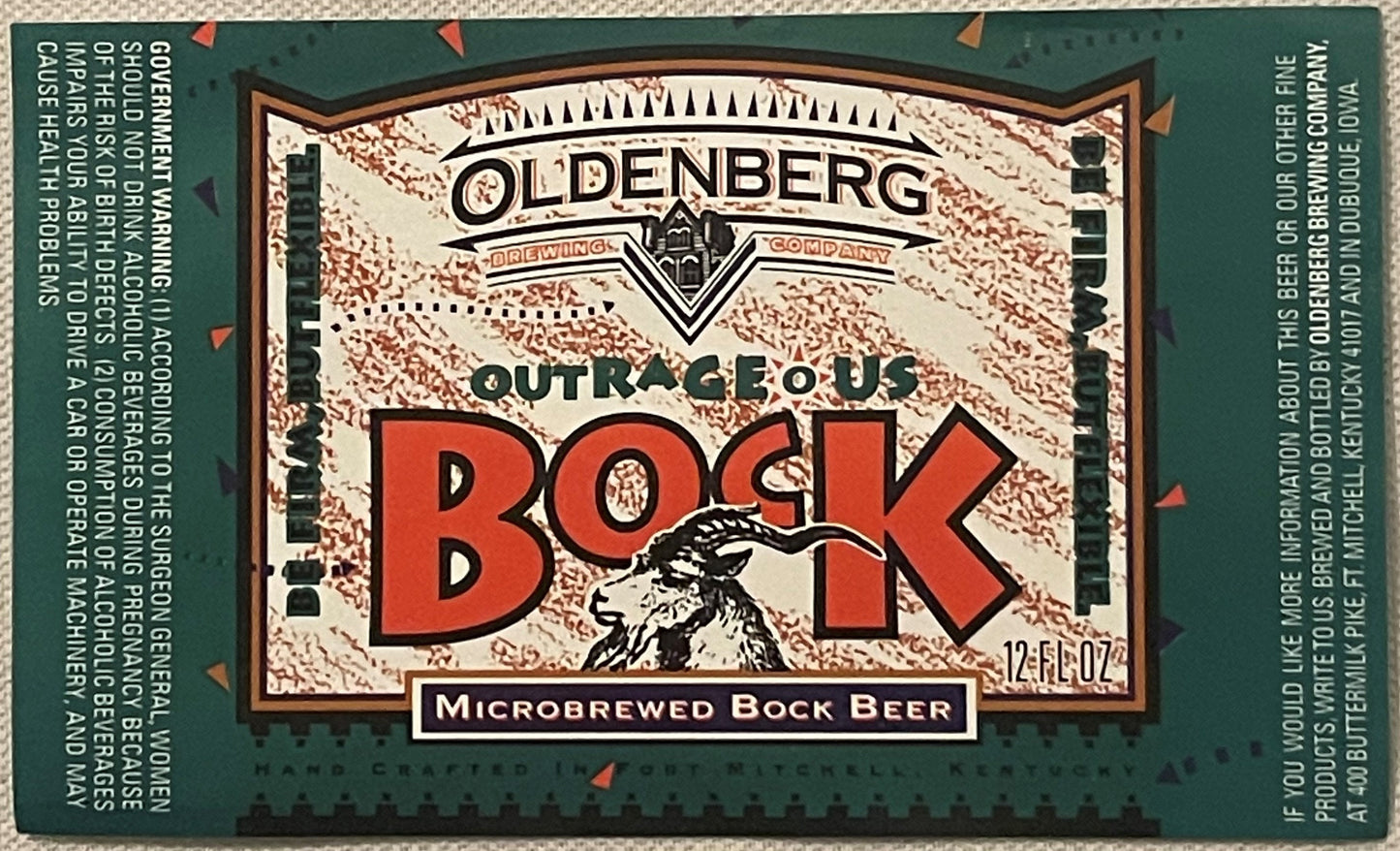
This is a New Old Stock (NOS) paper beer label for Oldenberg Brewing Company's Outrageous Bock — a microbrewed bock beer produced at Oldenberg's Fort Mitchell, Kentucky facility during the early-to-mid 1990s. "New Old Stock" means exactly what it sounds like: this label was printed, stored, and never applied to a bottle. It has been sitting somewhere cool and quiet since it left the print shop, and it shows. The front face carries a cream and sand-toned central panel framed in deep teal and brown, with the Oldenberg Brewing Company name arching across the top alongside their signature building logo mark. "Outrageous Bock" runs in two tiers — a smaller stacked word above, and then BOCK in massive, bold red lettering that dominates the center of the label. Tucked just inside the lower curve of that "O" in BOCK is a beautifully rendered goat's head — the traditional symbol of bock beer going back centuries — drawn in a slightly rustic, hand-illustrated style that suits a brewery that wore its craft credentials proudly. A banner along the bottom reads "Microbrewed Bock Beer," and "12 FL OZ" appears to the lower right within the cream panel. The whole composition is framed by geometric triangle accents in the teal field, giving it a confident, early-1990s craft aesthetic that feels both professionally designed and genuinely honest about what it was. This is a paper ephemera collectible from a specific moment in American brewing history — and in this condition, it does not come around often.


🏭 Oldenberg Brewing Company — Fort Mitchell, Kentucky's Unlikely Giant

Oldenberg Brewing Company opened its doors in September 1987 in Fort Mitchell, Kentucky, a suburban community sitting just five miles south of downtown Cincinnati in Kenton County. The timing was audacious. The American craft brewing revival was still in its infancy — Sierra Nevada had only been operating since 1980, the Boston Beer Company (Sam Adams) since 1984 — and the idea of opening a full-scale microbrewery in greater Cincinnati, a city with deep German-American brewing heritage but one whose major commercial breweries had been consolidating and closing for decades, was the kind of move that made bankers nervous and beer enthusiasts electric with curiosity.

What made Oldenberg unusual — and what made it legendary in the region — was the sheer ambition of the concept. This was not a humble garage operation. Oldenberg was designed from the beginning as a destination brewery, anchored to a sprawling entertainment and hospitality complex that included a restaurant, a large events venue, and most famously, what was promoted at the time as the World's Largest Collection of Beer Memorabilia — an enormous, museum-quality assembly of vintage beer cans, trays, taps, signs, labels, steins, and advertising artifacts that drew collectors and curious visitors from across the region. Lore passed down among breweriana collectors holds that the memorabilia collection numbered in the tens of thousands of individual pieces, and that serious collectors made pilgrimages to Fort Mitchell specifically to see it — sometimes having to be gently reminded that the brewery also made beer worth drinking. Local legend has it that the collection was so expansive and so seriously curated that regional antique dealers would quietly route their best beer-related finds toward Oldenberg's buyers before putting them on the open market, knowing they'd find a proper home there.

The brewery itself produced a range of styles that took the German lager tradition seriously — a sensible homage given the heavy German-immigrant heritage of both the Cincinnati and Northern Kentucky communities. Bock beer, of course, has deep roots in that tradition. Strong, malty, historically brewed by Bavarian monks as a seasonal sustenance during fasting periods, bock beer carried centuries of European brewing culture in its glass. Oldenberg's decision to call their version "Outrageous Bock" was a perfect expression of the early craft beer era's personality: one foot planted firmly in the old world, the other kicking enthusiastically into something new and American and unapologetic about being both at once.


📍 Fort Mitchell, Kentucky — The Cincinnati Region's Brewing Backyard

Fort Mitchell doesn't always get the credit it deserves when people trace the geography of American craft brewing history, but it earns its place in that story. Located in Kenton County — part of the larger constellation of Northern Kentucky communities that sit just across the Ohio River from Cincinnati — Fort Mitchell in the late 1980s and early 1990s was a comfortable, established suburban community that wouldn't have seemed, on paper, like the natural birthplace of a nationally recognized microbrewery. And yet.

The Cincinnati-Northern Kentucky metro area has one of the deepest German-American brewing histories in the entire country. Throughout the 19th and early 20th centuries, Cincinnati was a genuine rival to Milwaukee and St. Louis as a brewing powerhouse — a city whose Over-the-Rhine neighborhood was so saturated with German immigrants, beer gardens, and working lager cellars that it earned comparisons to Munich. That heritage didn't vanish when Prohibition shuttered the breweries and postwar consolidation finished off many of the survivors. It went underground, survived in family recipes, in neighborhood pride, in the particular way people in that region talked about what beer was supposed to taste like. When the craft brewing revival offered a path back to something locally rooted and honestly made, communities across the Greater Cincinnati area were primed to respond. Oldenberg, sited just across the river in Fort Mitchell, was positioned perfectly to absorb and reflect that heritage while also building something forward-looking and new.

Local collectors from the Kenton County and Campbell County areas still speak about the Oldenberg complex with the warmth reserved for places that shaped a decade. Stories circulate — passed down at bottle shows and antique malls — about the Friday nights at Oldenberg, the weekend tours, the big events and festivals the brewery hosted that drew thousands. It was, by multiple accounts, genuinely the kind of place that made people proud their region had it.


🍺 The Craft Beer Revolution — What This Label Represents

To fully appreciate what this Outrageous Bock label means as a collectible, it helps to understand how extraordinary the early American craft brewing scene actually was in historical terms. By 1990, the number of operating breweries in the United States had fallen from a pre-Prohibition high of over 1,300 to fewer than 100 — an almost complete erasure of regional brewing diversity that had taken less than a century to accomplish. The craft brewing revival was, in the truest sense of the word, a restoration movement. Breweries like Oldenberg weren't just making beer; they were rebuilding something that had been taken away.

The labels from this era carry that weight. They were designed not merely to identify a product but to communicate an identity — to say, loudly and clearly, we are here, we are local, we are serious, and we are proud. Look at the Outrageous Bock label's design choices: the hand-illustrated goat's head evoking centuries of bock beer tradition, the bold architectural confidence of that red BOCK lettering, the building logo that ties the beer directly to a specific place, the "Microbrewed" banner worn like a declaration rather than a disclaimer. This is a label that knows exactly what it is and where it comes from. In an era before every grocery store had a craft beer aisle, before "local" was a marketing category, that was a genuinely radical posture.

Ephemera from first-generation American craft breweries — particularly from smaller regional operations that have since closed or been absorbed — has become an increasingly respected area of breweriana collecting. A label that never touched a bottle, never sat in a recycling bin, never got wet — a label that simply waited — represents the cleanest possible artifact from that moment in time.


🐐 The Goat, the Bock, and a Symbol Older Than Most Nations

That small, beautifully rendered goat's head tucked inside the "O" of BOCK is doing more work than it might appear to do at first glance. The association between bock beer and the goat stretches back to medieval Germany — specifically, according to brewing lore, to the town of Einbeck in Lower Saxony, where a strong lager style was developed that eventually made its way to Munich, where Bavarian brewers mispronounced "Einbeck" as "ein Bock" — meaning, simply, "a billy goat." Whether or not that etymology is entirely accurate (brewing historians debate it with the particular enthusiasm reserved for questions that can never be fully resolved), the goat became the enduring symbol of bock beer, appearing on labels, tap handles, steins, and brewery logos across centuries and continents. When Oldenberg's label designers placed that illustrated goat's head inside the letter O, they were participating in one of the longest-running visual traditions in all of commercial brewing. On a label that says "Outrageous Bock" in 1990s Fort Mitchell, Kentucky — that's a lovely thing.


🖼️ Display Ideas

  • 🖼️ Matted and framed — the label's 5 x 3 inch format fits beautifully in a standard 4x6 or 5x7 mat opening; pair with deep teal or kraft-paper matting to echo the label's own color palette and give it gallery-worthy presence on any wall.
  • 🍺 Breweriana shadow box — combine with other Oldenberg pieces, vintage Cincinnati-area beer cans or bottle caps, and a small topographic or road map of Northern Kentucky for a compelling regional brewing history display.
  • 📚 Ephemera collection binder or album — NOS labels in this condition are ideal for archival-sleeve storage in a dedicated breweriana or paper ephemera collection, where they can be appreciated without handling risk.
  • 🐐 Bock beer themed display — the goat imagery makes this a natural centerpiece for a collection built around bock beer labels and memorabilia from multiple eras and breweries, letting the centuries-long visual tradition tell its own story across a single display.
  • 🏙️ Greater Cincinnati / Northern Kentucky regional pride wall — pair with maps, postcards, photographs, and other ephemera from the Fort Mitchell, Covington, or Newport areas for a deeply local display that honors the region's identity.
  • 🎨 Craft beer graphic design study — the Outrageous Bock label is a strong example of early-1990s American craft brewery visual identity; displayed alongside other labels from the era, it becomes part of a compelling graphic design history collection.

🎁 Who Collects These

The collector community that gravitates toward a piece like this Oldenberg Outrageous Bock label is broader and more varied than you might expect, and it's genuinely growing. Breweriana collectors — those who specialize in beer-related ephemera, advertising, and packaging — are the most natural audience. Within that world, first-generation American craft brewery material has been gaining consistent recognition as a historically important and increasingly scarce collecting category. Labels from defunct or significantly changed small breweries in NOS condition are among the most desirable finds at breweriana shows and in specialist dealer inventories.

Greater Cincinnati and Northern Kentucky regional collectors are another strong group. The Oldenberg brand carries genuine local resonance — it's the kind of place people remember viscerally, the kind of brewery that shows up in "whatever happened to..." conversations at family gatherings. For collectors with roots in Kenton County, Campbell County, Hamilton County, or the broader tristate area, an Oldenberg label is a piece of home.

Paper ephemera and graphic design collectors find early craft beer labels compelling as artifacts of a specific visual moment — the era when small American producers were developing independent design languages without large agency budgets, producing work that was sometimes rough but often brilliantly honest. Bock beer enthusiasts and homebrewers with an interest in the history of the style appreciate the goat imagery and the lineage it represents. And gift givers looking for something genuinely personal for the beer lover, the history buff, the Cincinnati expat, or the vintage graphic arts enthusiast in their lives will find this label does exactly what the best vintage gifts do — it tells a real story, and it tells it beautifully.


❓ Frequently Asked Questions

What does "New Old Stock" mean for this label, and why does it matter?

New Old Stock — abbreviated NOS in collector shorthand — means this label was manufactured and stored but never used for its original commercial purpose. In the case of a paper beer label, it was never applied to a bottle, never ran through a bottling line, and never entered the commercial distribution chain in applied form. It has simply been kept somewhere since its production in the early-to-mid 1990s. For paper ephemera collectors, NOS condition is the gold standard because paper is genuinely fragile over time — vulnerable to moisture, light, adhesive migration, tearing, and the routine damage that comes from actual use. A label in NOS condition from a brewery that has been closed or significantly changed for decades is a meaningful rarity. This particular label is described as clean, bright, and crisp with little to no wear — language that reflects exactly the kind of preservation NOS condition makes possible.

Is this label from a brewery that is still operating?

Oldenberg Brewing Company had a complex trajectory after its celebrated early years. The brewing operation and the broader entertainment complex went through significant changes during the 1990s, and the brewery as it was originally conceived — the destination complex with its massive memorabilia collection, restaurant, and event venue — no longer exists in that form. That history is precisely what makes early Oldenberg labels collectible: they represent a specific, documented moment in American craft brewing history that is now behind us. The label you're acquiring is from that original era of operation.

How should I store or display this label to protect it long-term?

For long-term storage, archival-quality polyester or polypropylene sleeves (often sold for trading card or paper ephemera storage) are ideal — they're acid-free, won't off-gas, and allow you to handle the sleeve rather than the label itself. Keep stored labels away from direct light, humidity, and temperature extremes. For display, UV-filtering glazing in a frame will protect against light fading significantly better than standard glass. Many collectors mat and frame NOS labels without ever applying any adhesive to the label itself, using small conservation corners or a mat opening sized to hold the label in place by its edges — this keeps the piece fully reversible and preserves its collector value.

What is the significance of the goat image on this label?

The goat — specifically the billy goat or bock — is one of the oldest and most consistent symbols in all of commercial brewing iconography, tied directly to the bock beer style. The traditional explanation traces back to the German town of Einbeck and the linguistic evolution of "Einbeck" into "ein Bock" (a billy goat) in Bavarian pronunciation, a folk etymology that stuck with remarkable persistence across centuries. German and later American bock beer labels, tap handles, and brewery signage have incorporated goat imagery consistently for well over 150 years. The goat's head rendered inside the "O" of BOCK on this Oldenberg label is Oldenberg's designers participating consciously in that tradition — connecting a 1990s Fort Mitchell, Kentucky microbrewery to a lineage that stretches back to medieval Bavarian brewing culture. For collectors interested in the iconographic history of brewing, that's a genuinely interesting detail.

Is this label valuable as a collectible investment?

First-generation American craft brewery ephemera — particularly from breweries that are no longer operating in their original form — has been a quietly appreciating area of the breweriana market for several years. NOS labels in clean condition from this era are scarcer than their relatively recent production dates might suggest, because most labels from working breweries were consumed in the bottling process. Oldenberg specifically has regional significance in the Northern Kentucky and Greater Cincinnati collector community that adds a layer of local demand beyond the general breweriana market. As with all paper ephemera, condition is the primary driver of value, and this label's described state — clean, bright, crisp, little to no wear — places it at the top of the condition range for this type of piece. Bottle shows in the Greater Cincinnati and Northern Kentucky region, regional antique malls, and specialist online breweriana dealers are the most productive hunting grounds. Given Oldenberg's well-documented emphasis on beer memorabilia collecting as part of its own identity, it's a pleasantly appropriate irony that Oldenberg's own material has become the thing collectors now seek out. Lore among Northern Kentucky antique dealers holds that the best Oldenberg pieces tend to surface in the tristate area first — around Cincinnati, Covington, and Lexington — before working their way into wider collector circulation.

What makes early 1990s craft beer label design distinctive, and why does it hold collector appeal?

Early American craft brewery labels occupy a very specific and unrepeatable visual moment. They were created by small teams — sometimes a single designer, sometimes the brewery owner working with a local print shop — without the significant budgets or brand strategy infrastructure that characterizes contemporary craft brewery design. What they often had instead was genuine conviction, direct connection to the brewery's actual identity, and a willingness to borrow freely from both historical brewing traditions and whatever design vocabulary felt right for the moment. The Outrageous Bock label is a strong example: hand-illustrated goat imagery nodding to centuries of bock beer tradition, bold typography with real graphic confidence, a color palette — teal, cream, brown, red — that is immediately of its era without feeling dated in a negative sense. These labels weren't designed to look vintage; they simply are vintage now, and the honesty of that is part of their appeal. They document a real moment in American cultural and commercial history that was genuinely important, and they do it with the directness that only ephemera can manage.

Shipping

🚚 Shipping & Handling

  • Shipping costs and timing are calculated at checkout.
  • Items curated and shipped directly by me include U.S. shipping at no additional cost, professionally packed to ensure safe arrival of your artifact.

Items from Vetted Pro Collectors
Shipping for items offered by vetted Pro Collectors is determined at checkout. All Pro Collector listings are reviewed to ensure fair, reasonable shipping practices.

For full details, please refer to our Shipping Policy.

Returns & Exchange

Product Page Return Policy

  • 60-Day Returns – Items must be in original condition.
  • Refunds – Issued after inspection (excluding shipping costs).
  • Return Shipping – Customer is responsible unless item is damaged or incorrect.
  • Damaged/Incorrect Items – Contact us within 48 hours for a replacement or refund.
  • Easy Returns – Email [email protected] or call 802-356-9872 to initiate a return.

For full details, visit our Refund Policy.

View full details