Skip to product information
1 of 3

Vintage and Antique Gifts

Vintage Jerry Brand Crate Label 🐕 — 1950s T.O. Tomasello Co. Watsonville California Produce, Boy & Fox Terrier Dog

Vintage Jerry Brand Crate Label 🐕 — 1950s T.O. Tomasello Co. Watsonville California Produce, Boy & Fox Terrier Dog

Regular price $8.00 USD
Regular price Sale price $8.00 USD
Sale Sold out
Shipping calculated at checkout.

Size: 9 1/2" x 7"

🚚 Free US Shipping — ships within one business day. International shipping calculated at checkout.

Quantity

Who Was Jerry? 🐕 Vintage 1950s Crate Label, T.O. Tomasello Co., Watsonville California

Size: 9 1/2" x 7"

A laughing boy, a wire fox terrier, and one of the last paper labels a Watsonville farm family put on its produce boxes before cardboard cartons ended the trade.

This is the Jerry Brand label of the T.O. Tomasello Co., packed and shipped from its main office in Watsonville, California, in the 1950s. It measures 9 1/2" x 7" ~ and was never pasted on a box.

The Label

A circle of pale blue sky at the top holds a grinning, rosy-cheeked boy in a white sailor collar striped with red, pressed cheek to cheek with a scruffy wire fox terrier whose tongue is out. Beneath them JERRY stands in fat gold three-dimensional block letters, with BRAND in red. PRODUCE OF U.S.A. is lettered in pale blue at the upper right. At the bottom, ribbon banners read "Packed and Shipped by T.O. Tomasello Co., Main Office, Watsonville, Calif.," beside a red-and-yellow shield bearing the letters T and T. Everything sits on a deep navy ground.

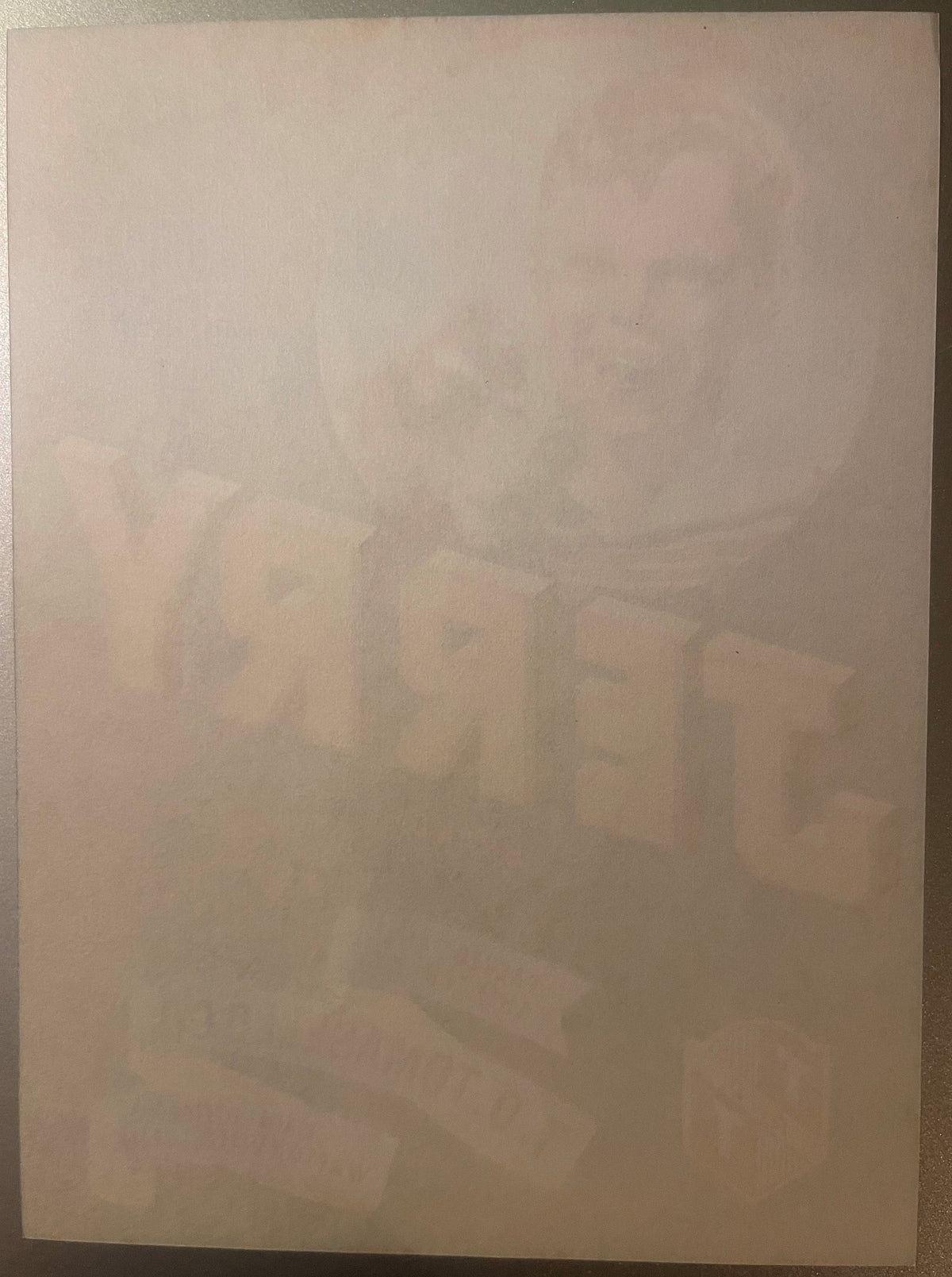
The back is blank, with the front showing through the paper in mirror image: JERRY reads backwards and the boy's face and the banners can be made out in the sheet. There is minor corner wear, which shows from the back rather than the front.

The label names no crop. Other Tomasello labels were made for tomatoes and vegetables, while Jerry promised only American produce and a boy with his dog.

How Old It Is

This is a 1950s label, from the final decade of the paper crate label.

The Tomasellos of Watsonville

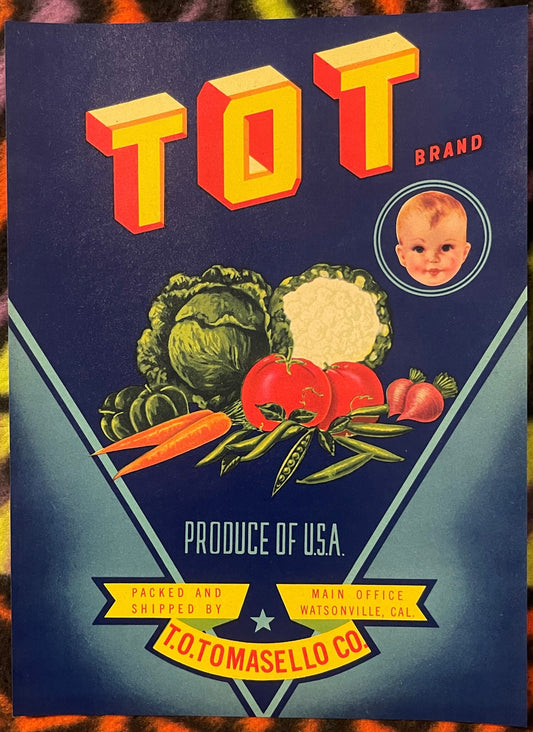
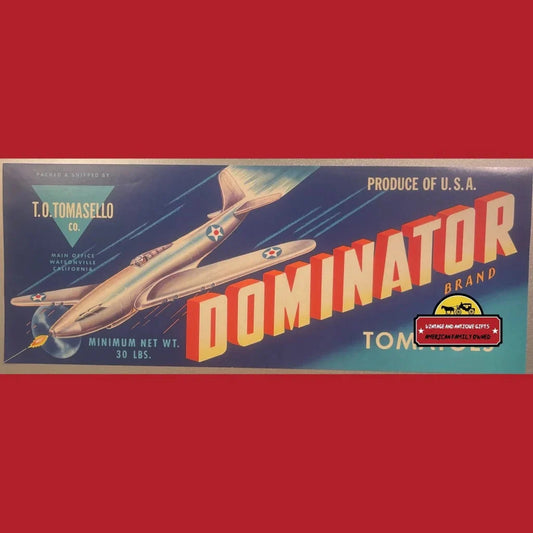
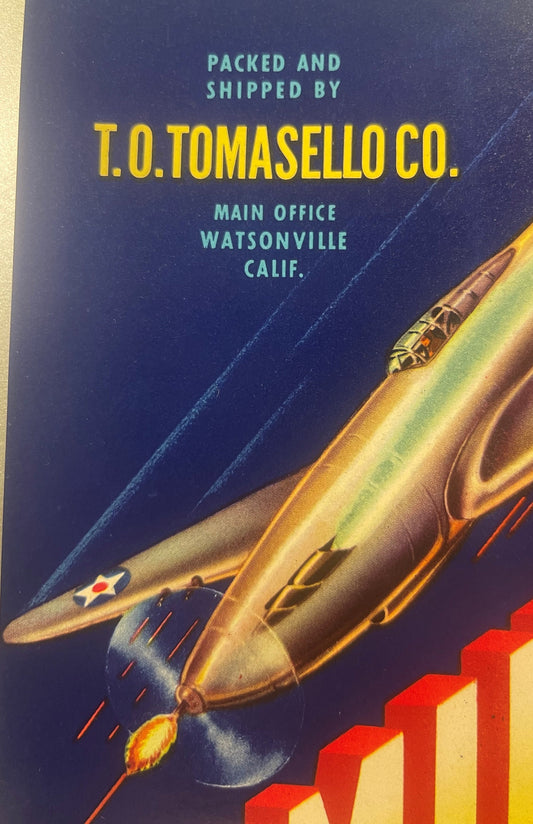
"Packed and shipped by" is the signature of a grower-shipper, a Pajaro Valley firm that raised a crop, graded and packed it in its own sheds, and sent it to market under its own brands. T.O. Tomasello Co. ran a whole family of them: Jerry, the fighter-plane Dominator, the bold Tri-X and TOT.

The family's own story runs through the valley's farm institutions. The Tomasellos were a Watsonville farm family of Italian heritage. Joseph J. Tomasello was born in Watsonville on December 8, 1935, the son of Antonio Tomasello and Mary Crosetti Tomasello. He went to Bellarmine College Prep and Santa Clara University, married Lori Triolo in 1959, served in the Army from 1960 to 1962, and then worked in the family farming business for forty years. He sat on the board of the Western Growers' Association and was president of the Salinas Valley Grower-Shipper Association in 1972 and 1973.

The Wire Fox Terrier

The wire fox terrier was developed in England by fox-hunting enthusiasts and was not a popular family pet until a wire fox terrier named Skippy played Asta, the scene-stealing dog of Nick and Nora Charles, in The Thin Man in 1934. Skippy went on to After the Thin Man, The Awful Truth and Bringing Up Baby, the breed's popularity soared, and a brand of canned dog food was named Skippy after him and carried his likeness on its own label for years. Hollywood lore, from Myrna Loy herself, has it that he once bit her during filming, and his trainers, Henry and Gale Henry East with Frank Weatherwax, kept the actors from playing with him between takes so he would stay on task.

The same breed was already a star across the Atlantic. Snowy, Tintin's faithful companion, first appeared in 1929 in Tintin in the Land of the Soviets. Hergé named him Milou, the nickname of his first girlfriend, Marie-Louise Van Cutsem, whose father disapproved of the young artist; the English translators chose Snowy partly because it fit in the speech balloons. Albert Einstein kept a wire fox terrier named Chico, Thomas Hardy one named Wessex, Rudyard Kipling one named Vicki, and King Edward VII one named Caesar. By 2019 the breed had won Best in Show at Westminster fifteen times, more than any other.

The Pajaro Valley When Jerry Was Printed

Watsonville had been Apple City at the start of the century, with a million trees on 14,000 acres by 1908. By the time this label was printed, berries and row crops were taking over. Driscoll's, founded in Watsonville in 1904 by Dick Driscoll and Ed Reiter as the Banner Berry Farm's Brand, named its first great strawberry the Banner for the big berry printed on the banner of every crate. In 1944 the Strawberry Institute of California was formed, and a variety its breeders crossed in 1946 was released in 1957 after ten years of work, better for shipping and later in the season.

The people who picked those crops changed with the war. Japanese families of the Pajaro Valley were sent to internment camps in 1942, and that same year the Bracero Program began bringing Mexican farm workers north on contract. By its end in 1964 it had issued 4.6 million contracts in 24 states, the largest guest worker program in United States history, promising a minimum of 30 cents an hour, decent housing and food. Its end came as the United Farm Workers rose under César Chávez, and the fight over farm wages that followed changed California agriculture for good.

The Last Decade of the Paper Label

Paper labels on produce boxes started on the West Coast in the 1880s, when growers began shipping east on the transcontinental railroads and needed their brands to stand out in markets a continent away. Printers used stone lithography until 1920 and offset presses after. World War II drained the crate makers' workforce and the printers' metal, and cheaper cardboard cartons with the brand printed straight onto the box replaced the wooden crate and its pasted label. By the end of the 1950s the trade was over, and what survives is the unused stock, like this Jerry.

Museums and libraries now keep whole collections of these labels, and collectors seek them out to preserve the history of the farms and families that printed them.

Questions People Ask

Who packed Jerry Brand produce?

T.O. Tomasello Co., the Watsonville grower-shipper named on the ribbon banners.

When was the Jerry label printed?

In the 1950s.

What kind of dog is on the Jerry label?

A wire fox terrier, the breed made famous by Asta in The Thin Man and by Tintin's Snowy.

What size is it?

9 1/2" x 7" ~

Has it been used?

No, it is unused. Minor corner wear shows from the back.

Where is Watsonville?

In the Pajaro Valley of Santa Cruz County, California, just inland from Monterey Bay.

Shipping

🚚 Shipping & Handling

  • Shipping costs and timing are calculated at checkout.
  • Items curated and shipped directly by me include U.S. shipping at no additional cost, professionally packed to ensure safe arrival of your artifact.

Items from Vetted Pro Collectors
Shipping for items offered by vetted Pro Collectors is determined at checkout. All Pro Collector listings are reviewed to ensure fair, reasonable shipping practices.

For full details, please refer to our Shipping Policy.

Returns & Exchange

Take your time — you've got a full six months. If a piece isn't right for you, send it back the way it reached you and we're good.

In the first 30 days your money goes straight back the way you paid. After that it's store credit, so you can put it toward something you'd rather have.

Return shipping we sort out between us, case by case. I don't make this difficult.

If something arrives damaged, or it isn't what I said it was, send me a photo within 48 hours and I'll make it right.

Email info@vintageantiquesgifts.com or call 802-356-9872 — that's me answering, not a call center.

The only things I can't take back are custom or special-order pieces and gift cards.

View full details

Preserving History: Authentic Objects Across Eras

— Curated by Travis Weigel