Skip to product information
1 of 3

Vintage and Antique Gifts

Vintage 1950s Liberty Bell Brand 🔔 Crate Label C. & A. Emerzian Growers Fresno & Modesto California Grapes

Vintage 1950s Liberty Bell Brand 🔔 Crate Label C. & A. Emerzian Growers Fresno & Modesto California Grapes

Regular price $7.00 USD
Regular price Sale price $7.00 USD
Sale Sold out
Shipping calculated at checkout.

Size: 13" x 5"

🚚 Free US Shipping — ships within one business day. International shipping calculated at checkout.

Quantity

Who Packed Liberty Bell Brand Grapes? 🔔 The Liberty Bell on a Grape Lug, and a Grower Name Already in the Courts by 1926

Size: 13" x 5"

A cracked bronze Liberty Bell hangs dead center on a deep navy field, the words LIBERTY and BELL in tall cream capitals outlined in red on either side. This is a 1950s grape lug label for LIBERTY BELL BRAND, printed for the growers and shippers C. & A. Emerzian of Fresno and Modesto, California — the long, low kind of label made for the end of a shallow wooden grape lug, the box that carried California table and wine grapes to market by rail.

The Emerzian name was in the California grape trade long before this label. A 1926 opinion of the California District Court of Appeal, R. Krasnow & Sons, Inc. v. C. Emerzian, describes a C. Emerzian and an A. G. Emerzian "engaged in the business of growing grapes of many varieties in what is designated as the 'Modesto District,' near the town of Sexton, Stanislaus County." On May 10, 1922, in the third year of Prohibition, C. Emerzian went to the Fresno main office of R. Krasnow & Sons about grapes then growing on the Sexton farm. The varieties in that deal read like a roll call of the Prohibition vineyard: Muscats, Carignane (the court spelled it "Carrigans"), Alicantes, Zinfandels, Tokays and Black Prince. Same surname, same two initials, same trade, and the same Fresno-to-Modesto run printed on this sheet.

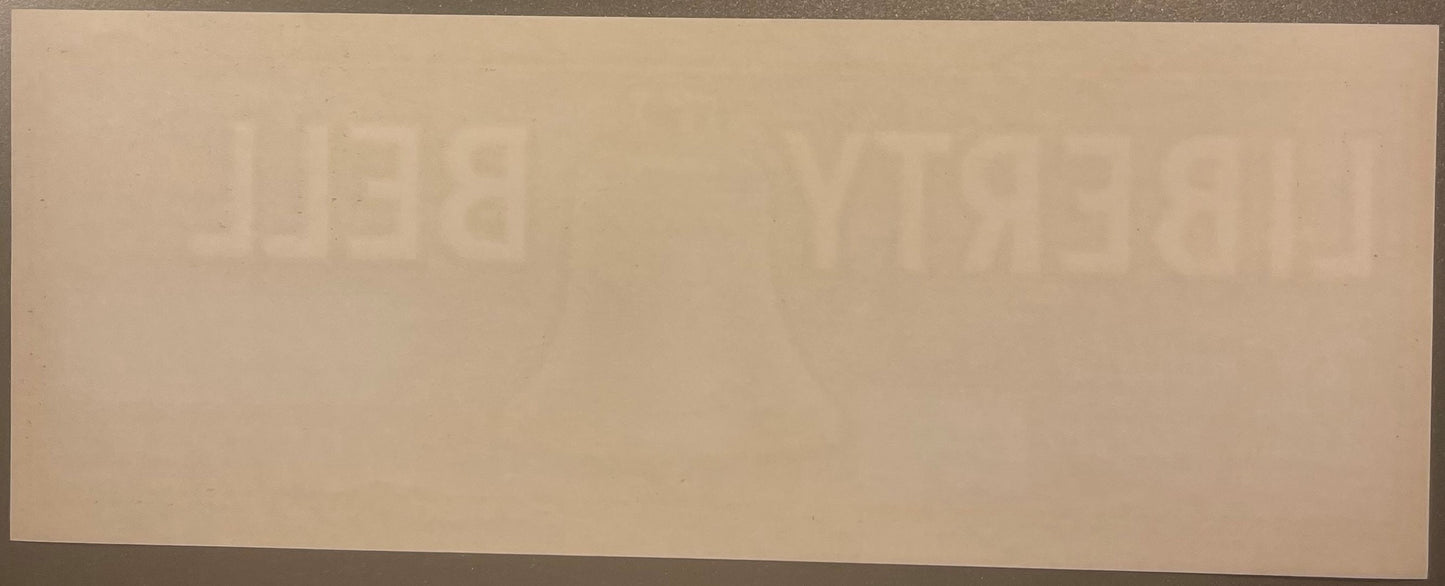
This is an unused label, never pasted to a crate. The back is plain cream paper, with the front printing faintly showing through.


📋 What Is Printed On This Label

  • LIBERTY BELL
  • BRAND
  • PRODUCE OF U. S. A.
  • C. & A. EMERZIAN
  • GROWERS & SHIPPERS
  • FRESNO AND MODESTO,
  • CALIFORNIA.
  • TRADE MARK REG.
  • GRAPES

A single line of tiny printer's credit runs along the red border rule at the lower right.

🎨 Reading the Artwork

The bell is drawn with its own lettering. Across the shoulder band the artist set a condensed version of the real bell's inscription — you can pick out "THEREOF LEV." and "STATE HOUSE IN PHILADA" — and on the waist sits the founders' line, "PASS AND STO[W]," "PHILADA," with a Roman-numeral year beneath it. The famous crack is drawn running down from that line toward the lip.

Two light-blue panels are left blank. One sits just to the right of the grower's name, a larger scalloped one sits above the word GRAPES. The sheet names no variety at all — only GRAPES — so one label could go on any lug the grower packed, whether Tokays for the table or Zinfandels for a home winemaker's cellar.

TRADE MARK REG. is printed in red beside the bell: the shipper's claim that LIBERTY BELL was a registered brand, not just a picture. PRODUCE OF U.S.A. sits in light blue at the upper right.

The colors are navy, red, cream, bronze and a bright sky blue — a red, white and blue label built around the most American object there is. Crate label collectors often say that a patriotic brand like this one was rarely an accident. Families who grew up around the packing houses tell how competitive the label game was: a striking brand could sway what a buyer paid per lug, and growers with strong brands were known in markets from Los Angeles to Boston.


🍇 Prohibition Changed What California Grew

The grapes named in that 1922 contract were not an accident of taste. When national Prohibition began in 1920, commercial wine became illegal, but households could still make wine at home; an IRS ruling allowed a household up to 200 gallons a year. Grapes that could stand a cross-country rail trip were suddenly worth planting, and California growers planted them.

Alicante Bouschet, first cultivated in France in 1866 by Henri Bouschet as a cross of Petit Bouschet and Grenache, became the grape of the moment. It is a teinturier — its flesh is red, not clear — and its thick skin let it survive the long rail trip from California to New York's Pennsylvania Station. Its pulp was so fleshy and juicy that fermentable juice could still be pressed from it a third time, and its deep color meant a wine could be stretched without looking thin. In 1928 a single buyer took one auction lot of 225 carloads of grapes, enough for more than two million gallons of wine.

A grower in the Modesto District with Alicantes on the vine in 1922 was standing squarely in the middle of that boom. The Emerzians also used a Liberty Bell label printed for Alicante grapes, cataloged in California's Calisphere digital library to about 1950-1960; this sheet leaves the variety blank.


🌄 Fresno and Modesto

Fresno began as a railroad stop. In 1872 the Central Pacific Railroad set a station near Easterby's wheat farm for its new Southern Pacific line; a store opened beside the station, and the store grew into the town of Fresno Station, later simply Fresno. The rails that made the town are the same rails that later carried its grapes to the rest of the country. Old-timers in the Fresno produce trade remember the lug-box era for the smell of fresh-cut wood, the slap of the label brush, and stacks of labeled crates waiting in the morning sun.

Modesto, the county seat of Stanislaus County, lies about 90 miles north of Fresno up the San Joaquin Valley. In the 1922 case the Emerzian vines stood up that way, by Sexton, while the buyer's office was down in Fresno — the same two cities this label names as home.

🕍 The Name, and Fresno's Armenian Growers

Emerzian carries the -ian ending that marks most modern Armenian family names — originally a patronymic, "descended from," the way Peterson means "son of Peter."

Fresno's Armenian story starts in 1881. Hagop Seropian, an Armenian merchant who had settled in Massachusetts and found the winters too hard, moved west to Fresno that year with his half-brothers George and John, drawn by a climate and land like the one they had known at home. Others followed, and a big wave reached Fresno County in 1894, driven by the Hamidian massacres. According to the Fresno City & County Historical Society, within fifty years of the Seropians' arrival — by 1930 — Armenians owned 40 percent of Fresno County's raisin acreage and were 25 percent of its growers.

Success did not bring welcome. The same historical society records that Armenians would not be fully accepted into the life of the Fresno community until the 1950s, a prejudice rooted in their Middle Eastern appearance, language and customs. That is the decade this label was printed — a grape label carrying an Armenian family name under the Liberty Bell.


📜 The Bell on the Label: Its Real Story, and Its Legend

In 1751 Isaac Norris, speaker of the Pennsylvania Provincial Assembly, ordered a bell for the State House in Philadelphia from the London firm of Lester and Pack, later renamed the Whitechapel Bell Foundry. It arrived in August 1752, and at the first strike of the clapper its rim cracked. Two local founders, John Pass and John Stow, recast it twice; by June 1753 the second recasting was complete. That is the founders' line the label's artist copied onto the waist of the bell — Pass and Stow, Philadelphia, and the year MDCCLIII, 1753, as it reads on the real bell.

The full inscription on the bell reads: "Proclaim LIBERTY Throughout all the Land unto all the Inhabitants Thereof Lev. XXV. v X. By Order of the ASSEMBLY of the Province of PENSYLVANIA for the State House in PhiladA." The name "Liberty Bell" came from abolitionists: it was first used in Anti-Slavery Record, published by the New York Anti-Slavery Society in 1835.

The legend of the crack. The story most often told — first published in 1876 — goes that the bell cracked while tolling for the death of Chief Justice John Marshall in 1835. There is little evidence for it, but it became the version everyone knew. What is documented is February 1846: the Philadelphia Public Ledger reported that around noon on February 23, ringing the bell was found to be extending the crack. The crack a 1950s commercial artist drew on a California grape label is that crack.


🖼️ Display Ideas

  • 🏛️ Americana wall — alongside Philadelphia or Independence Hall prints and other red, white and blue advertising art.
  • 🍇 Wine room or kitchen — a grape label from the Fresno-Modesto grape country, with the bronze and navy carrying a whole wall.
  • 🕍 Armenian-American heritage — for a Fresno family, a community hall or a collection of San Joaquin Valley history.
  • 🎁 Gift — at 13 x 5 inches it fits a standard panoramic frame, for a Californian, a history teacher or anyone with a Philadelphia connection.

🎁 Who Collects These

Crate label collectors who work by region collect San Joaquin Valley grape lugs. Patriotic advertising collectors come for the bell. Wine history collectors want anything tied to the Prohibition grape trade. And graphic design collectors come for the lithography itself — big confident letters, one heroic image, and not a wasted inch.

❓ Questions People Ask

What kind of label is this?
The kind pasted on the end of a flat wooden grape box, which is why it is so long and low. Its product line is GRAPES.

Is it original?
Yes. It is an original color lithograph label from the 1950s, unused and never pasted to a crate.

What variety of grape went under this label?
The sheet prints only GRAPES. Its two light-blue panels are blank, so no variety is printed on it.

Who were C. & A. Emerzian?
Growers and shippers, in the label's own words. The 1926 appeals case puts two Emerzians, initials C. and A. G., in the grape business by Sexton in Stanislaus County in 1922, selling through a Fresno buyer.

What does the bell on the label say?
A shortened copy of the real bell's Leviticus inscription, plus the Pass and Stow founders' mark and a Roman-numeral year — the artist copied the bell, lettering and all.

Did the Liberty Bell really crack for John Marshall's funeral?
That is the legend. It first appeared in print in 1876, some forty years after Marshall died, and the documented spread of the crack came in February 1846.

How big is it?
13 x 5 inches.

Shipping

🚚 Shipping & Handling

  • Shipping costs and timing are calculated at checkout.
  • Items curated and shipped directly by me include U.S. shipping at no additional cost, professionally packed to ensure safe arrival of your artifact.

Items from Vetted Pro Collectors
Shipping for items offered by vetted Pro Collectors is determined at checkout. All Pro Collector listings are reviewed to ensure fair, reasonable shipping practices.

For full details, please refer to our Shipping Policy.

Returns & Exchange

Take your time — you've got a full six months. If a piece isn't right for you, send it back the way it reached you and we're good.

In the first 30 days your money goes straight back the way you paid. After that it's store credit, so you can put it toward something you'd rather have.

Return shipping we sort out between us, case by case. I don't make this difficult.

If something arrives damaged, or it isn't what I said it was, send me a photo within 48 hours and I'll make it right.

Email info@vintageantiquesgifts.com or call 802-356-9872 — that's me answering, not a call center.

The only things I can't take back are custom or special-order pieces and gift cards.

View full details

Preserving History: Authentic Objects Across Eras

— Curated by Travis Weigel