Skip to product information
1 of 6

Vintage and Antique Gifts

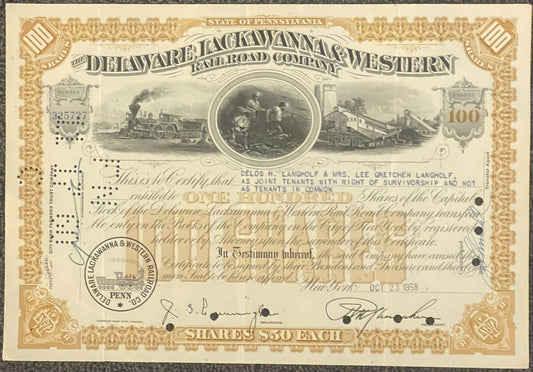
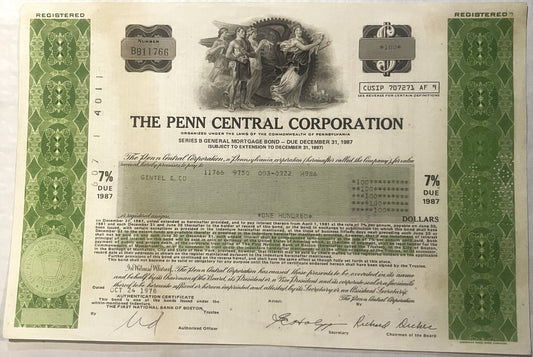
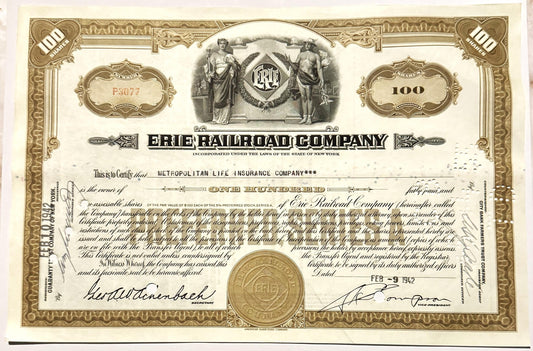
Vintage 1900s 1950s Pennsylvania Railroad Stock Certificate Pennsy Green Monopoly Icon Engraved Scripophily 📜

Vintage 1900s 1950s Pennsylvania Railroad Stock Certificate Pennsy Green Monopoly Icon Engraved Scripophily 📜

Regular price 5.50 USD
Regular price Sale price 5.50 USD
Sale Sold out
Shipping calculated at checkout.
Quantity

🚂 What Did It Feel Like to Hold a Piece of "The Standard Railroad of the World"?

There's a particular kind of magic in unfolding a stock certificate that's been sitting in a bank vault or an old ledger book for the better part of a century. The paper still has that stiff, substantial feel — nothing like modern printer stock — and the engraving catches the light in a way that photographs never quite capture. This is The Pennsylvania Railroad Company in its full corporate regalia: rearing horses, an eagle, a ship under full sail, and a banner promising virtue, liberty, and independence, all rendered in the kind of hand-cut steel engraving that used to be reserved for paper money. If you grew up rolling dice past its name on a Monopoly board, or if a grandfather or great-uncle once worked the rails for "the Pennsy," this is the real thing — an actual piece of ownership paper from the company that, for the better part of a century, was quite literally the biggest railroad on Earth.

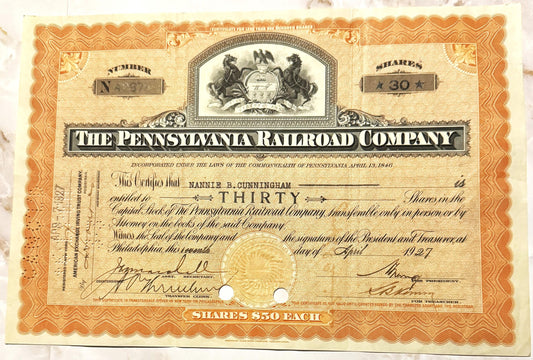
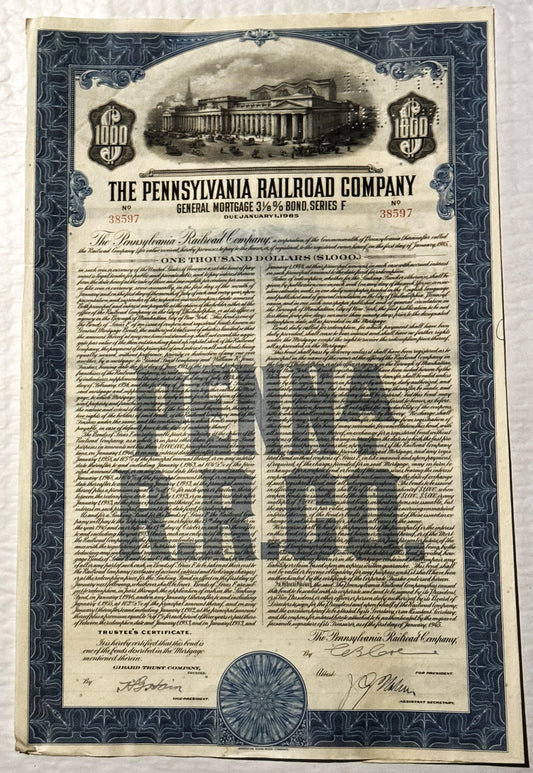
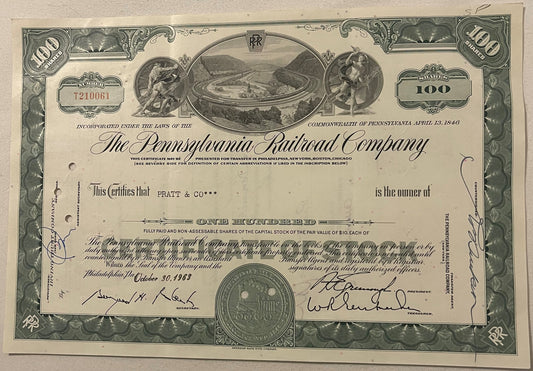
This is a genuine capital stock certificate issued by The Pennsylvania Railroad Company, headquartered in Philadelphia, Pennsylvania, for 100 shares at a par value of $50 each, engraved and printed by the American Bank Note Company's Philadelphia office — the same caliber of security printer trusted with currency and government bonds. Certificates in this issue were signed and sealed in Philadelphia in 1956, printed on heavy engraved stock in deep green and black ink over cream paper, and finished with the ornate guilloché lathe-work patterning — those tight, wave-like geometric loops — that security printers used specifically to make counterfeiting nearly impossible. Across the top sits an arched, richly detailed vignette: two rearing horses flank a central shield bearing a ship in full sail, a sheaf of wheat, and a plow, crowned by an eagle with wings outstretched, all wrapped in a banner reading "VIRTUE LIBERTY AND INDEPENDENCE." This is the official coat of arms of the Commonwealth of Pennsylvania itself, borrowed by the railroad to underscore that its charter came directly from the state legislature. Below, in bold engraved lettering, the certificate proudly announces "THE PENNSYLVANIA RAILROAD COMPANY," and the text of the certificate notes the company's incorporation "under the laws of the Commonwealth of Pennsylvania, April 13, 1846" — the founding date of the railroad itself, not the date this particular certificate was printed. An embossed green company seal, hole-punch cancellation perforations through the signature block (the standard mark used to formally retire a certificate once shares were transferred or the stock retired from circulation), and the ornate green micro-pattern border finish out the design. The piece measures 12 inches by 8 inches, and it comes to you as a genuine issued certificate — executed in ink, countersigned and registered, and punch-cancelled at the end of its run.


🐎 The Pennsylvania Railroad: "The Standard Railroad of the World"

The Pennsylvania Railroad was chartered by the Commonwealth of Pennsylvania on April 13, 1846 — the very date engraved on this certificate — with a single, audacious goal: build a rail line from Harrisburg over the Allegheny Mountains to Pittsburgh, so that Philadelphia's merchants wouldn't lose all their westward trade to Baltimore's B&O Railroad or to the Erie Canal's lock on traffic bound for New York. It was, in other words, a railroad born out of civic rivalry — a Philadelphia answer to the fear of being left behind. That mountain crossing eventually produced one of American engineering's most celebrated feats, the Horseshoe Curve near Altoona, where trains loop nearly 220 degrees around a mountain valley to gain elevation gradually enough for steam locomotives to climb. Old-timers along that stretch of track still talk about the curve as one of the wonders of American railroading, and generations of trainspotters have made the pilgrimage just to watch a Pennsy freight bend itself around that hillside.

From that single charter, the railroad grew into an empire. By the turn of the twentieth century the Pennsylvania Railroad had absorbed, leased, or built its way into a network stretching from New York and Washington, D.C., to Chicago and St. Louis, becoming — by its own proud corporate slogan — "The Standard Railroad of the World." It was, for decades, the largest publicly traded corporation on the planet by revenue, moving both freight and passengers on a scale that dwarfed nearly every other American business. Its keystone-shaped herald, echoing Pennsylvania's nickname as the "Keystone State," became one of the most recognized corporate symbols in the country, stamped on everything from locomotive tenders to baggage tags. The railroad's deep green livery — sometimes called Brunswick green in railroad circles — dressed its streamlined GG1 electric locomotives, engines whose sleek, riveted bodies were shaped with input from the industrial designer Raymond Loewy and remain, to collectors and rail historians alike, among the most beautiful machines ever to run on American rails. It's hard not to notice the coincidence: the same deep green that colored the Pennsy's engines and passenger cars is the very ink used to engrave this certificate.

Old railroad hands and collectors alike still swap stories about the sheer scale of the company in its heyday — that it employed hundreds of thousands of workers at its peak, that its Broad Street Station in Philadelphia was, for a time, the busiest and largest passenger terminal in the world, and that a share of Pennsylvania Railroad stock was considered about as safe and blue-chip an investment as existed in American finance, the kind of holding a family might pass down for generations the way they'd pass down a piece of land. For millions of Americans who never set foot in Philadelphia, the railroad's name was also cemented into pop culture in an entirely different way: it's one of the four railroads on the classic American Monopoly board, alongside Reading, B&O, and Short Line — meaning that long before most people ever held an actual Pennsylvania Railroad share, they were "buying" it at the kitchen table on family game night.


🏙️ Philadelphia: A Railroad and Its Hometown

The Pennsylvania Railroad was headquartered in Philadelphia for its entire independent existence, and the relationship between company and city ran deeper than any ordinary corporate address. For much of its history, the railroad's tracks ran on an elevated stone viaduct that cut straight through the middle of downtown Philadelphia, carrying trains in and out of Broad Street Station. Locals nicknamed this looming structure the "Chinese Wall," and for decades it split Center City in two, casting a permanent shadow over the blocks beneath it. By the 1950s — the very years this certificate was engraved — the railroad and the city struck a deal that would reshape downtown Philadelphia entirely: the Pennsylvania Railroad tore down the Chinese Wall, and in its place rose Penn Center, a sweeping complex of modern office towers built in partnership with city planner Edmund Bacon. It remains one of the landmark urban renewal projects of postwar America, and it's a genuinely remarkable thing to hold a certificate from the very corporation whose demolition crews and real estate deals quite literally redrew the skyline of a major American city.

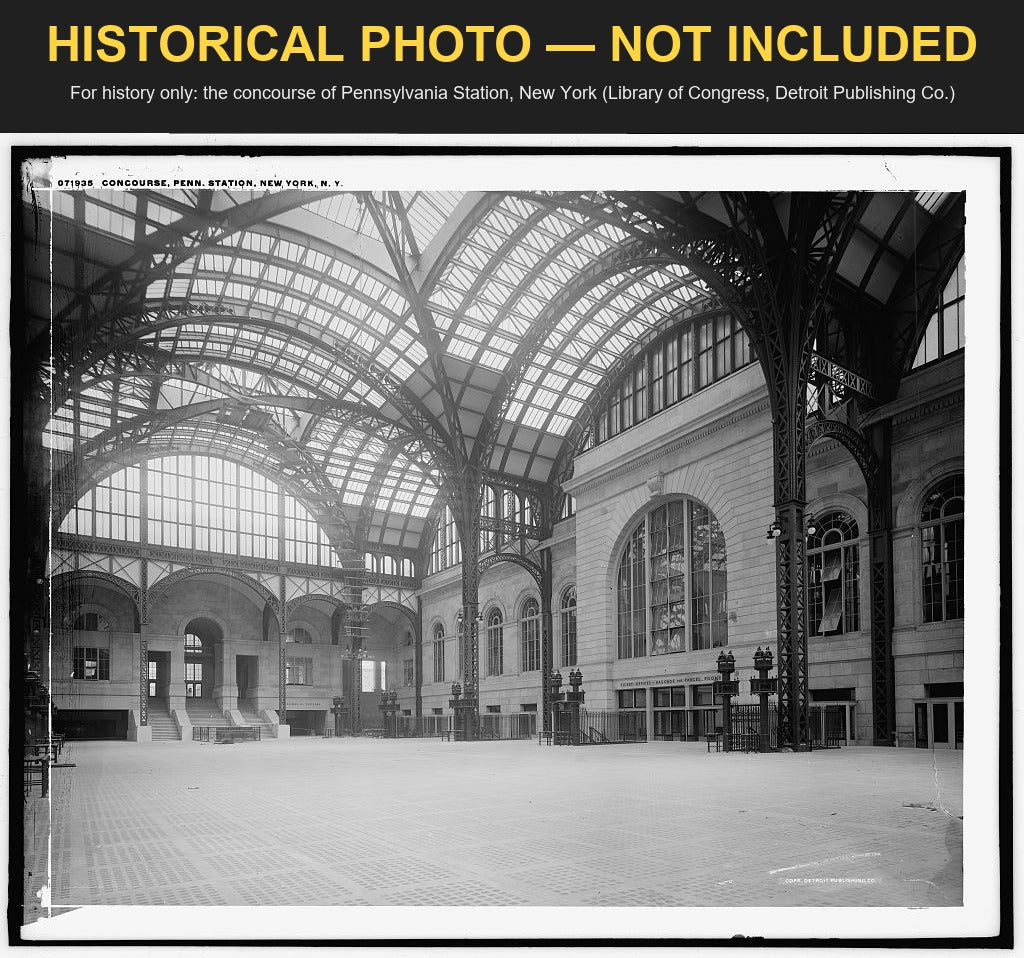
Collectors and Philadelphia history buffs still trade stories about Broad Street Station and its successor terminals — about the crush of commuters during wartime, about the elegant dining cars and parlor cars that once rolled out of the city bound for Chicago or Washington, and about the melancholy day in the 1960s when New York's original Pennsylvania Station — the railroad's grand Beaux-Arts gateway into Manhattan, modeled after Roman bathhouses — was demolished to make way for the current Madison Square Garden. That demolition is widely credited, in architectural preservation circles, as the single event that sparked the modern historic preservation movement in the United States; the outrage over losing such a monumental building helped push through the landmarks laws that protect countless historic structures today. It's a strange and poignant footnote to a company whose own name is stamped on a Philadelphia certificate like this one: the Pennsylvania Railroad built one of the most beautiful train stations America ever saw, lost it to the wrecking ball, and in losing it, helped teach the country to value what it still had.


🖋️ The Engraver's Art: American Bank Note Company

The fine, almost hypnotic geometric patterning bordering this certificate — that tight lattice of interlocking waves and curls known in the trade as guilloché or lathe-work — wasn't decoration for decoration's sake. It was engineered, quite deliberately, to be nearly impossible to forge by hand. This certificate carries the imprint of the American Bank Note Company, Philadelphia, a branch office of one of the most storied security printing firms in American history. Formed in 1858 through the merger of several earlier bank-note engraving houses, American Bank Note Company built its reputation printing paper currency, government bonds, and postage stamps — the kind of documents where a single forged copy could cause real financial damage — and that same steel-plate engraving expertise was extended to corporate clients like the Pennsylvania Railroad, who wanted their stock certificates to carry the same unimpeachable, currency-grade authority. The company maintained regional offices in major cities to serve its biggest corporate clients directly, and the "Philadelphia" imprint on this certificate reflects that local relationship between engraver and railroad, both headquartered in the same city.

Look closely at the central vignette and you're looking at true intaglio engraving — the image was cut by hand into a steel plate, then printed under enormous pressure so the ink sits slightly raised off the paper, giving the eagle's feathers, the horses' manes, and the folds of the ship's sails a crispness that no lithograph or offset print could match. It's the same printing method used on U.S. paper currency to this day, which is exactly why a stock certificate like this one can sit for decades and still show that same sharp, dimensional linework.


🏦 Irving Trust and the Machinery of Wall Street

Every share certificate needs a neutral third party to keep the official record of who owns what, and for this issue that role fell to the Irving Trust Company, named on the certificate as registrar in New York. Irving Trust traced its roots back to a New York bank chartered in 1851, and by the mid-twentieth century it had become one of Wall Street's most prominent trust institutions, headquartered in the landmark Art Deco skyscraper at One Wall Street. Acting as registrar and transfer agent for a giant like the Pennsylvania Railroad was exactly the kind of business a firm like Irving Trust specialized in — ensuring that when shares changed hands in Philadelphia, New York, Boston, Chicago, or even London, as this certificate explicitly permits, the company's books stayed accurate and above dispute. It's a small reminder that a stock certificate like this wasn't just a piece of art — it moved through a real financial machine, with real institutions standing behind every transfer.


📉 From the Standard Railroad of the World to Penn Central

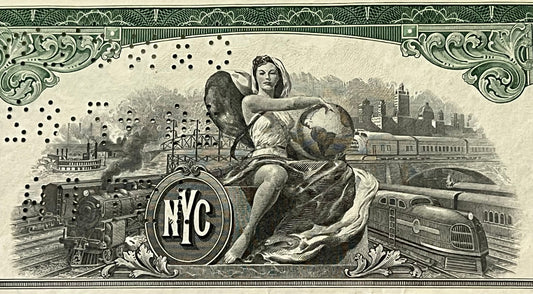
Part of what makes a certificate like this so poignant to collectors is knowing how the story ends. By the years surrounding this certificate's issue, the Pennsylvania Railroad was already facing the pressures that would eventually undo it: the rise of the automobile and the interstate highway system, the growth of commercial air travel, heavy losses on passenger service, and rate regulations that squeezed profits even as costs climbed. In 1968, the Pennsylvania Railroad merged with its longtime rival, the New York Central, to form the Penn Central Transportation Company — at the time, the largest corporate merger in American history. It was a merger meant to save both companies. Instead, Penn Central collapsed into bankruptcy in 1970, then the largest corporate bankruptcy the country had ever seen, and its rail lines were eventually folded into the federally created Conrail system in 1976.

Holding a certificate from 1956 means holding a piece of the company at what was very nearly its final chapter as an independent giant — a share of "the Standard Railroad of the World" printed just over a decade before it would cease to exist under its own name at all. Collectors often say that's exactly what gives these certificates their weight: they aren't relics of a company's beginning, but artifacts of its long, proud twilight, engraved with all the confidence and formality of a firm that, at the time, had no reason to think its story was nearly over.


🖼️ Display Ideas

  • 🖼️ Framed alone with a wide mat, letting the green engraving and the Pennsylvania coat of arms take center stage as a standalone piece of wall art
  • 🚂 Grouped with vintage railroad photographs or timetable ephemera in a train room, den, or home office
  • 🗺️ Paired with an old railroad route map for a wall that tells the story of how the Pennsylvania Railroad's lines actually ran
  • 🏙️ Displayed alongside Philadelphia memorabilia or cityscape prints for a Philadelphia-focused history corner
  • 🎲 Hung near a Monopoly board or game-room shelf for the collector who loves the real-world tie to the classic railroad squares
  • 💼 Framed for a finance or business office, as a conversation-starting piece of authentic American corporate history

🎁 Who Collects These

Stock and bond certificates like this one sit at the crossroads of several collecting worlds, which is part of why they've become so sought after. Railroad enthusiasts collect them as tangible artifacts of a company they've studied through locomotives, timetables, and photographs. Scripophily collectors — a niche but passionate global hobby built entirely around historic financial documents — chase certificates specifically for their engraving quality, their company history, and their rarity. Philadelphia and Pennsylvania history buffs want them for the direct tie to the Commonwealth's own coat of arms and one of the state's flagship corporations. And a great many buyers simply want a beautiful, authentic piece of Americana for a wall — something with the gravity of real history behind it, not a reproduction. It's also become a favorite gift for anyone with a family connection to the railroads: a retired conductor, a grandfather who worked the shops in Altoona, or simply someone who grew up loving trains.


❓ FAQ

Is this a real stock certificate?

Yes. This is genuine, authentic issued Pennsylvania Railroad Company paper out of the banking and brokerage world, not a reproduction or a printed replica.

Does this certificate still represent active shares in a company?

No. The Pennsylvania Railroad merged into Penn Central in 1968 and no longer exists as an independent company, so these certificates are collected today purely as historical artifacts and display pieces, not as financial instruments.

What does the 1846 date on the certificate mean?

That's the date the Pennsylvania Railroad Company was originally chartered under Pennsylvania law — it refers to the founding of the company itself, not to when this particular certificate was printed.

What is the central image on the certificate?

It's the official coat of arms of the Commonwealth of Pennsylvania — two rearing horses flanking a shield with a ship, a plow, and a sheaf of wheat, topped by an eagle, with a banner reading "Virtue, Liberty and Independence." The railroad used the state seal to emphasize that its charter came directly from the Commonwealth.

Why does the certificate have hole punches through it?

The perforations through the signature area are cancellation marks — the standard method used at the time to formally retire a certificate once shares were transferred out of an account, a routine part of how brokerage and transfer houses processed stock certificates.

Will the certificate I receive look exactly like the one in the photos?

Certificates in this series share the same engraved design, denomination, era, and issuing company shown here; details such as the individual certificate number and the exact date of issue will vary from copy to copy, giving each one its own bit of character.

Is this a good size for framing?

At 12 inches by 8 inches, it's a substantial, wall-worthy piece on its own, and it also fits comfortably into a grouped gallery arrangement with other railroad or Philadelphia ephemera.

These are issued instruments rather than blanks. Certificates of this type were filled in for a holder in ink, countersigned by the transfer agent and registered by the registrar, then punch- or cut-cancelled when they were redeemed and retired. Expect financial writings, markings, stamps, hole punches and staple holes as part of the life of the instrument: endorsements and signatures, transfer-agent and registrar stamps, revenue or documentary tax stamps, cancellation punches, staple holes from being bound into a transfer book, pencil ledger notations. That is the paper trail of a security that actually did its job, and it is what separates a document that lived from a blank that never did. No two are alike: holder details, serial numbers, dates, signatures, stamps and punch patterns vary from example to example, so the photographs show the type rather than the exact sheet that ships.

Shipping

🚚 Shipping & Handling

  • Shipping costs and timing are calculated at checkout.
  • Items curated and shipped directly by me include U.S. shipping at no additional cost, professionally packed to ensure safe arrival of your artifact.

Items from Vetted Pro Collectors
Shipping for items offered by vetted Pro Collectors is determined at checkout. All Pro Collector listings are reviewed to ensure fair, reasonable shipping practices.

For full details, please refer to our Shipping Policy.

Returns & Exchange

Take your time — you've got a full six months. If a piece isn't right for you, send it back the way it reached you and we're good.

In the first 30 days your money goes straight back the way you paid. After that it's store credit, so you can put it toward something you'd rather have.

Return shipping we sort out between us, case by case. I don't make this difficult.

If something arrives damaged, or it isn't what I said it was, send me a photo within 48 hours and I'll make it right.

Email info@vintageantiquesgifts.com or call 802-356-9872 — that's me answering, not a call center.

The only things I can't take back are custom or special-order pieces and gift cards.

View full details
  • 5 stars: 5 (100%)
  • 4 stars: 0 (0%)
  • 3 stars: 0 (0%)
  • 2 stars: 0 (0%)
  • 1 star: 0 (0%)
T
Tiffany

Product as described and quick shipping.

E
E

My items arrived exactly as pictured. I can not wait to give them as gifts. Such a cool piece of railroad history.

9
9***6 (222)

Great historical railroad bond

k
k***0 (738)

Item is exactly as described and as shown in photos. Expertly packaged to avoid damage from water! I highly recommend this seller - A+++++!

k
k***0 (738)

Item is exactly as described and as shown in photos. Expertly packaged to avoid damage from water! I highly recommend this seller - A+++++!