Skip to product information
1 of 3

Vintage and Antique Gifts

Vintage Hurdy Gurdy Brand Crate Label 🐒 — 1940s Egan, Fickett & Co. Orlando Florida, Organ Grinder & Monkey Art

Vintage Hurdy Gurdy Brand Crate Label 🐒 — 1940s Egan, Fickett & Co. Orlando Florida, Organ Grinder & Monkey Art

Regular price $10.00 USD
Regular price Sale price $10.00 USD
Sale Sold out
Shipping calculated at checkout.

Size: 8 1/2" x 3"

🚚 Free US Shipping — ships within one business day. International shipping calculated at checkout.

Quantity

Who Packed Hurdy Gurdy Oranges? 🐒 The Dockhand, the Organ Grinder and the Oranges

Size: 8 1/2" x 3"

In 1890 a young Irishman named Joseph Bernard Egan arrived in New York and went to work on the Hudson River docks, unloading ships. What caught his eye was the cargo: wooden boxes of fresh oranges from Florida. Twenty-four years later he co-founded Egan, Fickett & Co., and the firm sold Florida citrus under a brand nobody forgot, HURDY GURDY, with a cartoon organ grinder and his monkey. This long strip label carries that brand in red on a yellow banner, PRODUCE OF U.S.A. beneath it, and along the bottom the firm's name and town: EGAN, FICKETT & CO. · ORLANDO, FLORIDA.


🖼️ What the Label Shows

HURDY GURDY sweeps across a pennant banner, and at left stands the organ grinder: a round-faced man with a huge mustache, a crushed hat and trousers rolled at the cuff, his street organ hung from a shoulder strap and resting on a single pole, and a grinning monkey in a pillbox cap perched on his raised hand. The U.S.A. produce line runs under the banner, and a bar along the bottom carries the firm's name and ORLANDO, FLORIDA, followed at the far right by a line of tiny type.


🎵 What a Hurdy Gurdy Is

Strictly, a hurdy-gurdy is a string instrument, sounded by a rosined wheel turned with a crank. But as far back as the eighteenth century the name was also given to the small portable barrel organ, or street organ, played by poor buskers known as organ grinders, and that is the hurdy gurdy on this label. The organ grinder was a musical novelty of city streets through the nineteenth century and the early twentieth, and he often worked with a white-headed capuchin monkey on a string, which did tricks, drew a crowd and took up the coins from passers-by. New York City's Mayor Fiorello La Guardia banned the street organs in 1935, and that law was not repealed until 1975.


🏢 Joseph B. Egan: County Mayo to the Produce Trade

Joseph Bernard Egan was born in County Mayo, Ireland in 1867, the eldest son of a family in which, for more than ten generations, the eldest son had become a Roman Catholic priest. He bucked the tradition. After secondary school in Ireland he went to the University of Paris, became fluent in French, and could read Latin and Greek besides his English and Gaelic. Landing a job on the New York docks in 1890, he took a close interest in the Florida orange boxes coming off the ships; before refrigerated rail, shipping by water in holds packed with ice was the only way to keep fruit fresh on the trip north. He rose to president of A.F. Young & Co. in New York, and in 1914, the year the youngest of his nine children was born, he co-founded Egan, Fickett & Co. His partner, Stephen Fickett, supplied the money to start the company and stayed out of its management.

Joseph Egan went south himself, sailing from New York to Jacksonville and taking the train to Titusville, where he joined Florida state senator Jesse J. Parrish to form the Nevins Fruit Co., the family company's first venture into Florida citrus farming. The branding instinct was already there: Nevins was named after a popular Brooklyn fire chief, to win recognition among buyers. Joseph headed Egan, Fickett & Co. until he died suddenly in 1937.


🍊 Bernard Egan, the Godfather of Grapefruit

His youngest son, Bernard A. Egan, was born June 7, 1914 in Elizabeth, New Jersey. He left Fordham University for a job with the Refrigerated Steamship Line, a unit of the United Fruit Co., and when his father died he joined three brothers in the family business. In 1948 he became general manager of Egan, Fickett & Co., and a company photograph from the 1940s shows him in New York City among cartons of Florida citrus. In 1968 he moved the firm to Florida, first to Wabasso, then Vero Beach and finally Fort Pierce, and founded DNE, which he built into the largest fresh citrus marketing agent in Florida, shipping Indian River grapefruit to four continents. Bernard Egan went on to acquire more than 6,000 acres of citrus groves along Florida's east coast, becoming a grower with more than 10,000 acres. He became known as the "Godfather of Grapefruit." He died in 2004, a day after his ninetieth birthday, and stands in both the Florida Agricultural Hall of Fame and the Florida Citrus Hall of Fame. The company used the name Egan, Fickett & Co. for its first 75 years and carries on today as Bernard Egan & Co. of Fort Pierce.


🎡 The Hurdy Gurdy Brand

HURDY GURDY was a federal trademark for citrus fruit. The application was filed May 14, 1962 and registered April 30, 1963, and it gives October 22, 1948 as the date the name was first used; the registration expired in 2000. The Egan company's own history remembers Hurdy Gurdy as a popular and colorful label, and big trucks bearing the Hurdy Gurdy label delivered the fruit to chain stores. In a trade where growers and fruit sellers were told apart by their labels, a man with a monkey was easy to spot across a loading dock.

The State Library of Florida's crate label collection shows how far the brand traveled. One of its Hurdy Gurdy labels names Egan, Fickett at Orlando, as this one does. Others pair the brand with Florida packing houses, the Grand Island Citrus Cooperative in Umatilla, the T.B. Milam Packing House in Leesburg and Perkins Groves and Packing House in DeLand, with Egan, Fickett of New York as the seller. There was a Hurdy Gurdy Jr. label too.


🌴 Orlando and the Citrus Belt

Orlando is the town on this label, and long before the theme parks it was citrus country. The years 1875 to 1895 are remembered as Orlando's Golden Era, when it became the hub of Florida's citrus industry. That era ended in ice. On December 28, 1894 Orlando fell to 18 degrees, still its all-time record low, and a second freeze followed in February 1895; the fruit froze on the trees and the bark split from top to bottom. Many owners gave up their independent groves, holdings gathered into the hands of a few "citrus barons," and operations shifted south toward Lake Wales in Polk County. Florida recovered to become the world's second-largest orange producer, and its citrus went on carrying paper labels from the late 1800s into the early 1960s.


📅 How Old Is It?

The sheet has no printed year and no ZIP code. The firmest date comes from the brand: federal records put Hurdy Gurdy's first use in late October 1948, so this label was printed no earlier than that. The State Library of Florida dates its own Orlando Hurdy Gurdy label to the 1940s.


📦 Condition

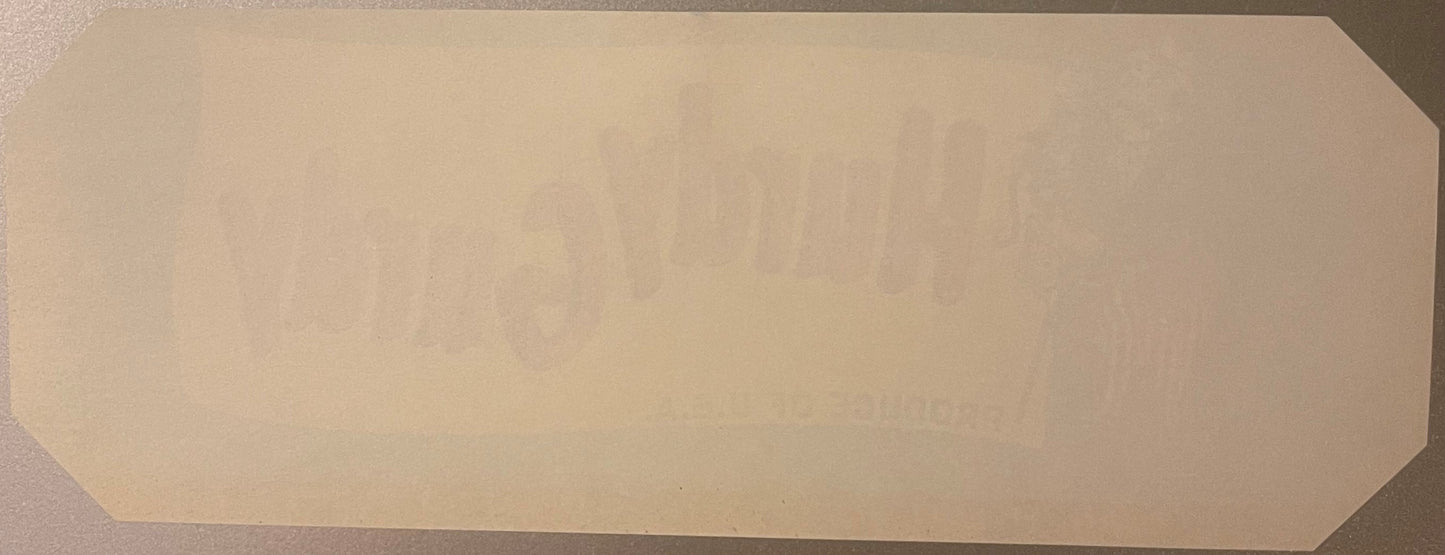
New old stock: an original paper strip label with clipped corners, never applied to a box, with a plain paper back.


🏠 Living With It

  • 🖼️ A long, slim frame over a kitchen doorway or a home bar.
  • 🎵 A music room piece for band organ, carousel and street music fans.
  • 🍊 Part of a Florida citrus label wall.
  • 🌴 A gift for anyone from Orlando, Vero Beach, Fort Pierce or the Indian River country.
  • 🐒 Pure fun for a child's room: a man, a monkey and a hurdy gurdy.

❓ Questions People Ask

Who was Egan, Fickett & Co.?

A New York produce sales and distribution house co-founded in 1914 by Irish immigrant Joseph Bernard Egan, with Stephen Fickett as the money partner. It moved to Florida in 1968 and is now Bernard Egan & Co.

What does "hurdy gurdy" mean on this label?

The street organ played by an organ grinder. The word first named a cranked string instrument and was borrowed for the portable barrel organ.

What fruit went under this label?

Citrus. The Hurdy Gurdy trademark was registered for citrus fruit, and the Egan firm sold Florida citrus; the label itself marks it as American produce.

How old is it?

Printed no earlier than October 1948, when the brand name was first used.

Why is it long and narrow?

It is a strip label. Florida labels most often measured 9 by 9 inches, but half-box sizes and long strip labels were also printed.

Is it original?

Yes, an original unused paper label with a blank back.

🏷️ What Is Printed on This Label

  • Hurdy Gurdy
  • PRODUCE OF U.S.A.
  • EGAN, FICKETT & CO.
  • ORLANDO, FLORIDA

Shipping

🚚 Shipping & Handling

  • Shipping costs and timing are calculated at checkout.
  • Items curated and shipped directly by me include U.S. shipping at no additional cost, professionally packed to ensure safe arrival of your artifact.

Items from Vetted Pro Collectors
Shipping for items offered by vetted Pro Collectors is determined at checkout. All Pro Collector listings are reviewed to ensure fair, reasonable shipping practices.

For full details, please refer to our Shipping Policy.

Returns & Exchange

Take your time — you've got a full six months. If a piece isn't right for you, send it back the way it reached you and we're good.

In the first 30 days your money goes straight back the way you paid. After that it's store credit, so you can put it toward something you'd rather have.

Return shipping we sort out between us, case by case. I don't make this difficult.

If something arrives damaged, or it isn't what I said it was, send me a photo within 48 hours and I'll make it right.

Email info@vintageantiquesgifts.com or call 802-356-9872 — that's me answering, not a call center.

The only things I can't take back are custom or special-order pieces and gift cards.

View full details

Preserving History: Authentic Objects Across Eras

— Curated by Travis Weigel