Skip to product information
1 of 14

Vintage and Antique Gifts

Vintage Planters Mr. Peanut Whistle 🥜 1950s NOS Advertising Collectible | Red & Gold Plastic Figures 🎩

Vintage Planters Mr. Peanut Whistle 🥜 1950s NOS Advertising Collectible | Red & Gold Plastic Figures 🎩

Regular price 13.00 USD
Regular price Sale price 13.00 USD
Sale Sold out
Shipping calculated at checkout.
Color

Description

🥜 Vintage 1950s Planters Mr. Peanut Advertising Whistle — New Old Stock Figural Plastic Promotional Collectible

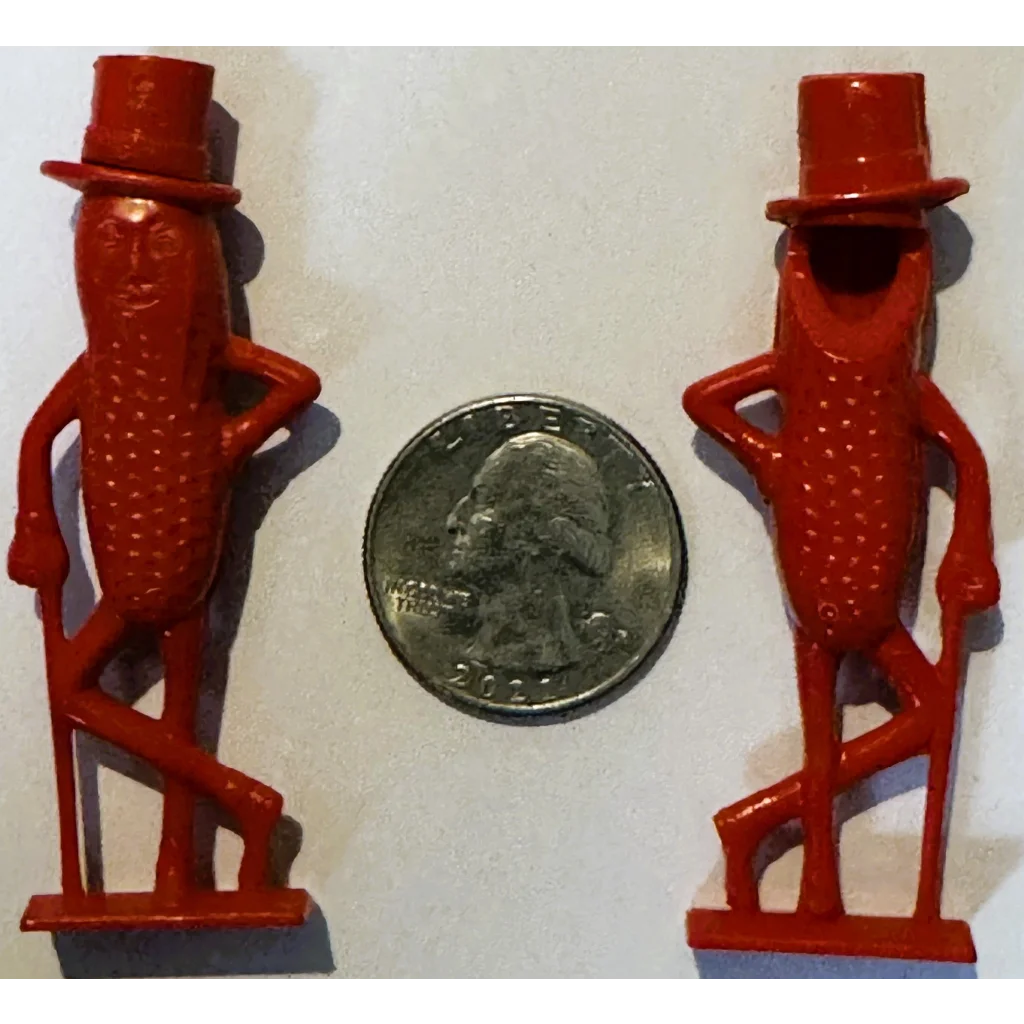
These are vintage 1950s Planters Mr. Peanut figural advertising whistles, New Old Stock (NOS) molded plastic promotional giveaways produced during the golden era of American mid-century brand marketing. Standing approximately 2.5 inches tall, each figure depicts the Planters mascot — peanut-shell body, top hat, cane, arms akimbo — with a hollow cylindrical hat that functions as the mouthpiece of a siren-style whistle. They survive in two colors, a deep brick red and a warm mustard gold, and what you are looking at here are examples of both, photographed front, back, top, and beside a quarter so the scale registers immediately. These are among the most recognized pieces of mid-century American food brand promotional material still circulating in collector hands.

🎩 There is a particular kind of mid-century magic that belongs entirely to the five-and-dime store era — the kind of small promotional treasure a child could hold in one palm and carry home from the boardwalk feeling like the luckiest kid on the block. This is exactly that kind of piece. The figure is shaped as a peanut in its shell, the surface textured across the body with the characteristic bumps and ridges of the nut itself. He stands upright on two slender legs that extend to a flat rectangular base. One arm rests at his side; the other bends at the elbow with the hand at his hip, a posture of confident, unhurried elegance that has defined this character since the moment he was born in 1916. A cane extends from one hand down to the base — the classic gentleman's accessory that has never left him.

🎩 The top hat is cylindrical and wide-brimmed, and on the gold version the hat carries embossed text reading MR. PEANUT around its crown. The face on the front-facing figures shows two eyes — one round, one rendered as a small swirl — and a composed, slightly bemused expression that has charmed a century of American consumers. The whistle mechanism is built into the hat itself: the cylinder is open at the top to form the mouthpiece, and the back of the figure's face carries an oval cutout that creates the airway. The sound produced is less a sharp tweet than a sustained, rotating tone — which is why collectors who have handled these long enough tend to call them sirens rather than whistles, and why that pleasant argument has no resolution and no urgency, which is exactly the right kind of argument to have about a 2.5-inch peanut man in a top hat.

🥜 The figures measure 2.5 inches tall and approximately 1 inch wide — pocket-sized monuments to one of the most recognized brand mascots in the entire history of American advertising. The quarter in the photographs does the work of any ruler: the size-to-detail ratio on these is genuinely striking. The rear photographs show the open hollow of the hat and the oval cutout behind the face — the full functional architecture of the siren visible in a single composed rear view.

---

🎨 Variant Guide — Red & Gold

🔴 Red variant — The red Mr. Peanut whistle is cast in a deep, saturated brick red, monochromatic across every element: hat, face, body, arms, legs, cane, and base all read as one unified color. The surface texture of the peanut shell body and the detail in the face are clearly defined. The red version is among the most visually striking of the known colorways for a vintage red Mr. Peanut whistle collector — the color is confident and bold on a shelf, and the figural detail holds up well against the dark ground. Collectors searching specifically for a brick red Planters advertising figure or a red plastic Mr. Peanut siren will recognize this one immediately.

🟡 Gold / Beige variant — The gold version is a warm mustard tan, consistent throughout, and carries the more legible facial detail — both eyes read clearly, the expression is distinct, and the embossed MR. PEANUT text on the hat crown is visible. This is the colorway most closely associated with the classic image of the character, and collectors searching for a gold Mr. Peanut whistle, a mustard yellow Planters promotional figure, or the tan plastic Mr. Peanut advertising piece will find this the more immediately recognizable of the two. Both variants share the same mold, the same proportions, and the same siren construction.

---

🏭 The Company Behind the Character

Planters was founded in 1906 in Wilkes-Barre, Pennsylvania, by Amedeo Obici, an Italian immigrant who arrived in America and recognized in the peanut something the rest of the country had not yet fully appreciated — a democratic, affordable, deeply satisfying snack that could reach every table and every pocket. He partnered with Mario Peruzzi, rented factory space, and called the enterprise the Planters Peanut Company. Two years later they incorporated as the Planters Nut and Chocolate Company. Obici later made the decision to move primary operations south to Suffolk, Virginia, to put the factory close to the peanut-growing fields and reduce the cost of raw material to the roasting room. Suffolk, widely recognized as the Peanut Capital of the World, would remain the heart of Planters production for decades.

🎨 The mascot arrived in 1916 through a design contest that has since become one of the most celebrated origin stories in American brand history. A fourteen-year-old schoolboy named Antonio Gentile submitted a sketch of a peanut figure — a simple, lively character with a hat and a cane — and won five dollars. A commercial artist then added the monocle, the top hat, and the refined posture, and Mr. Peanut was born. There is a long-running and unresolved dispute in the Planters collector community about exactly who made those additions: one attribution goes to commercial artist Andrew S. Wallach, while another persistent story credits Frank P. Krize Sr., a Wilkes-Barre artist, with the finishing touches. Wallach's daughter maintains that Krize joined the project after the character was already created. Neither Planters' own published history nor the collector literature has fully settled it, and the question has the quality of good lore — the kind that keeps people researching.

🏢 Mr. Peanut debuted in advertising in 1916 and has never left. By 1950, Planters had grown into a sixty-million-dollar-per-year operation with four principal manufacturing plants, dozens of retail stores, and roughly five thousand employees spread across North America. The company was acquired by Standard Brands in 1960, which later merged with Nabisco Brands in 1981. Kraft Foods acquired Nabisco — and with it Planters — in 2000. In 2021, Hormel Foods Corporation purchased the brand for 3.35 billion dollars, writing another chapter in a story that started in a rented Pennsylvania factory more than a century ago. The character outlasted every merger, every corporate owner, and every generation of marketing executives who inherited him.

---

🏖️ The Boardwalk Lore

The story that circulates most persistently among Planters collectors holds that these whistles were not sold — they were given. The lore says children received one by visiting a Planters retail Peanut Shoppe or by encountering the costumed Mr. Peanut character at promotional events, most famously along the Atlantic City boardwalk, where a life-sized Mr. Peanut was a fixture for decades. The story passed down is that a child did not buy this piece — they earned it by showing up, and that distinction matters to the people who collect them. Whether every example in every color reached a child's hand that way is impossible to confirm at this distance, but the lore is deeply embedded in the collector community and shapes how it feels to hold one.

🔁 A related detail fuels its own quiet corner of collector conversation: some examples show a small loop at the base of the figure, and the story that circulated for years held that these were designed to be worn on a lanyard or a string around a child's neck at promotional events — a wearable souvenir that doubled as a noisemaker. Whether that loop was universal across production runs or limited to certain batches is one of those questions no catalog sheet has answered, and the community has not resolved it either. These are the small, unverifiable details that make mid-century promotional material so alive to the people who study it.

🎶 Collectors who have handled enough of these debate whether the sound mechanism is technically a whistle or a siren. The airway — the open top of the hat, the oval cutout at the back — produces a tone that is more sustained and rotating than a sharp tweet, and anyone who has blown one tends to agree the sound is louder and more interesting than the small size suggests. The whistle-versus-siren debate has been going for decades and will probably go for decades more. That is not a problem. That is the pleasure of it.

---

✨ New Old Stock — What That Means Here

New Old Stock (NOS) survivors from mid-century American promotional runs do not surface in this condition every day. These figures have not been carried in a pocket for a decade, worked as a noisemaker at a carnival, or lost behind a couch cushion in 1958. What the photographs document is what you receive — the figure as it left production, in the condition it maintained through however many decades it spent out of circulation. The detail in the face, the clarity of the surface texture, the embossed hat lettering on the gold version — all of it is present and legible.

🥜 The 2020 Super Bowl advertisement in which Mr. Peanut was killed off — only to be reborn — became one of the most-discussed advertising moments of recent memory, and collectors who had been assembling Planters memorabilia quietly for years found themselves answering questions from people who had never previously thought about a 1950s promotional whistle. The cultural moment, brief as it was in the news cycle, drew new eyes to the entire archive of pre-2020 Planters material. Physical survivors of the mid-century promotional era — like these figural siren-whistles — became the objects new collectors wanted to start with, and established collectors used the moment to go deeper into the early runs.

🎩 Antonio Gentile was a child when he sketched the character that would outlast every corporate owner, every merger, and every generation of marketing executives. He drew a peanut with a hat and a cane, and somewhere along the line the monocle and the gentleman's posture were added and that figure was sent out into the world. These little plastic siren-whistles are part of what that figure looked like when it was handed to a child on a boardwalk in the early 1950s, before television had fully taken over American attention, when a costumed mascot and a small plastic noisemaker were still sufficient to make a brand feel like a friend. That is not nothing. That is, in fact, quite a lot.

---

🖼️ Ways Collectors Are Displaying These

  • 🥜 Displayed as a front-and-back pair — the face side beside the open hollow back — showing the full siren engineering in a single composed arrangement
  • 🎩 Grouped both colors together on a shelf dedicated to mid-century American brand mascots, alongside other figural advertising pieces from the same era
  • ✨ Set inside a shadow box with period Planters advertising imagery — a snapshot of the brand's mid-century visual language rendered in three dimensions
  • 🏖️ Placed in a curated kitchen or pantry shelf display alongside vintage tin canisters, peanut butter crocks, and other food brand memorabilia from the 1940s and 1950s
  • 🪙 Paired with a quarter in a display tray to preserve the scale relationship — the size-to-detail ratio at 2.5 inches tall is genuinely striking in person
  • 🎶 Used as a gift for the advertising history collector, the Planters enthusiast, the mid-century Americana devotee, or anyone who remembers the costumed Mr. Peanut as part of their childhood geography
  • 🥜 Incorporated into a dedicated Mr. Peanut collection that spans the character's century-long history in American brand culture — these are among the earliest physical promotional objects still found in collectible condition
---

❓ Questions Collectors Ask

What exactly is a Mr. Peanut advertising whistle, and what was it used for?

This is a vintage 1950s figural promotional giveaway produced by or for the Planters Peanut Company, molded in plastic in the form of the Mr. Peanut mascot. The hollow cylinder of the top hat serves as the mouthpiece, and an oval cutout at the back of the figure's head creates the airway that produces sound when blown. The mechanism functions more as a siren than a traditional whistle — the tone is sustained and rotating rather than a sharp tweet — which is why the piece is sometimes listed as a "Mr. Peanut siren" in collector catalogs. It was distributed as a free promotional item, not sold at retail.

How do I know these date to the 1950s specifically?

The molded plastic construction, the figural promotional format, and the style of the Mr. Peanut rendering are all consistent with mid-century American advertising giveaway production. Planters was a sixty-million-dollar-per-year operation by 1950 with dozens of retail stores and documented promotional output at that scale. The character design matches the mid-century advertising imagery Planters used in that era, before the monocle became the dominant feature in later stylized versions. No single date stamp is visible on these figures, but the production style and the NOS condition both point consistently to the early-to-mid 1950s.

How do I tell the two variants apart, and does one color turn up less often than the other?

The red variant is a deep, saturated brick red, monochromatic across every element of the figure with no color variation between the hat, body, arms, and base. The gold variant is a warm mustard tan and carries more legible facial detail, including the embossed MR. Verified research confirms this whistle was originally produced in four colorways — blue, orange, beige, and red — so the gold and red represented here are two of at least four known production colors. Whether any single color is genuinely scarcer than another in NOS condition is not something the published collector record has settled definitively.

What makes these New Old Stock, and how does that affect condition?

New Old Stock (NOS) means these figures were produced, stored, and never distributed or used — they are survivors of the original production run that came through decades of storage without the handling that most mid-century promotional giveaways endured. The surface texture across the peanut body, the facial detail, and the embossed lettering on the hat of the gold version are all present and clear in the photographs, consistent with figures that were not carried in pockets, blown repeatedly as noisemakers, or subjected to the wear that play-condition examples show. NOS mid-century plastic promotional figures are found in varying states of storage; what the photographs document here reflects figures that came through in strong condition.

Is the figure hollow throughout, or only at the hat and face?

The whistle mechanism is built into the top section of the figure — the hat cylinder is open at the top to form the mouthpiece, and the oval cutout at the back of the head creates the airway. The rear-view photographs in this listing show both openings clearly: the open top of the hat and the large oval void behind the face. The body of the figure below the head appears solid from the photographs, with the functional hollow limited to the head and hat assembly that makes the siren mechanism work.

How should I care for a vintage plastic figure like this?

Mid-century molded plastic is generally stable in normal indoor conditions but benefits from being kept out of direct sunlight, which can cause color fading or surface dulling over time. Dust can be removed with a soft dry cloth or a very soft brush — no solvents, no water submersion, and no abrasive cleaning, as the painted or molded surface color on figures this age can be sensitive to chemical exposure. Storage away from extreme heat and humidity preserves the plastic and prevents any warping of the thin structural elements like the cane and legs. Display in a shadow box or enclosed cabinet is the safest long-term approach for a figure in NOS condition.

Why do Planters Mr. Peanut collectibles from this era have particular resonance for collectors now?

Mr. Peanut is one of the oldest continuously used brand mascots in American advertising history, active since 1916 — which gives the entire archive of physical promotional objects a century-long lineage that very few American brand characters can match. The 2020 Super Bowl advertisement in which the character was "killed off" and then reborn drew significant new attention to pre-2020 Planters material, particularly early-run promotional objects like these siren-whistles. Beyond the news cycle, there is a deeper collector interest in the physical evidence of how brands reached consumers before television became dominant — the boardwalk giveaway, the in-store premium, the pocket-sized noisemaker — and these figures are direct physical survivors of that era of American promotional culture.

Shipping

🚚 Shipping & Handling

  • Shipping costs and timing are calculated at checkout.
  • Items curated and shipped directly by me include U.S. shipping at no additional cost, professionally packed to ensure safe arrival of your artifact.

Items from Vetted Pro Collectors
Shipping for items offered by vetted Pro Collectors is determined at checkout. All Pro Collector listings are reviewed to ensure fair, reasonable shipping practices.

For full details, please refer to our Shipping Policy.

Returns & Exchange

Product Page Return Policy

  • 60-Day Returns – Items must be in original condition.
  • Refunds – Issued after inspection (excluding shipping costs).
  • Return Shipping – Customer is responsible unless item is damaged or incorrect.
  • Damaged/Incorrect Items – Contact us within 48 hours for a replacement or refund.
  • Easy Returns – Email info@vintageantiquesgifts.com or call 802-356-9872 to initiate a return.

For full details, visit our Refund Policy.

View full details