
Skip to product information
1 of 3

Vintage and Antique Gifts

Vintage 1950s Red Lion Brand 🦁 Lithograph Crate Label — Red Lion Packing Co., Exeter, California

Vintage 1950s Red Lion Brand 🦁 Lithograph Crate Label — Red Lion Packing Co., Exeter, California

Regular price $5.50 USD
Regular price Sale price $5.50 USD
Sale Sold out
Shipping calculated at checkout.

Size: 13" x 4"

🚚 Free US Shipping — ships within one business day. International shipping calculated at checkout.

Quantity

Whose Name Is Behind the Red Lion? 🦁 Vintage 1950s Red Lion Brand Crate Label, Red Lion Packing Co., Exeter, California

Size: 13" x 4"

A roaring red lion, and behind it one grape grower's own name.

A 1950s Red Lion Brand crate label from Exeter, California, new old stock and never pasted to a lug box. The name across the bottom is not a corporation's. In a federal court opinion of June 16, 1948, John C. Kazanjian appears as "an individual doing business as Red Lion Packing Company, in Exeter, California": one grower and shipper whose three carloads of Emperor grapes, sold through a Los Angeles distributor to the Joseph Denunzio Fruit Company of Louisville, Kentucky, turned into a lawsuit that climbed from a Southern California courtroom to the Ninth Circuit and onto the docket of the U.S. Supreme Court.

The Label Up Close

A lion lies with his forepaws stretched out and his head swung toward you, mouth wide in a roar, fangs and whiskers bright, his mane blazing against the night. RED LION runs across the top in enormous block capitals that throw a hard shadow, with BRAND tucked beneath. One band carries NET WEIGHT 27 LBS., and the band below reads PRODUCE OF U.S.A. on the left and, on the right, JOHN C. KAZANJIAN - Grower and Shipper, RED LION PACKING CO., and EXETER, CALIFORNIA. A line of tiny type at the lower left credits the printer: Western Litho. Co. of Los Angeles.

  • Brand: Red Lion
  • Grower and packer named: John C. Kazanjian; Red Lion Packing Co.; Exeter, California
  • Also printed: NET WEIGHT 27 LBS. · PRODUCE OF U.S.A.
  • Printer's imprint: Western Litho. Co., Los Angeles
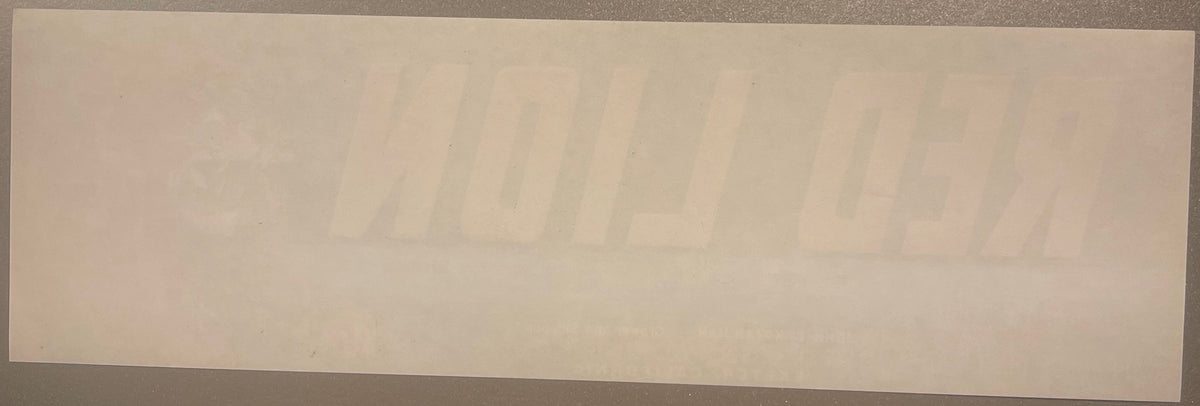
  • Lithographed paper crate label, plain back
  • Size: 13" x 4" ~
  • Age: 1950s
  • Condition: new old stock, never applied to a box

John C. Kazanjian and the Three Cars of Emperor Grapes

Red Lion Packing Co. was one man. The label calls John C. Kazanjian "Grower and Shipper," and the federal courts saw him the same way. The Joseph Denunzio Fruit Co. sued over a deal for three cars of U.S. No. 1 Emperor grapes, priced at $2.50 per lug plus a procurement charge of $50.00 per car. Raymond M. Crane had made the sale, and Judge J. F. T. O'Connor of the Southern District of California found that Crane was acting for Kazanjian, whom the court placed "in the status of an undisclosed (or at best partially disclosed) principal." Crane had no authority to bind him. On June 16, 1948, the judge entered judgment against Crane for $5,723.50 and dismissed the case against Kazanjian.

That was not the end of it. The later argument was over a claim that the contract was void because its price broke a ceiling set by federal price regulation. Judge Carter afterwards entered conclusions of his own, and on May 10, 1951, the Ninth Circuit Court of Appeals set them aside and ordered Judge O'Connor's findings and judgment reinstated. Crane carried it on to the U.S. Supreme Court, where it is recorded as Crane v. Joseph Denunzio Fruit Co., 344 U.S. 829, on October 13, 1952. For a label collector it is a rare thing: the grower named on a crate label, his town, his fruit and his price per lug, all set down in the federal law reports.

Exeter, California

Exeter was laid out in 1888, when a line of the Southern Pacific Railroad passed through this part of the San Joaquin Valley. D. W. Parkhurst, a railroad representative, bought the land from the settler John Firebaugh and named the town after his own hometown of Exeter, England. It incorporated in 1911. Cattle was big business there: the Gill Cattle Company, opened in the late 1800s, was once the largest such business in the United States.

The farm economy had a hard side too. In October 1929 Exeter was the site of a large anti-Filipino riot, when a mob stormed a Filipino work camp, beat 50 Filipino labourers and burned the camp. Today the town tells its own history on its walls, with 31 murals by professional artists painted across downtown buildings. The 2020 census counted 10,321 residents.

The Armenian Grape Growers of the Valley

Kazanjian is an Armenian name, and it belongs to one of the great immigrant stories of California farming. The first Armenian in California arrived in 1874 and settled in Fresno, drawn by land suitable for farming. Fresno became the first major Armenian community in the western United States, and Armenians became the largest minority group in Fresno County. Thousands more came to America after the Armenian genocide of 1915 to 1918.

The lore of those families lives on in the stories of William Saroyan. Born in Fresno on August 31, 1908, to Armenak and Takuhi Saroyan, immigrants from Bitlis in the Ottoman Empire, he based many of his stories on a childhood among the Armenian-American fruit growers of the San Joaquin Valley, above all the 1940 collection My Name Is Aram, about a young boy and the colorful characters of his immigrant family. That same year he won the Pulitzer Prize for Drama for The Time of Your Life and famously turned it down, saying commerce should not judge the arts.

Why a Lion

The red lion comes out of heraldry, and in Britain it became a popular pub name. It suits a town named after an English city. Whatever Kazanjian had in mind, his lithographer gave him a beast that roars off the end of a lug box from across a produce market.

What Changed

Labels like this belong to the age of the wooden lug box, when a grower-shipper's own name rode on every crate that left the packing house and a buyer hundreds of miles away picked his fruit by the picture on the end. The court record shows how that trade worked in practice: a grower in Exeter, a middleman who made the sale, a fruit company buying by the carload, and a federal price ceiling hanging over the deal. The legacy of that world is paper, and a label that was printed and never pasted keeps it at full color.

Good For

  • California crate label collectors, especially Tulare County and grape labels
  • Armenian-American heritage and San Joaquin Valley history
  • Lion and big-cat art lovers
  • Kitchen, wine room or home bar walls
  • A gift for anyone with roots in Exeter or the Central Valley

Questions People Ask

How old is the Red Lion label?
It dates to the 1950s. Kazanjian was already trading under the Red Lion name when the court ruled in 1948.

Was it ever used on a crate?
No. It is new old stock and was never pasted to a box.

Who was John C. Kazanjian?
The man named on the bottom band. The federal courts treated him as a private individual trading under the lion's name from his Exeter packing business, not as a corporation.

What fruit went in the box?
The label names no fruit. Kazanjian's court case concerned Emperor grapes sold by the lug, and a lug-box label like this one went on the end of a lug.

Who printed it?
A Los Angeles printing house, credited as Western Litho. Co. in microscopic type at the lower left.

Shipping

🚚 Shipping & Handling

  • Shipping costs and timing are calculated at checkout.
  • Items curated and shipped directly by me include U.S. shipping at no additional cost, professionally packed to ensure safe arrival of your artifact.

Items from Vetted Pro Collectors
Shipping for items offered by vetted Pro Collectors is determined at checkout. All Pro Collector listings are reviewed to ensure fair, reasonable shipping practices.

For full details, please refer to our Shipping Policy.

Returns & Exchange

Take your time — you've got a full six months. If a piece isn't right for you, send it back the way it reached you and we're good.

In the first 30 days your money goes straight back the way you paid. After that it's store credit, so you can put it toward something you'd rather have.

Return shipping we sort out between us, case by case. I don't make this difficult.

If something arrives damaged, or it isn't what I said it was, send me a photo within 48 hours and I'll make it right.

Email info@vintageantiquesgifts.com or call 802-356-9872 — that's me answering, not a call center.

The only things I can't take back are custom or special-order pieces and gift cards.

View full details

Preserving History: Authentic Objects Across Eras

— Curated by Travis Weigel