Skip to product information
1 of 3

Vintage and Antique Gifts

Vintage 1940s Lion Brand Vegetable Crate Label 🦁 Watsonville California, M.L. Kalich & Co. Selected Vegetables Lithograph

Vintage 1940s Lion Brand Vegetable Crate Label 🦁 Watsonville California, M.L. Kalich & Co. Selected Vegetables Lithograph

Regular price $6.00 USD
Regular price Sale price $6.00 USD
Sale Sold out
Shipping calculated at checkout.

Size: 9" x 7"

🚚 Free US Shipping — ships within one business day. International shipping calculated at checkout.

Quantity

Who Packed Lion Brand Vegetables in Watsonville? 🦁 A Lion Out of Watsonville

Size: 9" x 7"

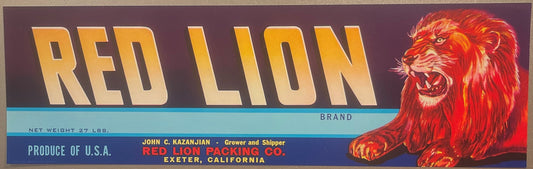
Some labels win you over with sheer confidence, and this one roars it. Against a dark, marbled midnight-blue ground reclines a magnificent lion, printed in rich, deep lithographic color — the tawny mane worked strand by strand, the amber eyes level and calm, one great paw draped over the edge of a scarlet band that runs across the base. Above him, in tall creamy-white capitals, stands the single word "LION," with "Brand — Finest Quality — Selected Vegetables" stacked beside. It is a Lion brand vegetable label from M.L. Kalich & Co. of Watsonville, California, and it is a small masterpiece of the lithographer's art. And it carries its own paper trail, if you know where to look.


🏢 M.L. Kalich & Co., Watsonville

The attribution is printed in full across the red base band: "Grown, Packed and Shipped by M.L. Kalich & Co., Main Office, Watsonville, California, U.S.A." M.L. Kalich & Co. was a grower-packer-shipper of California vegetables based in Watsonville, on the state's central coast. Lion was its flagship brand — a mark that appeared on the firm's selected vegetables, lettuce prominent among them — and collectors know the Kalich name from other labels too, including a folksy "Big Patch" brand showing a boy and his dog surveying a vegetable field. A firm that could commission and run distinct, professionally lithographed brands like these was a serious operation.

Here's the part I really like. In the lower corner of the red band it reads "Copyright 1925," and beneath that, "Trade Mark Registered No. 243,231 — June 12, 1928." Those are the birthdays of the artwork and the trademark, and the trademark has a story of its own. The Patent Office file for registration 243,231 shows the Lion mark was filed in September 1926 and registered on that June day in 1928 for apples and lettuce — and it claims the Lion was first used on April 1, 1910. So this lion was standing guard over Pajaro Valley produce a good fifteen years before this painting of him was copyrighted. The mark was renewed for the second time in 1968 and finally lapsed in 1992, a run of more than eighty years.

The date of this actual sheet is hiding in the smallest type on the label, down in the red band: "Crocker-Union, S.F." That's the printer, and the name is the giveaway. The Union Lithograph Company of San Francisco was bought by H. S. Crocker & Co. — a Sacramento firm founded in 1856 — in 1922, but it kept printing under its own name until 1936. Only from 1936 into the mid-1940s did labels go out under the joint Crocker-Union credit. So this sheet came off the press in that window, most likely in the 1940s, from a design first drawn back in 1925. The Boston Public Library keeps this same Crocker-Union printing in its collection.

Watsonville sits in the Pajaro Valley, just inland from Monterey Bay, a mild and fertile bowl of central-coast farmland long famous for its apples, its berries and its row crops, worked by generations of growers and shippers who sent its produce across the country. The railroad reached the valley in 1871 and made Watsonville an agricultural hub, and between 1910 and 1920 — the same years the Lion mark first went into use — refrigerated rail cars finally let growers ship lettuce, a notoriously fragile crop, to markets clear across the country. A Kalich vegetable brand out of Watsonville is a genuine thread in that story: one firm's contribution to one of the great agricultural valleys of the American West.


✨ Why the Lion, and Why It Works

Because the label's one job was to be unforgettable, and nothing confers instant strength and dignity on a brand like the king of beasts. In a wholesale market a buyer's eye slid across dozens of stacked crates in seconds; a noble, beautifully painted animal stopped that eye and made a crate of ordinary vegetables feel like a premium choice. Majestic-animal subjects — lions, elk, eagles, stags — form a recognized and sought-after strand of crate-label design for exactly this reason, with cross-over appeal to collectors of wildlife and sporting art. Look at the quality here: the modelling of the mane, the weight of the reclining body, the calm authority of the gaze against that deep marbled blue. This is lithography at a high level, and it holds up superbly framed on a wall.


📦 Genuinely Old, Never Used

A word on why a label this old still looks so rich: it was never used. American produce moved in nailed wooden crates that each wanted a pasted paper label, so shippers ordered them in quantity. When the pre-printed cardboard carton replaced the wooden crate — with the brand printed on the box — the paper labels became obsolete, and surplus stock was set aside and forgotten in storerooms. This Lion label is one of those unused survivors: never pasted, its reverse clean but for a soft ghost of the front bleeding through, its color as deep as the day it was printed.


🖼️ How to Live With It

A design this regal, from a real Watsonville shipper, earns a place on a wall:

  • 🦁 Frame it as bold, handsome art — the tall portrait format and commanding lion suit a den, a study, a library or a boy's room.
  • 🌴 Anchor a wildlife or big-cat grouping with it, alongside other animal ephemera.
  • 🥗 Or play up the produce angle and let the noble lion preside over a kitchen wall of fruit and vegetable labels.
  • 🏡 Give a Pajaro Valley or Watsonville connection a keepsake — a genuine local shipper's label is a specific piece of home.
  • 🎁 Use it as an affordable, genuinely vintage gift for a collector, a design lover or anyone drawn to the lion.

🎁 Who This Is For

This label speaks to several kinds of people. The crate-label collector values a bold, shipper-attributed California vegetable label with a strong figural design, a named lithographer and a trademark that goes back to 1910. The collector of wildlife and big-cat imagery simply wants that magnificent lion on the wall. The lover of vintage lithography reads the modelling and marbled ground for the accomplished art it is. And the person with roots in Watsonville or the Pajaro Valley finds real local history in the Kalich name.


❓ Questions Worth Answering

Who made it?

The Kalich company of Watsonville, California — a grower-packer-shipper of California vegetables that marketed under the Lion brand (and others, including Big Patch). The label was lithographed by Crocker-Union of San Francisco.

How old is it?

This printing is from the Crocker-Union years — 1936 into the mid-1940s — and most likely the 1940s. The "Copyright 1925" and "Trade Mark Registered No. 243,231, June 12, 1928" lines are the dates of the artwork and the trademark, which the Kalich firm kept printing on its labels for years afterwards; the printer's credit, Crocker-Union of San Francisco, is what dates the sheet itself.

Is it original or a reproduction?

An original vintage lithographed label. The bleed-through-only reverse and paper character indicate genuine unused new-old-stock.

Vegetables, with a lion?

Yes. The label reads "Selected Vegetables." The lion is pure brand strength — exactly how these labels worked, borrowing the animal's dignity for the crate.

What condition is it in?

Unused, with a clean blank back (bearing only a faint bleed-through) and a deep, richly colored face.


📦 How a Label Like This Was Used

It helps to picture the label doing its original job. M.L. Kalich & Co. graded and packed its selected vegetables in the Watsonville packing house, filled nailed wooden crates, and pasted a paper label just like this one to the end panel of each. Stacked in a rail car or a market, those tall panels faced outward — so this magnificent lion was quite literally the face the firm's produce wore on its journey out of the Pajaro Valley. The portrait format and the commanding animal were chosen for exactly that job: to stop a buyer's eye and lend the crate instant dignity, read and remembered in a glance among dozens of competitors. An unused survivor like this one preserves that whole intention unused, a full century after the design was copyrighted.


🖼️ A Word on Framing and Care

Because it is flat, light and unmounted, this label could not be simpler to live with. Its tall portrait shape frames beautifully in a slim moulding with a neutral mat, which suits the commanding lion. As with all vintage paper, a few small courtesies keep it exactly as it is now: use acid-free framing materials, hang it out of direct sunlight to protect the deep marbled blue and warm mane, and handle it by the edges. Given that ordinary care, this lithograph will stay as rich for the next owner as it is today.


✨ Why It Matters

Every one of these labels is a small window into how a real company once sold its food — not with a photograph and a barcode, but with a painting good enough to stop a busy buyer in his tracks. Out in Watsonville, the Kalich packers did it by borrowing the dignity of the king of beasts: a tawny lion on a deep marbled blue, presiding over the firm's selected vegetables. And this one carries its own paper trail: a 1925 copyright, a 1928 trademark that reaches back to 1910, and a printer's credit from the Crocker-Union years. Preserved unused for some eighty years, it still commands the eye. Frame it and you are keeping a real, richly-made piece of how one Pajaro Valley shipper sold California's harvest.

Shipping

🚚 Shipping & Handling

  • Shipping costs and timing are calculated at checkout.
  • Items curated and shipped directly by me include U.S. shipping at no additional cost, professionally packed to ensure safe arrival of your artifact.

Items from Vetted Pro Collectors
Shipping for items offered by vetted Pro Collectors is determined at checkout. All Pro Collector listings are reviewed to ensure fair, reasonable shipping practices.

For full details, please refer to our Shipping Policy.

Returns & Exchange

Take your time — you've got a full six months. If a piece isn't right for you, send it back the way it reached you and we're good.

In the first 30 days your money goes straight back the way you paid. After that it's store credit, so you can put it toward something you'd rather have.

Return shipping we sort out between us, case by case. I don't make this difficult.

If something arrives damaged, or it isn't what I said it was, send me a photo within 48 hours and I'll make it right.

Email info@vintageantiquesgifts.com or call 802-356-9872 — that's me answering, not a call center.

The only things I can't take back are custom or special-order pieces and gift cards.

View full details

Preserving History: Authentic Objects Across Eras

— Curated by Travis Weigel