Skip to product information
1 of 8

Vintage and Antique Gifts

Vintage 1960s Hires Draft Root Beer Cork Bottle Cap • Baker Bottling MO 🟠 American Icon RIP 2022

Vintage 1960s Hires Draft Root Beer Cork Bottle Cap • Baker Bottling MO 🟠 American Icon RIP 2022

Regular price $6.00 USD
Regular price Sale price $6.00 USD
Sale Sold out
Shipping calculated at checkout.

Size: 1 1/4"

🚚 Free US Shipping — ships within one business day. International shipping calculated at checkout.

Quantity

When Did Hires Root Beer Start to Fade? 🟠 Vintage 1960s Hires Draft Root Beer Cork Bottle Cap, Baker Bottling MO

Size: 1 1/4"

Hires is gone — and this cap comes from the decade the ground started moving under it. In 1960 the founder's family let go of the business Charles Elmer Hires had started in 1876, and that same year the government banned the ingredient root beer had been flavored with from the start. Look at the small print on this cap: "Naturally & Artificially Flavored." That is the change, in four words.

The root beer itself is gone now too. The cans stopped, the brand dropped off its owner's list, and in August 2024 the last company still making Hires fountain syrup sold out. Collectors say it plainly: American icon, RIP 2022.

🟠 What This Is

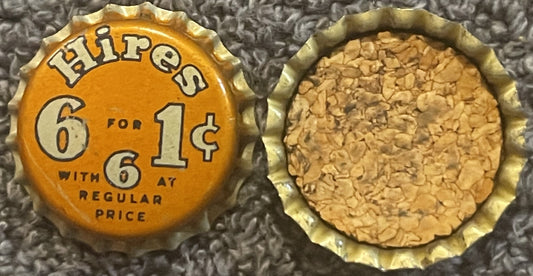
An unused Hires Draft Style root beer crown cap — new old stock, never crimped onto a bottle. Hires orange, with DRAFT STYLE across the top in white, the chunky white Hires logo with its orange dot set in a dark brown panel, ROOTBEER beneath it, and around the lower edge CARAMEL COLORED · NATURALLY & ARTIFICIALLY FLAVORED.

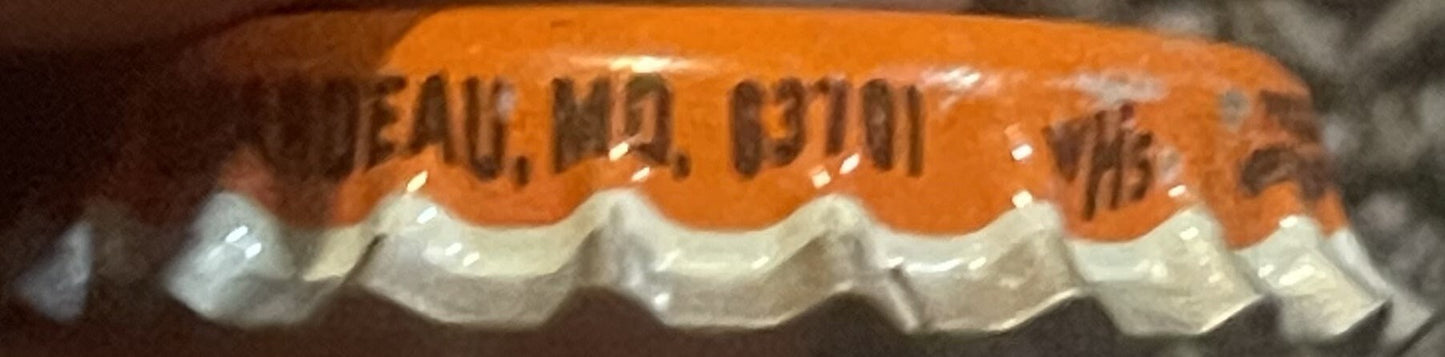
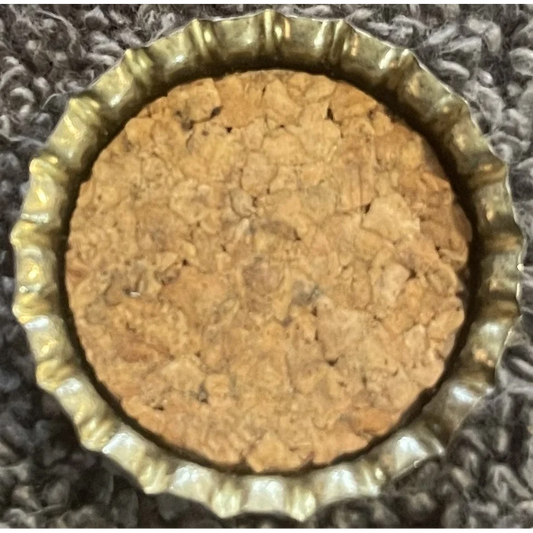
Around the skirt it carries the bottler's name — Baker Bottling Co. Inc., Cape Girardeau, Mo. — and inside, the original natural cork liner is still pressed into the fluted crown. The rest of the skirt is the bit I like best: PRODUCED UNDER THE AUTHORITY OF THE HIRES DIVISION, 2201 MAIN ST., EVANSTON, ILL. 60204. That was Crush International's American office, in Evanston, just north of Chicago. Crush made its concentrate there and in Trenton, New Jersey, and sold it to the bottlers franchised for Orange Crush and Hires — more than 300 of them across the country in 1968. Baker, down on the Mississippi with its own 63701 printed on the cap, was one of those bottlers.

📅 How Old It Is

1960s. The flavor line printed on the cap belongs to root beer after 1960, when artificial flavor replaced what the FDA had just banned, and the bold panel logo is the Hires look of those years. The cork liner puts it before plastic liners took over the industry. And both addresses on the skirt carry a five-digit ZIP code, which the Post Office only brought in on 1 July 1963 — so this cap was printed no earlier than that.

🌿 1960: The Year Root Beer Changed

For most of its history root beer tasted the way it did because of sassafras. The oil from sassafras root bark is mostly safrole — 80 to 90 percent of it — and in 1960 the Food and Drug Administration banned sassafras in foods and drinks after laboratory studies linked safrole to cancer.

Every root beer maker in America had to reformulate. After the ban, root beer was made with sarsaparilla, with safrole-free extracts, or with artificial flavor — which is why a cap like this one tells you, right on its face, that the drink under it was "naturally & artificially flavored."

🏢 The Family Lets Go

The same year, the Hires family sold the company to Consolidated Foods. Two years later, in 1962, it went to Crush International. From there it passed to Procter & Gamble in 1980, Cadbury Schweppes in 1989, Dr Pepper Snapple Group in 2008, and finally Keurig Dr Pepper — one brand among dozens, in the company of the brands it had once outsold.

🎶 Fifty Cents And Two Bottle Caps

Here is the piece of Hires lore that makes a cap like this one worth a second look. In the early 1960s the jazz singer Blossom Dearie — the small, girlish voice behind a string of cult records — sang Hires Root Beer's television commercials, and the jingle she recorded in 1962 was a hit.

Hires turned it into a premium: in 1963 it put out an LP, Blossom Dearie Sings Rootin' Songs, with jazz versions of the day's standards — "Days of Wine and Roses," "I Left My Heart in San Francisco," "Fly Me to the Moon." You could not buy it in a record shop. You sent in 50 cents and two Hires bottle caps. For a little while, caps like this one were money.

🚚 Baker Bottling Co., Cape Girardeau

Big soda brands did not bottle their own drinks everywhere; they sold syrup to regional bottlers who put the brand's name on local bottles and caps. In Cape Girardeau, Missouri, on the Mississippi, that bottler was Baker Bottling Company — which also traded as Baker Carbonic and bottled Hires alongside the likes of Double Cola and Canada Dry. Its name on the skirt of this cap is the part that makes it a Cape Girardeau piece.

Cape Girardeau was an old river town long before it was a bottling town. It takes its name from a French trader, Girardot, whose post stood on the rocky cape that juts into the Mississippi; the town itself was founded on 4 January 1793 on a Spanish land grant to Louis Lorimier, whose "Red House" trading post became the best-known stop between St. Louis and Memphis. Lewis and Clark called there on 23 November 1803, and once the steamboats arrived in 1835 it grew into the biggest trading town on that stretch of river — the kind of place where a local bottler could put a national brand on every cooler for miles.

🍺 "Draft Style"

The best root beer was never supposed to come from a bottle — it came from a soda fountain tap at the drugstore or the five-and-dime, foaming into a heavy glass, often with a scoop of vanilla on top. "Draft Style" on the cap was the bottler's promise that the root beer under it tasted like the fountain pour.

🥤 Where Hires Began

Charles Elmer Hires, a Philadelphia pharmacist born in Roadstown, New Jersey, in 1851, was selling 25-cent packets of root beer powder at the 1876 Centennial Exposition and handing out free glasses to win customers. The legend says a preacher, Russell Conwell — founder of Temple University — steered him to call it root beer rather than root tea, so hard-drinking Pennsylvania coal miners would order it. It worked well enough that "root beer" became an American word, and Hires the name that set the standard for every root beer after it. And it was a Philadelphia business through and through: he first sold his root beer at his drugstore at Sixth and Spruce, the first factory was on Arch Street, and by about 1905 the company was in the Hires Building on North Broad Street.

🕯️ How Hires Disappeared

By 2023 Keurig Dr Pepper no longer listed Hires among its brands. The last canning had been done at the American Bottling Company in Ottumwa, Iowa, and the last Hires fountain syrup came from Kalil Bottling Company of Tucson, Arizona, which sold its operations to Keurig Dr Pepper on 9 August 2024.

✅ Condition

New old stock. Unused, never crimped onto a bottle. Colors bright, the white lettering crisp, cork liner intact.

🖼️ What People Do With These

  • Frame it next to a copy of Blossom Dearie Sings Rootin' Songs — the cap that paid for the record
  • Add it to a Missouri or Cape Girardeau collection alongside local bottles and signs
  • Set it on a board of soda caps, where the orange Hires cap is the one people point at
  • Give it to someone who grew up on Hires and cannot buy it anymore
  • Put it in a shadow box with a root beer float glass

🏭 WHS — the Mark of W. H. Hutchinson & Sons, Chicago

One small mark near the edge reads WHS. It identifies the manufacturer of the cap rather than the bottler or the brand: W. H. Hutchinson & Sons of Chicago, whose route into the crown cap business is a story in itself.

William H. Hutchinson was a Chicago soda bottler and a maker of bottling plant. In 1879 his son Charles G. Hutchinson patented the Hutchinson's Patent Spring Stopper — a wire loop and rubber disc that sealed a soda bottle from the inside, and that you opened by thumping it down with your thumb. It swept the trade and made every rival closure obsolete. By 1882 the family had sold the bottling side to the Hayes brothers so the firm could concentrate on manufacturing.

Then William Painter's crown cap arrived and did to the Hutchinson stopper exactly what the stopper had done to everything before it: cheaper, more sanitary, quicker to apply. Painter was a Baltimore man — he patented his "crown cork" in 1892 and started the Crown Cork & Seal Company of Baltimore to make it. Rather than go down with their own patent, W. H. Hutchinson & Sons went into making crown caps, shipping them out of Chicago by the gross in wooden barrels stencilled W H HUTCHINSON & SONS CHICAGO and marked to be kept dry — because of the cork. The mark on this cap belongs to the people whose own invention the crown cap destroyed.

❓ Questions People Ask

Can you still buy Hires Root Beer?
No — the brand is off Keurig Dr Pepper's list, and the last Hires fountain syrup was made in 2024.

Why does it say "Naturally & Artificially Flavored"?
In 1960 the FDA banned sassafras, the traditional root beer flavor, and root beer makers reformulated with artificial flavor.

Who was Baker Bottling?
The regional bottler in Cape Girardeau, Missouri, that bottled Hires under license; its name is on the cap.

How old is it?
1960s.

Has it been used?
No. New old stock, never crimped, cork liner intact.

Shipping

🚚 Shipping & Handling

  • Shipping costs and timing are calculated at checkout.
  • Items curated and shipped directly by me include U.S. shipping at no additional cost, professionally packed to ensure safe arrival of your artifact.

Items from Vetted Pro Collectors
Shipping for items offered by vetted Pro Collectors is determined at checkout. All Pro Collector listings are reviewed to ensure fair, reasonable shipping practices.

For full details, please refer to our Shipping Policy.

Returns & Exchange

Take your time — you've got a full six months. If a piece isn't right for you, send it back the way it reached you and we're good.

In the first 30 days your money goes straight back the way you paid. After that it's store credit, so you can put it toward something you'd rather have.

Return shipping we sort out between us, case by case. I don't make this difficult.

If something arrives damaged, or it isn't what I said it was, send me a photo within 48 hours and I'll make it right.

Email info@vintageantiquesgifts.com or call 802-356-9872 — that's me answering, not a call center.

The only things I can't take back are custom or special-order pieces and gift cards.

View full details

Preserving History: Authentic Objects Across Eras

— Curated by Travis Weigel