Skip to product information
1 of 5

Vintage and Antique Gifts

Antique American Bank Note Co 🦅 Preferred Stock Certificate, Brown Eagle Vignette, NYC

Antique American Bank Note Co 🦅 Preferred Stock Certificate, Brown Eagle Vignette, NYC

Regular price $10.00 USD
Regular price Sale price $10.00 USD
Sale Sold out
Shipping calculated at checkout.

Size: 12" x 8"

🚚 Free US Shipping — ships within one business day. International shipping calculated at checkout.

Quantity

How Did Seven Engravers Become the American Bank Note Company? 🦅 An Antique American Bank Note Company 6% Cumulative Preferred Stock Certificate, Brown Eagle

Size: 12" x 8"

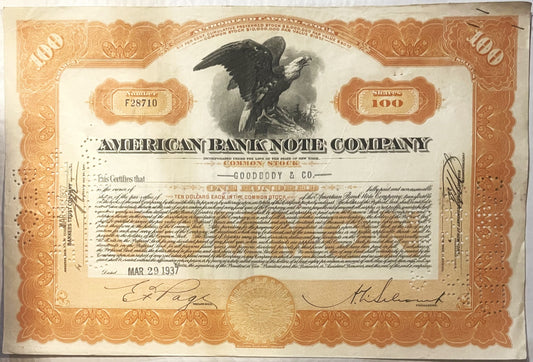
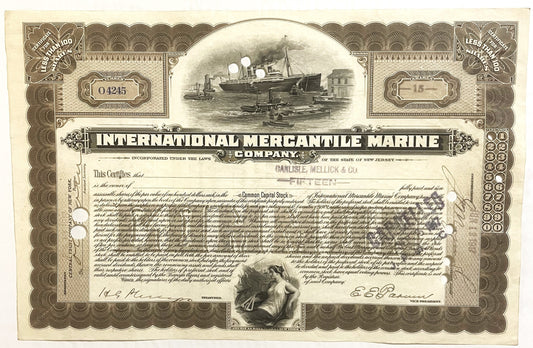
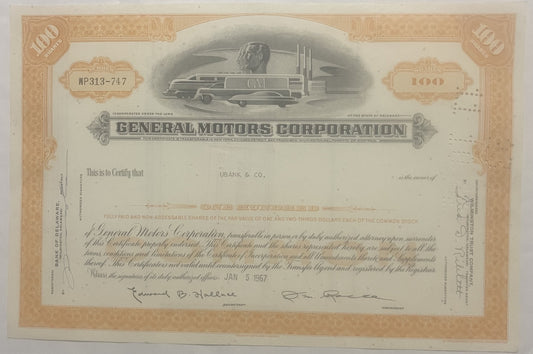
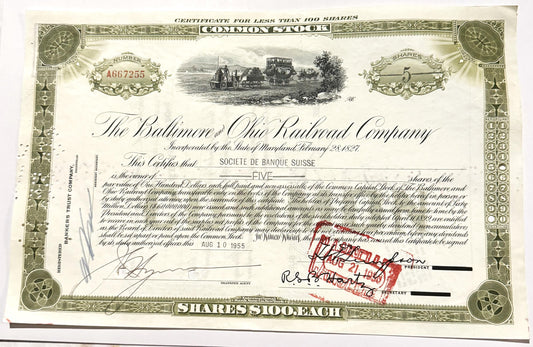
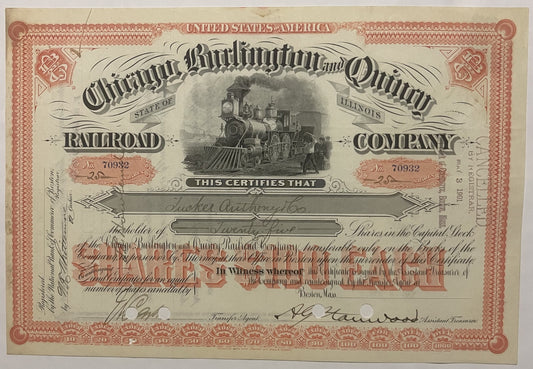
Most old stock asks you to believe in a railroad or a mine. This one is a share of the AMERICAN BANK NOTE COMPANY itself - the firm that engraved everybody else's money and stock - printed on its own presses with its own imprint, American Bank Note Co. New York. It's the SIX PER CENT. CUMULATIVE PREFERRED STOCK, FIFTY DOLLARS EACH, with CERTIFICATE FOR LESS THAN 100 SHARES in both top ovals, a black bald eagle on a rock above the pines, a brown lathework border, and the authorized capital arched across the top: $5,000,000 of preferred at $50 par and $10,000,000 of common at $10. The registrar is Bankers Trust Company and the transfer agent Guaranty Trust Company of New York. Each one was filled in, signed, sealed and punch-cancelled.

📅 1930s-1950s

There's no printed date, but the transfer agent dates the plate: Guaranty Trust became Morgan Guaranty when it merged with J.P. Morgan & Co. in 1959, so this was engraved before that. Its sister common-stock sheets, with the same header and the same banks, turn up stamped from 1934 to 1952. The one you get will carry its own date, number, owner, share count and stamps, and may look a little different from the one in my pictures.

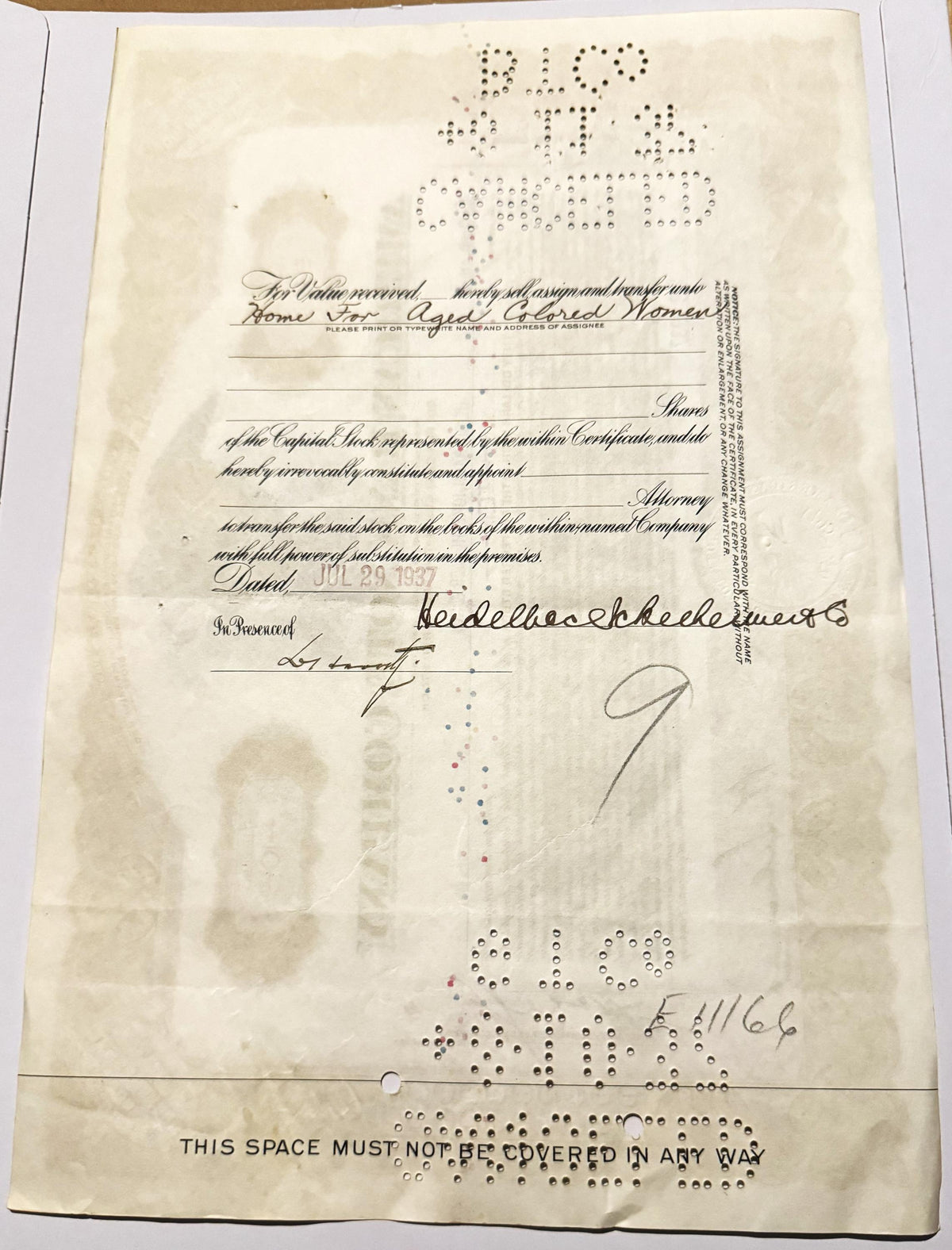
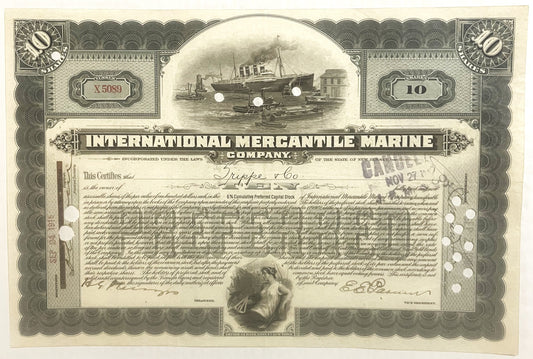
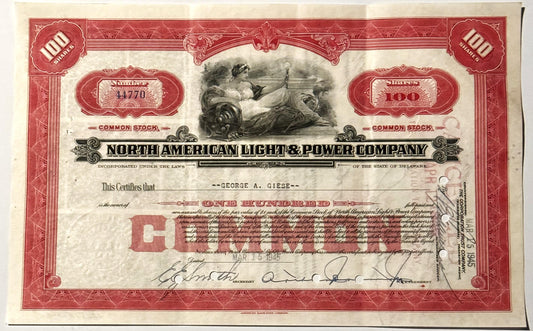
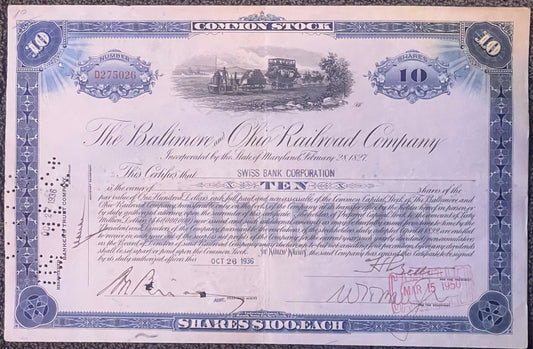
📜 Every one of these certificates had a working life, and it can show. Depending on the sheet, you may find staples or staple holes, cancellation punch holes (often right through the signatures), hand stamps from banks, brokers and transfer agents, real federal or state stock transfer tax stamps, handwriting or a filled-in transfer on the back, papers still attached, seals (a corporate seal pressed into the paper, a foil wafer seal, or a bank's signature-guarantee stamp signed across an endorsement), or a silver strip pasted over an officer's signature with the new officer's signature printed on top. That last one is what collectors call silvering: when the officers changed, the new signature could be pasted right over the old one on certificates already printed. None of that is damage. Each mark is part of the paper's own history, and they vary sheet to sheet, so no two are quite alike.

🏛️ Seven engravers, one company

American Bank Note came together in 1858, in the shaky aftermath of the Panic of 1857, when seven of the country's big security engravers - Toppan, Carpenter; Rawdon, Wright, Hatch & Edson; Danforth, Perkins; Jocelyn, Draper, Welch; Wellstood, Hay & Whitney; Bald, Cousland; and John E. Gavit - decided merging beat fighting. Its roots go back further, to 1795 and the engraving shop of Robert Scot, the first chief engraver of the U.S. Mint. John Draper learned the trade at Scot's Philadelphia shop and around 1810 went into business with George Murray and Gideon Fairman as Murray, Draper, Fairman and Co., one of the banknote houses whose line ran into the merger. And the company never strayed far from Wall Street: its first home and plant were at 55 Wall Street, the old Merchants' Exchange, with a currency press up in the penthouse from 1862; it moved to 142 Broadway in 1867, to 78-86 Trinity Place in 1882, and in 1908 into its own building at 70 Broad Street, which held the head office until 1988. In the Civil War it printed the government's first Demand Notes along with the National Bank Note Company, from 1879 to 1894 it printed the nation's postage stamps, finishing with the 1893 Columbian commemoratives, and in 1879 and 1911 it swallowed its rivals National, Continental and United Bank Note. Its engraver-president Albert Gallatin Goodall, who had cut banknote plates in Philadelphia before he ran the place and signed its stock in the 1880s, is said to have traveled Europe and South America himself to bring home foreign contracts.

🏭 The Bronx plant

Its legendary printing plant at Hunts Point in the Bronx went up between 1909 and 1911, and in the 1960s it was handling more than five million pieces of paper a day and printing half the securities traded on the New York Stock Exchange, plus money for 115 countries, best known for Latin America's - Cuba, Mexico, Brazil, Haiti, Ecuador and Costa Rica among them. Collectors passing this certificate down through the hobby have kept alive a piece of workplace lore worth preserving here: it's said the company employed its own in-house counterfeiter - an engraver whose actual job was to try to copy ABN's own banknotes and securities from a locked office high in the plant's tower. Whenever he succeeded, the story goes, it wasn't treated as a failure but as free intelligence, and the design got harder to fake. Old-timers in the trade also recall that every single sheet of paper was counted thirty-three separate times, with any reject burned in the furnace rather than risk it leaving the building - and the plant's own history bears all three of them out.

On March 20, 1977 the FALN set off a bomb there, calling the plant a symbol of capitalist exploitation. By 1984 or 1985 the company had moved its printing up to Blauvelt, New York, and in 2008 the Hunts Point plant became a city landmark. Through the 1980s and '90s Wall Street moved share ownership off engraved paper and into electronic records, and the work dried up: the company filed for Chapter 11 in December 1999, came out of it in 2002, and carries on today as ABCorp, headquartered in Boston and making secure payment cards.

🦅 About these

They're 12 by 8 inches, engraved on heavy banknote-style paper. Frame one for a banker, a stamp or coin collector, or anybody who'd appreciate owning a piece of the printer instead of the printed. The supply is finite - nobody's issuing American Bank Note preferred again, and once these last ones are framed, they'll be very difficult to acquire.

Shipping

🚚 Shipping & Handling

  • Shipping costs and timing are calculated at checkout.
  • Items curated and shipped directly by me include U.S. shipping at no additional cost, professionally packed to ensure safe arrival of your artifact.

Items from Vetted Pro Collectors
Shipping for items offered by vetted Pro Collectors is determined at checkout. All Pro Collector listings are reviewed to ensure fair, reasonable shipping practices.

For full details, please refer to our Shipping Policy.

Returns & Exchange

Take your time — you've got a full six months. If a piece isn't right for you, send it back the way it reached you and we're good.

In the first 30 days your money goes straight back the way you paid. After that it's store credit, so you can put it toward something you'd rather have.

Return shipping we sort out between us, case by case. I don't make this difficult.

If something arrives damaged, or it isn't what I said it was, send me a photo within 48 hours and I'll make it right.

Email info@vintageantiquesgifts.com or call 802-356-9872 — that's me answering, not a call center.

The only things I can't take back are custom or special-order pieces and gift cards.

View full details
  • 5 stars: 2 (100%)
  • 4 stars: 0 (0%)
  • 3 stars: 0 (0%)
  • 2 stars: 0 (0%)
  • 1 star: 0 (0%)
n
n***e (1234)

Super FAST shipping ! Item arrived as described. Stock note was well packaged and arrived securely intact. A++

a
a***a (387)

Hi my friends I received my order my vintage company stock certificate and am very excited to see it . I love it great collection and right on time. I’m very proud to support you and your family keep up your great work I’ll be back for more stay safe and healthy my friends 👍

Rescuing American History Since 2007

— Travis & the Kids