Skip to product information
1 of 3

Vintage and Antique Gifts

Antique 1930s-1940s North American Light & Power Stock Certificate 📜 SEC Casualty Engraved Bank Note Company Share

Antique 1930s-1940s North American Light & Power Stock Certificate 📜 SEC Casualty Engraved Bank Note Company Share

Regular price $7.00 USD
Regular price Sale price $7.00 USD
Sale Sold out
Shipping calculated at checkout.

Size: 12" x 8"

🚚 Free US Shipping — ships within one business day. International shipping calculated at checkout.

Quantity

What Did the Studebakers Have to Do With North American Light & Power? ⚡ An Antique 1930s-1940s North American Light & Power Company Stock Certificate, American Bank Note Company

Size: 12" x 8" ~ Little to no wear.

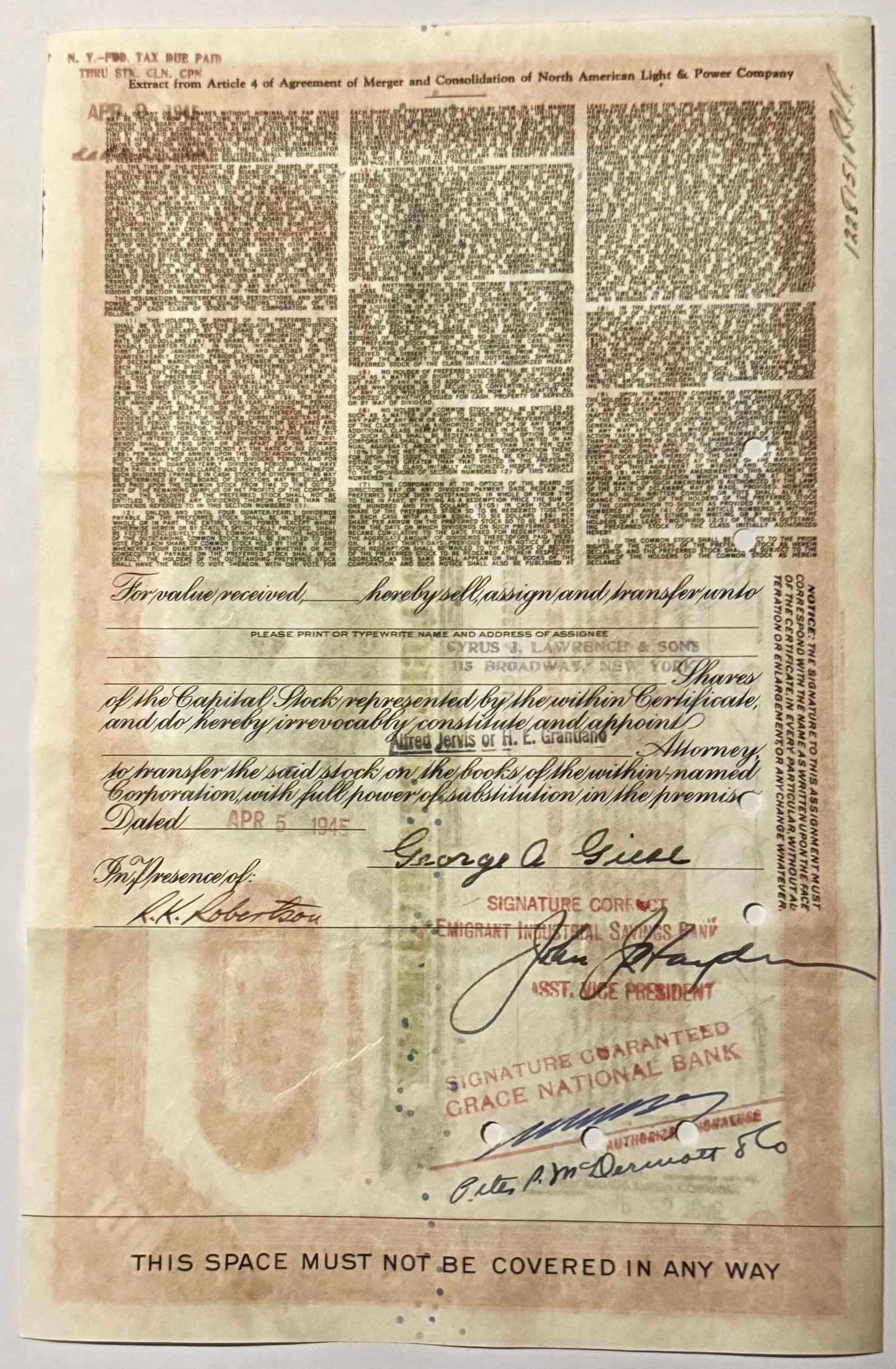
A real, issued common stock certificate of the NORTH AMERICAN LIGHT & POWER COMPANY, INCORPORATED UNDER THE LAWS OF THE STATE OF DELAWARE, engraved in red and black by the AMERICAN BANK NOTE COMPANY. The vignette is the electric age dressed up as mythology: a reclining classical woman holding up a glowing light bulb like a torch, leaning on a dynamo. A big red COMMON runs across the face, The Corporation Trust Company of Wilmington, Delaware countersigned as transfer agent, and the back carries an extract from the company's Agreement of Merger and Consolidation and the transfer form. Each one was signed, stamped CANCELLED and punched when the shares changed hands.

Read the fine print on the front and you'll see these were shares "of the par value of $1 each" of the common stock. Flip it over and the heading tells you exactly which part of the deal you're reading - Article 4 of the Agreement of Merger and Consolidation - set in tiny type over three columns, with the assignment form underneath and a stern line along the bottom: THIS SPACE MUST NOT BE COVERED IN ANY WAY. The assignment form is where the brokers and banks stamped their signature guarantees as the shares moved from hand to hand.

⚡ The Studebaker connection

North American Light & Power was a utility holding company out of South Bend, Indiana, and from 1916 its president was Clement Studebaker Jr. (1871-1932) - son of Clement Studebaker of the wagon and automobile family. South Bend folks like to say the Studebakers moved America and lit it too. Under him the company owned or controlled more than a hundred gas and electric properties, Illinois Power and Traction and Washington Gas and Electric among them.

Clement Jr. was born in South Bend on August 11, 1871, and he learned the family business from the floor up, working his way through the Studebaker departments to a seat on the board and the treasurer's job, and serving as vice-president of E-M-F, the Detroit carmaker Studebaker took over. The family's showpiece was Tippecanoe Place, the big mansion Chicago architect Henry Ives Cobb designed for his father in 1889. Power was where the son made his own name: besides running North American Light & Power he was president and chairman of the Illinois Power and Light Company and its Illinois Traction Company, he headed the South Bend Watch Company, and he was treasurer of the Chicago South Shore and South Bend Railroad. He moved to Chicago around 1920 and died at his home at 1500 Lake Shore Drive in December 1932. They brought him home to South Bend and laid him in the family mausoleum at the City Cemetery.

🔌 How the Illinois side came together

The company was put together around 1915, and it grew by buying. In 1919 it picked up Southern Illinois Light & Power, which had been formed in 1913 to pull together the little utilities east of St. Louis. In 1923 it bought Illinois Traction, the outfit William B. McKinley had started in 1904 out of heat, light and power companies in Danville, Champaign, Urbana and Decatur, and merged the two into Illinois Power & Light Corporation, with McKinley as chairman. That piece of the pyramid went on to become the Illinois Power Company, headquartered in Decatur, and it stood on its own in 1947 when North American Light & Power finally let go of it.

🏛️ The pyramid and the SEC

By 1940 it was one of the three big holding companies among the ten direct subsidiaries of The North American Company, a $2.3 billion pyramid of some 80 companies - a dollar at the top controlling many dollars of power plants and wire at the bottom. That parent at the top was older still: it was incorporated in New Jersey on June 14, 1890, under Henry Villard, kept its offices at 60 Broadway in Manhattan, and was one of the twelve original stocks in the Dow Jones Industrial Average when the index started on May 26, 1896.

The Public Utility Holding Company Act of 1935 gave the Securities and Exchange Commission the power to take pyramids like that apart. On December 30, 1941 the SEC ordered North American Light & Power liquidated; it started selling off its properties in 1942, let go of its last Illinois Power interest and was dissolved by 1947-48. The parent fought the Act all the way to the Supreme Court and lost on April 1, 1946, in North American Co. v. SEC. That's why collectors call these SEC casualties - this is paper from a company the government took apart.

📅 How old are they

This red common printing was in use for more than a decade. Dated sheets of the same design run from the mid-1930s to 1947, with the earlier ones countersigned in Chicago and the later ones by The Corporation Trust Company in Wilmington, like the one in my photos. The one you get will carry its own date, number, owner, share count and bank stamps, and may look a little different from the one in my pictures.

🖋️ The engraving

American Bank Note Company engraved currency, stamps and bonds for governments around the world, and that's steel-plate intaglio you're looking at - the fine cross-hatching on the dynamo and the woman's drapery is cut into steel and pressed into the paper, so you can feel the ink standing up. Look close and you'll find leaves and a band in her hair, and the bulb in her hand throws engraved rays out over the garden wall behind her. Paper shares go back to 1606, when the Dutch East India Company issued the oldest one known; Disney stopped issuing paper certificates in 2013, which pretty much closed the book.

📜 About these

They're 12 by 8 inches, issued and cancelled. Frame one for a home office, give it to a Studebaker fan or anybody from South Bend, or put it with other utility paper for an electric-age wall. The supply is finite - the company was dissolved more than 75 years ago, nobody's issuing its stock again, and once these last ones are framed, they'll be very difficult to acquire.

Shipping

🚚 Shipping & Handling

  • Shipping costs and timing are calculated at checkout.
  • Items curated and shipped directly by me include U.S. shipping at no additional cost, professionally packed to ensure safe arrival of your artifact.

Items from Vetted Pro Collectors
Shipping for items offered by vetted Pro Collectors is determined at checkout. All Pro Collector listings are reviewed to ensure fair, reasonable shipping practices.

For full details, please refer to our Shipping Policy.

Returns & Exchange

Take your time — you've got a full six months. If a piece isn't right for you, send it back the way it reached you and we're good.

In the first 30 days your money goes straight back the way you paid. After that it's store credit, so you can put it toward something you'd rather have.

Return shipping we sort out between us, case by case. I don't make this difficult.

If something arrives damaged, or it isn't what I said it was, send me a photo within 48 hours and I'll make it right.

Email info@vintageantiquesgifts.com or call 802-356-9872 — that's me answering, not a call center.

The only things I can't take back are custom or special-order pieces and gift cards.

View full details
  • 5 stars: 1 (100%)
  • 4 stars: 0 (0%)
  • 3 stars: 0 (0%)
  • 2 stars: 0 (0%)
  • 1 star: 0 (0%)
J
Jim Eisfeller

Beautiful, intricately detailed, old stock certificate. Arrived in good condition in a protective plastic sleeve. Personal notes from the seller and his children were a nice touch.

Preserving History: Authentic Objects Across Eras

— Curated by Travis Weigel