Skip to product information
1 of 4

Vintage and Antique Gifts

Antique 1882 Oregon and Transcontinental Railroad 1000 Dollar Gold Bond Henry Villard Northern Pacific History 📜

Antique 1882 Oregon and Transcontinental Railroad 1000 Dollar Gold Bond Henry Villard Northern Pacific History 📜

Regular price 26.00 USD
Regular price Sale price 26.00 USD
Sale Sold out
Shipping calculated at checkout.
Quantity

What Were These Two Watching for on the Bluff Above the Valley? 🏔️🚂

I've spent a good part of my collecting life going through boxes of old railroad paper, and every so often a piece stops me cold — not because of the numbers printed on it, but because of the picture. This one does exactly that. Two Native American figures, feathered and watchful, kneel on a rocky bluff looking down over a valley where a steam locomotive rolls past a suspension bridge and a paddle steamer works its way upriver toward a distant town. It's a small engraving, tucked into the top of a big financial document, but it tells you everything about the moment this bond was printed — a moment when the old world and the new one were staring at each other across the same valley, and everybody making money on paper like this one knew exactly which way the wind was blowing.

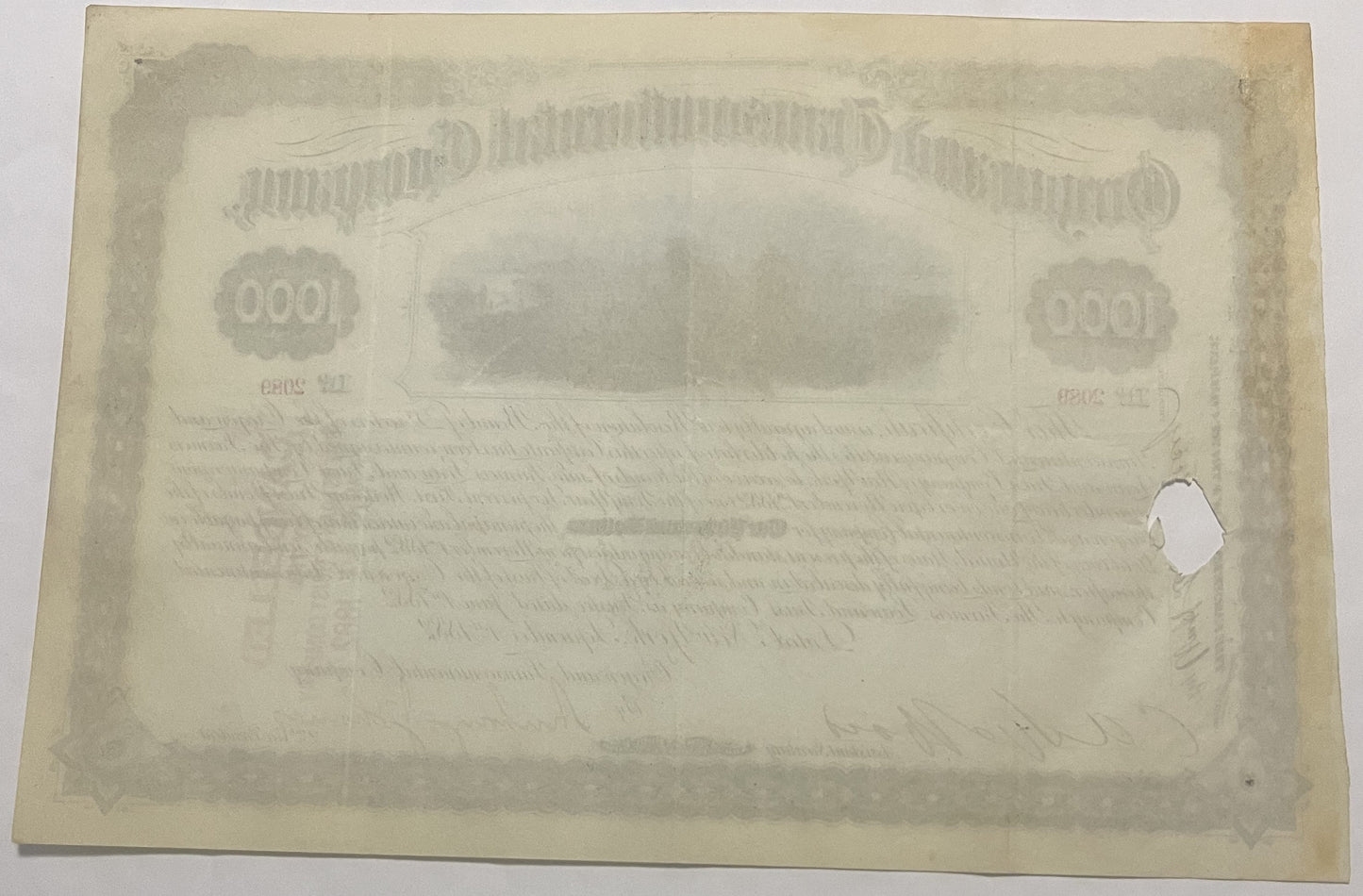
This is an Oregon and Transcontinental Company $1,000 First Mortgage Trust Bond certificate, engraved and printed by the American Bank Note Company of New York, with this issue's printed date of September 1, 1882. It is an issued and cancelled piece measuring 11.5 x 7.75 inches, done in black and green ink on cream banknote paper, combining hand-set letterpress text, flowing engraved script, and a central steel-plate vignette bordered by elaborate lathe-work scrollwork — the kind of ornamental engine-turned engraving that Gilded Age bank note printers used specifically because it was almost impossible to counterfeit. Each certificate in this series carries a hand-inked serial number in red ink, and examples that completed their financial life, like this one, carry a red CANCELLED overprint along with the hand signatures of the company's officers. It's a genuine artifact of 1880s American railroad finance — not a reproduction, not a replica, but an actual piece of paper that once represented real money backing a real transcontinental railroad.


🚂 Henry Villard's "Blind Pool" and the Race to the Pacific

To understand what this certificate represents, you have to understand the man behind it: Henry Villard, a German-born journalist turned financier who became one of the most audacious railroad men of his era. Villard had made his name reporting on the Civil War and covering Abraham Lincoln, but by the late 1870s he'd pivoted hard into finance, buying up struggling Pacific Northwest rail and steamship lines and consolidating them into the Oregon Railway and Navigation Company. His real prize, though, was bigger: the Northern Pacific Railroad, a struggling transcontinental line chartered back in the Lincoln era that had never managed to reach the coast.

Collectors and railroad historians still talk about Villard's famous 1881 "blind pool" — a fundraising scheme so bold it became legend in its own time. Villard went to his network of investors and asked them to commit millions of dollars to an unnamed venture, promising only that he knew what he was doing and that the returns would be worth the mystery. They bit. The money raised in that blind pool became the engine behind the Oregon and Transcontinental Company, organized as the holding company that let Villard weld the Northern Pacific and the Oregon Railway and Navigation Company into a single Pacific Northwest empire. Bonds like this one were part of the machinery that kept that empire financed — a Forty Year, Six Percent First Mortgage Trust Bond, principal and interest payable in gold coin of the United States, the gold clause itself a reminder that this was an era when paper money's worth was still measured against a stack of bullion in a vault.


🏔️ The Northern Pacific: A Ribbon of Rail Across a Continent

The Northern Pacific was no small undertaking. Old-timers in the railroad history world still cite its reach — a network eventually stretching nearly 6,800 miles across Minnesota, North Dakota, Montana, Idaho, Oregon, and Washington, with connections running north into Winnipeg, Manitoba. It was a land-grant railroad, meaning the federal government had handed over enormous tracts of western land to help finance construction, betting that a rail line to the Pacific would open the Northwest to settlement, agriculture, timber, and trade the way the first transcontinental route had opened the Central route a decade earlier.

Villard poured his fortune and his reputation into finishing the job. Local legend among railroad buffs holds that when the Northern Pacific's rails finally met in September of 1883 out in Montana Territory, Villard threw one of the most extravagant celebrations the American West had ever seen — chartering special excursion trains to bring former President Ulysses S. Grant, foreign dignitaries, and a small army of journalists out to witness the ceremonial last spike. It was, by every account passed down, a spectacle built to prove that the frontier had officially been tamed by iron rail. Bonds like this one, dated the year before that celebration, were part of the financial scaffolding that made the whole triumphant moment possible.


🎨 Two Figures on a Bluff: Reading the Vignette

The central engraving on this certificate deserves its own long look, because it's doing more storytelling than most bond vignettes of its era. Two Native American men, adorned in feathered headdresses and ear ornaments, kneel together on a rocky outcropping overlooking a broad river valley. One reaches a hand forward, almost as if pointing or gesturing toward something below; the other steadies himself against the rock. Below them, spread across the valley floor, is the whole apparatus of industrial expansion: a steam locomotive hauling freight cars along a track, work crews laying rail, a suspension bridge spanning the water, a paddle-wheel steamboat threading between the bridge towers, sailing vessels further out, and in the far distance, a town rising along the shoreline with mountains standing sentinel behind it.

This kind of composition — the watching figures of the original inhabitants set against the arriving machinery of settlement — was a favorite visual device of American banknote and bond engravers in the second half of the nineteenth century. It borrowed from the same romantic landscape tradition that painters like Bierstadt and Church had made famous, dramatizing the meeting of wilderness and industry on a single canvas. Engravers at firms like the American Bank Note Company used vignettes like this one deliberately: they were beautiful, they were emotionally resonant to investors back east who'd likely never seen the Pacific Northwest with their own eyes, and — practically speaking — the fine detail of hand-engraved figures and landscape was extraordinarily difficult for a forger to reproduce. Whatever else it was, this vignette was a small advertisement for the whole grand narrative of westward expansion that companies like the Oregon and Transcontinental Company were selling to investors: civilization arriving, rails advancing, the old world giving way to the new.


🖋️ The American Bank Note Company: Engraving the Nation's Trust

The engraving work on this certificate came from the American Bank Note Company, formed in New York from a consolidation of several of the country's most skilled security-printing firms. By the 1880s, American Bank Note was among the preeminent producers of currency, postage stamps, and financial certificates in the United States, and its engravers were true craftsmen — steel-plate specialists who could render a mountain range, a locomotive, or a human face in lines finer than a hair, all while weaving borders of geometric lathe-work so intricate that duplicating them by hand was nearly impossible. That combination of artistry and security is exactly why so many surviving bonds and stock certificates from this era, this one included, are collected today as much for their engraving as for their financial history. A share certificate or bond from a company that thrived might be tucked away in a bank vault; a bond from a company caught up in a moment as dramatic as the Northern Pacific's race to the Pacific becomes something closer to a printed history painting.


🏦 The Farmers' Loan and Trust Company: Guardians of Gilded Age Capital

Look closely at the text of this certificate and you'll find another name doing quiet, important work: The Farmers' Loan and Trust Company of New York, acting as trustee under the Deed of Trust securing these bonds. Trust companies like Farmers' Loan were the unglamorous backbone of Gilded Age finance — the institutions investors relied on to hold collateral, countersign certificates, and make sure that when a company like the Oregon and Transcontinental Company promised to pay interest semi-annually in gold coin, there was a neutral party standing behind that promise. It's easy to look past that fine print in favor of the dramatic vignette up top, but for the investors who actually held bonds like this one in 1882, the trustee's name was often the difference between confidence and hesitation.


📈 From Golden Spike to Cancelled Bond: What Happened Next

The triumph of 1883 didn't last long for Villard personally. The financial strain of finishing the Northern Pacific, combined with construction costs that ran far past projections, hit his companies hard, and within a year of that celebrated last-spike ceremony Villard had lost control of the empire he'd built. The Oregon and Transcontinental Company continued on for a time afterward as part of the broader reorganizations that swept through American railroad finance in the decades that followed, as so many overleveraged rail ventures of the era did. The CANCELLED stamp on certificates like this one marks the natural end of that story from a paper standpoint — the bond was redeemed, the obligation fulfilled, the certificate retired from active duty and, eventually, saved rather than destroyed. That's really the quiet miracle of scripophily as a hobby: these documents were never meant to outlive their financial purpose, yet here one is, more than a century later, still legible, still beautifully engraved, still telling the story of the men who bet everything on rails reaching the Pacific.


🖼️ Display Ideas

  • 🖼️ Framed alone under glass, letting the engraved vignette and ornamental borders take center stage in a study or office
  • 🚂 Paired with other railroad-era ephemera for a themed gallery wall celebrating the transcontinental era
  • 🏔️ Displayed near Pacific Northwest artwork or maps to anchor a regional history corner
  • 💼 Matted alongside a short write-up on Henry Villard and the Northern Pacific for a conversation-piece desk display
  • 📚 Kept in an archival sleeve as the centerpiece of a financial-history or scripophily collection
  • 🎓 Used as a teaching artifact for lessons on Gilded Age capital, westward expansion, or American engraving craft

🎁 Who Collects These

Scripophily collectors — people who collect old stock and bond certificates specifically for their history and artistry — are the natural home for a piece like this, but they're far from the only ones. Railroad history buffs chase down anything tied to the Northern Pacific and the transcontinental race. Fans of American engraving and banknote art collect these pieces purely for the steel-plate vignette work, the same skill set that produced the nation's currency. Pacific Northwest history enthusiasts value the direct tie to Oregon's early rail development. And plenty of people simply want a striking, authentically old piece of Americana with real depth behind it — something that rewards a closer look rather than just filling wall space.


📜 What This Document Actually Is

Read the certificate itself and it tells you plainly. It entitles the holder, once the sheet has been countersigned by The Farmers’ Loan and Trust Company of New York, to receive one of the Forty Year Six Percent First Mortgage Trust Bonds of the Oregon and Transcontinental Company for one thousand dollars — principal and interest payable in Gold Coin of the United States, secured by a Deed of Trust dated June 1st 1882.

So this is the step before the bond: an interim certificate, exchangeable on surrender for the bond itself. That is why so few survive intact. They were meant to be handed in and destroyed once the exchange was made, and the ones still here are the ones that completed that journey and were cancelled rather than quietly pulped.

This example is dated New York, September 1st 1882, carries its serial in red ink, and was cancelled by The Farmers’ Loan and Trust Company with a dated stamp and a punch. The engraving is by the American Bank Note Company of New York, whose imprint sits at the foot of the sheet — the same house that engraved United States currency.

🏞️ The Vignette

The scene in the centre is worth looking at properly. Two Native American figures stand on a bluff, one seated and one rising with an arm raised, looking down over a valley where a locomotive and its cars run along the near bank, a river opens toward the mountains, and a settlement spreads across the middle distance. It is steel-plate engraving of the first order, cut in fine line at a scale where the rolling stock and rooftops stay legible.

It is also, unmistakably, a picture of what the company was selling to its investors: the railroad arriving in country that had not had one. The figures on the bluff are placed as witnesses to it. Reading that vignette a hundred and forty years on, knowing what the transcontinental lines meant for the people already living along them, is a large part of what makes this piece worth keeping.

❓ FAQ

Is this an original 1882 certificate, or a reproduction?

This is an original, non-reproduction bond certificate. It is a genuine issued certificate on period paper, not a modern reprint.

What does the CANCELLED marking mean?

The red CANCELLED overprint indicates this bond completed its financial life and was formally retired after redemption, which is standard for surviving certificates of this kind.

Who was Henry Villard, and how is he connected to this bond?

Villard was the financier behind the Oregon and Transcontinental Company, organized to consolidate the Northern Pacific Railroad and the Oregon Railway and Navigation Company as part of his push to complete a rail connection to the Pacific Northwest.

What do the two figures in the central engraving represent?

The vignette depicts two Native American figures overlooking a valley scene of a railroad, suspension bridge, and steamboat — a composition common to the era's banknote and bond engravings, contrasting the western landscape with the arrival of industrial transportation.

Who printed this certificate?

The American Bank Note Company of New York, one of the era's leading security engravers, produced the steel-plate vignette and ornamental borders.

What size is the certificate?

It measures 11.5 x 7.75 inches.

Is this suitable for framing and display?

Yes — its scale and the detail of the central engraving make it well suited to framing as a standalone historical display piece.

Condition notes, plainly: an irregular dime-size paper hole sits left of center (visible both sides), with edge toning and top-left corner wear — a mid-grade example of a certificate nearly always found cancelled, priced accordingly.

These are issued instruments rather than blanks. Bonds and debentures of this type were registered to a holder, authenticated by the trustee, and punch- or cut-cancelled when they were finally redeemed. Expect financial writings, markings, stamps, hole punches and staple holes as part of the life of the instrument: endorsements and signatures, trustee and registrar stamps, revenue or documentary tax stamps, cancellation punches, staple holes from being bound into a transfer book, pencil ledger notations. That is the paper trail of a security that actually did its job, and it is what separates a document that lived from a blank that never did. No two are alike: holder details, serial numbers, dates, signatures, stamps and punch patterns vary from example to example, so the photographs show the type rather than the exact sheet that ships.

Shipping

🚚 Shipping & Handling

  • Shipping costs and timing are calculated at checkout.
  • Items curated and shipped directly by me include U.S. shipping at no additional cost, professionally packed to ensure safe arrival of your artifact.

Items from Vetted Pro Collectors
Shipping for items offered by vetted Pro Collectors is determined at checkout. All Pro Collector listings are reviewed to ensure fair, reasonable shipping practices.

For full details, please refer to our Shipping Policy.

Returns & Exchange

Take your time — you've got a full six months. If a piece isn't right for you, send it back the way it reached you and we're good.

In the first 30 days your money goes straight back the way you paid. After that it's store credit, so you can put it toward something you'd rather have.

Return shipping we sort out between us, case by case. I don't make this difficult.

If something arrives damaged, or it isn't what I said it was, send me a photo within 48 hours and I'll make it right.

Email info@vintageantiquesgifts.com or call 802-356-9872 — that's me answering, not a call center.

The only things I can't take back are custom or special-order pieces and gift cards.

View full details