

Skip to product information
1 of 3

Vintage and Antique Gifts

Antique 1910s Two Homers Cigar Band 🚬 Homing Pigeon Lithograph Tobacco Label Scalloped Cigar Ephemera

Antique 1910s Two Homers Cigar Band 🚬 Homing Pigeon Lithograph Tobacco Label Scalloped Cigar Ephemera

Regular price $6.00 USD
Regular price Sale price $6.00 USD
Sale Sold out
Shipping calculated at checkout.

Size: 2 3/4" x 3/4"

🚚 Free US Shipping — ships within one business day. International shipping calculated at checkout.

Quantity

Why Two Homing Pigeons on a Cigar Band? 🕊️ "They Always Come Back": A 1910s Two Homers Cigar Band from a Crossroads Village Near Gettysburg

Size: 2 3/4" x 3/4"

In October 1918 a wounded pigeon named Cher Ami flew through German fire to bring help to American soldiers trapped by the enemy and shelled by their own guns. In that same decade, in the Adams County village of Bonneauville, Pennsylvania, the A. J. Golden cigar factory was selling a smoke called Two Homers under a promise everybody understood: They Always Come Back.

Golden's shut its doors in March 1943, and the village has never had a more successful business since. The brand is gone, the factory is gone, and nearly every band that went around a Two Homers cigar went into an ashtray. This one never went around a cigar at all.

From the A. J. Golden stock, Pennsylvania.


🏷️ What Is Printed on This Band

  • Brand: TWO HOMERS, arched across the center in black capitals
  • Slogan: THEY ALWAYS COME BACK, printed twice, once on each side
  • Art: two homing pigeons standing side by side, drawn in fine dark line work
  • Colors: a warm yellow-gold field inside a cream border, with black type
  • Shape: a wavy, scalloped band that swells at the middle; at one end the gold field forks into a notched tab, printed on, with the paper itself left whole
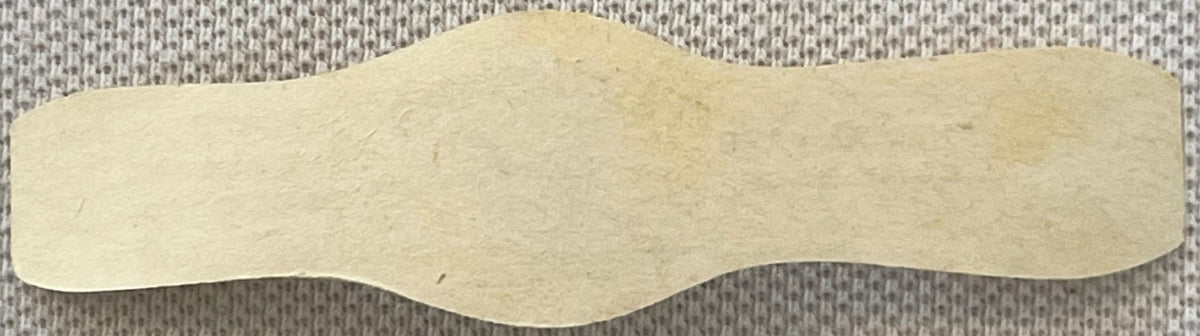
  • Back: plain, unprinted paper
  • Size: 2¾ inches by ¾ inches
  • Made: lithograph on paper, 1910s
  • Maker of the brand: A. J. Golden, Bonneauville, Pennsylvania
  • Condition: new old stock, never wrapped around a cigar

The two birds are the whole show. They stand chest-forward on a little patch of ground, one just behind the other, every feather put in with short strokes so the wings read as layered and the necks shine. The yellow is strong enough to catch an eye across a store counter, which is exactly the job a band had to do.


🏭 A. J. Golden and the Cigar Makers of Bonneauville

A. J. Golden started making cigars in Bonneauville in 1895, licensed under federal cigar tax number 2464. The business began at 1 W. Hanover Street, moved across to 1 E. Hanover Street, and later to a third building about two blocks east along the same road. By 1906 the village had four licensed cigar manufacturers: A. J. Golden, Emery L. Golden, F. H. Smith and A. L. Wagaman. E. L. Golden alone was turning out around three million cigars a year from factories in Bonneauville and nearby Two Taverns.

The Goldens ran about ten brands. Their star was Blue Ribbon, a label first designed in 1909, and A. J. Golden held the copyright for Golden's Blue Ribbon by 1926. Beside it came Bokay-Grande, Bunney Boys, Penn Rose, Two Friends, Newcomers, Tu-Tu-Chu chewing cigars, and Two Homers, which the firm put out from about 1910. The Two Homers cigar box labels carry the same pair of pigeons on the same bright yellow with the same line, They Always Come Back.

Local history remembers Golden's as the most successful business ever to operate in Bonneauville. Production stopped on March 5, 1943.


🏘️ Bonnaughtown: The Village Behind the Band

Bonneauville was settled in 1755 and grew up where two country roads crossed at odd angles, one running from New Oxford to Two Taverns and the other from Hunterstown to Littlestown. A blacksmith shop, a log hotel and a few houses made the start. The first families were Low Dutch; after 1800 Pennsylvania Germans took over the homes and farms. Its old name, Bonnaughtown, turns up in the journals of officers and soldiers who marched through during the Gettysburg campaign of the Civil War. The village did not become a borough until 1961, and it counted 1,758 people in 2020.

Bonneauville sat in the middle of Pennsylvania's cigar country. Lancaster County grew tobacco as its leading cash crop from 1840 all the way to 2000. In York County, cigar making employed more people than any other industry by the early 1900s, and the small town of Red Lion was making roughly 10 percent of all the cigars produced in the United States. Village factories like Golden's rolled the leaf into cigars and sold them under names a smoker would remember. Golden's was just one of them in a very big trade. In New York, a young Samuel Gompers and his father rolled cigars by hand at home in a crowded Lower East Side tenement after the family came over from England in 1863, and Samuel went on to found the American Federation of Labor. Down in Florida, Vicente Martinez Ybor signed on in 1885 to move his cigar business from Key West to 40 acres outside Tampa, and by 1910 Tampa had more than two hundred cigar factories turning out over a million cigars a day. And the little cigar towns of New York, Pennsylvania and Ohio were served by printers like F. M. Howell of Elmira, New York, which opened in 1883, shipped by horse, barge and rail to thousands of small cigar makers across those three states, and became a major supplier of their cigar bands. That's the world a band like this one came out of.


⚾ One Word With Two Meanings

By the 1910s homer was an everyday American word twice over. Baseball had been using it as short for a home run since 1868, and pigeon fanciers had been calling a bird trained to fly home from a distance a homer since 1880. A man reading "Two Homers" on a cigar band could hear the ballpark or the backyard loft. The pictures on this band settle which one the printer drew.


🐦 The Birds That Always Came Back

Homing pigeons were brought to America from Europe, and the first club to race them was formed by 1872. Philadelphia had the biggest crowd of fanciers; at an 1880 pigeon show there, the Red Star Club's guests agreed to form the Atlantic Federation of Homing Pigeon Societies. Rival leagues fought over the sport for decades until the American Racing Pigeon Union was founded in Washington, D.C., on November 9, 1910, to write one set of rules and pay out cash prizes. The union was new when Two Homers was new.

Then the war made the homer a hero. On October 4, 1918, Major Charles W. Whittlesey's "Lost Battalion" was surrounded by German forces and taking a barrage from American artillery that had the wrong coordinates. The men had one pigeon left, the eighth and last: Cher Ami. The bird flew about 25 miles in roughly 30 minutes through heavy German fire, badly wounded, and delivered the message that gave the battalion's exact position. The survivors were relieved on October 7. The French government awarded Cher Ami the Croix de Guerre with palm, and the Army Signal Corps gave the bird to the Smithsonian, where it went on public display in June 1921.

The birds on this band are homers, not passenger pigeons, and the difference is its own story. The passenger pigeon once flew across North America in the billions. Hunting and the clearing of the forests wiped it out in about a hundred years, and the last known one, a bird named Martha, died at the Cincinnati Zoo on September 1, 1914. She was frozen into a 300-pound block of ice and sent by fast train to the Smithsonian. One kind of pigeon vanished in the same decade the other became a national symbol of coming home.


🚬 The Legend of the First Cigar Band

Every cigar band carries a little legend with it. The story goes that Catherine the Great of Russia smoked her cigars wrapped in silk so they would not stain her fingers, and that her court copied her with fabric bands of their own. Another tale says paper bands were put on cigars shipped to England to keep gentlemen's white gloves clean. No reliable record shows Catherine ever smoked.

Historians instead credit Gustave Bock, a Dutch-born cigar maker in Cuba, who ordered paper rings printed with his signature for every cigar he exported to Europe as a mark of quality. Other Cuban makers soon did the same, and the band became the cigar's calling card. Collecting them has its own name, vitolphilia, and its own society, the International Label, Seal and Cigar Band Society.


🕰️ What Survives

The cigar towns of southern Pennsylvania shaped whole communities: who worked, where the roads went, what a village like Bonneauville had to trade. That legacy mostly went up in smoke. A band like this was meant to be slipped off and thrown away, which is why a clean, unused one is the piece of the story that lasts. Two pigeons, one slogan, and the name of a brand from a crossroads village that made millions of cigars and then quietly stopped.


❓ Questions People Ask

Who made Two Homers cigars?
A. J. Golden of Bonneauville, Adams County, Pennsylvania, a cigar firm that ran from 1895 until March 1943 and was best known for Blue Ribbon.

How old is this band?
It is a 1910s band, new old stock, never put on a cigar.

How big is it?
2¾ inches by ¾ inches.

Are those passenger pigeons?
No. They are homing pigeons, called homers, the racing and message-carrying birds the brand is named for.

What does "They Always Come Back" mean?
A homing pigeon returns to its own loft from far away. The line promises the same loyalty from anyone who tries the cigar.

What is cigar band collecting called?
Vitolphilia.

Where is Bonneauville?
In Adams County, Pennsylvania, near Gettysburg.

Who would enjoy it?
Tobacciana and cigar band collectors, pigeon fanciers and racing-club members, World War I and Cher Ami enthusiasts, Adams County and Gettysburg-area history lovers, and baseball fans who like a word with a double life.

Shipping

🚚 Shipping & Handling

  • Shipping costs and timing are calculated at checkout.
  • Items curated and shipped directly by me include U.S. shipping at no additional cost, professionally packed to ensure safe arrival of your artifact.

Items from Vetted Pro Collectors
Shipping for items offered by vetted Pro Collectors is determined at checkout. All Pro Collector listings are reviewed to ensure fair, reasonable shipping practices.

For full details, please refer to our Shipping Policy.

Returns & Exchange

Take your time — you've got a full six months. If a piece isn't right for you, send it back the way it reached you and we're good.

In the first 30 days your money goes straight back the way you paid. After that it's store credit, so you can put it toward something you'd rather have.

Return shipping we sort out between us, case by case. I don't make this difficult.

If something arrives damaged, or it isn't what I said it was, send me a photo within 48 hours and I'll make it right.

Email info@vintageantiquesgifts.com or call 802-356-9872 — that's me answering, not a call center.

The only things I can't take back are custom or special-order pieces and gift cards.

View full details
  • 5 stars: 7 (100%)
  • 4 stars: 0 (0%)
  • 3 stars: 0 (0%)
  • 2 stars: 0 (0%)
  • 1 star: 0 (0%)
J
John

Great pieces of history !!! Will go great in my collection. Thanks for the bonus piece too !!!

R
Renee

Purchased as a surprise for my husband. He loves it!

M
Madison

My package arrived timely and had the cutest notes in it! Will be ordering again from here in the future!

We really appreciate it and can't wait to see you again!

L
Lacey

This seller was so sweet! Excellent communication and the way my item was sent made me smile!

Thank you so much for your kind words! We really appreciate it.

4
401rambler

Excellent eBay seller!!!

Thank you, we think you are pretty awesome too! Happy Holidays

b
birdsnbe_86

ALL GOOD START TO FINISH!!!RECOMMENDED!!!

Thank you so much! We are so glad you are happy. Happy Holidays to you and your family!

m
missoliviak

Awesome vintage cigar label ordered arrived quickly and in excellent condition. Seller packing adorable. Speedy delivery as always! Many thanks. A+++

Thank you so much again for your business. Happy Holidays to you and your family!

Preserving History: Authentic Objects Across Eras

— Curated by Travis Weigel