
Skip to product information
1 of 4

Vintage and Antique Gifts

Antique 1920s Rudolph Valentino Cigar Band 🚬 Quality Cigar Label Collectible Silent Film Era Tobacco

Antique 1920s Rudolph Valentino Cigar Band 🚬 Quality Cigar Label Collectible Silent Film Era Tobacco

Regular price $5.50 USD
Regular price Sale price $5.50 USD
Sale Sold out
Shipping calculated at checkout.

Size: 2 3/4" x 1/2"

🚚 Free US Shipping — ships within one business day. International shipping calculated at checkout.

Quantity

Why Was a Cigar Named for Rudolph Valentino? 🎬 The Rudolph Valentino Quality Cigar Band, 1920s

Size: 2 3/4" x 1/2" ~ NOS unused stock, little to no storage wear.

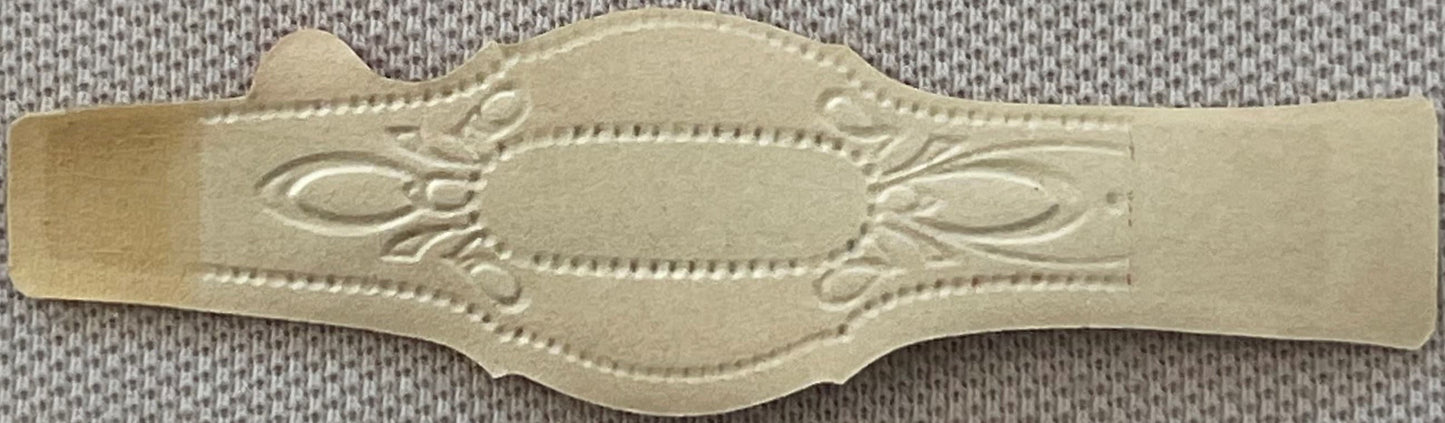
How many movie stars get their name on a cigar? This little band was made to wrap around a Rudolph Valentino cigar, and it never got used. RUDOLPH VALENTINO is lettered in cream on a black oval in the middle, with gold scrollwork on either side, QUALITY across the top and CIGAR across the bottom in cream letters on red, trimmed in gold. One end has a little TEAR HERE tab, and the other end has a tiny printed C. Turn it over and the back is plain cream paper, blind-embossed with the whole pattern of the front.

Up close it's a jewel box of a thing. Two little black ovals sit in the gold scrolls on either side of the name like set stones, and every bit of the gold is raised, so it catches the light when you tilt it. That's all it says, front and back: no maker, no town, no price. Just his name and the promise of quality.

✂️ That Little Tab

The TEAR HERE tab has a story of its own. In 1911 two inventors, Call and Smith, filed a patent for a cigar band with a pull tab made stronger than the band itself, so a tug on the tab would part the band. The patent, No. 1,017,282, was granted on February 13, 1912, and that's the idea behind the little tab on this one.

🌹 The Great Lover

Valentino was born Rodolfo Guglielmi on May 6, 1895, in Castellaneta, in the south of Italy, and landed in New York two days before Christmas in 1913 with a bank draft worth about $4,000 in his pocket. He danced for a living, first as a taxi dancer and then in ballrooms, until The Four Horsemen of the Apocalypse in 1921 made him a star overnight and got America doing the tango. The Sheik came out that same year and made him the Latin Lover for good, and Blood and Sand (1922), The Eagle (1925) and The Son of the Sheik (1926) followed. That is also why this band can only date from the 1920s. Before 1921 hardly anybody knew his name.

Getting there took some doing. He sailed from Genoa on December 9, 1913 aboard the S.S. Cleveland, in first class. His first job was as an apprentice landscape gardener at Oak Hill, the Long Island estate of Cornelius N. Bliss Jr., and he lost it after he damaged his boss's motorcycle. For a while he couldn't afford a room and slept in Central Park. Then the dancing took off: a taxi dancer at Maxim's, then in December 1914 the partner of the exhibition dancer Bonnie Glass at $50 a week, taking over from a young Clifton Webb, and in 1916 the partner of Joan Sawyer at $240 a week, dancing for President Woodrow Wilson. In 1917 he headed west with a touring show, met the actor Norman Kerry in San Francisco, and was talked into trying the movies. His first real part came in The Married Virgin in 1918, billed as "Rodolfo di Valentina."

💍 Two Wives and a Beauty Tour

His love life was as dramatic as his films. He married the actress Jean Acker in Hollywood on November 5, 1919, and she locked him out of the room on their wedding night. He married the designer Natacha Rambova in Mexicali, Mexico on May 13, 1922, before the divorce from Acker was final, and got arrested for bigamy for it; the two married again, legally, in Crown Point, Indiana on March 14, 1923.

And this band wasn't the only thing his name sold. With his manager S. George Ullman he signed on to promote Mineralava, a beauty product, and in the spring of 1923 he toured 88 cities across the United States and Canada for it. The whole thing wound up with a national beauty and dance contest at Madison Square Garden, where he handed out the prize on November 28, 1923.

🥊 The Powder Puff Fight

Fame made him a target, too. In July 1926 a Chicago Tribune editorial, set off by a machine selling pink talcum powder in a ballroom men's room, blamed Valentino for making American men soft. Since dueling was illegal, he challenged the writer to box or wrestle, and when nobody answered, he climbed into a ring on the roof of the Ambassador Hotel in New York against Frank "Buck" O'Neil, a boxing writer for the New York Evening Journal, with Jack Dempsey refereeing. Valentino won. The Son of the Sheik had opened that same month, on July 9, 1926, and at the premiere he made up with his old friend June Mathis.

Then it all stopped. On August 23, 1926, Valentino died in New York of peritonitis at just 31 years old. His body was taken to the Frank E. Campbell Funeral Chapel, and an estimated 100,000 people lined the streets of Manhattan to pay their respects, windows were smashed as fans tried to get in, an all-day riot broke out on August 24, and it took more than 100 mounted police to restore order. Suicides of heartbroken fans were reported. His friend June Mathis offered him a spot in the crypt she had bought for herself, she died the very next year, and the two of them still lie side by side at Hollywood Forever Cemetery.

And here's the legend. For decades a mysterious woman in black has come to his crypt with a red rose, usually on the anniversary of his death. The first one seems to have been a publicity stunt dreamed up by press agent Russel Birdwell in 1928, but the tradition stuck, and there's still a woman in black today, the film historian Karie Bible. The story is even said to have inspired the song "Long Black Veil."

🎁 His Name on the Cigar Box

The cigar trade was quick to put his name to work. In the last days of August 1926, right around his death, RUDOLPH VALENTINO turned up in the registrations column of The Tobacco World, the trade's own paper, as a title for cigars, No. 44,723, filed by M. H. Sevis & Son, cigar makers in Springvale, a little village in York County, Pennsylvania. And at Christmas the next year, on December 2, 1927, a grocer's holiday list in the Kingston Daily Freeman of Kingston, New York offered "Rudolph Valentino's Cigars" by the box for $1.50, right alongside Capitol Crooks and Peter Schuylers. This band doesn't name its maker, so whose box it went to is anybody's guess, but that's the world it came from.

🚬 The Little Paper Ring

The cigar band has its own legends. One says Catherine the Great wrapped her cigars in silk so they would not stain her fingers, and another says bands were put on cigars shipped to England to keep gentlemen's white gloves clean. Cigar historians give the credit to Gustave Bock, a Dutch-born cigar maker in Cuba, who in the 1830s had paper rings with his signature put on every cigar he exported to Europe. By 1900 Americans were going through about 2 billion cigar bands a year. Printers shipped them precut in bundles of 100, and the cigar maker put each one on by hand with a dab of plant-based glue.

A Rudolph Valentino cigar label is part of the collection of the Cooper Hewitt, Smithsonian Design Museum in New York, a gift of Dr. Ellery Karl, so this little band is in very good company. The Cincinnati Art Museum keeps one too, a Rudolph Valentino cigar box label printed in color and embossed, much like the gold on this band. And over in England, the Bill Douglas Cinema Museum at Exeter keeps a Valentino cigar display box made by the Atlantic Carton Corporation of Connecticut, billed as "the sheik of five cent cigars." I love that line. Kids used to save bands like this and paste them into scrapbooks, and collecting them even has a name, vitolphilia.

It would look great framed with a still of Valentino in The Sheik, or tucked into a silent film collection. A perfect little gift for any old Hollywood fan.

Shipping

🚚 Shipping & Handling

  • Shipping costs and timing are calculated at checkout.
  • Items curated and shipped directly by me include U.S. shipping at no additional cost, professionally packed to ensure safe arrival of your artifact.

Items from Vetted Pro Collectors
Shipping for items offered by vetted Pro Collectors is determined at checkout. All Pro Collector listings are reviewed to ensure fair, reasonable shipping practices.

For full details, please refer to our Shipping Policy.

Returns & Exchange

Take your time — you've got a full six months. If a piece isn't right for you, send it back the way it reached you and we're good.

In the first 30 days your money goes straight back the way you paid. After that it's store credit, so you can put it toward something you'd rather have.

Return shipping we sort out between us, case by case. I don't make this difficult.

If something arrives damaged, or it isn't what I said it was, send me a photo within 48 hours and I'll make it right.

Email info@vintageantiquesgifts.com or call 802-356-9872 — that's me answering, not a call center.

The only things I can't take back are custom or special-order pieces and gift cards.

View full details
  • 5 stars: 1 (100%)
  • 4 stars: 0 (0%)
  • 3 stars: 0 (0%)
  • 2 stars: 0 (0%)
  • 1 star: 0 (0%)
s
superstud-21

Very nice items. Prompt delivery.

Thank you so much for your support!

Rescuing American History Since 2007

— Travis & the Kids