Skip to product information
1 of 8

Vintage and Antique Gifts

Antique 1924 The Southern Philatelist Vol I No 1 Confederate Stamps Postal History 📬

Antique 1924 The Southern Philatelist Vol I No 1 Confederate Stamps Postal History 📬

Regular price 21.00 USD
Regular price Sale price 21.00 USD
Sale Sold out
Shipping calculated at checkout.
Quantity

Size: 10 x 6.75 inches ~ Aged paper, edge wear and toning. They vary a little one to the next.

📬 Volume I, Number 1 — The Southern Philatelist Begins

This is where The Southern Philatelist starts: Volume I, Number 1, dated right on its own masthead — November, 1924. It was published monthly in Richmond, Virginia, by the Press of the Dietz Printing Company at 109 East Cary Street, edited by August Dietz, with his son August Dietz, Jr. as business manager. The masthead carries its own motto, “An Exponent of Advanced Philately,” and prints the terms of the day right on the page: two dollars a year, twenty cents the single copy.

The cover is a small piece of theater in itself. At its center is a Confederate twenty-cent stamp design with a portrait, printed in green and brown — and struck across it, as part of the printed design itself, is a bold circular postmark reading RICHMOND · NOV 1 1924 · VA. It's the same on every copy that left the press: a brand-new 1924 magazine dressed up as though it had just passed through a Confederate-era post office. Clever design, and it tells you exactly what's inside.

🖋️ August Dietz, the Father of Confederate Philately

August Dietz was born in Prussia in 1869 and brought to Richmond as a toddler in 1871. He trained as a lithographer and printer, and in 1901 he founded the Dietz Printing Company — the very house that printed this magazine. He came to be called the Father of Confederate Philately, and a come-back is how he opens this first issue - a short note of his own titled “A Come-Back.” He had done this before: from 1897 to 1900 he edited The Virginia Philatelist, a Richmond journal for trading in Confederate stamps, before handing his interest to Royal B. Bradley. Then, a few pages later, launches the serialized history of the Confederacy's postage stamps that made his name. He kept going with it: The Southern Philatelist ran through 1929, folded into The New Southern Philatelist for a few more years after that, and in 1929 he published “The Postal Service of the Confederate States of America,” built on more than thirty years of research and interviews with surviving Confederate postmasters, followed by his Specialized Catalog of Confederate stamps in 1931. He died in 1963. This first number is the opening page of all of it.

📯 “The Proposal and the Bidders”

The lead article — the one this whole magazine was really built around — tells the story of how the Confederacy got its first postage stamps. On March 27, 1861, from Montgomery, Postmaster General John H. Reagan put out the call for stamp proposals - and Reagan wasn't even the Confederacy's first pick for the job: Henry T. Ellett and Wirt Adams, both of Mississippi, had each turned it down that February. Dietz reprints the bids and sample designs that came in: J. W. Hayes of Newark, A. Hoen & Company, a design called “Hoyer & Ludwig's Flag,” a water-color sketch marked “probably American Bank Note Co.,” and a design from an unknown artist of New Orleans — and the article breaks off with “To Be Continued,” a cliffhanger from 1924. There's also a small engraving of the old Statehouse at Columbia, South Carolina, where the legislature adopted the Ordinance of Secession on December 20, 1860.

🖨️ Hoyer & Ludwig, and a Press Dietz Later Owned Himself

Here's the part I love telling people. With the war on, the Northern bidders were out of the picture, and the contract went to Hoyer & Ludwig, a small Richmond lithography shop. Their press, known as Press No. 3, was the hand-cranked machine that printed the first five Confederate postage stamps, starting with the 5-cent green Jefferson Davis on October 16, 1861 — designed and engraved by Charles Ludwig, and the first time a living president had ever appeared on a postage stamp. And here's the twist: years later, that very press was given to August Dietz himself, a gift from Hudson P. Hoen, and Dietz kept it until he died in 1963. It stands today at Mystic Stamp Company's headquarters in Camden, New York. So the man writing this magazine in 1924 later became the keeper of the actual machine that started the story he was telling in it.

📪 The Rest of the Issue, and a Little World of 1924 Stamp Dealers

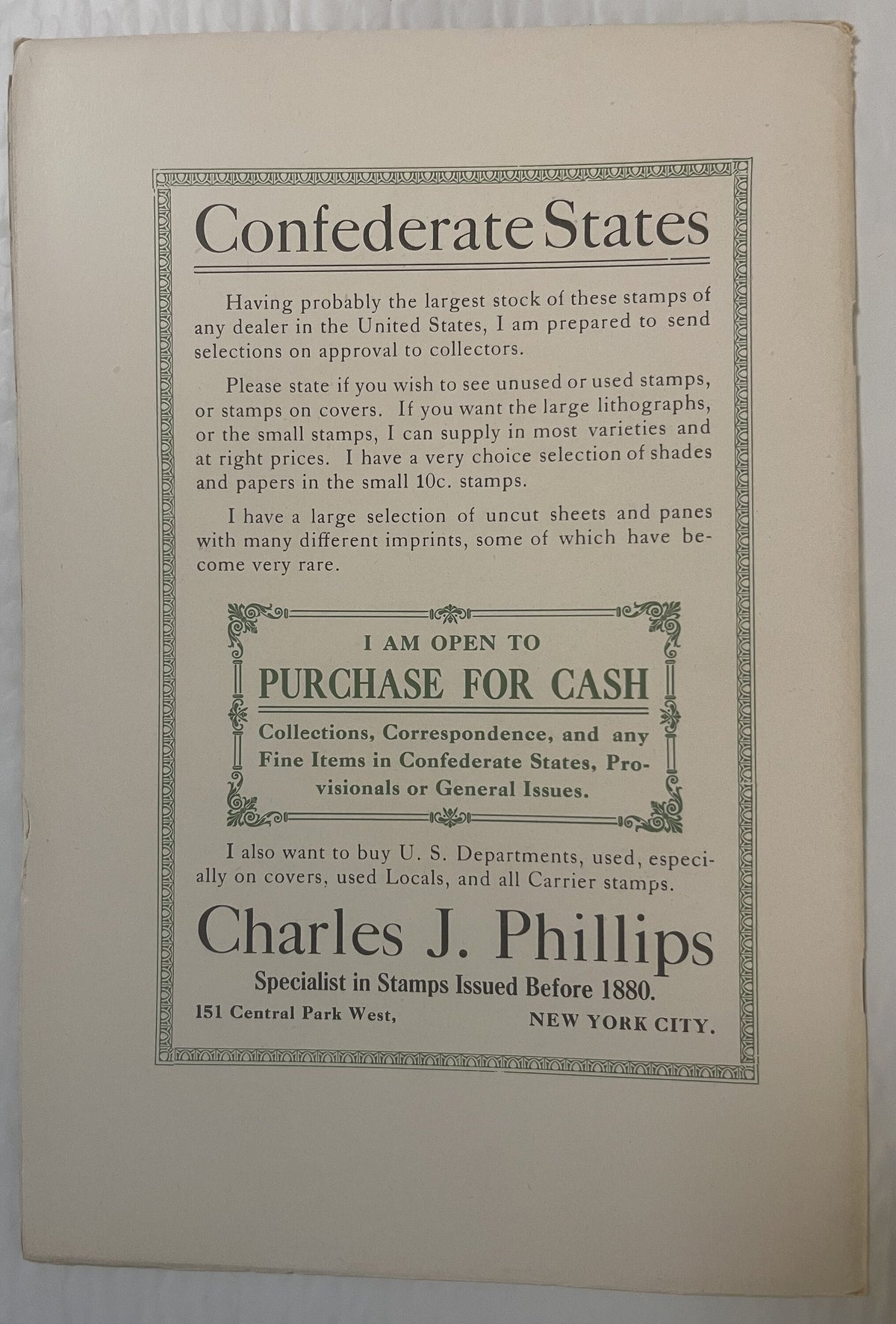
There's more packed in besides the lead history. “What Constitutes a Confederate 'Local'?,” also by Dietz, and “Unique Confederate Covers — No. 1” both have their place in these pages. And around all of it run the advertisements, which are honestly one of my favorite parts — a little time capsule of the stamp trade in late 1924. New York's Nassau Street was known then as the “Street of Stamps,” and you can see why: Y. Souren Co. at 145 Nassau Street is running its 8th and 9th auction sales, Nassau Stamp Co. at 116 Nassau Street wants “CONFEDERATES,” and the Economist Stamp Co. sits at 87 Nassau Street. Eugene Klein of Philadelphia and H. P. Atherton of Springfield, Massachusetts both have want-ads in for Confederate covers, Geo. C. Ginn & Co. of 115 Moorgate, London offers a British Colonial Empire collection, and Charles J. Phillips — an English rarities dealer who had crossed over to New York only two years earlier, in 1922, to specialize in stamps issued before 1880 — advertises from 151 Central Park West. Dietz's own shop gets a page too: “The House of Dietz” at 109 East Cary Street, calling itself a “Shop of the Craftsmen” in the old guild-hall style.

📐 What You're Getting

These are original 1924 printings of Vol. I, No. 1 — the kind of paper a hundred-year-old specialist magazine has, made for a small circle of collectors and never meant to be kept. If you collect Confederate philately, Richmond printing history, or you just like paper that comes with a good story attached, this is the first chapter of one.

Shipping

🚚 Shipping & Handling

  • Shipping costs and timing are calculated at checkout.
  • Items curated and shipped directly by me include U.S. shipping at no additional cost, professionally packed to ensure safe arrival of your artifact.

Items from Vetted Pro Collectors
Shipping for items offered by vetted Pro Collectors is determined at checkout. All Pro Collector listings are reviewed to ensure fair, reasonable shipping practices.

For full details, please refer to our Shipping Policy.

Returns & Exchange

Take your time — you've got a full six months. If a piece isn't right for you, send it back the way it reached you and we're good.

In the first 30 days your money goes straight back the way you paid. After that it's store credit, so you can put it toward something you'd rather have.

Return shipping we sort out between us, case by case. I don't make this difficult.

If something arrives damaged, or it isn't what I said it was, send me a photo within 48 hours and I'll make it right.

Email info@vintageantiquesgifts.com or call 802-356-9872 — that's me answering, not a call center.

The only things I can't take back are custom or special-order pieces and gift cards.

View full details