Skip to product information
1 of 4

Vintage and Antique Gifts

Antique Banquet Hall Mince Meat Label 🥧 LARGE VERSION, Edgar Brick & Sons Crosswicks NJ, NOS 1930s

Antique Banquet Hall Mince Meat Label 🥧 LARGE VERSION, Edgar Brick & Sons Crosswicks NJ, NOS 1930s

Regular price $11.00 USD
Regular price Sale price $11.00 USD
Sale Sold out
Shipping calculated at checkout.

Size: 8 1/4" x 5 1/2"

🚚 Free US Shipping — ships within one business day. International shipping calculated at checkout.

Quantity

Real Brandy and Real Beef in a Mince Pie? 🥧 Antique 1930s Banquet Hall Mince Meat Label, Edgar Brick & Sons, Crosswicks, N.J. - Large Version

Size: 8 1/4" x 5 1/2"

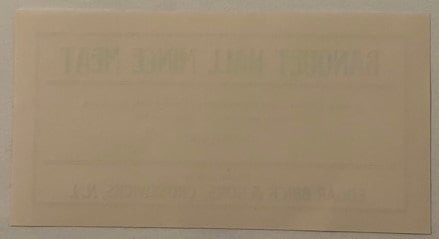
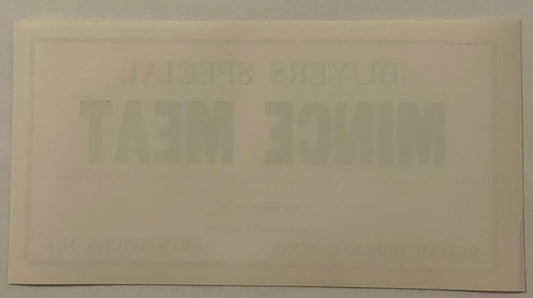
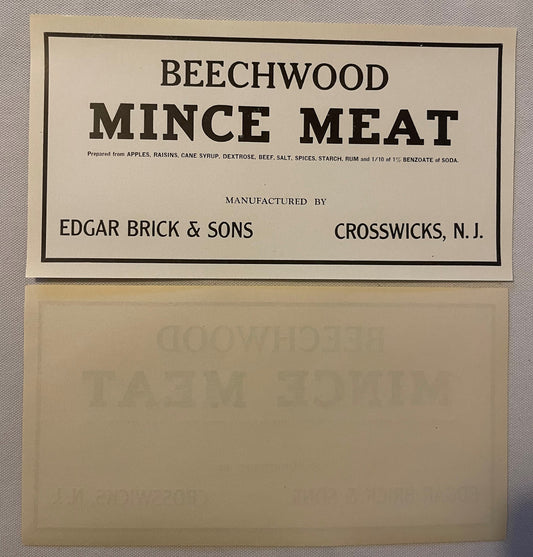
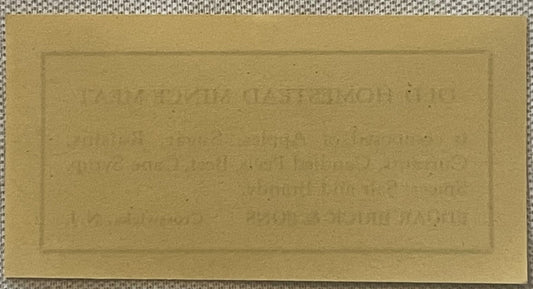
Now that's a recipe: "Combines Apples, Sugar, Raisins, Currants, Candied Peels, Beef, Spices, Salt, Brandy and 1/10 of 1% Benzoate of Soda." BANQUET HALL MINCE MEAT runs across the top in tall black letters, NET WEIGHT 30 LBS. sits in a little box, and Manufactured by EDGAR BRICK & SONS, CROSSWICKS, N.J. fills the bottom, all inside a checkered border on cream paper. It's the big 30-pound tub size, and it was never used. Stores sold Brick's by the pound: in 1907 Karg's and Durand's, both advertising in the Mount Holly News, had it at 10 and 12 cents a pound, and Durand's promised that with Brick's "you always have good pies." Mince pie was a big deal back then - it had been part of Thanksgiving dinner since the 1600s, and it was thought of as America's national dish until apple pie took over in the 1940s.

🥃 Why I Call It 1930s

Three things on the label tell you. The benzoate line follows the 1909 rule that let packers use 1/10 of 1% benzoate of soda if they said so on the container. The net weight follows the 1913 law that made packers print it, the Gould Amendment, signed on March 3, 1913. So it's 1914 or later, at the very earliest. Then look at the name at the bottom: EDGAR BRICK & SONS. Brick's own label from the early Pure Food Act years reads plain "Edgar Brick," and so do the 1912 and 1918 records - the "& Sons" shows up in print in 1925, after Edgar died in 1920 and his three sons had taken over. And the brandy is just listed, plain as day, with nothing about Prohibition anywhere on it.

Mince meat and liquor didn't part ways in 1920, either. Food was exempt from the alcohol ban, canned mince meat got popular during Prohibition precisely because it still had alcohol in it, and some tinned mincemeat ran over 14 percent. In 1922 the national catering and liquor interests launched a legal fight for a cooking exemption, and they built their case almost entirely on mince pie. A Prohibition-era Banquet Hall label from Brick's shows what that looked like on the label: a federal Prohibition permit number, N.J. H-926, and PROOF ALCOHOL BY VOLUME 14 PER CENT. This one has none of that - just Brandy, sitting in the list between the salt and the benzoate. That's why I put it after Repeal in December 1933, in the 1930s. They used real brandy in this old recipe, which probably helped with customer retention :)

🏪 Brick's of Crosswicks

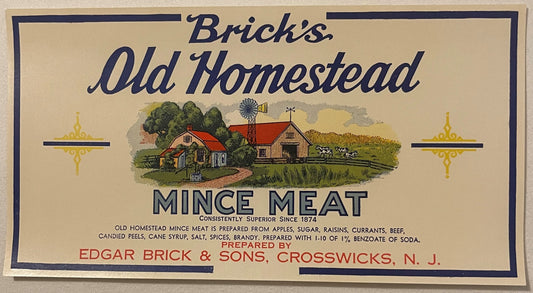
Edgar Brick and his wife Susan came to Crosswicks in the 1850s and opened a general store on Main Street, and in 1874 Edgar decided the mince meat he was buying from Philadelphia wasn't good enough and made his own. Seventy-six pounds the first year! After five years of growing sales he needed more room, so in 1879 he moved two farmhouses onto the lot and joined them into a factory, and by 1900 Edgar Brick - still under his own name then - was the biggest mince meat maker in New Jersey. His sons Arthur, Josiah and Charles took over when he died in 1920, the Brick family ran the business for another 48 years, and by World War II they were the biggest in the whole country - three million pounds a year with 40 workers. Banquet Hall was one of their brands, along with Nonpareil, Old Homestead and Beechwood.

Brick's was a very popular mince meat in the late 1800s and early 1900s, and the papers of the day said so. In November 1893 the Jamesburg Record called Brick's Mince Meat "known in twenty States" and declared that a good mince pie with Brick's between the crusts could soothe a panic-stricken people faster than a ton of silver-bill repealers (this was right in the middle of the Panic of 1893). A few months later the Mount Holly News reported that Edgar had started out with a chopping knife and 60-pound batches, and was now making 700 pounds at a batch, more than half a million pounds a year, with shipments going as far as Boston, Detroit, Akron and Washington, D.C.

That same 1894 report says the factory could turn out more than 6,000 pounds a day, and that "Mr. Brick has also laid the foundation for an extensive canning business." And the Jamesburg editor had clearly done his homework: "We have recently sampled a bucket of this delicious fruit." By 1905 a grocer down the shore in Wildwood was advertising two Brick's mince meats side by side in the Five Mile Beach Journal - Nonpareil, "Finest and Cleanest," and Homestead, "made by the same, fine goods, 10c lb." Those are very likely the same "two kinds" Karg's had in 1907. Edgar ran his own ads too, as "EDGAR BRICK, Manufacturer," of Crosswicks, in the Friends' Intelligencer, the Quaker weekly, around 1899 to 1904.

People went looking for it by name. In September 1916 a reader wrote in to the trade paper Modern Merchant and Grocery World asking for "the name and address of the concern that packs Brick's mincemeat," and the answer came back: "Edgar Brick, Crosswicks, N. J." The 1918 Industrial Directory of New Jersey has "a mince-meat plant owned by Edgar Brick, employing 25 persons." Edgar died on June 23, 1920, at 83. When the "& Sons" name turns up in 1925, it's at the Washington Retail Grocers' Association food show in Washington, D.C., January 5 to 17, where Edgar Brick & Sons was among the exhibitors handing out samples.

The 30-pound tub stayed a Brick's package for a long time. A federal food record lists 97 thirty-pound tubs of Brick's Old Homestead Mince Meat going from Crosswicks to Philadelphia in December 1944 and January 1945 - the same big size this label was printed for.

Americans started eating less mince meat in the 1960s. Brick's quit mince meat in 1968, made alcoholic beverages for a while, and closed in 1979, when much of the old equipment and furnishings went at auction. The Hamilton Uniform Company bought the old farmhouse factory in 1980 and kept a business there for many years. The building sits right in the Crosswicks Village historic district, and Preservation New Jersey put it on its endangered list in 2017, after it had stood empty for several years.

The Bricks did a lot more for the village than make pie filling - they helped bring electricity to Crosswicks, built a mill and an ice plant on Crosswicks Creek, and helped start the Chesterfield Township Historical Society. Edgar himself joined the Crosswicks fire company in 1864 and became its first chief in 1882, and his sons Josiah, Charles and Arthur gave the company its first firehouse and a motor chemical fire engine in his memory. The firehouse was dedicated on November 25, 1922.

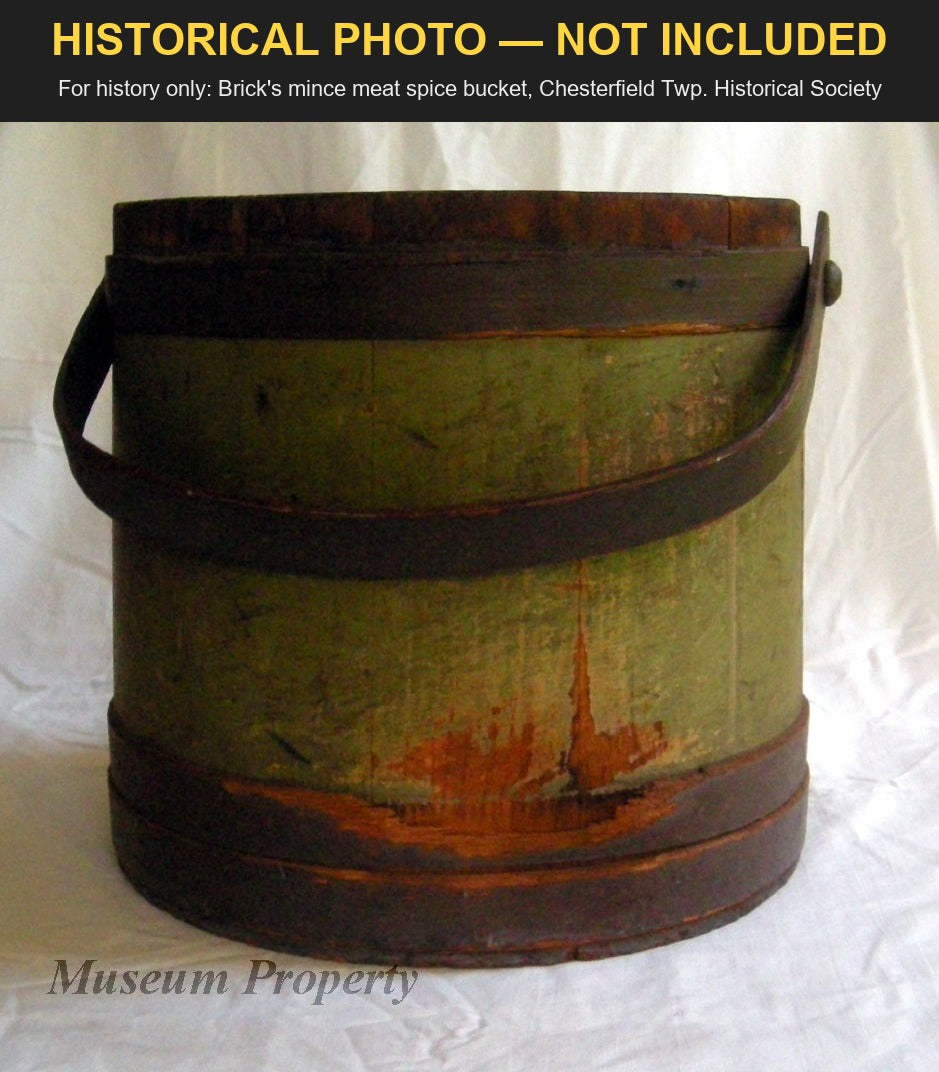
The Chesterfield Township Historical Society keeps more of the family's things, and they tell the label story better than I can. There's a Brick's bucket whose side label reads "Guaranteed by Edgar Brick, Under the National Food and Drugs Act, June 30th, 1906. Serial No. 1597," preserved with "1-10 of 1 per cent of Benzoate of Soda" - the same benzoate line as ours, under Edgar's own name. There are two Nonpareil buckets from the dry years marked "Alcohol added. Permit N.J.--H-926 Edgar Brick & Sons." And there are the printing blocks Edgar first used on his own printing press, which, the Society's card says, were later loaned to a printer to make labels for the company. I love that - the man had his own printing press going before he ever handed the job to a print shop.

💣 The Village

Crosswicks, in Chesterfield Township, Burlington County, is a Quaker village going back to 1677, and there's a cannonball from a June 23, 1778 skirmish still mortared into the wall of its brick Friends Meeting House, built in 1773. That fight came five days before the Battle of Monmouth, and three cannonballs hit the meeting house. One left its dent in the brick, and the story in the village is that it was saved and later set back into the wall right where it struck. Historian Colin Zimmerman, writing in the Journal of the American Revolution in 2022, thinks it was more likely added years after the battle, during a repair - either way, it's still there.

Great framed in a kitchen, a bakery or a dining room. You'll get one like the one shown.

📷 About the Last Two Photos

Those are just for history - you get the label, not them! They're the Brick family's own things, kept today by the Chesterfield Township Historical Society in Crosswicks: the chopping block the family says Edgar made his very first mince meat on (the Society dates it to about 1864), and the green spice bucket they measured spices with. The society says the bucket still smells of spices.

Shipping

🚚 Shipping & Handling

  • Shipping costs and timing are calculated at checkout.
  • Items curated and shipped directly by me include U.S. shipping at no additional cost, professionally packed to ensure safe arrival of your artifact.

Items from Vetted Pro Collectors
Shipping for items offered by vetted Pro Collectors is determined at checkout. All Pro Collector listings are reviewed to ensure fair, reasonable shipping practices.

For full details, please refer to our Shipping Policy.

Returns & Exchange

Take your time — you've got a full six months. If a piece isn't right for you, send it back the way it reached you and we're good.

In the first 30 days your money goes straight back the way you paid. After that it's store credit, so you can put it toward something you'd rather have.

Return shipping we sort out between us, case by case. I don't make this difficult.

If something arrives damaged, or it isn't what I said it was, send me a photo within 48 hours and I'll make it right.

Email info@vintageantiquesgifts.com or call 802-356-9872 — that's me answering, not a call center.

The only things I can't take back are custom or special-order pieces and gift cards.

View full details

Rescuing American History Since 2007

— Travis & the Kids