Skip to product information
1 of 5

Vintage and Antique Gifts

Antique 1930s Hereford Brand Yakima Valley Apples Crate Label 🐂 — Hovde Bros., Selah WA, Bull Medallion

Antique 1930s Hereford Brand Yakima Valley Apples Crate Label 🐂 — Hovde Bros., Selah WA, Bull Medallion

Regular price $13.00 USD
Regular price Sale price $13.00 USD
Sale Sold out
Shipping calculated at checkout.

Size: 10 1/2" x 8 3/4"

🚚 Free US Shipping — ships within one business day. International shipping calculated at checkout.

Quantity

Who Packed Hereford Brand Apples in Selah? 🐂 HEREFORD Brand Yakima Valley Apples, Hovde Bros., Selah, Washington

Size: 10 1/2" x 8 3/4" ~ Little to no wear.

A big horned Hereford with that famous white face stares right out at you from a round medallion, and I swear he looks like he's waiting for somebody to bring him an apple. Behind him a post-and-rail fence runs around the pasture under a night sky, with HEREFORD arched across the top and APPLES across the pasture. It's one of those labels that just feels like the West.

🏷️ Every Word on the Label

  • HEREFORD, BRAND
  • Yakima Valley
  • APPLES
  • CONTENTS ONE U.S. BUSHEL
  • PRODUCT of U.S.A.
  • HOVDE BROS., GROWERS AND PACKERS, SELAH, WASHINGTON, U.S.A.

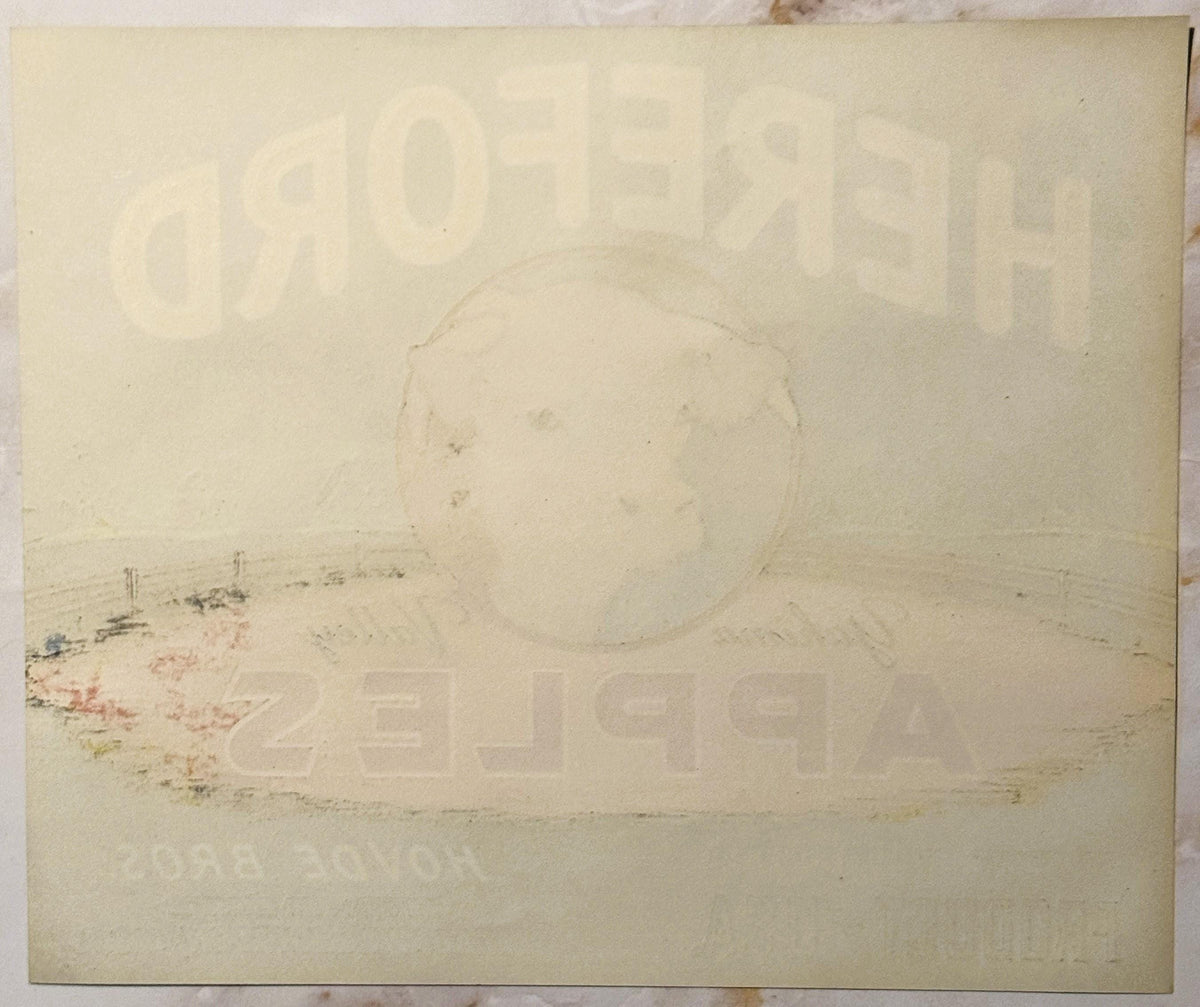
There's no printer's credit anywhere on the sheet and no grade line. The back is blank, with HEREFORD, APPLES and the medallion showing through faintly in reverse. Hovde Bros. tell you right on the label what they did: they grew the apples and they packed them, one U.S. bushel to the box.

🐄 The Whiteface

Hereford cattle come from Herefordshire in the West Midlands of England, and the first ones brought to the United States were imported around 1817 by the statesman Henry Clay, with bigger shipments following from the 1840s on. They're known for the white face and red body, and there were horned and polled types, with the polled Hereford kept as its own breed from 1889. The one on this label has a fine pair of horns. I love that a cattle breed ended up selling apples in a valley that started out as sheep and cattle country, which is exactly what the Selah Valley was before the water came.

💧 Selah, "Still Water"

Selah sits just north of Yakima above where the Naches River meets the Yakima, and its name comes from an Indian word meaning "still or smooth water." For centuries the Yakama people camped near the mouth of Wenas Creek, where the swirling water made the fishing easier. The first settler in what's now Selah was Alfred Henson, who staked his claim in 1865, and George S. Taylor homesteaded there in 1866. Early farmers mostly raised sheep. Then in 1880 Taylor dug a small ditch to bring water from the Yakima River into the Selah Valley, and homesteaders started turning their sheep and cattle farms into hop yards, orchards and alfalfa. In 1888 B. F. Young and John Stone formed the Selah Ditch Company, and by 1895 the valley had gone from dry sage to green cropland.

In 1907 two Swedish immigrants, Gus Remington and Olaf Larson, arrived and set about building a town, starting with the Selah Trading Company. A fire wiped out most of the businesses in 1908, and they built right back. Remington ran ads in Swedish newspapers in the Midwest to bring more immigrants out to farm the valley. The railroad station was called Wenas until 1909, when the Northern Pacific renamed it Selah, and that same year the Selah Horticultural Union was set up by local fruit growers with $50,000 in capital to handle their fruit, building a warehouse on Produce Row.

My favorite story from Selah is how it became a city. State law said a town needed 300 residents to incorporate, and in 1918 Selah had nearly 200. So the boosters waited for the fall harvest, when the itinerant workers showed up for the apple orchards and alfalfa farms, quickly signed some of them up, and counted 310 "residents." In March 1919 all 63 voters present said yes, and on March 17, 1919 Selah became a town. Apple pickers, in other words, helped put Selah on the map.

🍎 Hard Times and Apple Juice

The Great Depression of the 1930s hit Selah hard. Wages fell and a lot of local orchardists struggled just to meet expenses, and after riots broke out in the Yakima Valley between farmers and striking workers, the State Patrol and the National Guard were called in to protect the crops. After Prohibition ended in 1933 the Yakima Valley Brewing Company opened a brewery in Selah, and Selah Springs beer was a favorite in Central Washington until the brewery closed in the 1950s. But the business that really took root during the Depression was apple juice. A small processing plant grew into a real industry by the 1950s and was taken over by the grower-owned Tree Top co-operative in 1960, and Selah has called itself the "Apple Juice Capitol of the World" ever since.

📦 The Paper Label Era

Labels like this were pasted on the ends of wooden apple boxes, and paper crate labels stayed in use until the 1950s, when produce moved into cardboard boxes printed directly. I date this Hereford label to the 1930s, made for apples packed in those hard Depression years.

🖼️ Display

Crate Labels are a reminder of a bygone era but the amazing lithography process is unparalleled even to this day in my opinion. Museums and Art Institutes have galleries dedicated to them and more and more collectors are seeking these out to preserve their history. Once the limited supply for sale is gone and on display with collectors or in galleries then they will be very difficult to acquire.

Imagine this amazing vintage advertising hanging as home decor in any room of your home instead of a museum!

Shipping

🚚 Shipping & Handling

  • Shipping costs and timing are calculated at checkout.
  • Items curated and shipped directly by me include U.S. shipping at no additional cost, professionally packed to ensure safe arrival of your artifact.

Items from Vetted Pro Collectors
Shipping for items offered by vetted Pro Collectors is determined at checkout. All Pro Collector listings are reviewed to ensure fair, reasonable shipping practices.

For full details, please refer to our Shipping Policy.

Returns & Exchange

Take your time — you've got a full six months. If a piece isn't right for you, send it back the way it reached you and we're good.

In the first 30 days your money goes straight back the way you paid. After that it's store credit, so you can put it toward something you'd rather have.

Return shipping we sort out between us, case by case. I don't make this difficult.

If something arrives damaged, or it isn't what I said it was, send me a photo within 48 hours and I'll make it right.

Email info@vintageantiquesgifts.com or call 802-356-9872 — that's me answering, not a call center.

The only things I can't take back are custom or special-order pieces and gift cards.

View full details

Preserving History: Authentic Objects Across Eras

— Curated by Travis Weigel