
Skip to product information
1 of 5

Vintage and Antique Gifts

Antique Roberts Jersey Dairy Creamery Butter Box 🐄 NOS 1930s–40s Utica, NY Pastoral Print

Antique Roberts Jersey Dairy Creamery Butter Box 🐄 NOS 1930s–40s Utica, NY Pastoral Print

Regular price $10.00 USD
Regular price Sale price $10.00 USD
Sale Sold out
Shipping calculated at checkout.

Size: 5" x 2 1/2"

🚚 Free US Shipping — ships within one business day. International shipping calculated at checkout.

Quantity

Who Made Roberts Jersey Dairy Butter? A Utica Butter Box That Never Held an Ounce of Butter 🐄

Size: 5" x 2 1/2"

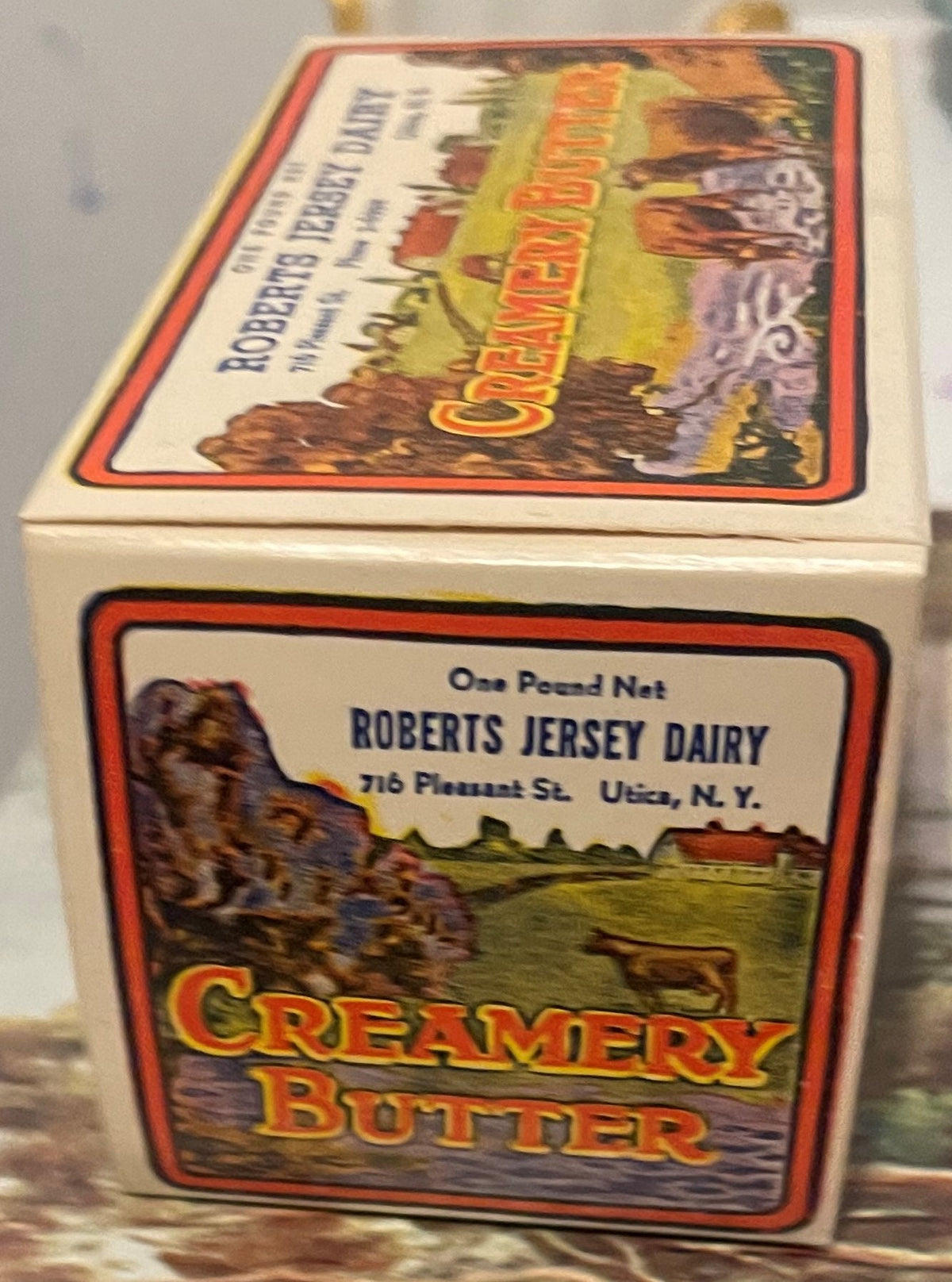
Roberts Jersey Dairy put the breed of its cows in its own name. That one word was a promise to every kitchen in Utica: this butter came from Jerseys, the cattle bred on a Channel Island for the richest cream in the barn. This one-pound carton carried that promise onto the shelf, and it never got filled. It is New Old Stock, printed in full color with two fawn cows at a stream and a red-roofed farm behind them, from the same county where the American dairy factory was born.

What This Box Is

A one-pound creamery butter carton printed for Roberts Jersey Dairy of Utica, New York, from the 1930s–40s. It is about 5" x 2 1/2" folded into a box, and roughly 11 3/4" x 5 1/4" laid flat, printed in full color on coated cardboard. The photographs show it both ways: folded into its box shape, and opened out flat so the whole printed sheet can be seen, with its plain white glue flaps and tuck ends.

The top and the front carry the same label, framed in a red-orange double border. In navy type it reads:

  • ONE POUND NET
  • ROBERTS JERSEY DAIRY
  • 716 Pleasant St.   Phone 2-6994   Utica, N.Y.
  • CREAMERY BUTTER, in big red letters outlined in yellow across the scene
  • The picture under the lettering is a farm in late summer colors. Two fawn-brown cows stand in the foreground at a stream, one with its head down drinking. A third cow grazes in the green field behind them, a rail fence runs toward a red-roofed barn and farmhouse, and a far-off skyline of rooftops and spires sits on the horizon. Autumn trees close in on both sides like curtains.

    The end panel has its own smaller picture: a single cow walking across a field toward a red-roofed farmhouse, a rocky wooded bank on the left, and CREAMERY BUTTER stacked in two lines under the dairy's name and street. The end panel leaves off the telephone number.

    No printer's name appears on it. It is New Old Stock: never filled, never sealed around a pound of butter, never set in an icebox.


    🧈 What "Creamery Butter" Meant

    The two biggest words on the box were a claim, not decoration. For generations, the butter a grocer sold came in two kinds. "Dairy" butter was churned on the farm, usually by the farm wife, and packed down in tubs in the cellar until there was enough to trade at the country store. "Creamery" butter was made in a factory from the cream of many farms, under one roof and one set of standards.

    That factory butter began in New York State. Alanson Slaughter opened a butter factory at Wallkill, in Orange County, in 1861. The Elgin Butter Company in Illinois became the first plant built to make butter alone, in 1871. Two inventions finished the job. The De Laval cream separator arrived from Sweden in 1879 and let a farmer spin the cream off at home and ship it to a creamery by rail. In 1890 the Babcock test let a creamery measure exactly how much butterfat was in each farmer's cream, so it could pay for richness instead of volume. By the time Roberts printed "Creamery Butter" on this carton, the phrase told a shopper the butter was made to a standard, not scooped from a crock.

    🐄 Why "Jersey" Was in the Name

    Jersey is the largest of the Channel Islands, off the coast of Normandy, and its farmers bred their small fawn cattle for one thing: butter. Jersey milk is famous for its high butterfat, which is exactly what a butter maker wants. The breed crossed to America in the early 1800s, often as a single family cow on a ship, and in 1868 its American breeders founded the American Jersey Cattle Club, the oldest dairy breed association in the United States. The club began official Register of Merit testing in 1903, using the Babcock test to prove each cow's fat.

    So "Roberts Jersey Dairy" was a quality claim in three words. Plenty of dairies sold milk. A Jersey dairy sold cream, and it put the proof in its name. The cows drinking at the stream on this box are the same color as the breed: that warm fawn brown.

    🧀 Oneida County: Where the Dairy Factory Was Born

    Utica sits in Oneida County, and Oneida County changed American farming. In 1851, on a farm just north of Rome, Jesse Williams combined the milk from his own farm with his son's and made it into cheese in one place. Soon dozens of neighboring farmers were hauling their milk to him, and the factory turned out 100,000 pounds of cheese in its first year. It is recognized as the first cheese factory in the United States. The idea of pooling milk from many farms into one plant spread across the country and led straight to the creameries.

    Next door in Herkimer County, Little Falls opened the first cheese market in the United States in 1861, where farmers, factory men and brokers met to taste and bargain. From 1864 to 1870 it was the largest interior cheese market in the world, and the Utica Morning Herald ran an agricultural page edited by Xerxes A. Willard reporting on the cheese business of Herkimer and Oneida counties. A Utica dairy printing "Creamery Butter" on its cartons was working in the heart of that tradition.

    🏙️ Utica, New York

    Utica grew up on the Mohawk River, and the Erie Canal, finished in 1825, made it a trading city and a printing and publishing center. Its mills made it a textile town: in 1919, two-thirds of the Uticans with jobs worked in textiles. The 1930 census counted 101,740 people, the most the city has ever had. As early as 1928 the Chamber of Commerce was already trying to bring in new industries as the mills struggled, and in later years General Electric, Bendix Aviation and Univac all built plants there.

    That was the market a city dairy served in the years this box was printed: a crowded mill city of a hundred thousand people, buying its milk and butter by the pound from dairies whose names, streets and telephone numbers were printed right on the package.

    📦 The One-Pound Carton

    Butter first went to market in tubs, crocks and molded blocks. Around the turn of the century, waxed paper packages took over; in April 1902 the Elgin Dairy Report carried an advertisement for a new paraffined paper package promising to keep butter fresh longer than anything else. In 1907 Swift and Company asked the Elgin Butter Company to cut butter into quarter-pound sticks as well as the usual one-pound blocks, and the Elgin, or Eastern-pack, stick was born: about 4.8 inches long and 1.3 inches wide, stacked two by two in a long boxy carton. This box has that same long, square-ended pound-of-butter shape, still the one found in grocery cases east of the Rockies.

    📞 A Number Short Enough to Remember

    "Phone 2-6994" is a single digit and four numbers, the kind of short local number a customer could keep in her head, long before every American number grew to seven digits. It sits on the box right beside the street address, so a shopper knew exactly where the dairy was and how to reach it.


    🖼️ Display Ideas

    • 🧈 Fold it into its box and stand it on a kitchen shelf beside a butter crock or an old milk bottle
    • 🖼️ Frame it opened flat to show the whole printed sheet, both big panels and the end panel
    • 🐄 Group it with other Jersey dairy pieces for a breed-themed shelf
    • 🗺️ Add it to a Utica, Oneida County or Mohawk Valley history collection
    • 📦 Pair it with other printed food cartons of the 1930s and 1940s for a grocery-shelf display

    🎁 Who Collects These

    Dairy collectors who chase milk bottles, caps and creamery packaging from hometown dairies. Utica and central New York local historians. Jersey cattle breeders and farm families who know what the word on the box meant. Collectors of printed food packaging and advertising art from before the supermarket. And farmhouse kitchen decorators who want a real period carton rather than a reproduction.

    ❓ Questions People Ask

    What size is the box?

    About 5" x 2 1/2" folded, and roughly 11 3/4" x 5 1/4" laid flat.

    Was it ever used?

    No. No butter ever went into it.

    How old is it?

    It dates to the 1930s–40s.

    What does "Creamery Butter" mean?

    Factory-made butter, as opposed to "dairy" butter churned by hand at home on a single farm.

    Why is it called a Jersey dairy?

    Jersey cattle are the high-butterfat breed from the island of Jersey. Naming the dairy after them told customers the butter came from cream-rich milk.

    What is printed on it?

    The dairy's name, its Utica street address and telephone number, the one-pound weight, and the words Creamery Butter over a farm scene with cows at a stream.

    Who printed it?

    The carton carries no printer's mark.

    Shipping

    🚚 Shipping & Handling

    • Shipping costs and timing are calculated at checkout.
    • Items curated and shipped directly by me include U.S. shipping at no additional cost, professionally packed to ensure safe arrival of your artifact.

    Items from Vetted Pro Collectors
    Shipping for items offered by vetted Pro Collectors is determined at checkout. All Pro Collector listings are reviewed to ensure fair, reasonable shipping practices.

    For full details, please refer to our Shipping Policy.

    Returns & Exchange

    Take your time — you've got a full six months. If a piece isn't right for you, send it back the way it reached you and we're good.

    In the first 30 days your money goes straight back the way you paid. After that it's store credit, so you can put it toward something you'd rather have.

    Return shipping we sort out between us, case by case. I don't make this difficult.

    If something arrives damaged, or it isn't what I said it was, send me a photo within 48 hours and I'll make it right.

    Email info@vintageantiquesgifts.com or call 802-356-9872 — that's me answering, not a call center.

    The only things I can't take back are custom or special-order pieces and gift cards.

    View full details
    • 5 stars: 6 (100%)
    • 4 stars: 0 (0%)
    • 3 stars: 0 (0%)
    • 2 stars: 0 (0%)
    • 1 star: 0 (0%)
    8
    8***o (567)

    Exactly as advertised. Beautiful job! Fast shipping. Great Ebayer family!

    e
    e***e (782)

    great item, quick and safe shipping, would buy from again !

    c
    c***b (1306)

    Beautiful! Thank You! Great note!

    s
    stevemarino55

    An excellent seller. Highly recommended.

    D
    Dawn

    Awesome seller. Highly recommend. Thank you so much for the fun extras!

    Thank you for your support and review! We really appreciate it. Happy Holidays!

    S
    Steven

    Great seller. Thank you very much!

    Thank you, we appreciate it!

    Preserving History: Authentic Objects Across Eras

    — Curated by Travis Weigel