Skip to product information
1 of 6

Vintage and Antique Gifts

Antique 1900s American Navy Tin Tobacco Tag 🚬 Battleship Collectible Intact Backing Lithograph

Antique 1900s American Navy Tin Tobacco Tag 🚬 Battleship Collectible Intact Backing Lithograph

Regular price $5.50 USD
Regular price Sale price $5.50 USD
Sale Sold out
Shipping calculated at checkout.

Size: 1 1/2" x 1"

🚚 Free US Shipping — ships within one business day. International shipping calculated at checkout.

Quantity

Which Navy Ship Is on This Tobacco Tag? ⚓ Antique 1900s American Navy Tin Tobacco Tag, Battleship

Size: 1 1/2" x 1" ~ a real plug-tobacco tag that did its job, wearing the dark tin patina only real age gives.

⚓ What's Printed On It

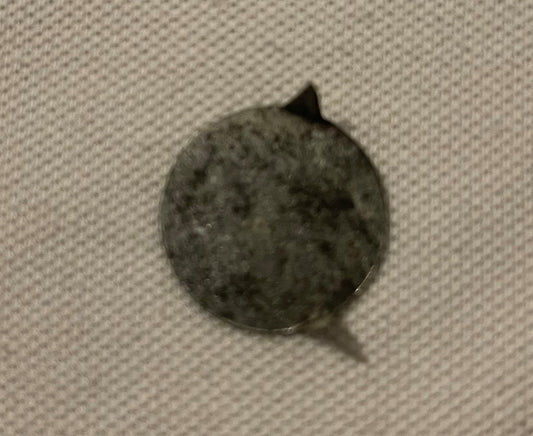
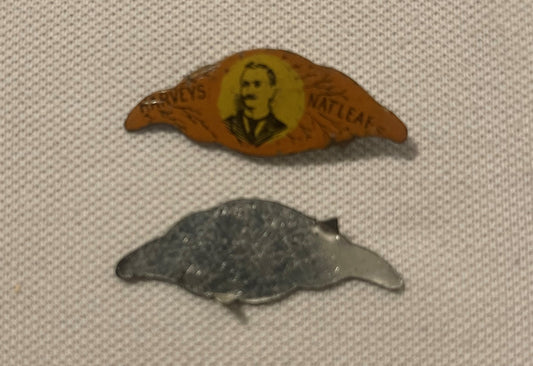
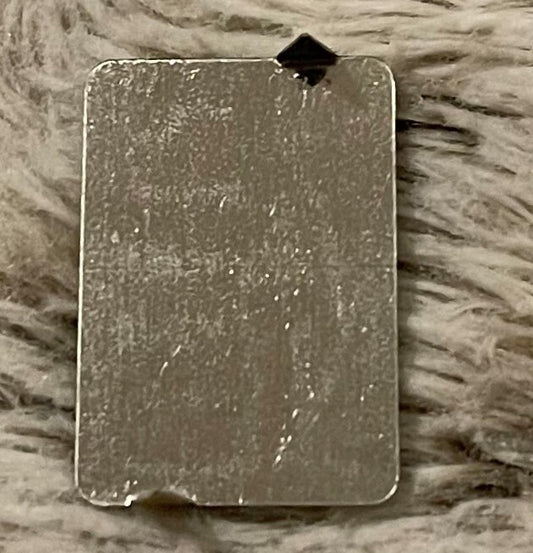
Right side up, it's a red ground with AMERICAN NAVY arched across the top left in black, and under that a three-funnel, two-masted battleship working its way across a blue, hatched sea, hull picked out in cream. Turn it over and the color drops out entirely — plain tin with a deep, aged patina, stamped in block letters: SAVE THESE TAGS, THEY ARE GOOD FOR PRESENTS. Two small triangular prongs stick out from the sides of the back. Those prongs did the actual work here — they're what pressed this tag into a plug of chewing tobacco at the factory.

🎖️ What a Tag Like This Was For

Plug chewing tobacco came as a pressed brick, and every brick got a tag pinned into it to say what brand you were holding. That's the basic job — part label, part proof you'd bought the real thing. And that proof mattered. Right after the Civil War, chewing and smoking tobacco both shipped in wooden crates called caddies, and once a caddie was open, one maker's tobacco looked about like anybody else's. Some of the less honest dealers took to refilling the empty caddies with cheap stuff, which cheated the maker and the fellow doing the chewing both. But tags like this one did double duty, because the company behind them ran a redemption program: save enough tags and trade them in for presents, which is exactly what the back of this tag is telling you in plain block letters. Liggett & Myers used the very same word — Duke University's Rubenstein Library still has their 1916 booklet, Catalogue of Presents Offered for Tobacco Tags, Tobacco Coupons and Cigarette Coupons. And the presents were real household goods — back in those days, 500 tags could get you six Rogers knives and forks for nothing, so a man who couldn't swing a set of silverplate for his wife's table could still get there, one plug at a time. Credit for putting tin tags on plug tobacco in the first place usually goes to the P. Lorillard Company of New Jersey, one of the oldest tobacco houses in the country. The way the story's told, though, Lorillard tucked those first tin tags under the outside leaf of the brick, where you never saw one until you cut or bit into it — chipped teeth and unhappy customers. It was Ben Finzer, who owned the Ben Finzer Tobacco Company in Louisville, who put the tag on the outside where it belonged. He tried to patent the idea and the placement, the courts turned him down, and after that tobacco makers everywhere took up bright tin tags. They cost so little that makers could turn out custom brands, tags and all, for retailers and wholesalers, and collectors have cataloged more than 12,000 different tags. The tin tag had about a forty-year run. It finally went out in the 1920s, when machines started wrapping one-ounce bricks of plug in printed cellophane, and by then paper coupons had mostly taken over the premium side of things.

The best story in the whole tag trade belongs to Charles Hasker of Richmond, Virginia. He was born a Londoner in 1831, came over to America in his teens, and went into the U.S. Navy, where he was a boatswain before the war. In the Civil War he served aboard the Confederate ironclad CSS Virginia — built on the raised, burned-out hull of the USS Merrimack — as her boatswain, and he was on her at Hampton Roads in March 1862, when she fought the USS Monitor in the first battle ever between two ironclads. Richmond's own history even credits him with saving the ship in that fight. In August 1863, at Charleston, he was aboard the submarine H. L. Hunley the first time she sank. By then he was a lieutenant, and he had the lead spot on the hand crank that drove her, sitting right behind the officer in command. The hatch cover came down and pinned him by the leg, he rode her all the way to the bottom in forty-two feet of water, and he still worked himself free and swam up. After the war he went into making tobacco tags in Richmond, and in 1891 he and the Marcuse family formed the Hasker & Marcuse Manufacturing Company. Thanks to Milton Marcuse, the company added a lithographed tin tag that could be put on a plug faster than the old kind. Hasker & Marcuse became part of the new American Can Company in 1901, and that Richmond factory kept turning out tins until 1951. That's the world a tag like this one came out of.

The heavyweight in those years was the American Tobacco Company, put together in 1890. From 1895 to 1898 it fought what the trade remembers as the plug wars - selling chew at a loss until it had well over half the plug business - and then folded its rivals into the Continental Tobacco Company. Lorillard, the house credited with the first tin tags, had been around since 1760. And if this gets you hooked, Louis Storino's 1995 book, Chewing Tobacco Tin Tags 1870-1930, is the one every tag collector keeps on the shelf.

🚢 Dating It Off the Ship, Not a Mark

The ship does the dating on its own. A three-funnel, steel-hulled battleship like the one printed here is a design the US Navy simply wasn't building before the 1890s — the ship type didn't exist yet. And battleships of that generation are what we now call pre-dreadnoughts — the whole lot went out of date almost overnight once Britain's HMS Dreadnought arrived in 1906. So the ship type rules out anything before the 1890s, and the dealers who handle this same tag date it right around 1900 - circa 1900 is what nearly all of them say. That makes it a 1900s tag, from just after the Spanish-American War, when a navy-themed brand was tapping into about as much national pride as American tobacco ever traded on. 1898 was the year of "Remember the Maine!" after the battleship blew up in Havana harbor that February, and the newspapers followed the USS Oregon for 66 days as she steamed from San Francisco clear around South America to get into the war, then took the lead in the chase at Santiago that July. Naval imagery was good business right then — up in Baltimore, Gail & Ax launched their own "Navy" plug brand right after the 1898 war ended. That's a different company and a different tag, but it tells you the mood: everybody wanted a piece of that flag.

And that steel Navy was brand new. Congress didn't pay for its first four steel warships - the Atlanta, Boston, Chicago and Dolphin - until March 1883, $1.3 million for the lot. Fifteen years later, on May 1, 1898, Commodore George Dewey took the cruiser Olympia into Manila Bay and finished off Spain's Pacific squadron in one morning. When he came home in September 1899 New York gave him a naval parade and a land parade under the big Dewey Arch, and his face went onto souvenir spoons for years after, Tiffany's included.

🗽 Why I Still Reach For These

Nobody chewing tobacco out of this plug thought they were leaving a piece of history behind — they were just buying their brand. That's what I like about it. These tags wear the kind of patina you only get on things that actually got carried around. Both sides are still here and still legible, ship and stencil both, which after well over a century in circulation is not nothing.

📷 About the Last Two Photos

Those are just for history - you get the tag, not the Navy! One is Dewey's flagship Olympia, photographed around the turn of the century, and the other is her sailors marching through the Dewey Arch in New York in September 1899 - the kind of moment that made a battleship on a tobacco tag sell.

Shipping

🚚 Shipping & Handling

  • Shipping costs and timing are calculated at checkout.
  • Items curated and shipped directly by me include U.S. shipping at no additional cost, professionally packed to ensure safe arrival of your artifact.

Items from Vetted Pro Collectors
Shipping for items offered by vetted Pro Collectors is determined at checkout. All Pro Collector listings are reviewed to ensure fair, reasonable shipping practices.

For full details, please refer to our Shipping Policy.

Returns & Exchange

Take your time — you've got a full six months. If a piece isn't right for you, send it back the way it reached you and we're good.

In the first 30 days your money goes straight back the way you paid. After that it's store credit, so you can put it toward something you'd rather have.

Return shipping we sort out between us, case by case. I don't make this difficult.

If something arrives damaged, or it isn't what I said it was, send me a photo within 48 hours and I'll make it right.

Email info@vintageantiquesgifts.com or call 802-356-9872 — that's me answering, not a call center.

The only things I can't take back are custom or special-order pieces and gift cards.

View full details
  • 5 stars: 2 (100%)
  • 4 stars: 0 (0%)
  • 3 stars: 0 (0%)
  • 2 stars: 0 (0%)
  • 1 star: 0 (0%)
D
Dawn Davidson

Absolutely love this pin, it's going to be a Christmas present for my boyfriend. Great detail and color, and it's in great shape. Fast shipper

e
earne-lon

Great item, Fast shipping, Triple A + seller.

Thank you! We appreciate it. Hope to work with you again soon!

Preserving History: Authentic Objects Across Eras

— Curated by Travis Weigel