Skip to product information
1 of 4

Vintage and Antique Gifts

Antique Blue Ribbon Cigar Box Label 🎀 M.H. Sevis & Son Springvale PA, Gold Embossed Prize Rosette, Lions Crest NOS

Antique Blue Ribbon Cigar Box Label 🎀 M.H. Sevis & Son Springvale PA, Gold Embossed Prize Rosette, Lions Crest NOS

Regular price $5.50 USD
Regular price Sale price $5.50 USD
Sale Sold out
Shipping calculated at checkout.

Size: 4 3/4" x 4 3/4"

🚚 Free US Shipping — ships within one business day. International shipping calculated at checkout.

Quantity

Who Won the Blue Ribbon? 🎀 Antique Gold Embossed Cigar Box Label, M.H. Sevis & Son, Springvale PA

4 3/4" x 4 3/4" ~ NOS unused stock, little to no storage wear.

🎀 A Prize Rosette in Gold, and the Two Names Behind It

This is an original antique Blue Ribbon cigar box label, never pasted to a box, never trimmed. It is square with clipped corners, 4 3/4 inches each way, and it is a serious piece of printing.

BLUE RIBBON arches across the top, embossed so the letters stand off the paper, over a sunburst. At the center is a prize rosette with a ribbon banner across it reading BLUE and RIBBON, above it a small crest of two lions rampant supporting a shield, and in each upper corner a cluster of prize medallions struck with profile heads. Along the foot, heavy acanthus scrollwork surrounds a little shield carrying a single castle, which is easy to miss in all that gold.

Turn it over and there is no ink at all — just the whole design pressed through in blind relief.

And along the bottom edge, in type you could miss entirely: DESIGN REGISTERED M.H. SEVIS & SON, SPRINGVALE, PA.

🖨️ M.H. Sevis & Son Made the Label — Not the Cigars

That distinction matters and it is easy to get backwards. M. H. Sevis & Son of Springvale, Pennsylvania were a cigar box label house. They designed and registered label artwork and printed it for the cigar manufacturers who bought it. Springvale is a village in Windsor Township, York County, and the Blue Ribbon brand itself belonged to a cigar company in the next county over.

That company was Golden's of Bonneauville, in Adams County, and Blue Ribbon was their brand.

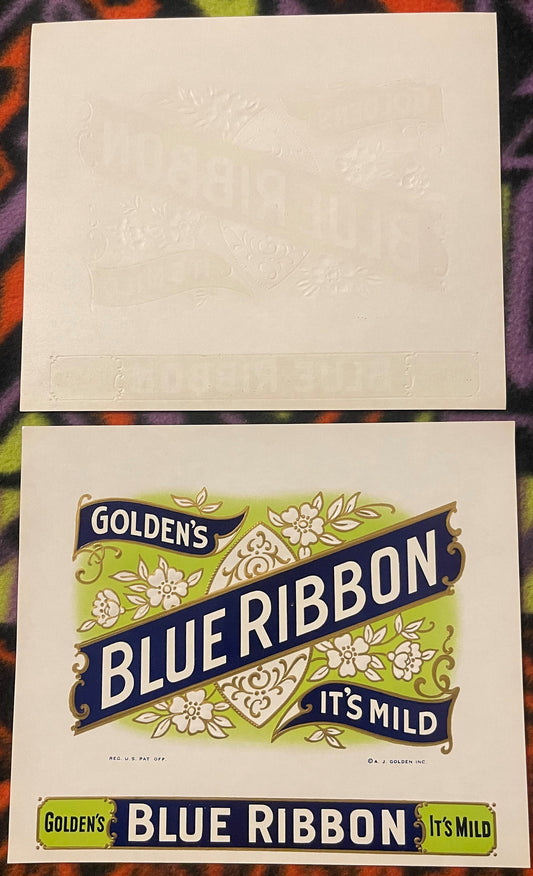
The Goldens had a slogan for Blue Ribbon, too: It's Mild. It is printed right on one of their own Blue Ribbon box labels - a navy BLUE RIBBON band across a lime-green ground of wild roses, GOLDEN'S on one little ribbon, IT'S MILD on the other, and © A. J. GOLDEN INC. in the small print. And this very Sevis artwork - the rosette, the lions, the coins and the little castle shield - was also printed as a bigger, rectangular label with one more line across the bottom in red: FOR MEN WHO KNOW. I love a cigar brand with its sales pitch printed right on the box.

Golden's made cigars from 1895 to 1943, and everything about this sheet - the deep-die gold, the velvety rosette, the lions and the coins - belongs to the great age of the embossed cigar label, which ran from the 1880s into the 1920s. That puts it right around a hundred years old, and I think it has worn the century better than most of us will.

🏭 Golden's of Bonneauville — the Best Business That Town Ever Had

Bonneauville is an old place. It was settled in 1755, had its name by 1789, and did not become a borough until 1961 - a crossroads with a blacksmith shop, a log hotel and a few houses that grew up a few miles east of Gettysburg on the Hanover road. During the Civil War, the town's museum records, thousands of troops marched through and slept in the streets of Bonneauville on their way to the battle already raging at Gettysburg. And the same museum reckons that an estimated twenty percent of all cigars smoked in America were made within ten miles of the town. Cigars were being rolled there by 1880, when A. Ackerman was at it.

The Bonneauville Museum keeps the record, and it is a good one. The Tobacco Trade Directory for 1906 lists four licensed cigar manufacturers in that one small town: A. J. Golden (tax no. 2464), Emery L. Golden (tax no. 2280), F. H. Smith (tax no. 2161), and A. L. Wagaman (tax no. 42). There was at least one unlicensed maker besides.

The Goldens were, in the museum's own words, the most successful business ever to operate in Bonneauville. Blue Ribbon was their renowned brand, made from the beginning right through past the middle of the century, and the brothers are credited as its co-inventors. They started producing it in quantity in a building on West Hanover Street, outgrew that, and put up a new structure on East Hanover Street early in the twentieth century — a general store on the ground floor with cigar production upstairs. That building still stands; it is a shop today. Later they built a bigger factory a couple of blocks east, put up houses on the site for the Golden families, and a good share of the town went to work there. Much of what we know about those buildings comes from Frederick and Robert Golden, whose 2002 interviews the museum keeps on file.

The numbers are startling for a village. The Gettysburg Companion told the story in its April/May 2012 issue under a headline I could not have written better - "When Cigar Makers Were King" - and it records that E. L. Golden was turning out around three million cigars a year across two factories, one in Bonneauville and one at Two Taverns. Blue Ribbon cigars were, as the museum puts it, "licensed up and down the East Coast." And the Gettysburg Times gives the end of it precisely: Golden was in business from 1895 until he produced his last cigar on 5 March 1943. And cigars were not his only idea: the museum notes that E. L. Golden tried his hand at a Model T Ford dealership too.

That second factory sat at Two Taverns, a crossroads village in Mount Joy Township on the Baltimore Pike between Gettysburg and Littlestown, which grew up around cigar companies, a stone creamery, a gunsmith, a furniture works and a fruit market. It has its own Civil War night: General George Armstrong Custer and his Michigan Wolverines camped at Two Taverns on 2 July 1863 and rode out before dawn on the 3rd to join Gregg's cavalry on the Low Dutch Road, for the fight on what became the East Cavalry Field. That is a lot of history for two little towns that most people drive straight through.

Their other brands are worth the roll call for the names alone: Bokay-Grande (the B standing for Bonneauville — Bonneauville-Okay), Bunney Boys (Bunney, again, for Bonneauville), Penn Rose, Two Homes, Grande, Two Friends, Newcomers — which landed them in a lawsuit — and Tu-Tu-Chu, a sweetened and flavored cigar made not for smoking at all but for chewing slowly.

🔗 Why Two Different Firms Appear on One Brand

Here is the thing that explains this sheet. The museum notes that factory numbers and tax numbers vary across Golden's Blue Ribbon boxes, and gives the reason: their products were often licensed to other manufacturers. A brand that popular did not stay in one building. The artwork was registered by a label house in York County, the cigars were rolled in Adams County and elsewhere under license, and the paperwork on any given box reflects whoever was making that particular run.

So what this label tells you for certain is its design registration. What the record around it tells you is which brand it belongs to, and that is a brand with a documented town, a documented family and a documented last day.

🌾 York County, Where the Cigars Came From

Springvale sat in the middle of something enormous. In 1907 there were twelve hundred cigar factories in York County alone, turning out three hundred million cigars a year. By the 1920s the York County Cigar Manufacturers Association was billing the place as "The home of the five cent cigars," and roughly twenty percent of every cigar smoked in America came out of that one county. The town of Red Lion by itself accounted for about a tenth of the national output. Cigar making employed more York County people than any other industry, and in 1907 alone the county's makers paid close to $1 million in federal tax. The York historian George Prowell named the hubs - Dallastown, Hanover, Red Lion, Yoe and Windsorsville - and Windsor Township is Springvale's own township.

Springvale was a cigar village in its own right. It was founded around 1820; the York and Peach Bottom Railroad reached it in 1874, and by 1876 it had a station, a freight depot, a grist mill, a saw mill, a tannery and a general store. In the early 1900s H. G. Barnhart ran a cigar factory there before he turned to selling automobiles - which, now that I think about it, is the same road E. L. Golden went down with his Model T dealership. Cigar men and cars, a couple of counties apart.

That is the world a label house like Sevis served: hundreds of small manufacturers within a day's cart ride, every one of them needing artwork good enough to make a box stand out on a counter.

✨ The Gold

The gold on this label is the expensive part, and it was done with real materials and a lot of tonnage. By the early 1890s label lithographers were running presses of thirty-eight tons with precision-machined dies, embossing the sheet and laying metal into the raised areas in the same operation. In America most houses pressed bronze flake into the die; the finest work took 22 karat gold or bronze leaf, and European printers favored 24-karat gold leaf. Whichever it was here, it has not dulled: the letters, the crest, the coins and the scrollwork all still catch the light and shift as you tilt the sheet. The better labels of this period took twelve separate colors, each its own pass through the press, before the embossing and gilding runs even began.

🎀 The ribbon and the crest

The heraldry people have written about this very label. "Cigar Box Heraldry" in The Armiger's News, the journal of the American College of Heraldry, Winter 2014, uses it as an example and credits it to the Springvale label house. The piece points out that the crest up top is built like a crown without actually being one - just lions either side of a staff - and picks out that tiny, almost vestigial shield at the bottom with its single castle. Its take on the name is a good one: the ribbon has to refer to the ribbons that went with cigars. Up until about the Civil War, when cigars carried no brand names at all, you bought them one at a time or in bundles of 25 or 50 tied together with a ribbon, and the first cigar boxes held those tied bundles.

I love that a label made to sell cigars ended up in a heraldry journal. Two lions, a staff, a castle, a rosette and a row of prize medals, and not one of them refers to a real coat of arms or a real prize - it's borrowed grandeur, which is exactly what a brand called Blue Ribbon wanted on the lid.

🎀 About these

They're 4 3/4 by 4 3/4 inches, square with clipped corners, never glued to a box. Frame one with a generous mat in a small square frame, and hinge it at the back instead of pressing it flat behind the glass - the embossing is the point, and it needs room to stand up. It sits beautifully with other cigar labels and bands, on a Pennsylvania wall, or over a humidor. The supply is finite - nobody's embossing gold onto Blue Ribbon labels again, and once these last unused ones are gone, they'll be very difficult to acquire.

Shipping

🚚 Shipping & Handling

  • Shipping costs and timing are calculated at checkout.
  • Items curated and shipped directly by me include U.S. shipping at no additional cost, professionally packed to ensure safe arrival of your artifact.

Items from Vetted Pro Collectors
Shipping for items offered by vetted Pro Collectors is determined at checkout. All Pro Collector listings are reviewed to ensure fair, reasonable shipping practices.

For full details, please refer to our Shipping Policy.

Returns & Exchange

Take your time — you've got a full six months. If a piece isn't right for you, send it back the way it reached you and we're good.

In the first 30 days your money goes straight back the way you paid. After that it's store credit, so you can put it toward something you'd rather have.

Return shipping we sort out between us, case by case. I don't make this difficult.

If something arrives damaged, or it isn't what I said it was, send me a photo within 48 hours and I'll make it right.

Email info@vintageantiquesgifts.com or call 802-356-9872 — that's me answering, not a call center.

The only things I can't take back are custom or special-order pieces and gift cards.

View full details
  • 5 stars: 2 (100%)
  • 4 stars: 0 (0%)
  • 3 stars: 0 (0%)
  • 2 stars: 0 (0%)
  • 1 star: 0 (0%)
t
tattman45

very pleased with this vintage label

The kids and I are so glad you like it!

f
founttl

Great label and fast shipping, thanks

Thank you so much for the kind words! We really appreciate it. My dad had to take a break for a bit so I apologize for the delay in responding. We hope to work with you again in the future!

Rescuing American History Since 2007

— Travis & the Kids