Skip to product information
1 of 4

Vintage and Antique Gifts

Antique 1920s Large Sonny Boy Embossed Cigar Label 🚬 Historic!

Antique 1920s Large Sonny Boy Embossed Cigar Label 🚬 Historic!

Regular price $7.00 USD
Regular price Sale price $7.00 USD
Sale Sold out
Shipping calculated at checkout.

Size: 8 3/4" x 8"

🚚 Free US Shipping — ships within one business day. International shipping calculated at checkout.

Quantity

Who Smoked Sonny Boy Cigars? 🎩 A Smoking Jacket, a Wingback Chair and a Five-Cent Cigar

Size: 8 3/4" x 8" ~ NOS unused stock, little to no storage wear.

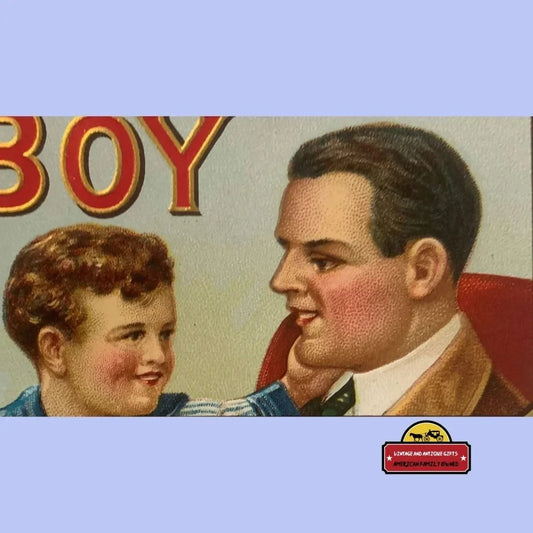
A father sits back in a wingback armchair, dressed in a smoking jacket with a shawl collar. His curly-headed boy, in a sailor suit, is perched on his knee with a box of cigars in his lap and one hand up at his father's chin. Beside the chair a cigar rests in an ashtray, and a thin thread of smoke climbs past the wing of the chair. Two shields give the price, 5¢, and two more promise MILD.

This is a large, nearly square Sonny Boy cigar box label from the 1920s, and in tiny capitals along its bottom edge it names the house that printed it: CONSOLIDATED LITHOGRAPHING CORPORATION BROOKLYN N.Y. The Consolidated firm only started operating on January 1, 1926, so the label is no older than that - a late-1920s Sonny Boy, from the same years the name was the biggest song in America. By January 1935, TIME magazine was calling the man who organized that company, Jacob A. Voice, a "Bandman": his Consolidated Lithographing Corp. of Brooklyn made the bands for 70 percent of America's cigars, some 3,500,000,000 of them, and was the biggest cigar-band manufacturer in the world. This one is unused new old stock that was never pasted to a box, with the gold still bright and the embossing standing up off the paper.

🔍 What Is Printed on This Label

The label is a nearly square sheet of paper, lithographed in full color with gold and embossed so the lettering and the figures stand in relief. SONNY BOY is printed on it twice.

Centered under the lower SONNY BOY is the printer's line.

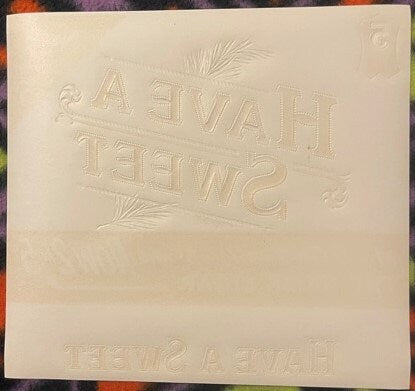
On the back the paper is plain, with the design pressed through in reverse by the embossing die, both SONNY BOYs backward.

🧥 The Jacket, the Sailor Suit and the Wing Chair

Everything the artist put this father in and around has a history of its own. The smoking jacket was designed in the 1850s. London's Gentleman's Magazine described it as a "kind of short robe de chambre" of velvet, cashmere, plush, merino or printed flannel, lined in bright colors. When the Crimean War made Turkish tobacco popular in Britain, smoking took off, and a gentleman might put on a smoking jacket after dinner and retire to a smoking room, the jacket taking the smoke and the falling ash instead of his good clothes. The classic cut has a shawl collar and turn-up cuffs, which is exactly what the man in this chair is wearing. The jacket stayed in fashion well into the twentieth century: Cary Grant, Dean Martin and Frank Sinatra wore them, and Fred Astaire was buried in one.

The boy's outfit goes back to 1846, when the four-year-old Albert Edward, Prince of Wales, was given a scaled-down copy of the uniform worn by the ratings on the Royal Yacht. Franz Xaver Winterhalter painted him in it that year, popular engravings spread the look, and by the 1870s the sailor suit had become fashionable dress for boys and girls in many countries.

The chair is older still. Wing chairs were first made in England in the 1600s and caught on in the 1720s. The wings shielded the sitter from draughts and trapped the heat of the fireplace the chair was usually drawn up to. There is a grislier story too: the first winged chairs are said to have been all-wood seats used by barber-surgeons, the wings keeping draughts from blowing hair and blood around during an operation.

🧾 5¢ and MILD: The Nickel Cigar

The price in those shields put Sonny Boy in the biggest class of cigar in America. In 1917, with the First World War to pay for, Congress went back to the Civil War system of taxing cigars by the price they were made to sell at, with revenue stamps color coded to match. There were five classes. The orange Class A stamp, for cigars sold for not more than 5¢ each, was by far the most common; green Class B covered cigars from 6¢ to 8¢. On a stamped box, the top line of the cancellation gave the factory number, the tax district and the state. The Class A stamp turned violet in mid-1940, and the whole color-coded scheme was redesigned in 1942, when taxes were raised to fight the Second World War.

The Revenue Act of 1926, signed by President Calvin Coolidge on February 26 of that year, added a rule of its own: the Commissioner of Internal Revenue could require a "conspicuous label" on every box naming the clause of law under which the cigars inside had been tax paid, and that label had to agree with the tax-paid stamp.

Nickel cigars owned the counter in those years. They made up 63 percent of all cigar sales in the twelve months from 1930, and 73 percent by July 1931, and through the 1930s about nine cigars in ten sold in the United States cost 5¢ or less. The trade was being remade underneath them. In 1929, 375 cigar factories closed, nine in ten of them shops of six or fewer workers making higher-priced cigars, and by 1930 the average cigar factory employed 64 people, against 6 in 1900. The big brands came down to meet the nickel: Phillies and Harvester were among the brands cut from 10¢ to 5¢ in 1933, and in the two years after that cut Bayuk's Phillies went from selling 17,000,000 cigars to 365,000,000 and became the best-selling cigar in the country.

🏭 Consolidated Lithographing Corporation of Brooklyn, New York

Jacob A. Voice's story is a real American one. He came over from Romania as a boy of four, and at fourteen he was working at Steiner's as a bronze feeder (most of the gold on American labels was bronze powder) for $2.50 a week. That was Wm. Steiner & Sons, which had grown out of Steiner & Rosenthal, the house William Steiner and Isaac Rosenthal founded in 1884 to make nothing but cigar bands, and which took the Wm. Steiner & Sons name in 1896; in 1905 Steiner put up his own building on West 17th Street in Manhattan. Voice went on to run a firm of his own, the Pasbach-Voice Lithographing Company, with Oscar Pasbach, and in 1926, at the head of his firm, he merged with Steiner's. That year the firm's name became Consolidated Lithographing Corporation. The announcement ran in The Tobacco World on January 15, 1926: having taken over Pasbach-Voice and William Steiner Sons & Company, the new corporation would run both sets of factories from January 1, 1926, signed by Jacob A. Voice as first vice-president and general manager, with letters from Oscar Pasbach and Henry Steiner alongside. Consolidated stayed in Brooklyn until 1952 and then moved out to Long Island, so a Brooklyn imprint like this one belongs to those first Brooklyn years.

Brooklyn already had a name in the trade. The best cigar label printers were run by German immigrants: George Schlegel, O. L. Schwenke, Schmidt & Co., Witsch & Schmitt, Schumacher & Ettlinger and F. Heppenheimer's Sons in lower Manhattan, and Moehle Litho in Brooklyn. Consolidated moved to the front of that field. The American Lithographic Company, formed in 1892, was sold in 1929 to the United States Printing and Lithographic Company, which in 1930 sold off its cigar label business to Consolidated. By the mid-1930s Consolidated was the biggest cigar-band maker in the world.

In 1935 Voice gave the Museum of the City of New York a collection of cigar box labels running from about 1870 to 1930. Sidney P. Voice, a vice-president of Consolidated, gathered cigar bands, cigar box labels and salesman's sample books from New York and Brooklyn lithographers spanning about 1890 to 1963, and gave them to the New-York Historical Society in 1973, 1977 and 1983. The Cary Graphic Arts Collection at the Rochester Institute of Technology keeps progressive proof books of chromolithographed labels from four firms, and Consolidated is one of them.

✨ Stone, Bronze and the Embossing Die

A label like this began as a monthlong job. It started with an idea or a rough sketch from the customer or the printer's art department. That became a finished pencil drawing, then, once approved, a watercolor. The lithographic department turned the painting into a key line drawing, a black-and-white map of every color, and staff lithographic artists drew each color onto limestone in grease pencil. It was standard practice to destroy the original painting as soon as it had been transferred to stone, which is why the artwork behind hundreds of thousands of cigar labels almost never survived.

After 1890, embossing and gilding meant extra press runs. By 1892 lithographers were embossing labels in 38-ton presses with precision-machined dies, the kind of die that raised the lettering, the figures and the shields on this sheet. The gold went on either as genuine gold leaf or as bronze powder, rubbed in with a buffing wheel much like a shoe-shine brush. Most American labels were gilded with bronze; 24-karat gold is generally found on European ones.

The people who drew them were mostly anonymous. One label artist of the period, Henry Maier, never became famous in the art world, and the story goes that he preferred partying and womanizing to work. By the 1920s lightweight metal plates on high-speed presses were replacing the Bavarian limestones, and photoengraving and four-color presses arrived together with cigar-making machinery and the closing of fully 80 percent of American cigar factories in less than a decade.

🎶 "Sonny Boy": The Name in 1928

For a season in 1928 those two words belonged to Al Jolson. Ray Henderson, Buddy DeSylva and Lew Brown wrote "Sonny Boy," and legend has it they wrote it in Atlantic City as a joke, a song so shamelessly sentimental that even Jolson would hate it. He loved it, and sang it to a little boy in The Singing Fool, the Warner Bros. part-talkie that premiered in New York on September 19, 1928. His record held number one for twelve weeks, it became the first song from a movie to sell over a million copies, and sheet music, piano rolls and records together passed three million. One trade paper predicted the picture would be to talking pictures what The Birth of a Nation had been to silent ones, and it stayed Warner Bros.' most successful film until Sergeant York in 1941.

The boy was Davey Lee, born in Hollywood on December 29, 1924, and three years old when he played Sonny. In 1929 he starred in a picture of his own called Sonny Boy and joined Jolson again in Say It with Songs. His whole film career was six pictures between 1928 and 1930, ending with The Squealer. He died in Los Angeles on June 17, 2008, at 83. The song lived on in records by Paul Robeson, the Andrews Sisters, Sonny Rollins, Petula Clark and Mandy Patinkin, and its original words and music entered the public domain in the United States in 2024.

The cigar label never mentions Jolson, the song or the film. What it shares with them is the name, a father and his boy, and the same stretch of American life.

🖼️ Good For

  • A square frame over a bar cart, a desk or a reading chair, where the smoking jacket and the wingback feel at home.
  • A Father's Day, new dad or grandfather gift built around a picture of a father and his boy.
  • A cigar room or tobacco wall with other labels from the nickel cigar years.
  • A companion for "Sonny Boy" sheet music or a Jolson 78.
  • Collectors of Brooklyn and New York printing history.

🎩 About these

Every one was never applied to a box, the back clean but for the embossing pressed through. Use a mat or spacers so the glass sits off the paper and never presses the raised lettering and figures, and hang it out of direct sun - a den, a study, or beside a wingback chair of your own. The supply is finite - nobody's embossing Sonny Boy labels like this again, and once these last unused ones are gone, they'll be very difficult to acquire.

Shipping

🚚 Shipping & Handling

  • Shipping costs and timing are calculated at checkout.
  • Items curated and shipped directly by me include U.S. shipping at no additional cost, professionally packed to ensure safe arrival of your artifact.

Items from Vetted Pro Collectors
Shipping for items offered by vetted Pro Collectors is determined at checkout. All Pro Collector listings are reviewed to ensure fair, reasonable shipping practices.

For full details, please refer to our Shipping Policy.

Returns & Exchange

Take your time — you've got a full six months. If a piece isn't right for you, send it back the way it reached you and we're good.

In the first 30 days your money goes straight back the way you paid. After that it's store credit, so you can put it toward something you'd rather have.

Return shipping we sort out between us, case by case. I don't make this difficult.

If something arrives damaged, or it isn't what I said it was, send me a photo within 48 hours and I'll make it right.

Email info@vintageantiquesgifts.com or call 802-356-9872 — that's me answering, not a call center.

The only things I can't take back are custom or special-order pieces and gift cards.

View full details
  • 5 stars: 1 (100%)
  • 4 stars: 0 (0%)
  • 3 stars: 0 (0%)
  • 2 stars: 0 (0%)
  • 1 star: 0 (0%)
k
k***e (15)

Great looking vintage cigar label great for my collection.

Rescuing American History Since 2007

— Travis & the Kids