
Skip to product information
1 of 6

Vintage and Antique Gifts

Antique 1920s-1930s Sonny Boy 🎸 NOS Chromolithograph Cigar Box Label Embossed Cellophane Collectible

Antique 1920s-1930s Sonny Boy 🎸 NOS Chromolithograph Cigar Box Label Embossed Cellophane Collectible

Regular price $5.50 USD
Regular price Sale price $5.50 USD
Sale Sold out
Shipping calculated at checkout.

Size: 8 1/2" x 2.12"

🚚 Free US Shipping — ships within one business day. International shipping calculated at checkout.

Quantity

Why Was Sonny Boy on a Cigar Box? 🎶 "Sonny Boy": The Two Words All of America Was Singing

Size: 8 1/2" x 2 1/8"

In the fall of 1928 there was no getting away from "Sonny Boy." Al Jolson sang it to a little boy in The Singing Fool, the Warner Bros. part-talkie that premiered in New York on September 19, 1928, and his record of it held number one for twelve weeks and sold a million copies. It was the first song from a movie ever to sell a million, and sheet music, piano rolls and records together went past three million. The boy on the screen, Davey Lee, not yet four years old, was for a while the most popular child star since Jackie Coogan, and in 1929 Warner Bros. gave him a picture of his own called Sonny Boy.

This cigar box label wears the same two words over a curly-haired boy grinning up at his father. It never mentions Jolson or the film. What it shares with them is the name, the father and son, and the moment: its small print, a box "CELLOPHANED" and a tax notice written for the nickel cigar, puts it in the late 1920s and the 1930s. It is unused new old stock that was never glued to a box, with the gold still bright and the embossing still standing up off the paper.

🔍 What Is Printed on This Label

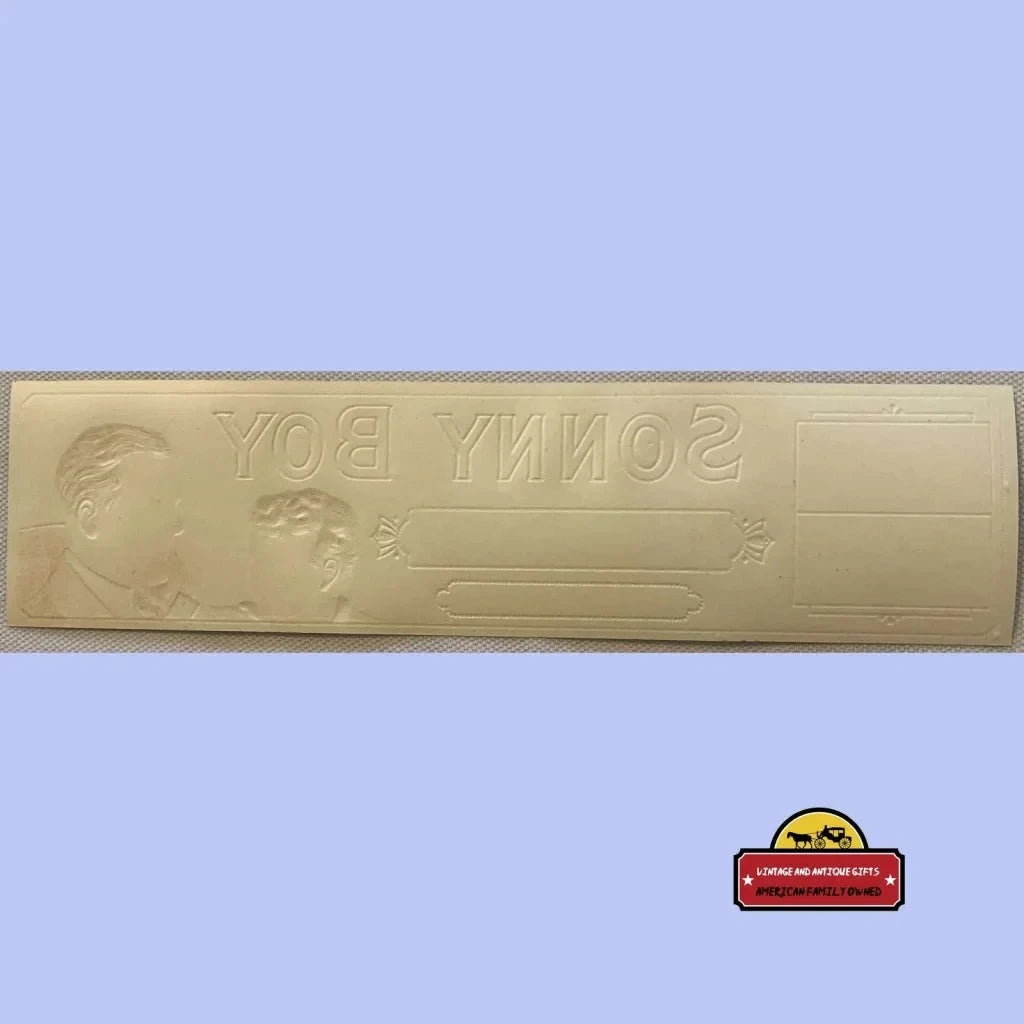
The label is a long, narrow strip, lithographed in color and gold and embossed. SONNY BOY runs across the top in raised red capitals outlined and shadowed in gold. Below the name, QUALITY CIGAR stands out in cream letters on a blue cartouche with gold scrollwork at either end, and beneath that a cream oval banner with a beaded gold edge reads CELLOPHANED.

The picture fills the right end. A boy with a mop of curls, in a sailor collar and striped sleeves, reaches up to his father's chin and beams at him, and the father, dark hair combed back, collar and patterned tie, sits in an armchair and smiles down at the boy. Up close the faces are modeled in fine stippled dots of color, the lithographer's way of building up skin tone and blush, and the whole label is framed in a gold border with a beaded inner line.

The left end holds two cream panels inside a gold frame. The upper one is blank. The lower one carries the notice that makes this label a small piece of tax history:

THE CIGARS HEREIN CONTAINED WERE MANUFACTURED TO RETAIL AT NOT MORE THAN 5c. EACH AND ARE SO TAX-PAID

On the back the paper is plain, and the whole design shows through in reverse relief: SONNY BOY backwards, the two heads, the frames of the cartouche and the banner, all pressed through by the embossing die.

🧾 "And Are So Tax-Paid": The Nickel Cigar Under Federal Law

That notice is a legal declaration, not decoration. In 1917, with the First World War to pay for, Congress went back to the Civil War system of taxing cigars by the price they were made to sell at. Large cigars were sorted into five classes, and each class had its own color of revenue stamp. Class A, the orange stamp, was for cigars made to retail at not more than 5 cents each, and it became by far the most common stamp on an American cigar box. Class B, in green, covered cigars selling for 6 to 8 cents; dark blue marked Class C, from 8 to 15 cents; claret marked Class D, from 15 to 20 cents; and a brownish orange stamp went on Class E, the cigars over 20 cents. The Class A stamp stayed orange until mid-1940, when it turned violet.

The Revenue Act of 1926, passed on February 26 of that year, kept the price classes and set new rates: $3 per thousand on cigars made to retail above 5 cents and up to 8 cents, $5 per thousand up to 15 cents, and $10.50 per thousand up to 20 cents, with the nickel cigar in the cheapest class of all. The law also carried a rule that explains this panel exactly. The Commissioner of Internal Revenue could require every box to bear "a conspicuous label" naming the clause under which the cigars inside had been tax paid, and that label had to match the tax-paid stamp on the box. A box finished with this strip was declaring, to the tax collector and to everyone down the line to the tobacconist, that it held nickel cigars and wore the Class A stamp.

Those classes held until 1942, when World War II taxes rewrote the whole scheme: Class A became cigars up to two and a half cents, and the nickel cigar dropped into Class C. A notice worded "not more than 5c. each" belongs to the years before that change.

The nickel was where the trade was heading. Five-cent cigars made up 63 percent of all cigar sales in the twelve months from 1930, and by July 1931 the share had climbed to 73 percent. Through the 1930s about nine cigars in ten sold in the United States cost 5 cents or less. In 1929 alone, 375 cigar factories closed, nine in ten of them shops of six or fewer workers making higher-priced cigars. Even the big brands chased the nickel: after Bayuk cut Phillies from 10 cents to 5, sales went from 17 million cigars to 365 million in two years, and Phillies became the best-selling cigar in the country.

✨ "Cellophaned": The Wrapper That Dates the Label

Cellophane was invented in 1908 by Jacques Brandenberger, a Swiss textile engineer. The story goes that it began when he watched a spilled glass of wine stain a tablecloth and set out to make a waterproof fabric. In 1924 he sold the American manufacturing rights to DuPont, and there William Hale Charch took on the film's great weakness: the original cellophane kept out water but let moisture vapor through. Charch's nitrocellulose coating made it moisture-proof, and the patent came in 1927. For the first time a clear film could keep tobacco from drying out.

Before that, a cigar maker who wanted to protect his cigars wrapped them in foil. Shredded-filler nickel cigars dried out fast, and foil went from decoration to necessity. A hard-working youngster could foil-wrap about 2,400 cigars a day, usually in September and October ahead of the Christmas trade, and a new 1928 foil-wrapping machine could do ten times that. By the end of the 1920s cellophane had reached the cigar trade and could be put on by machine. In 1931 P. Lorillard was packing its Postmaster cigars cellophane-wrapped at two for 5 cents in boxes of 100. The film was new enough that the same year Cornell University issued a solemn warning against eating the transparent wrappings on cigars. It stuck: by 1958 only the bakery and meat industries used more cellophane than the tobacco companies.

So CELLOPHANED gets its own banner here, telling the buyer the cigars inside came in the newest wrapper in packaging. Local legend in the tobacco trade holds that some shopkeepers would hold a cellophane-wrapped cigar up to the window light to show a doubtful customer it was fresh. Together with the nickel tax notice and the Consolidated name on the brand's large label, it places the Sonny Boy strip in the late 1920s and the 1930s.

🏭 Consolidated Lithographing Corporation of Brooklyn, New York

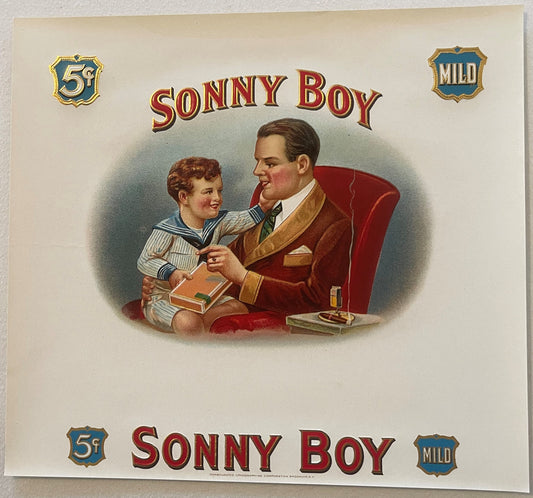
This strip crops in tight on two faces. The brand's large, nearly square Sonny Boy label shows the whole scene: the boy in a striped sailor suit sitting on his father's knee with a cigar box in his lap, the father in a smoking jacket with a gold shawl collar, a cigar resting in a tray on a side table with a thread of smoke rising from it, and gold shields reading 5¢ and MILD in the corners. Along its bottom edge, in small capitals, runs the imprint CONSOLIDATED LITHOGRAPHING CORPORATION BROOKLYN, N.Y. The artwork on this strip is that same father and son, so the Sonny Boy design came off Consolidated's presses.

The company was built by Jacob A. Voice. Voice was born in Romania in 1884 and came to the United States at the age of three. In 1903 he went to work for Wm. Steiner & Sons, a lithographic house that grew out of Steiner & Rosenthal (1884), and by 1911 he had organized a company of his own. Around 1925 he merged it with Steiner's, and the firm took the name Consolidated Lithographing Corporation. The consolidating kept going: the American Lithographic Company was taken over by U.S. Printing & Lithograph in 1929, and in 1930 its cigar label business went to Consolidated. When Fortune ran a piece on Voice and his company in March 1933, it named him America's foremost maker of cigar box art.

In 1935, while president of the company, Voice gave a collection of cigar box labels spanning roughly 1870 to 1930 to the Museum of the City of New York. He died in 1942. Sidney Voice, a vice-president of Consolidated, built a collection of his own, cigar bands, cigar box labels and salesman's sample books from New York and Brooklyn lithographers dating from about 1890 to about 1963, and the New-York Historical Society holds it today. Labels for nickel cigars went out with the empty boxes by the millions; this one was never pasted down at all.

🎬 The Other Sonny Boy: Jolson's Song and the Boy Who Played Him

"Sonny Boy" was written by Ray Henderson, Buddy DeSylva and Lew Brown. The story goes that the three of them, tired of being pestered by Jolson for a song, knocked it out in a single sitting in an Atlantic City hotel room as a joke, making it so sentimental that even Jolson would hate it. He did not hate it. It became one of the biggest popular hits of its time, and The Singing Fool remained the most successful film in Warner Bros. history until Sergeant York in 1941. One critic of 1928 predicted it would be to talking pictures what The Birth of a Nation had been to silent ones. Paul Robeson, the Andrews Sisters, Ruth Brown, Sonny Rollins and Petula Clark all recorded the song in later years, and the original words and music entered the public domain in the United States in 2024.

Davey Lee, who played Sonny Boy, was born December 29, 1924. His parents eventually took him out of the movie business. He died in Los Angeles on June 17, 2008, at 83.

🖼️ Good For

  • A slim frame over a desk, a bar or a doorway, where the long strip fits a narrow space.
  • A cigar room or tobacco wall alongside other labels from the nickel cigar years.
  • A Father's Day, new dad or grandfather gift built around the picture of a father and his boy.
  • A companion piece for "Sonny Boy" sheet music or a Jolson 78 from 1928.
  • Collectors of revenue and tax history: the label spells out a federal cigar tax class in its own words.

❓ Questions People Ask

How old is the Sonny Boy cigar label?

It dates to the late 1920s-1930s. The word CELLOPHANED ties it to the years after DuPont's moisture-proof cellophane patent of 1927, when cellophane moved into cigar packing. The 5-cent tax notice matches the federal price classes that stood until 1942. And the Consolidated Lithographing Corporation name printed on the brand's large label only dates from 1925.

Who printed the Sonny Boy labels?

Consolidated Lithographing Corporation, the Brooklyn house run by Jacob A. Voice. Its imprint runs along the bottom of the large Sonny Boy label, which carries the same father-and-son artwork as this strip.

What does "so tax-paid" mean on a cigar box label?

It means the maker had paid federal tax on the cigars in that box at the rate for cigars made to sell for a nickel or less, the old Class A. Federal law let the revenue commissioner require a label naming that tax clause, and it had to agree with the stamp.

Was the Sonny Boy cigar named for Al Jolson's song?

Nothing on the label says so. The song came out in 1928 as the biggest hit in the country, and the label's cellophane banner and nickel tax notice put it in those same years, so the two share a name, a father and son, and a moment in American life.

Is this label new old stock?

Yes. It was never applied to a box. The back is clean paper with nothing on it but the reverse of the embossing.

Shipping

🚚 Shipping & Handling

  • Shipping costs and timing are calculated at checkout.
  • Items curated and shipped directly by me include U.S. shipping at no additional cost, professionally packed to ensure safe arrival of your artifact.

Items from Vetted Pro Collectors
Shipping for items offered by vetted Pro Collectors is determined at checkout. All Pro Collector listings are reviewed to ensure fair, reasonable shipping practices.

For full details, please refer to our Shipping Policy.

Returns & Exchange

Take your time — you've got a full six months. If a piece isn't right for you, send it back the way it reached you and we're good.

In the first 30 days your money goes straight back the way you paid. After that it's store credit, so you can put it toward something you'd rather have.

Return shipping we sort out between us, case by case. I don't make this difficult.

If something arrives damaged, or it isn't what I said it was, send me a photo within 48 hours and I'll make it right.

Email info@vintageantiquesgifts.com or call 802-356-9872 — that's me answering, not a call center.

The only things I can't take back are custom or special-order pieces and gift cards.

View full details
  • 5 stars: 1 (100%)
  • 4 stars: 0 (0%)
  • 3 stars: 0 (0%)
  • 2 stars: 0 (0%)
  • 1 star: 0 (0%)
B
Butch (New York, US)
Fantastic

Items arrived with-in a few days. Perfect condition and I couldn't b happier! I have grandkids your kids age and they love grampies collection. Looks like I'm your new regular customer!

Preserving History: Authentic Objects Across Eras

— Curated by Travis Weigel