Skip to product information
1 of 2

Vintage and Antique Gifts

Vintage 9XXXX Streamliner Train Broom Label NOS 1930s 1940s Hamburg PA Railroad Art Deco Locomotive Advertising Paper Ephemera 🚂

Vintage 9XXXX Streamliner Train Broom Label NOS 1930s 1940s Hamburg PA Railroad Art Deco Locomotive Advertising Paper Ephemera 🚂

Regular price 9.00 USD
Regular price Sale price 9.00 USD
Sale Sold out
Shipping calculated at checkout.
Quantity

When Did a Pennsylvania Broom Town Become the Center of the World — and Leave Behind Art This Good? 🚂

There is a particular kind of object that stops you cold the moment you hold it. Not because it's flashy or expensive or rare in the way auction-house rarities are rare — but because it is so completely itself, so utterly of a specific place and a specific moment, that the decades between you and its making simply collapse. This Hamburg Broom Works streamliner train label is exactly that kind of object. It sat somewhere, untouched, never pressed to paper, never glued to the flat of a broom handle or stapled to a bundle of broomcorn — and because of that, it arrived in the present in the same condition it left the printer. New Old Stock. The graphic ink still punches. The paper still holds its body. The locomotive on its face still charges forward as though the 1940s never ended.

That is the magic of New Old Stock ephemera, and if you've been collecting long enough, you already understand the almost irrational satisfaction of finding something that was made to be used and somehow, improbably, wasn't. This label is that satisfaction in a 3.75 × 5.25 inch rectangle.


🏷️ What You Are Looking At

This is a vintage broom label — catalog number 9XXXX — produced for the Hamburg Broom Works of Hamburg, Pennsylvania, almost certainly during the 1940s. It measures 3.75 inches by 5.25 inches, a compact but commanding size that was standard for broom bundle labels of the period, designed to be seen at a glance in a hardware store, a general goods shop, or a farm supply. It is New Old Stock: never applied, never folded into service, never subjected to the glue, the pressure, or the warehouse humidity that consumed most of its siblings. What you receive is the label as its designer and printer intended it to exist — pristine, flat, and complete.

The design belongs unmistakably to the Art Deco streamliner era. A sleek passenger locomotive — low-nosed, aerodynamic, rendered in cool silver-grey tones that suggest polished steel — advances along a raised earthen embankment directly toward the viewer. Its passenger cars trail behind in a long, disciplined line, the whole train conveying momentum and modernity. A bold red star marks the locomotive's flank, a graphic accent that reads like a badge of pride. The sky behind the train is pale and open, dotted with billowing white clouds and a suggestion of distant green treeline — the landscape of the American mid-Atlantic, recognizable to anyone who has watched the countryside roll past a train window in Pennsylvania. The foreground floods with warm golden yellow, earth and sunlight pressed into a single powerful graphic field that anchors the entire composition and makes the cool silver of the locomotive pop with real contrast. Above the image, in deep navy blue block lettering that commands the top of the label: 9XXXX. Below the train, on that golden ground, the company's full name: HAMBURG BROOM WORKS, HAMBURG, PA — stated plainly, without apology, the way a town states itself when it knows exactly who it is.

The printing reflects the commercial lithography standards of the era — color-separated, carefully registered, built to hold up under handling in a retail environment. That it survived in unhandled condition makes the detail all the more visible now. These labels were not an afterthought. They were the face of the product, the brand impression, and the Hamburg Broom Works chose to put a streamliner locomotive on theirs. That choice tells you something about the ambition of this operation, and about the moment in which it was made.


🏭 The Hamburg Broom Works — A Century of Craft in Berks County

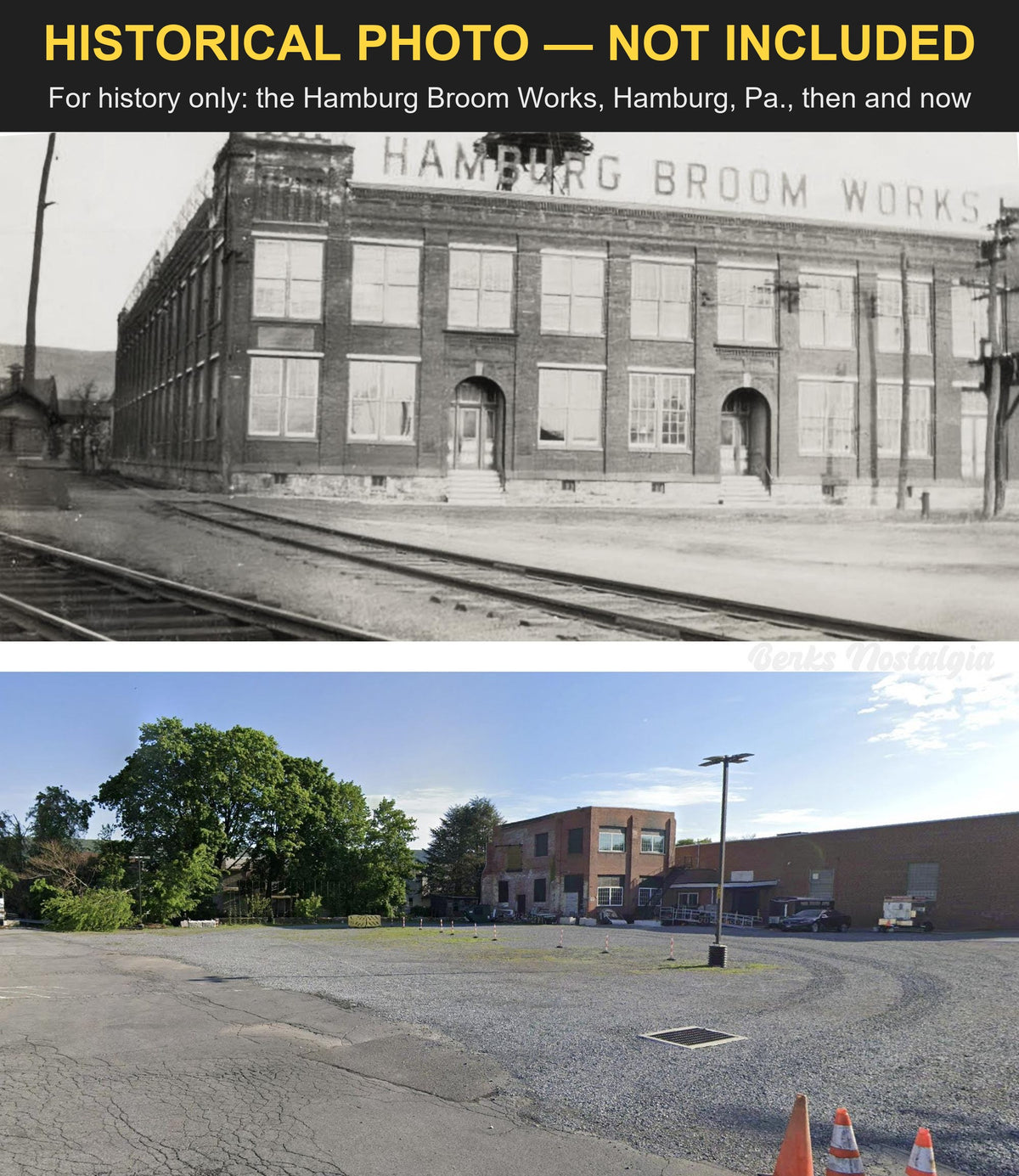
The Hamburg Broom Works was established in 1894 by Wilson Schmick, in the borough of Hamburg, Pennsylvania — a small, industrious community in Berks County situated along the Schuylkill River about sixty miles northwest of Philadelphia. Schmick built something that was, by any reasonable measure, a manufacturing success story of the old Pennsylvania kind: rooted in a local agricultural economy, refined over decades by skilled hands, and stubbornly resilient across generations of change.

At its height, the operation produced brooms on a scale that earned Hamburg a title that sounds almost mythological today — the Broom Capital of the World. Not of Berks County. Not of Pennsylvania. The world. That designation reflects the convergence of several conditions: proximity to the Reading Railroad, which made raw material and finished-goods transport efficient; a regional tradition of German-heritage craftsmanship that translated naturally into precision manufacturing; a ready supply of broomcorn from agricultural suppliers; and an owner and subsequent operators who understood that a broom was a competitive product in a crowded market, and that branding — the label, the look, the name — mattered.

The factory ran for over a century. It survived both World Wars, navigated the decline of domestic broomcorn agriculture (broomcorn production in the United States shifted westward and eventually largely southward as the twentieth century progressed), and outlasted dozens of competitors who had once seemed equally permanent. Local industrial histories note that at certain periods, the Hamburg Broom Works employed a significant portion of the borough's working population — the kind of anchor employer that shapes a community's rhythms, its lunch-hour foot traffic, its sense of collective identity.

The train image on this label was not chosen arbitrarily. The Reading Railroad ran directly through Hamburg, and the relationship between the Broom Works and the railroad was practical and immediate — raw materials arrived by rail, finished products departed the same way. Putting a streamliner locomotive on the label was both a tribute to that logistical lifeline and a savvy piece of aspirational branding. The 1940s streamliner was the symbol of American forward motion, of speed and modernity and confidence. Plastering one on a broom label said: we are not a backwater operation. We are connected. We move. We are modern.


🌽 The Broomcorn World — An Industry Hiding in Plain Sight

For collectors who come to this label from the railroad or advertising side rather than the household goods side, the broomcorn industry deserves a moment of its own. Broomcorn — Sorghum vulgare var. technicum, if you want the Latin — is not corn in any culinary sense. It is a tall, fibrous grass whose seed-bearing stalks, when harvested and dried, produce the stiff, resilient fibers that made American-made brooms the standard of quality for the better part of two centuries. The craft of broom-making from broomcorn is genuinely skilled work: the stalks must be sorted by length and quality, dampened for pliability, wound and stitched under tension onto a handle, and trimmed to a consistent working face. A well-made broomcorn broom is a tool that rewards the work put into it.

By the 1940s — when this label was almost certainly printed — the industry was at an interesting inflection point. Synthetic alternatives were beginning to appear in product development pipelines, though they had not yet displaced natural fiber at retail. Domestic broomcorn acreage was declining. But the established broom manufacturers, the ones with real infrastructure and loyal regional distribution, were still strong. Hamburg was still Hamburg. The label was still worth designing well.

Lore passed down among paper and advertising ephemera collectors holds that broom labels from the Pennsylvania operations — particularly those from Berks County manufacturers — are among the most graphically accomplished of the category, reflecting the regional print culture centered around Reading and Allentown, both of which had commercial lithography operations of real sophistication. Whether the 9XXXX label was printed locally in Pennsylvania or contracted to a larger specialty printer is not documented in surviving records that have surfaced publicly, but the quality of the color registration and the confidence of the composition suggest a printer who understood commercial graphic work at a high level.


🏘️ Hamburg, Pennsylvania — The Town Behind the Title

Hamburg is a borough of just over four thousand souls, nestled in the Great Valley of the Schuylkill just below the Blue Mountain ridge. It is Pennsylvania German country in the deepest sense — a place where craftsmanship was not a lifestyle aspiration but an inherited expectation, where a business established in 1894 was not considered particularly old, and where the connection between a factory and a community was understood to be mutual and long-term.

The borough's grid of streets runs orderly and practical, the architecture a mix of Federal and Victorian commercial buildings that still give Hamburg's downtown a legible nineteenth-century coherence. The Schuylkill River and the Reading Railroad line defined Hamburg's economic geography for most of its history — the river providing early mill power, the railroad providing later industrial reach. For the Broom Works, that railroad connection was the artery through which the business breathed.

Local legend has it that at the peak of the Hamburg Broom Works' production, you could smell broomcorn being processed from several blocks away on damp mornings — that particular dusty, slightly sweet, vaguely agricultural smell that former employees and their families still describe with something between grimace and affection when the factory comes up in conversation. Whether that's precise memory or the kind of sensory mythology that accumulates around beloved local institutions is impossible to say now, but it is the kind of detail that locates a place in time more precisely than any census record.

Another thread of local lore, repeated in Berks County historical circles, holds that Wilson Schmick chose Hamburg deliberately over competing sites not for the river access or the railroad — both of which were available elsewhere — but because of the existing concentration of skilled German-heritage craftsmen in the borough who already understood fiber work and manual manufacturing precision. If true, it reflects a sophisticated understanding of labor geography that many larger industrialists of the era missed entirely.


🎨 The Art Deco Streamliner Moment — Why This Design Still Works

The streamliner locomotive as a graphic symbol belonged to a very specific window in American visual culture — roughly the mid-1930s through the late 1940s — when the industrial design movement collided with railroad marketing and produced some of the most enduring commercial imagery in American history. The Pennsylvania Railroad's GG1, the Burlington Zephyr, the New York Central's 20th Century Limited — these were not just transportation. They were designed objects, aesthetic statements, and the companies behind them understood that a beautiful machine was a marketing asset.

The locomotive on the Hamburg Broom Works label participates in that aesthetic conversation without being a copy of any specific prototype. It is a generalized streamliner — the idea of modern rail travel rendered in commercial lithography for a broom label. The choice to use it was, in the 1940s, the equivalent of a contemporary brand using a sleek EV or a drone image: it said forward-looking, efficient, connected to the larger currents of the modern world. On a broom. The incongruity is part of what makes it delightful now.

The color palette — navy, silver-grey, warm gold, sky blue, and that punchy red star — is a masterclass in limited-color commercial lithography. Each hue is doing specific work: the gold grounds and warms the scene, the navy anchors and commands attention, the silver renders the industrial object with appropriate cool authority, and the red star provides the accent that the eye needs to complete its circuit of the composition. This is not accidental. Somebody made deliberate choices here, and those choices have aged better than most.


🖼️ Display Ideas

  • 🚂 Frame it solo as a railroad art print — in a simple black or antique brass frame with a mat in navy or gold, this label reads as a finished piece of American graphic art. It holds a wall the way a vintage travel poster holds a wall, at a fraction of the footprint and cost.
  • 🧹 Anchor a Pennsylvania industrial history vignette — pair it with other Berks County or Reading Railroad ephemera: a timetable, a railroad pass, a Berks County agricultural fair ribbon. The label becomes the graphic centerpiece of a curated regional story.
  • 🏠 Kitchen or mudroom vintage display — household goods advertising ephemera belongs in household spaces. Grouped with other NOS household labels, trade cards, or small advertising pieces in matching frames, this creates the layered, lived-in look that no reproduction can replicate.
  • 📚 Archival presentation in a collector's portfolio — kept flat in an archival sleeve within a display binder, it becomes part of a serious commercial art or advertising ephemera collection, catalogued and protected for the long term.
  • 🎁 Gift-framed for the railroad or Pennsylvania history enthusiast — pre-framed in a simple presentation frame, this makes a gift that requires no explanation and no apology. It is genuinely unusual, genuinely old, and genuinely beautiful.
  • 🏛️ Local history or museum context display — Hamburg-area and Berks County historical societies, local libraries, and community display cases have used commercial ephemera exactly like this to anchor exhibits on regional industry. This label deserves that kind of institutional attention.

🎁 Who Collects These

The collector pool for a piece like this is broader than it might initially appear, and that breadth is part of what makes it an interesting acquisition regardless of which collecting tradition you come from.

Railroad and transportation collectors are the most obvious audience — the streamliner imagery, the Reading Railroad connection, and the Art Deco design sensibility all speak directly to the community that chases railroad timetables, passes, promotional prints, and operational ephemera. A broom label is an unusual entry point, but the design quality makes the argument for itself.

Advertising and commercial art ephemera collectors — the serious ones, the ones who understand that a well-designed label from a regional manufacturer is often more graphically interesting than the national brand equivalent — will recognize the 9XXXX label as a find. NOS condition in a piece of this age and quality is genuinely uncommon.

Pennsylvania local history and regional collectors form a passionate community. Hamburg, Berks County, and the broader Reading area have active collector communities and local historical organizations. For someone with roots in that geography, this label is a direct connection to a century of local industrial identity.

Paper and print culture collectors — those who collect chromolithography, commercial printing history, and the visual culture of American manufacturing — will appreciate the label for its technical qualities as much as its subject matter.

Vintage Americana and general antique enthusiasts who may not identify with any single specialized collecting category will nonetheless respond to what this piece is: old, beautiful, made with care, and connected to a real story in a real place.


❓ Frequently Asked Questions

What does "New Old Stock" (NOS) mean for this label, and why does it matter?

New Old Stock means this label was produced for commercial use — to be applied to a broom product — but was never actually used. It remained in storage, likely in a printer's overstock or a warehouse lot, untouched and unapplied for the entirety of its existence. For paper ephemera, NOS condition is the highest possible state of preservation because it means the piece has never been subjected to adhesive, handling wear, folding, or the environmental conditions that come with being part of an active product. What you receive is the label exactly as it came from the printer, with all of its original color saturation, paper body, and graphic detail intact. In the context of 1940s commercial printing on paper stock that was not designed for archival longevity, NOS survival is genuinely significant.

How do I know this is actually from the 1940s?

The dating to the 1940s is supported by several converging factors: the Art Deco streamliner design vocabulary, which was current in American commercial art from the mid-1930s through the late 1940s and had largely given way to different graphic conventions by the early 1950s; the color lithography printing technique and palette, which are consistent with commercial label printing of that period; and the known operational history of the Hamburg Broom Works, which was active and producing labeled products throughout the 1940s. The streamliner as a specific graphic motif in advertising reached its cultural peak during World War II and the immediate postwar years, when rail travel was both practically dominant and culturally aspirational. The colors are vivid and well-saturated. The paper holds its body. The Reading Railroad served Hamburg, Pennsylvania directly, and for a manufacturing operation of the Hamburg Broom Works' scale, rail access was not optional — it was the logistical foundation of the business. Raw broomcorn arrived by rail; finished brooms departed the same way, distributed to hardware stores, general goods retailers, and wholesale buyers across the region and beyond. The streamliner image on this label therefore carries dual meaning: it is an Art Deco design choice that signals modernity and forward momentum, and it is a quiet acknowledgment of the railroad infrastructure that made the Hamburg operation viable. That layering of meaning is part of what makes the label interesting beyond its purely graphic qualities.

Is this label suitable for framing, and what framing approach works best?

Absolutely suitable for framing, and the 3.75 × 5.25 inch format is very accommodating. For a presentation that honors both the piece and standard frame sizes, a simple 5×7 frame with a mat — or an 8×10 frame with a wider mat — works beautifully. Color choices that amplify the label's own palette: a deep navy mat picks up the block lettering at the top; a warm cream or buff mat complements the golden foreground. Archival-quality framing materials (acid-free mat and backing, UV-filtering glazing) are recommended for any NOS paper ephemera that you intend to display rather than store, as they will significantly extend the life of the piece under ambient light conditions. The label is small enough that it can also be displayed in a grouping of similarly sized pieces — a grid of vintage labels or railroad ephemera in matching frames creates a striking wall installation.

How rare is this label? Can I find others like it?

Hamburg Broom Works labels in NOS condition appear infrequently in the collector market. The factory produced labels over many decades and in multiple design variations, but the survival rate of NOS examples is inherently low — most labels were used, most overstock was discarded, and most paper ephemera from manufacturing operations of this era was lost to time, fire, flood, or simple indifference. When NOS examples do surface, they typically come from estate lots, old printer's stock discoveries, or the occasional warehouse find. The streamliner design specifically — with its Art Deco graphic quality and railroad imagery — is among the most desirable of the Hamburg Broom Works label designs that collectors have documented. Lore among Pennsylvania ephemera collectors holds that multiple label designs existed for the Broom Works over its long history, but that the streamliner version is the one that consistently generates the most interest when it appears.

Is this appropriate for a collection focused on railroad history specifically, or does it belong more in an advertising ephemera collection?

Honestly, it belongs in both, and that cross-category appeal is one of the things that makes it a genuinely interesting acquisition. From the railroad history perspective: it documents the visual relationship between the Reading Railroad corridor and the manufacturers it served, it captures the streamliner era's grip on popular commercial imagination, and it is a tangible artifact of the mid-century Pennsylvania rail economy. From the advertising ephemera perspective: it is a fine example of regional commercial lithography in NOS condition, with a design quality that stands up to serious scrutiny. From the Pennsylvania local history perspective: it is direct material evidence of Hamburg's manufacturing identity at its height. Collectors who operate across categories — and many serious collectors do — will find it satisfying on multiple levels simultaneously, which is exactly the kind of piece that tends to hold its place in a collection long-term rather than cycling through it.

Shipping

🚚 Shipping & Handling

  • Shipping costs and timing are calculated at checkout.
  • Items curated and shipped directly by me include U.S. shipping at no additional cost, professionally packed to ensure safe arrival of your artifact.

Items from Vetted Pro Collectors
Shipping for items offered by vetted Pro Collectors is determined at checkout. All Pro Collector listings are reviewed to ensure fair, reasonable shipping practices.

For full details, please refer to our Shipping Policy.

Returns & Exchange

Take your time — you've got a full six months. If a piece isn't right for you, send it back the way it reached you and we're good.

In the first 30 days your money goes straight back the way you paid. After that it's store credit, so you can put it toward something you'd rather have.

Return shipping we sort out between us, case by case. I don't make this difficult.

If something arrives damaged, or it isn't what I said it was, send me a photo within 48 hours and I'll make it right.

Email info@vintageantiquesgifts.com or call 802-356-9872 — that's me answering, not a call center.

The only things I can't take back are custom or special-order pieces and gift cards.

View full details