Skip to product information
1 of 4

Vintage and Antique Gifts

Antique No 6 Elk Broom Label 🧹 Hamburg Broom Works Hamburg Pennsylvania NOS 1920s Buck Chromolithograph New Old Stock

Antique No 6 Elk Broom Label 🧹 Hamburg Broom Works Hamburg Pennsylvania NOS 1920s Buck Chromolithograph New Old Stock

Regular price $5.50 USD
Regular price Sale price $5.50 USD
Sale Sold out
Shipping calculated at checkout.

Size: 6" x 3 1/2"

🚚 Free US Shipping — ships within one business day. International shipping calculated at checkout.

Quantity

Who Made No. 6 Elk Brooms? 🦌 No. 6 ELK, from the Hamburg Broom Works

Size: 6" x 3 1/2"

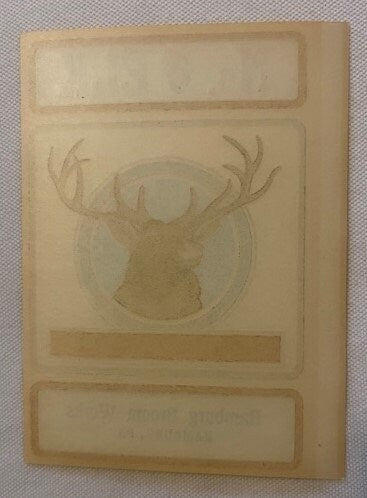
A big bull elk with a full rack of antlers, glowing yellow, and the name of a real Pennsylvania broom factory across the bottom. This is an antique 1920s broom label from the Hamburg Broom Works of Hamburg, Pennsylvania, New Old Stock and never wrapped around a broom handle.

🔍 What's on it

No. 6 ELK runs across the top. In the middle, an elk's head with a huge set of antlers in fine linework inside a dotted ring, with a blank bar under it for the broom maker's own words, and at the bottom, Hamburg Broom Works, HAMBURG, PA. Down in the corners, in tiny print, R J K & CO, the printer's mark, and 933, most likely the stock design number. The back is plain paper with the print showing through.

🧹 Hamburg, a broom town

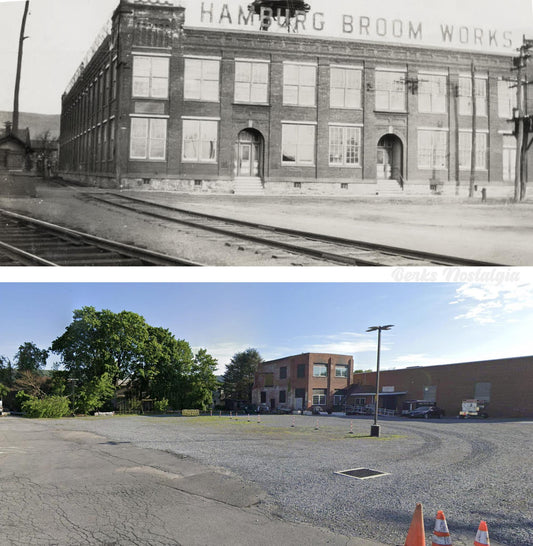
Hamburg is a small borough in Berks County, on the Schuylkill River north of Reading, with the Blue Mountain ridge behind it. It started as a 250-acre tract called "Hamburg" that Martin Kaercher Sr., who came over from Germany, bought in 1772. Then the turnpike, the canal and the railroads came through. The old Centre Turnpike, the toll road running north out of Reading toward Pottsville, was first; the Schuylkill Canal opened along the river in the 1820s, and for about forty years Hamburg was a boat-building town; and in 1842 the Philadelphia and Reading Railroad came through on its line from Philadelphia to Pottsville, with a second railroad following later. Hamburg was once reputed to have more jobs per person than any other town in the country, and I can believe it: in just a few blocks on the southwest side of town there were more than a dozen foundries, plants and mills employing thousands of people. Hamburg's factories turned out canal boats, carriages, fire engines, iron stoves, silk goods, knit goods, batteries, plows and, of course, brooms. Berks County made brooms for a long time: Henry H. Krouse started making corn brooms down in Reading in 1840. In Hamburg, Wilson Schmick founded the Hamburg Broom Works in 1894. By 1911 the business had outgrown its spot over in West Hamburg, just south of the Reading Railroad station, so he put $25,000 into a new factory on Pine Street, and in 1921 he sold that building to the Burkey Underwear and Hosiery Company and kept the brooms going in the building right across Pine. The Broom Works ran as a public company from 1923 to 1999 before going private and ending up part of Hamburg Industries. It isn't making brooms anymore. People who collect broom labels know Hamburg as a broom town, and you'll hear it called the broom capital of the world.

The brooms were made from broomcorn, a tall sorghum grown out in the Midwest and shipped in by rail, and the finished brooms went back out on the rails to hardware and dry-goods stores. When W.H. Hoover started selling his electric suction vacuum with a cloth bag in 1908, it was the beginning of a long, slow decline for the broom trade, but Hamburg kept on making brooms for decades after.

The business did well enough that Schmick built himself a fine house in town in 1909, which still stands and takes guests today as The Bismarck. A 1912 catalog of the company's brooms survives, and one of its 1920 advertisements put a locomotive front and center, fitting for a factory that shipped everything by rail. These days the old factory site is on the EPA's Superfund list.

🦌 Why an elk?

The Benevolent and Protective Order of Elks, founded in 1868, had lodges in nearly every American town by the early 1900s, and the elk was everywhere, on lodge halls, pins and parade floats. An elk on a broom was a proud, strong, all-American picture that everyone recognized. Teddy Roosevelt even had an elk of his own: in December 1897 his friend, the mammalogist C. Hart Merriam, named the Olympic elk after him, and it's still called the Roosevelt elk. Protecting those elk was one of the main reasons President Roosevelt set aside Mount Olympus National Monument in 1909. Local legend among Hamburg collectors holds that "No. 6" was the heavy-duty grade, the big broom sold to hardware stores for working farms and large households.

🖨️ The printer

That little R J K & CO is most likely R.J. Kittredge & Co. of Chicago, a label printer whose account ledgers survive from the 1910s. Broom factories bought their labels from printers like this in stock designs, which is where a number like 933 comes in, and then had their own name printed in.

🏡 Display

Great framed in a farmhouse kitchen or a mudroom, grouped with other Hamburg broom labels, or hung with some hunting or Elks lodge pieces. That yellow really glows on the wall.

Shipping

🚚 Shipping & Handling

  • Shipping costs and timing are calculated at checkout.
  • Items curated and shipped directly by me include U.S. shipping at no additional cost, professionally packed to ensure safe arrival of your artifact.

Items from Vetted Pro Collectors
Shipping for items offered by vetted Pro Collectors is determined at checkout. All Pro Collector listings are reviewed to ensure fair, reasonable shipping practices.

For full details, please refer to our Shipping Policy.

Returns & Exchange

Take your time — you've got a full six months. If a piece isn't right for you, send it back the way it reached you and we're good.

In the first 30 days your money goes straight back the way you paid. After that it's store credit, so you can put it toward something you'd rather have.

Return shipping we sort out between us, case by case. I don't make this difficult.

If something arrives damaged, or it isn't what I said it was, send me a photo within 48 hours and I'll make it right.

Email info@vintageantiquesgifts.com or call 802-356-9872 — that's me answering, not a call center.

The only things I can't take back are custom or special-order pieces and gift cards.

View full details

Preserving History: Authentic Objects Across Eras

— Curated by Travis Weigel