Skip to product information
1 of 4

Vintage and Antique Gifts

Vintage 1970s Philadelphia Coach and Four 🐎 Sarsaparilla Soda Label

Vintage 1970s Philadelphia Coach and Four 🐎 Sarsaparilla Soda Label

Regular price $5.50 USD
Regular price Sale price $5.50 USD
Sale Sold out
Shipping calculated at checkout.

Size: 3 1/2" x 2 1/2"

🚚 Free US Shipping — ships within one business day. International shipping calculated at checkout.

Quantity

Who Drank Sarsaparilla in Philadelphia? 🐎 Vintage 1970s Coach and Four Sarsaparilla Soda Label

Size: 3 1/2" x 2 1/2"

Say "sarsaparilla" and half of us picture a dusty cowboy leaning on a saloon bar. This little Philadelphia label is a lot more city than that, but the drink it names has one of the wildest histories on any soda shelf. Great yellow and black colors, that stagecoach, and a story worth telling.

🐎 What's on it

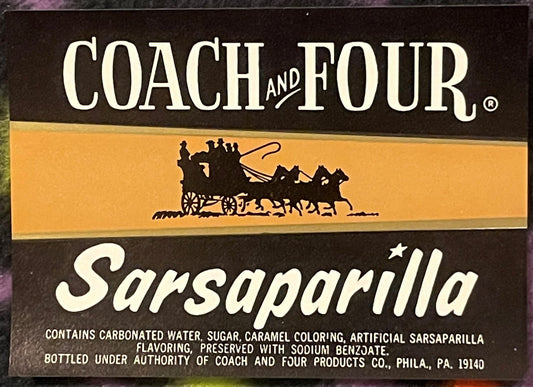
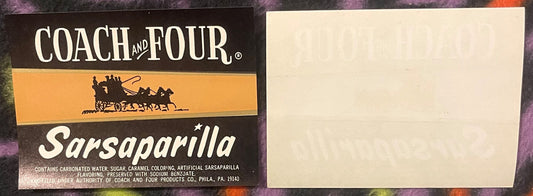
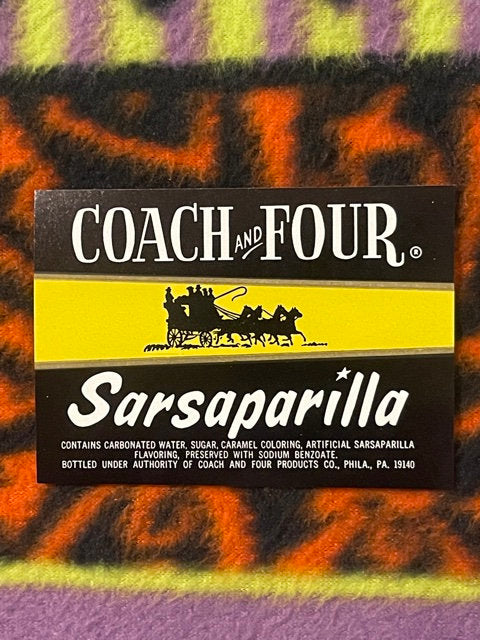
COACH AND FOUR over a black coach-and-four silhouette, Sarsaparilla across the yellow band, and the fine print: "Contains carbonated water, sugar, caramel coloring, artificial sarsaparilla flavoring, preserved with sodium benzoate." Along the foot: "Bottled under authority of Coach and Four Products Co., Phila., Pa. 19140." Plain paper back.

👬 The people behind the stagecoach

The name first went on soft drinks on June 26, 1956, spelled COACH'N FOUR back then. Sheffield Bottling Co., a Philadelphia partnership trading as "Coach 'N Four Products Co.," registered the name with the U.S. Patent Office on January 29, 1957 (trademark No. 640,759), with Harry Labovitz signing as partner. On July 11, 1969 the name and goodwill went to Coach and Four Products Company, the partnership of Harry Labovitz and Arthur Labovitz on North 6th Street in North Philadelphia, ZIP 19140, which is the company named on this label. In January 1971 the registration was amended to the new owner and to the COACH AND FOUR form printed here. The mark was renewed in 1977 and lapsed in 1997.

🏠 The family bottling works behind the stagecoach

Coach and Four was a brand of Sheffield Bottling Co., a family soda works at 3727-3729 North 6th Street, listed there in a bottlers' trade journal as early as 1945. Sheffield told the Patent Office it had used its mark on soft drinks since October 6, 1931. In 1949 Mr. Labovitz of Sheffield was president of the Philadelphia Manufacturers of Carbonated Beverages and sat on the board of the Pennsylvania Bottlers Association, and in 1950 Sheffield was packing Logan Beverages for the Penn Mutual Grocery Co. A 1974 Philadelphia industrial directory still lists the Sheffield Beverage company at 3729 N. 6th St., ZIP 19140, making soft drinks with 20 employees, Harry and Arthur Labovitz partners.

A grandson of the family got in touch with me about this brand, and the way the family tells it, Coach and Four was meant to be the more polished line next to the everyday Sheffield label. Coach and Four got the dressier names, which is why this label says sarsaparilla where the everyday Sheffield label said root beer. A big part of the business was filling seltzer bottles for Philadelphia's hotels and bars and for the dining cars of the Pennsylvania Railroad, headquartered right here in Philadelphia, and when Sheffield bought out smaller bottlers it kept their labels, Girard and Rising Sun among them, running on the old routes so the customers got what they were used to.

⚖️ The milk company that wanted the name

In November 1961 Sheffield applied to register its own label: SHEFFIELD on a red-and-gold pennant with a chess knight and the word "Tingly." National Dairy Products Corporation, the company behind New York's Sheffield Farms milk, opposed it, and its own Sheffield Farms carbonated drinks, ginger ale and club soda among them, came up in the case. The Trademark Trial and Appeal Board dismissed the opposition on June 7, 1967. National Dairy appealed to the U.S. Court of Customs and Patent Appeals, and that appeal was dismissed on May 9, 1969. Two months later the Coach and Four name went to its own company. The family remembers the legal bills of fighting for the Sheffield name, with more still coming, as the reason everything moved over to Coach and Four. And that chess knight? The grandson says his dad loved carved chess pieces.

📅 How old is it?

Three clues on the label itself. The five-digit ZIP, 19140, can't predate July 1, 1963, when ZIP codes began. And look at the words "artificial sarsaparilla flavoring." Old-time sarsaparilla leaned on sassafras oil, but on November 30, 1960 the FDA banned safrole and sassafras oil from food after safrole was found to cause cancer. Every American sarsaparilla after that had to get its flavor another way, and this label says so right on its face. And the name at the foot, "Coach and Four Products Co.," is the Labovitz partnership that took over in July 1969, printed with the COACH AND FOUR form that only went onto the registration in January 1971. That makes it a 1970s label.

💊 From "blood purifier" to soda pop

Sarsaparilla started out as medicine. The real thing came from the root of a tropical vine, Smilax, and in the 1800s it was sold by the bottle as a cure for "skin and blood problems." One of the biggest names was Charles Ira Hood, a druggist's son from Chelsea, Vermont, who opened a drug store in Lowell, Massachusetts and started compounding Hood's Sarsaparilla in 1876. His mix had sarsaparilla root, dandelion, gentian, juniper berries and about 18 percent alcohol, and he claimed it purified the blood and helped everything from rheumatism to heart trouble. It sold like crazy. By 1898 his Lowell laboratory had 175,000 square feet of floor space, the largest building in the world devoted to making patent medicine.

Here's the part I love as a paper collector: Hood was a leader in using color lithography for advertising. He printed everything in-house on twenty presses of his own, trade cards, posters, calendars, cookbooks and pamphlets, which is why so much colorful Hood's ephemera still turns up today. A label like this one comes straight out of that tradition of selling a drink with a great-looking piece of printed paper.

Once the medicine claims faded, sarsaparilla settled in as a soft drink, and popular culture did the rest: the parched cowboy asking for a sarsaparilla at the saloon. It's much harder to find in America now, but it's still a big seller across Southeast Asia, as "Sarsi" in the Philippines and Singapore.

🎨 A coach and four

A coach and four is a carriage pulled by four horses and driven four-in-hand by one driver. Philadelphia's own famous one is Thomas Eakins's painting The Fairman Rogers Four-in-Hand (1879 to 1880), in the Philadelphia Museum of Art, with the horses posed from Eadweard Muybridge's 1878 photographs of horses in motion.

🏡 Display

This one's fun framed in a kitchen, a bar, or a western-themed den, and it looks great with the rest of the Coach and Four flavors as a set.

Shipping

🚚 Shipping & Handling

  • Shipping costs and timing are calculated at checkout.
  • Items curated and shipped directly by me include U.S. shipping at no additional cost, professionally packed to ensure safe arrival of your artifact.

Items from Vetted Pro Collectors
Shipping for items offered by vetted Pro Collectors is determined at checkout. All Pro Collector listings are reviewed to ensure fair, reasonable shipping practices.

For full details, please refer to our Shipping Policy.

Returns & Exchange

Take your time — you've got a full six months. If a piece isn't right for you, send it back the way it reached you and we're good.

In the first 30 days your money goes straight back the way you paid. After that it's store credit, so you can put it toward something you'd rather have.

Return shipping we sort out between us, case by case. I don't make this difficult.

If something arrives damaged, or it isn't what I said it was, send me a photo within 48 hours and I'll make it right.

Email info@vintageantiquesgifts.com or call 802-356-9872 — that's me answering, not a call center.

The only things I can't take back are custom or special-order pieces and gift cards.

View full details

Preserving History: Authentic Objects Across Eras

— Curated by Travis Weigel