Skip to product information
1 of 4

Vintage and Antique Gifts

Antique Green 1920s-1930s Irving Trust Company Stock Certificate 🏦 Unveiled

Antique Green 1920s-1930s Irving Trust Company Stock Certificate 🏦 Unveiled

Regular price $5.50 USD
Regular price Sale price $5.50 USD
Sale Sold out
Shipping calculated at checkout.

Size: 13 1/2" x 9 1/2"

🚚 Free US Shipping — ships within one business day. International shipping calculated at checkout.

Quantity

Who Printed Irving Trust's Certificates? 🏦 Irving Trust Company Stock Certificate, New York, American Bank Note Company

Size: 13 1/2" x 9 1/2" ~

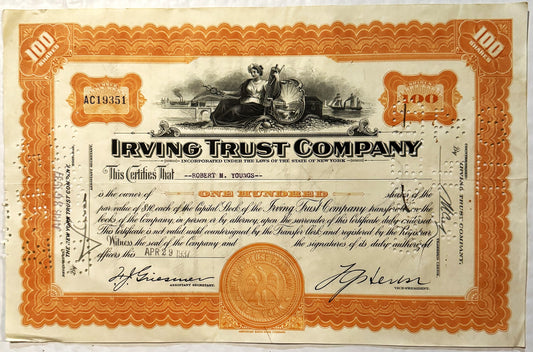
A handsome piece of Wall Street! This is an antique 1920s-1930s Irving Trust Company stock certificate, a certificate for less than 100 shares, engraved by the American Bank Note Company with a deep green border on cream banknote paper. The black engraved vignette up top shows a seated woman holding the caduceus of commerce in one hand and a fasces hung with balance scales in the other, beside a scroll lettered ENTERPRISE, with an open strongbox, a heap of gold coins and a cornucopia at her feet, and paddle steamers, a steam train crossing a stone viaduct and a full-rigged sailing ship behind her. IRVING TRUST COMPANY runs across in big bold capitals, and the company's seal, a spread eagle ringed with IRVING TRUST COMPANY, NEW YORK, sits at the bottom.

🏷️ What's Printed on It

  • IRVING TRUST COMPANY
  • INCORPORATED UNDER THE LAWS OF THE STATE OF NEW YORK
  • CERTIFICATE FOR LESS THAN 100 SHARES
  • ENTERPRISE (in the vignette)
  • REGISTERED: THE NEW YORK TRUST COMPANY, REGISTRAR
  • COUNTERSIGNED, IRVING TRUST COMPANY, TRANSFER CLERK
  • AMERICAN BANK NOTE COMPANY (the printer)

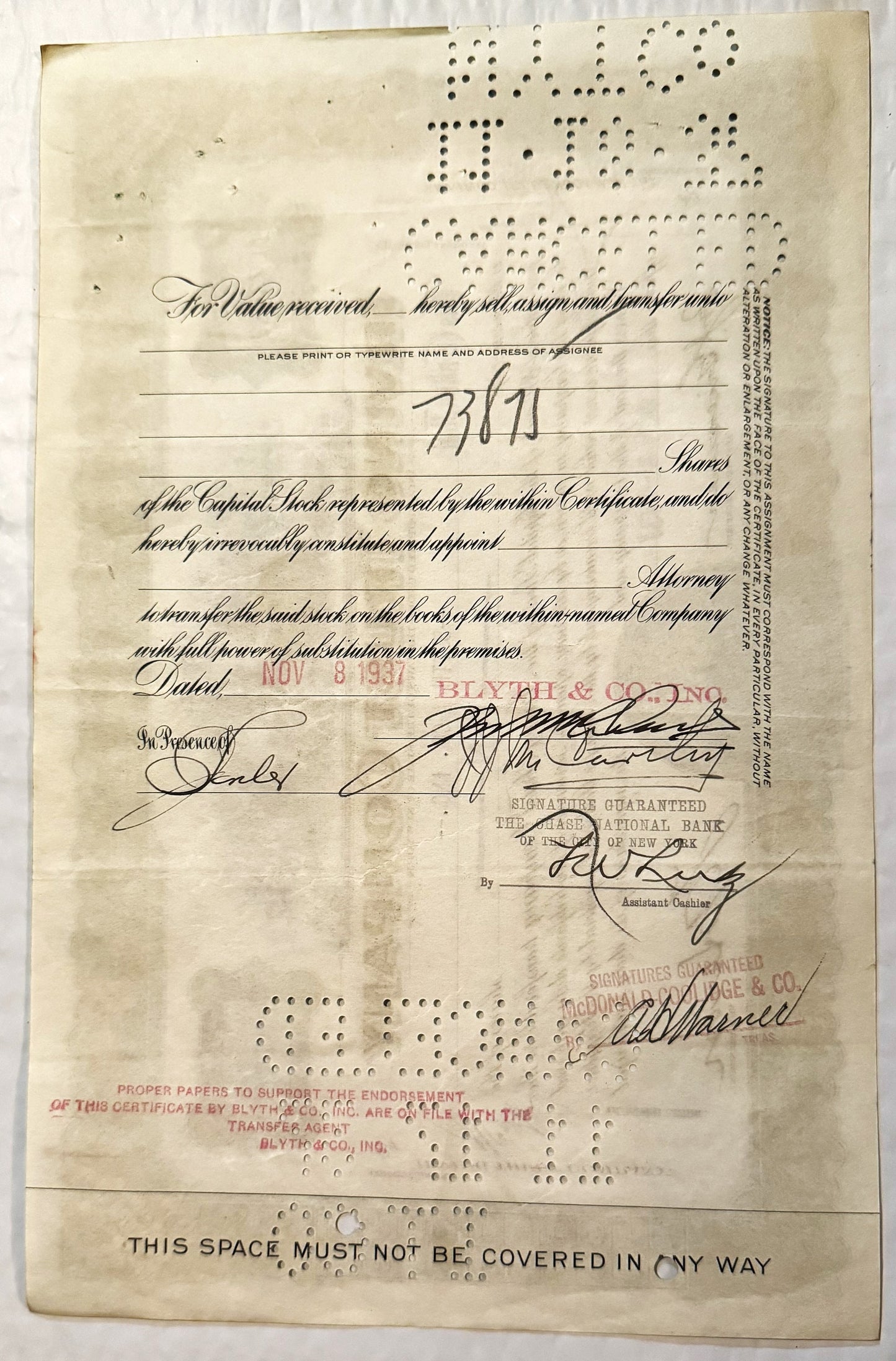
These are real issued certificates, signed, punch-cancelled and endorsed on the back when the shares changed hands. Issued and cancelled, every one, and they vary a little one to the next. That printed registrar line helps date the stack, too. The New York Trust Company merged with Chemical Corn Exchange Bank in September 1959 and the combined bank became Chemical Bank New York Trust Company, so a certificate that names The New York Trust Company as registrar was printed between Irving's 1929 renaming and 1959. The dated sheets of this green design run from 1929 through the 1930s, which is the range these fall in.

On these you'll see the paper trail of a certificate doing its job plainly: signatures, the bank and broker stamps on the back, and the cancellation punched right through.

📜 Every one of these certificates had a working life, and it can show. Depending on the sheet, you may find staples or staple holes, cancellation punch holes (often right through the signatures), hand stamps from banks, brokers and transfer agents, real federal or state stock transfer tax stamps, handwriting or a filled-in transfer on the back, papers still attached, seals (a corporate seal pressed into the paper, a foil wafer seal, or a bank's signature-guarantee stamp signed across an endorsement), or a silver strip pasted over an officer's signature with the new officer's signature printed on top. That last one is what collectors call silvering: when the officers changed, the new signature could be pasted right over the old one on certificates already printed. None of that is damage. Each mark is part of the paper's own history, and they vary sheet to sheet, so no two are quite alike.

There are some neat printed details to look for, too. The script text sets the shares at a par value of $10 each of the Capital Stock of the Irving Trust Company. Down the right edge runs a little column of printed numbers headed TENS and UNITS, so the clerk could punch the share count right through the paper, and the corner medallions repeat CERTIFICATE FOR LESS THAN 100 SHARES. Turn it over and there's the printed transfer form, "For Value received ... hereby sell, assign and transfer unto," with a little instruction to PLEASE PRINT OR TYPEWRITE NAME AND ADDRESS OF ASSIGNEE, and a band across the bottom that reads THIS SPACE MUST NOT BE COVERED IN ANY WAY.

🖋️ The printer and the registrar

The American Bank Note Company was formed in 1858, when several of the country's security printers merged, and its roots go back to the old engraving firm of Murray, Draper, Fairman & Co. It engraved bank notes, stamps and stock certificates like this one, and from 1908 it worked out of its own headquarters at 70 Broad Street, now a New York City landmark. The company is still around today as ABCorp. The registrar printed on the left, The New York Trust Company, started out on April 3, 1889, as the New York Security and Trust Company and took the New York Trust name on March 1, 1905.

🗽 Irving Trust, from Washington Irving to One Wall Street

The bank goes back to 1851, when it opened as the Irving Bank of the City of New York, named for the author Washington Irving, and it put his portrait right on its bank notes. There was no national paper money yet in 1851, so a bank printed its own. It became the Irving National Bank in 1865, the Irving National Exchange Bank in 1907, the Irving National Bank again in 1912, and the Irving Trust Company in 1929, the name on this certificate. Along the way it swallowed up a string of other New York banks: the Market and Fulton National Bank in 1918, the Sherman National Bank and the National City Bank of Brooklyn in 1919, and the American Exchange-Pacific Bank in 1926.

The company that actually issued these shares has a family tree of its own. According to the New York State Banking Department, the corporation goes back to a special act of the state legislature in 1871, chapter 616, as the Mutual Benefit Life Policy Loan and Trust Company of New York. It became the Commercial Trust Company in 1884, the New York and London Trust Company in 1900 and the Columbia Trust Company in 1905. In 1912 it took over the Knickerbocker Trust Company, and that's a name with a story. The Knickerbocker's president, Charles T. Barney, got tangled up in a scheme to corner the copper market, J.P. Morgan turned down his plea for help, and the run on the Knickerbocker set off the Panic of 1907. After a few more names, Columbia-Knickerbocker, Columbia Trust again, Irving Bank-Columbia Trust and Irving Bank and Trust, that last one after taking in the wonderfully named National Butchers & Drovers Bank in 1926, it became the American Exchange Irving Trust Company on December 11, 1926, and finally the Irving Trust Company on February 1, 1929.

That same year Irving ranked as New York's fourth-largest financial institution and fifth in the whole country. From 1913 it worked out of the Woolworth Building, and in 1931, on March 23, it moved to its own tower at 1 Wall Street, the landmark Art Deco skyscraper that later served as the Bank of New York's headquarters, and BNY Mellon's after that, until 2015. Ralph Walker of Voorhees, Gmelin and Walker designed it, 50 stories and 654 feet tall, built from 1929 to 1931. The limestone face is cut in shallow fluted bays that hang like a stage curtain, and the bank's reception room, the Red Room, is covered in mosaics by Hildreth Meière. The outside became a city landmark in 2001 and the Red Room in 2024, and since 2023 the old bank tower has been condominiums, 566 of them. Irving had been looking for a friendly partner, Italy's Banca Commerciale Italiana, when the Bank of New York came after it. On October 7, 1988, after a yearlong hostile takeover fight, Irving's board agreed to merge with the Bank of New York, making the combined bank the twelfth largest in America. The Irving Trust name itself hung on until October 6, 1989, when the Bank of New York merged into Irving and the company took the Bank of New York name. Together the two banks held $42 billion in assets.

🏡 Display

It looks great framed in an office or a study, and it's a perfect gift for a banker, a New Yorker, a Washington Irving fan, or anybody who loves Wall Street history.

The supply is finite - once these last green Irving Trust certificates are gone, they'll be very difficult to acquire.

Shipping

🚚 Shipping & Handling

  • Shipping costs and timing are calculated at checkout.
  • Items curated and shipped directly by me include U.S. shipping at no additional cost, professionally packed to ensure safe arrival of your artifact.

Items from Vetted Pro Collectors
Shipping for items offered by vetted Pro Collectors is determined at checkout. All Pro Collector listings are reviewed to ensure fair, reasonable shipping practices.

For full details, please refer to our Shipping Policy.

Returns & Exchange

Take your time — you've got a full six months. If a piece isn't right for you, send it back the way it reached you and we're good.

In the first 30 days your money goes straight back the way you paid. After that it's store credit, so you can put it toward something you'd rather have.

Return shipping we sort out between us, case by case. I don't make this difficult.

If something arrives damaged, or it isn't what I said it was, send me a photo within 48 hours and I'll make it right.

Email info@vintageantiquesgifts.com or call 802-356-9872 — that's me answering, not a call center.

The only things I can't take back are custom or special-order pieces and gift cards.

View full details

Rescuing American History Since 2007

— Travis & the Kids