Skip to product information
1 of 4

Vintage and Antique Gifts

Antique Orange 1930s Irving Trust Company 🏦 Stock Certificate

Antique Orange 1930s Irving Trust Company 🏦 Stock Certificate

Regular price $7.00 USD
Regular price Sale price $7.00 USD
Sale Sold out
Shipping calculated at checkout.

Size: 13 1/2" x 9 1/2"

🚚 Free US Shipping — ships within one business day. International shipping calculated at checkout.

Quantity

What Was Irving Trust? 🏦 Irving Trust Company, orange 100-share certificate

Size: 13 1/2" x 9 1/2"

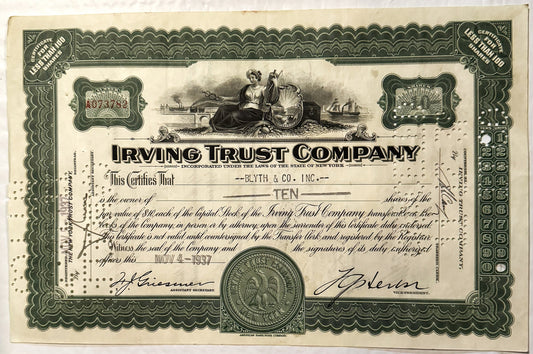
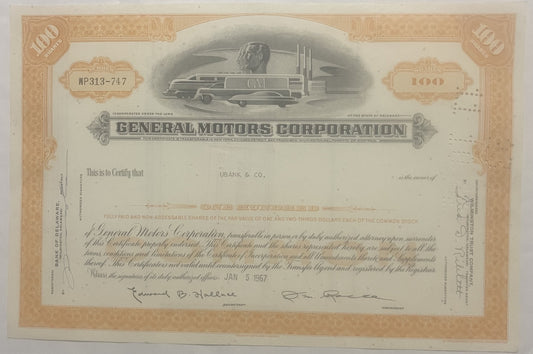
A big, bright orange stock certificate from one of Wall Street's great old banks, engraved by the American Bank Note Company. These are 1930s Irving Trust Company certificates for one hundred shares, each one cancelled, from a bank that was gone by 1988.

🔍 What's on it

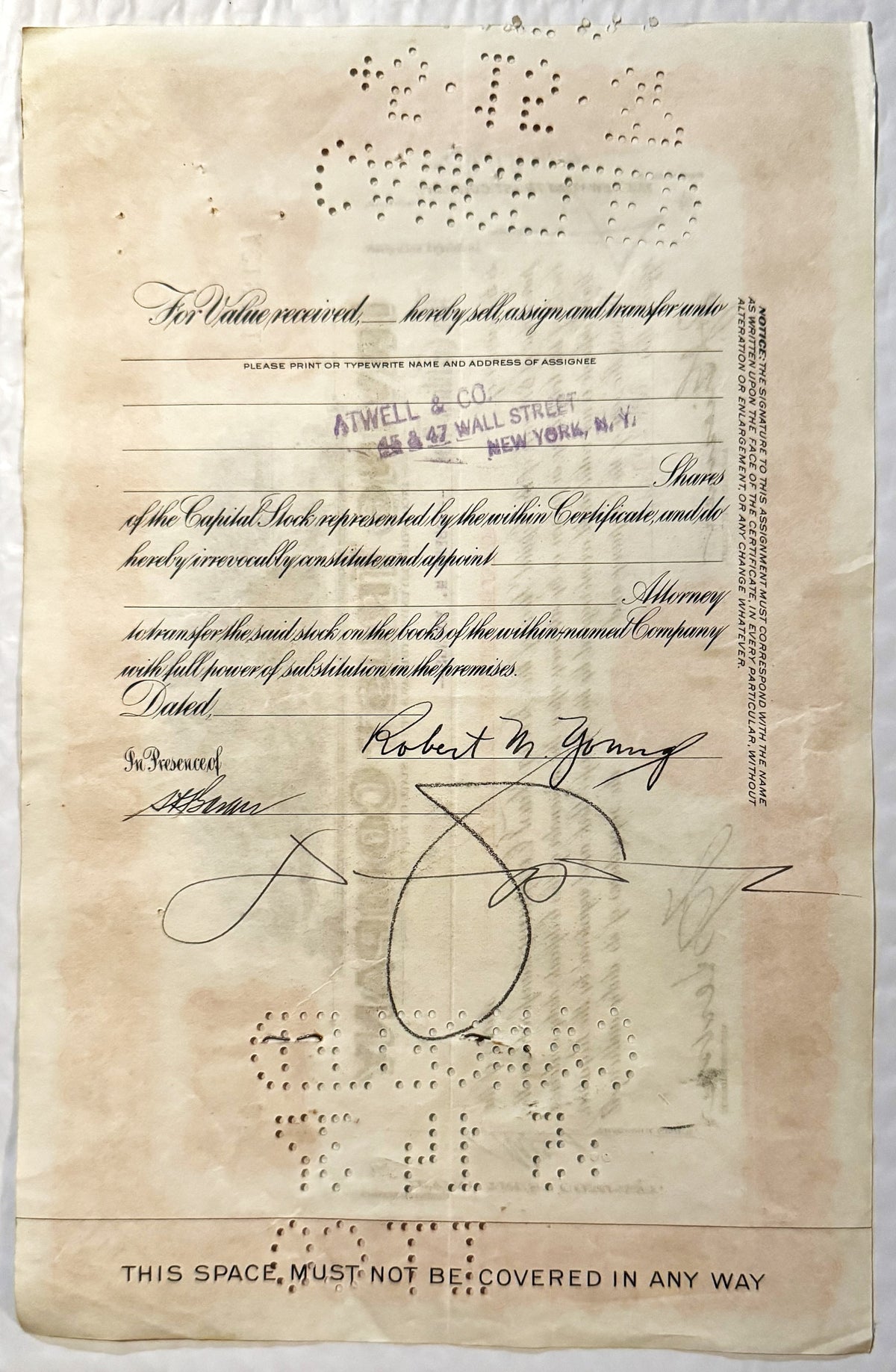
Across the top, an engraved harbor scene: a seated woman in a laurel wreath holding a caduceus in one hand and a bundle of rods hung with a balance scale in the other, beside a shield marked ENTERPRISE with a plow and a sheaf of wheat under a rising sun. Behind her a train crosses a stone-arch bridge, paddle steamers work the harbor, a ship comes in under both sail and steam, and a strongbox sits at her side with a heap of coins spilling in front of it. Somebody at the bank note company packed a whole lot of commerce into one little picture. Under it, IRVING TRUST COMPANY in big shaded letters and INCORPORATED UNDER THE LAWS OF THE STATE OF NEW YORK. 100 SHARES sits in the orange corner panels, and the body reads ONE HUNDRED shares of the capital stock at a par value of $10 each. There's an orange embossed-look seal with a spread eagle, IRVING TRUST COMPANY, NEW YORK, the registrar line for The New York Trust Company, and AMERICAN BANK NOTE COMPANY along the bottom edge. All of it is framed in fine orange lathework. The back carries the transfer form, and the certificates are punch-cancelled.

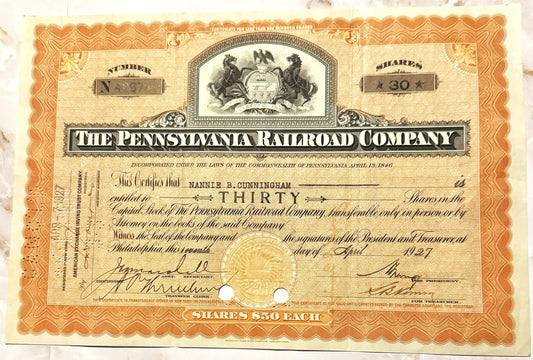
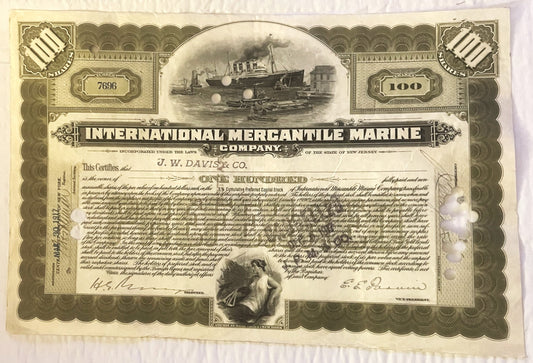
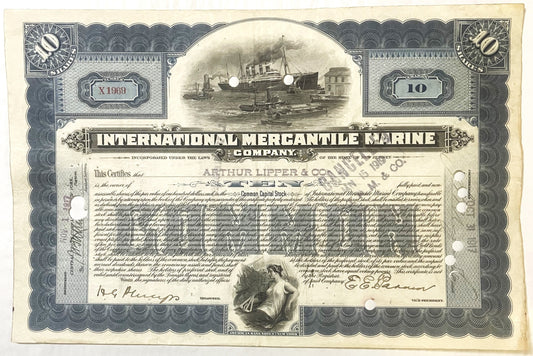
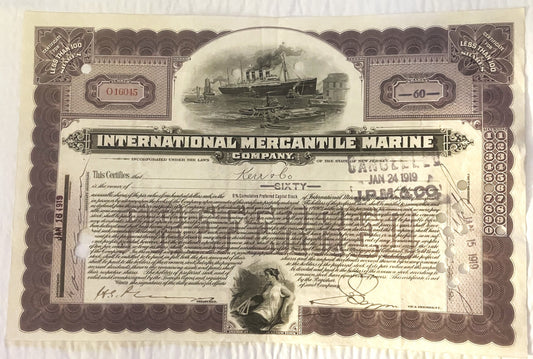
📜 Every one of these certificates had a working life, and it can show. Depending on the sheet, you may find staples or staple holes, cancellation punch holes (often right through the signatures), hand stamps from banks, brokers and transfer agents, real federal or state stock transfer tax stamps, handwriting or a filled-in transfer on the back, papers still attached, seals (a corporate seal pressed into the paper, a foil wafer seal, or a bank's signature-guarantee stamp signed across an endorsement), or a silver strip pasted over an officer's signature with the new officer's signature printed on top. That last one is what collectors call silvering: when the officers changed, the new signature could be pasted right over the old one on certificates already printed. None of that is damage. Each mark is part of the paper's own history, and they vary sheet to sheet, so no two are quite alike.

📜 The bank named for Washington Irving

The bank goes back to 1851, when the Irving Bank of the City of New York was founded, named for Washington Irving, the author of "Rip Van Winkle" and "The Legend of Sleepy Hollow," who had become America's first internationally famous man of letters. His portrait even appeared on the bank's own notes. It grew into a giant: from 1913 to 1931 its headquarters was in the Woolworth Building, then the tallest building in the world, and in 1929 Irving was the fourth-ranked financial institution in New York and fifth in the whole country. After 1931 it moved to its own tower at 1 Wall Street, where it stayed for the rest of its life.

The name on this certificate took a while to arrive. The Irving became the Irving National Bank of New York in 1865 under the National Bank Act, the Irving National Exchange Bank after a 1907 merger, and plain Irving National Bank in 1912. It bought up the Market and Fulton National Bank in 1918 and the Sherman National Bank and the National City Bank of Brooklyn in 1919, joined the state-chartered Columbia Trust Company in 1922 as the Irving Bank and Trust Company, and merged with the American Exchange-Pacific Bank in 1926 to become the American Exchange Irving Trust Company. Only in 1929 did it take the name printed across the top of this certificate, IRVING TRUST COMPANY, and it kept that name to the end.

And then it was gone. After a year-long hostile takeover fight, the Irving Trust board agreed on October 7, 1988 to merge with the Bank of New York. The building at 1 Wall Street is still there, and a certificate like this is what's left of the bank that built it. The deal made the combined bank the 12th largest in the country, with $42 billion in assets, and Irving had spent part of that year looking for a friendlier partner in Italy's Banca Commerciale Italiana.

🏙️ 1 Wall Street

The tower Irving built for itself is one of the great Art Deco buildings in New York. Ralph Walker of Voorhees, Gmelin and Walker designed it, it went up from 1929 to 1931 and opened on March 24, 1931, and it stands 654 feet tall with 50 floors. Inside, the ground-floor banking hall known as the Red Room is covered wall to ceiling in mosaics designed by Hildreth Meière. The city made the outside a landmark on March 13, 2001, and the Red Room followed on June 25, 2024. The Bank of New York and then BNY Mellon held on to it until a group led by Macklowe Properties bought it in May 2014 for $585 million, staying on as tenants until September 2015, and between 2018 and 2023 it was turned into 566 condominium apartments.

📅 How old is it?

This orange 100-share form is a 1930s printing. The registrar printed on them, The New York Trust Company, was itself merged away in 1959, when it joined the Chemical Corn Exchange Bank to make the Chemical Bank New York Trust Company.

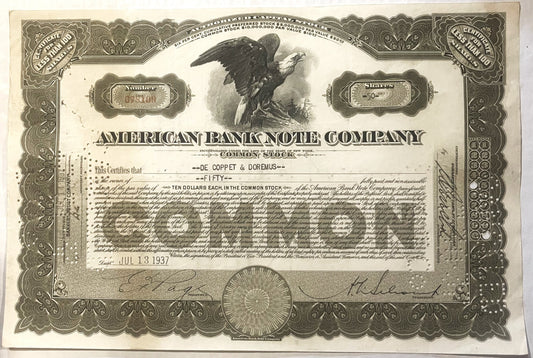
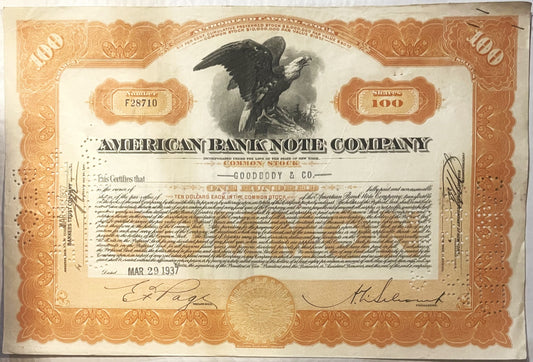
The engraving came from the American Bank Note Company, about as old a name as there is in American security printing. Its roots go back to Murray, Draper, Fairman & Company, started in 1795 by Robert Scot, the first official engraver of the U.S. Mint. The American Bank Note Company itself was formed in 1858 when several New York security printers merged, it printed Demand Notes for the U.S. Treasury during the Civil War, and in 1879 it took in the National Bank Note Company and the Continental Bank Note Company, which held the Post Office's stamp contract at the time.

Some collectors research the other signatures on stock certificates and their history. I have never done this, as I can barely read my own signature, let alone one from over 100 years ago!

🏡 Display

That orange border looks sharp framed in an office, a den or behind a desk, and it's a great gift for anyone in banking or finance, or anybody who loves New York history.

Shipping

🚚 Shipping & Handling

  • Shipping costs and timing are calculated at checkout.
  • Items curated and shipped directly by me include U.S. shipping at no additional cost, professionally packed to ensure safe arrival of your artifact.

Items from Vetted Pro Collectors
Shipping for items offered by vetted Pro Collectors is determined at checkout. All Pro Collector listings are reviewed to ensure fair, reasonable shipping practices.

For full details, please refer to our Shipping Policy.

Returns & Exchange

Take your time — you've got a full six months. If a piece isn't right for you, send it back the way it reached you and we're good.

In the first 30 days your money goes straight back the way you paid. After that it's store credit, so you can put it toward something you'd rather have.

Return shipping we sort out between us, case by case. I don't make this difficult.

If something arrives damaged, or it isn't what I said it was, send me a photo within 48 hours and I'll make it right.

Email info@vintageantiquesgifts.com or call 802-356-9872 — that's me answering, not a call center.

The only things I can't take back are custom or special-order pieces and gift cards.

View full details
  • 5 stars: 1 (100%)
  • 4 stars: 0 (0%)
  • 3 stars: 0 (0%)
  • 2 stars: 0 (0%)
  • 1 star: 0 (0%)
a
a***a (391)

Hi my friends I received my antique vintage 1930s stock certificate in great condition and very great service this is the best service I ever had fast and reliable service I thank you for your service stay safe and healthy and friendly I’ll be back soon 👍

Rescuing American History Since 2007

— Travis & the Kids