Skip to product information
1 of 5

Vintage and Antique Gifts

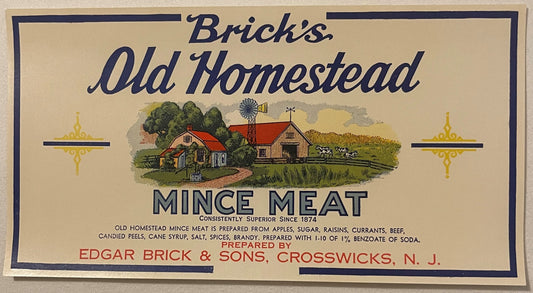
Antique Brick's Old Homestead Mince Meat Label 🏚️ LARGE RECTANGULAR Farm Scene, Edgar Brick & Sons NJ, NOS 1920s

Antique Brick's Old Homestead Mince Meat Label 🏚️ LARGE RECTANGULAR Farm Scene, Edgar Brick & Sons NJ, NOS 1920s

Regular price $13.00 USD
Regular price Sale price $13.00 USD
Sale Sold out
Shipping calculated at checkout.

Size: 9 1/2" x 5"

🚚 Free US Shipping — ships within one business day. International shipping calculated at checkout.

Quantity

Was Brick's Old Homestead Mince Meat Really "Consistently Superior Since 1874"? 🏚️

Size: 9 1/2" x 5" ~ NOS unused stock, little to no storage wear.

Most old labels brag about something nobody can check. This big one prints its own birth year in plain type, CONSISTENTLY SUPERIOR SINCE 1874, and the history behind it holds up. It's a New Old Stock Brick's Old Homestead Mince Meat label from the 1920s, printed for the Crosswicks, New Jersey firm of Edgar Brick & Sons and never used. The family that made it is worth the read, I promise you.

🫙 What It Says

Under the farm scene comes MINCE MEAT, then that 1874 line, then the recipe, which it says Old Homestead is prepared from: apples, sugar, raisins and currants, beef, candied peels and cane syrup, salt and spices, and brandy. After that the preservative, 1-10 OF 1% BENZOATE OF SODA, then it closes with PREPARED BY over the maker's name, Edgar Brick & Sons, Crosswicks, N. J.

The label doesn't name its printer, but the family had a hand in that side of things too. The Chesterfield Township Historical Society keeps Brick's own printing blocks, and its card says they were first used by Edgar Brick on his own printing press, and later loaned to a printer to make labels for the company.

🧪 Uncle Sam's Fine Print

That benzoate line is the government talking. The 1906 Pure Food and Drug Act started making food makers own up to their preservatives, and by 1909 the rule allowed benzoate of soda at up to one-tenth of one percent, so long as the amount was stated on the package. "1-10 of 1%" is exactly that rule at work, so this label came after 1906. I put these big Old Homestead labels in the 1920s.

🏪 Seventy-Six Pounds

Edgar Brick and Susan, his wife, settled in Crosswicks in the 1850s and kept a general store on Main Street. The mince meat on their shelves came from Philadelphia makers, Edgar thought it was nothing special, and in 1874 he made a batch of his own. He sold 76 pounds of it that first year. That's the 1874 on this label: not a slogan, the year one storekeeper decided he could do better.

Sales kept climbing, and five years in he needed real room. In 1879 he bought two farmhouses nearby, moved them onto the property and joined them into one factory, which kept picking up additions for decades after. The Mount Holly News looked in on him in February 1894: E. Brick, it said, had started with a hand chopping knife and a batch of 60 pounds, and now had a large, well-equipped factory turning out 700 pounds at a batch, over half a million pounds a year, with shipments going as far as Boston, Detroit, Akron and Washington, D.C. By the turn of the 20th century, Brick's - still under Edgar's own name - was the largest mince meat maker in New Jersey.

Local grocers knew what they had. A 1907 ad in the Mount Holly News ran, "MINCE MEAT.—Brick's, there are two kinds, we have both," at 10 and 12 cents, and another line in the same paper promised, "When you use Brick's Mince Meat you always have good pies. It is clean, sweet and reliable." Not a bad review. Those "two kinds" were most likely Nonpareil and Homestead. Down the shore, the Five Mile Beach Journal in Wildwood listed both in 1905: Nonpareil, "Finest and Cleanest, made by Brick at Crosswicks, N. J.," and Homestead, "made by the same, fine goods, 10c lb." So the Homestead name on this label goes back at least that far.

👨‍👦‍👦 The Brick Boys

In 1918 the state's industrial directory listed a mince meat plant owned by Edgar Brick, employing 25 people. Edgar died in 1920 and the company passed to Arthur R., Josiah E. and Charles W., his three sons. Brick family members ran it for the next 48 years, and they grew it into something Edgar never saw. At the peak, during World War II, forty workers in Crosswicks turned out around three million pounds of mince meat a year, the biggest output of any mince meat maker in the country.

They were a civic bunch, too. Edgar had been a Crosswicks fireman since 1864 and was named the fire company's first chief in 1882, and in 1922 his sons gave the company its first firehouse, plus a motor chemical engine, in his memory. In 1919 the new Crosswicks Community Association picked Josiah as its first president. Charles had the old mill on Crosswicks Creek in the 1920s, when new ice-making machinery went in and its ice went out to customers like the Hildebrecht Ice Cream Company in Trenton. The family helped bring electricity to the village, ran a mill and ice plant on the creek, and helped form the Chesterfield Township Historical Society.

🥃 Brandy on the List

See the last ingredient? Brandy. Prohibition started in 1920, almost right away people lobbied to keep foods like mince meat legal, and by 1922 the caterers and the liquor people had a legal fight going for a culinary exemption, built almost entirely on mince pie. Food stayed exempt, and the alcohol in some canned mince meat climbed past 14 per cent. Brick's kept its federal paperwork in order: two Brick's Nonpareil buckets at the Chesterfield Township Historical Society read "Alcohol added. Permit N.J.--H-926 Edgar Brick & Sons." The story collectors like to pass around is that the brandy was a big part of why customers stayed loyal through the dry years. Take that one as legend, but it's a good legend.

🌾 Crosswicks

Quakers settled Crosswicks in 1677, which makes it the oldest of the three villages in Chesterfield Township, and the township's historical society counts Chesterfield among the first Quaker communities in the Delaware Valley. The name traces to the Lenape word Crossweeksung. The 1773 Friends meeting house still carries a cannonball in its wall that the village ties to the skirmish of June 23, 1778, fought five days ahead of the Battle of Monmouth, and to this day nobody knows whether the British or the Americans fired it. Historian Colin Zimmerman, writing in the Journal of the American Revolution in 2022, thinks it was more likely set into the wall years after the battle, during a repair. In 1976 the village's historic district went on the National Register of Historic Places for its architecture, military history, religion and transportation.

🏚️ The Last Chapter

By the 1960s mince meat was falling out of fashion. In 1968 the company stopped making it and went into alcoholic beverages, and in 1979 it closed, 105 years after Edgar's first batch, with much of the equipment sold off at auction. The Hamilton Uniform Company bought the factory in 1980 and ran there for many years before closing as well. When Preservation New Jersey put the building on its endangered list in 2017, it was sitting empty with sections of the roof collapsed, still standing in the Crosswicks Village historic district.

The recipe got a second life anyway. At the Chesterfield Township Historical Society's 2014 Heritage Day in Crosswicks, the mince meat for sale was made from a recipe based on Brick's.

🍎 Mince Meat, the Old Way

Old American mince meat was winter food put up in the fall: cooked beef, suet, apples, dried fruit, sugar and spices, with brandy or rum to preserve it, baked into pies for Thanksgiving and Christmas. Brick's still had beef in it, the way Americans liked it long after the British had mostly dropped meat from their mince pies. And if anybody tells you Oliver Cromwell outlawed mince pies at Christmas, that one's a myth, though a fun one.

🏷️ The Brick's Family of Labels

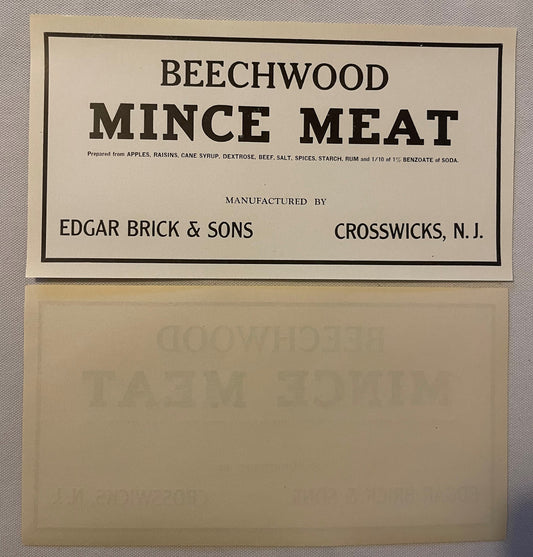
Brick's sold mince meat under several names, including Old Homestead, Nonpareil, Banquet Hall and Beechwood, and Old Homestead itself came in more than one design, including a small oval with its own farm scene.

The supply is finite - the Bricks stopped making mince meat in 1968, nobody's printing Old Homestead labels again, and once these last unused ones are gone, they'll be very difficult to acquire.

🎁 Good For

  • 🖼️ Framing big. At 9 1/2 by 5 inches it holds a wall by itself, and UV glass with an acid-free mat keeps it safe.
  • 🍂 Fall and holiday kitchen decor, out every October and put away after New Year's
  • 🏡 New Jersey and Burlington County history collections
  • 🫙 Grocery label collectors who like a label that tells you its own age

📷 About the Last Two Photos

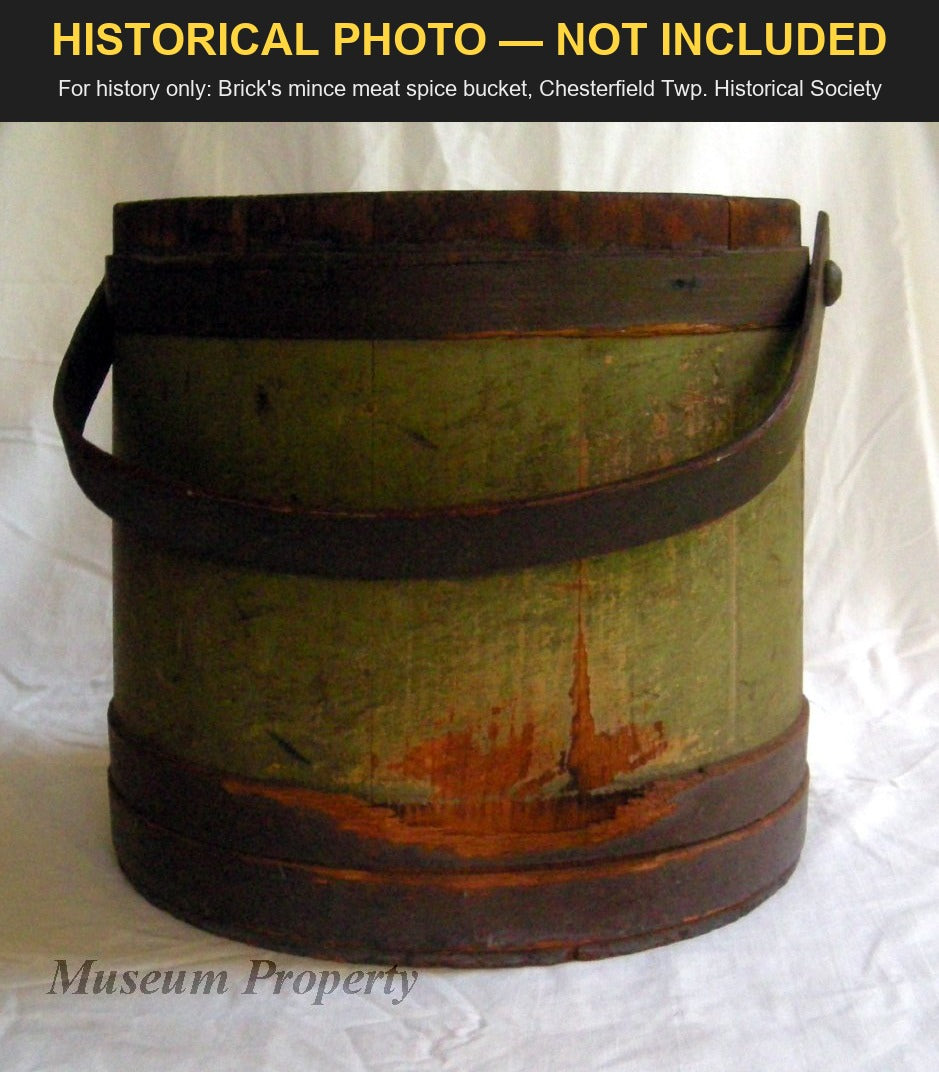
Those are just for history - you get the label, not them! They're the Brick family's own things, kept today by the Chesterfield Township Historical Society in Crosswicks: the chopping block the family says Edgar made his very first mince meat on, and the green spice bucket they measured spices with. The society says the bucket still smells of spices.

Shipping

🚚 Shipping & Handling

  • Shipping costs and timing are calculated at checkout.
  • Items curated and shipped directly by me include U.S. shipping at no additional cost, professionally packed to ensure safe arrival of your artifact.

Items from Vetted Pro Collectors
Shipping for items offered by vetted Pro Collectors is determined at checkout. All Pro Collector listings are reviewed to ensure fair, reasonable shipping practices.

For full details, please refer to our Shipping Policy.

Returns & Exchange

Take your time — you've got a full six months. If a piece isn't right for you, send it back the way it reached you and we're good.

In the first 30 days your money goes straight back the way you paid. After that it's store credit, so you can put it toward something you'd rather have.

Return shipping we sort out between us, case by case. I don't make this difficult.

If something arrives damaged, or it isn't what I said it was, send me a photo within 48 hours and I'll make it right.

Email info@vintageantiquesgifts.com or call 802-356-9872 — that's me answering, not a call center.

The only things I can't take back are custom or special-order pieces and gift cards.

View full details

Rescuing American History Since 2007

— Travis & the Kids