Skip to product information
1 of 9

Vintage and Antique Gifts

Vintage Pan Am Stock Certificate Brown Golden Age of Air Travel Juan Trippe Aviation History Decor 📜

Vintage Pan Am Stock Certificate Brown Golden Age of Air Travel Juan Trippe Aviation History Decor 📜

Regular price 7.00 USD
Regular price Sale price 7.00 USD
Sale Sold out
Shipping calculated at checkout.
Quantity

✈️ Remember When Flying Felt Like Stepping Into the Future? 🌍

There was a time when a plane ticket was an event. When you dressed up to board — hat, gloves, your best coat — because crossing an ocean by air still felt like a small miracle, and the people who ran the airlines seemed to be inventing the modern world in real time. No name carried that feeling further than Pan American World Airways. This engraved capital stock certificate is a genuine survivor of that era — a piece of paper that once represented real ownership in the airline that quite literally connected the continents, back when "Pan Am" wasn't just a company name, it was a promise.

This is an original Pan American World Airways, Inc. capital stock certificate, engraved and printed by the American Bank Note Company of New York — the same security-printing house trusted with currency, postage, and bonds for governments and corporations across the country. The certificate is a New York corporation issue, printed in rich brown, black, and cream, with a border of fine engraved scrollwork framing a striking allegorical vignette: a great American eagle with wings fully outstretched, perched above twin globes of the world, flanked by two classical male figures — one bearing a torch, the other Mercury himself, messenger of the gods, resting a hand on his caduceus.

Below, in bold engraved lettering, the company name stretches the full width of the certificate: PAN AMERICAN WORLD AIRWAYS, INC. This issue bears the facsimile signature of Juan T. Trippe as President — the very man who built Pan Am from nothing. The certificate measures 12 x 8 inches, a substantial, fully engraved document meant for framing as much as filing.

It comes from Pan Am's stock issues of the 1950s, the years just after the company officially adopted the "World Airways" name in January of 1950 — a rename that lines up exactly with the wording engraved across this certificate.

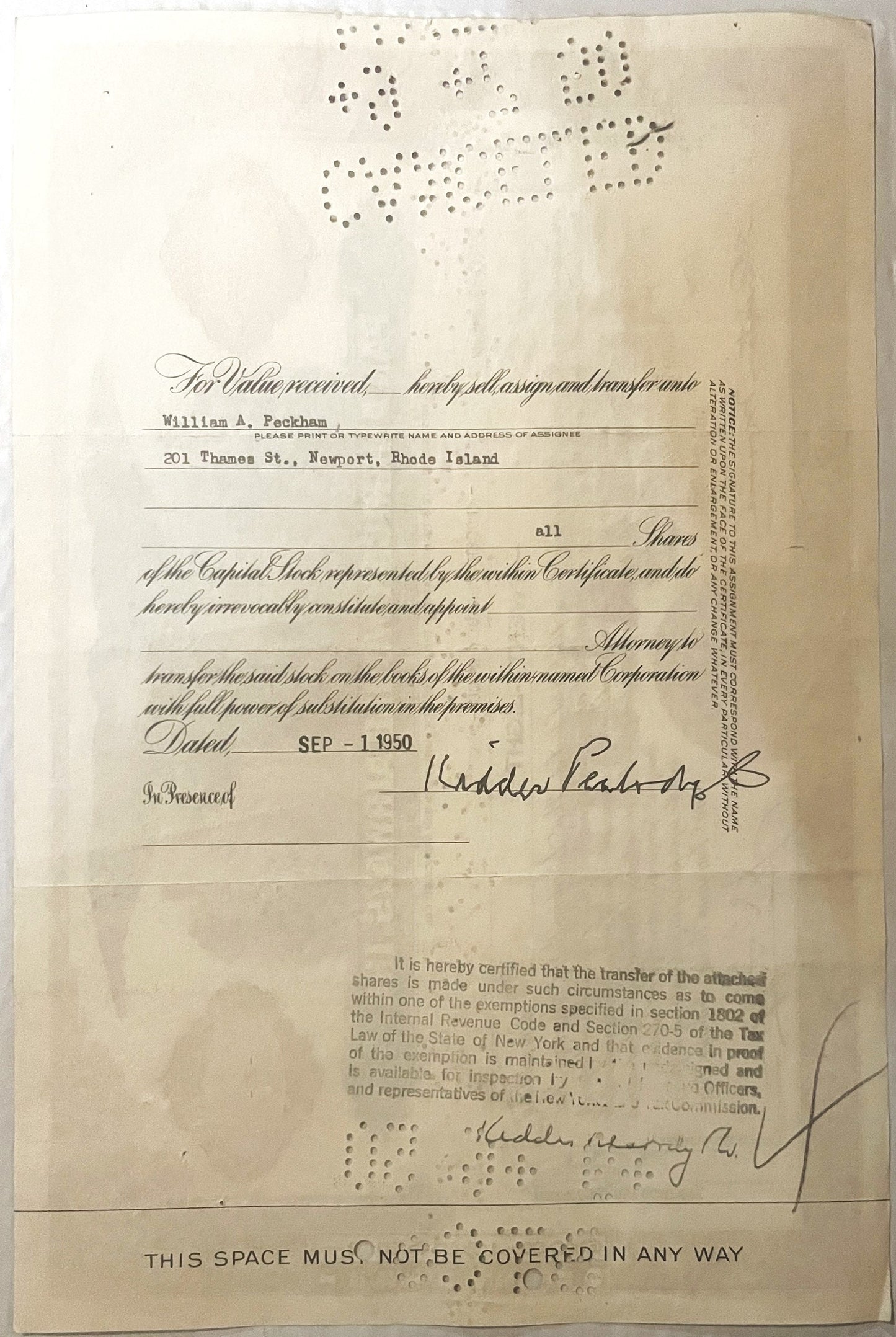
The life of a certificate like this can show up on the paper itself, not just in the vignette: things like a registrar's stamp, a documentary tax stamp, a cancellation punch, staple holes from being bound into a transfer ledger, pencil notations, or signatures across the reverse. It is history on the page, not a condition problem, the kind of detail that separates a real financial artifact from a print.


🌎 The Airline That Shrank the World

Pan American World Airways — universally known simply as Pan Am — was, for most of the 20th century, the closest thing America had to a national flag carrier for international travel, even though it was never formally designated as one. From the 1930s until its collapse in 1991, Pan Am was the airline that opened routes no one else dared fly, and it did it with a swagger that made "flying Pan Am" synonymous with glamour, ambition, and trust. Its blue globe logo — simple, confident, unmistakably modern — became one of the most recognized marks of American enterprise anywhere on Earth.

🗺️ From Key West to Havana — and Then Everywhere

The company's roots trace back to March 14, 1927, when Pan American Airways, Incorporated was founded — notably, by three United States Army Air Corps officers, Henry "Hap" Arnold, Carl Spaatz, and John Jouett. History records their motive plainly: concern over the growing influence of a German-owned airline operating in Colombia, and a belief that American commercial aviation needed to establish itself in Latin America before others got there first. That founding year, 1927, is the very year stamped into the corporate seal engraved on this certificate — the company's birth year, carried forward on every certificate long after, the way a cornerstone date is carried on a building built decades later.

The airline's very first scheduled flight covered just ninety miles — Key West, Florida, to Havana, Cuba — and took about an hour. From that single, short hop came sixty-four years of aviation firsts. Pan Am's holding company, the Aviation Corporation of the Americas, quickly became one of the hottest stocks on the New York Curb Exchange by 1929, with shares reportedly jumping fifty percent in a single day as speculators chased each new route the company was awarded. It's the kind of Wall Street frenzy that, looking back, feels almost impossible to picture — a brand-new airline, barely two years old, already commanding that kind of attention from investors who'd never once set foot on an airplane.

👨‍✈️ Juan Trippe: The Man Whose Signature Is On Your Certificate

The name on the bottom of this certificate — J.T. Trippe, President — belongs to Juan Terry Trippe, the aviation pioneer who spent more than four decades building Pan Am into the largest international airline in the world. Trippe organized his own company, the Aviation Corporation of the Americas, in June of 1927, with a quarter-million dollars in startup capital and backing from politically connected financiers including Cornelius Vanderbilt Whitney. Within a year, the competing young airline companies of the era were merged together, and though Trippe wasn't installed as president of the merged entity right away, he and his partners held forty percent of the equity — enough to eventually steer the entire enterprise.

Under Trippe's direction, Pan Am didn't just fly passengers — it pushed the entire industry forward. He championed the Sikorsky S-42 flying boat, which opened trans-Pacific air travel for the first time. He backed the Boeing 307 Stratoliner, the first airliner to introduce cabin pressurization. He was behind the Boeing 707, ushering in the jet age of affordable international travel, and later the Boeing 747 — the jumbo jet that changed commercial aviation forever. Pan Am flew the first commercially scheduled 747 service in January of 1970, when the Clipper Young America lifted off from New York bound for London. Trippe's ambitions reached beyond the runway too — he founded InterContinental Hotels, reasoning correctly that a passenger who could fly anywhere in the world would also need somewhere elegant to stay once they landed.


🗽 New York's American Bank Note Company — The Hands Behind the Engraving

Every line of the eagle's feathers, every curve in the globes, every letter of scrollwork bordering this certificate was engraved by the American Bank Note Company, headquartered in New York City. The firm's lineage runs remarkably deep — its origins trace back to the 1790s, to an engraver named Joseph Perkins working out of Newburyport, Massachusetts, and the company that would eventually carry the American Bank Note name was formally incorporated in 1858, born from the merger of several of the era's most prominent security printers. Further consolidations followed: in 1879 the National Bank Note Company merged into it, bringing with it the Continental Bank Note Company and, remarkably, the U.S. Post Office's own stamp-printing contract.

By the time this certificate rolled off its presses, American Bank Note had spent the better part of a century as the nation's most trusted name in security engraving — printing currency, postage and revenue stamps, government bonds, stock certificates, checks, and letters of credit for institutions across the country. The company's landmark Bronx printing plant, built in 1911 in the Hunts Point neighborhood, still stands today, designated a New York City landmark in 2008 — a monument to just how much of America's paper history once ran through that one building. It's the reason a Pan Am stock certificate, a piece of financial paperwork at its core, ended up as a genuine work of engraved art: the same craftsmen trusted with the nation's currency were the ones putting ink to this eagle and these globes.


💼 Kidder, Peabody & Co. — Wall Street's Own Story

The name filled in on this issue — Kidder, Peabody & Co. — belonged to one of the most established securities firms on Wall Street. Founded in Massachusetts in 1865, Kidder Peabody spent well over a century in investment banking, brokerage, and trading, a fixture of American finance through booms, crashes, and the entire arc of the 20th century. The firm was eventually sold to General Electric in 1986, and after a period of heavy losses, it was sold again to Paine Webber in 1994 — a sale that closed out Kidder Peabody's 130-year run on Wall Street for good. What remains of the firm today lives on inside UBS AG, which acquired PaineWebber in 2000. Holding Pan Am shares in the name of a brokerage house like Kidder Peabody, rather than an individual investor, was standard practice of the era — brokerages routinely held stock in "street name" on behalf of their clients, which is exactly the kind of institutional paper trail this certificate preserves.


📉 The Fall — and Why This Piece of Paper Still Matters

Pan Am's story doesn't end at its peak, and that's part of what makes a surviving certificate like this one so evocative. The airline's decline unfolded over roughly two decades, driven by a combination of forces: the 1973 oil crisis that sent fuel costs soaring, the Airline Deregulation Act of 1978 that opened the skies to fierce new competition, a costly and ultimately unsuccessful push into domestic routes, and finally the tragedy of Pan Am Flight 103, destroyed over Lockerbie, Scotland, on December 21, 1988, with 270 lives lost. On December 4, 1991, Pan American World Airways — once the most prestigious airline on Earth — filed for bankruptcy and ceased operations for good, its final flight reportedly touching down in Miami. Roughly 7,500 employees lost their jobs that single day, and for many, historians included, that moment marked the symbolic end of the golden age of air travel itself — the last day the sky felt as limitless as it once had.

It's exactly that arc — from a ninety-mile hop between Key West and Havana, to jumbo jets circling the globe, to a bankruptcy filing that closed a 64-year chapter of American aviation — that gives a certificate like this one its weight. Stock and bond collecting, known in the trade as scripophily, has long prized Pan Am issues precisely because the company's rise and fall are so completely documented, so widely remembered, and so tied to a name that still means something to people who never set foot on one of its planes.


🖼️ Display Ideas

  • ✈️ Framed above a home bar or study desk as a conversation-starting piece of aviation history
  • 🗽 Paired with other New York financial ephemera in a Wall Street or business-history collection
  • 🌍 Displayed alongside vintage travel posters or globes in a travel-themed room
  • 💼 A distinctive gift for anyone with ties to aviation, Wall Street, or classic American business history
  • 📚 Matted and hung in a library or home office where engraved period documents feel right at home
  • 🛫 Featured in a rotating aviation memorabilia display alongside model planes or route maps

🎁 Who Collects These

Pan Am stock certificates draw a wonderfully specific mix of collectors — scripophily enthusiasts who collect historic stocks and bonds purely for the engraving artistry and the company history behind them; aviation history buffs building out a collection around the golden age of flight; Wall Street and finance history collectors drawn to the Kidder Peabody name and the New York corporate story; and everyday nostalgia seekers who simply remember, or wish they'd lived through, an era when air travel still felt genuinely glamorous. It's also a favorite gift for anyone with a personal connection to Pan Am itself — a retired employee, a frequent flyer from the era, or a family member who still tells stories about their first transatlantic flight.


❓ FAQ

Is this a real Pan American World Airways stock certificate?
Yes — this is an original, engraved capital stock certificate issued by Pan American World Airways, Inc., printed by the American Bank Note Company of New York, carrying the facsimile signature of President Juan T. Trippe.

What does the "1927" on the seal mean?
That's the year Pan American Airways was originally founded and incorporated — carried in the corporate seal on every certificate issued, no matter how many years later that certificate was actually printed and registered.

What size is the certificate?
It measures 12 x 8 inches, printed on a single sheet of engraved certificate stock.

Who is Juan Trippe?
Juan Terry Trippe was the founder and long-time president of Pan American World Airways, credited with pioneering trans-Pacific flight, cabin pressurization, jet-age travel, and the introduction of the Boeing 747.

Why does it say "Kidder, Peabody & Co."?
Shares of this issue were commonly registered to major Wall Street brokerage firms of the era, which held Pan Am stock in "street name" — the ordinary practice of registering shares in the brokerage's own name while the beneficial owner remains the client behind it. It is why a certificate can carry the name of a Wall Street firm rather than an individual, and it is a normal feature of mid-century share registration rather than anything unusual about this issue.

Shipping

🚚 Shipping & Handling

  • Shipping costs and timing are calculated at checkout.
  • Items curated and shipped directly by me include U.S. shipping at no additional cost, professionally packed to ensure safe arrival of your artifact.

Items from Vetted Pro Collectors
Shipping for items offered by vetted Pro Collectors is determined at checkout. All Pro Collector listings are reviewed to ensure fair, reasonable shipping practices.

For full details, please refer to our Shipping Policy.

Returns & Exchange

Take your time — you've got a full six months. If a piece isn't right for you, send it back the way it reached you and we're good.

In the first 30 days your money goes straight back the way you paid. After that it's store credit, so you can put it toward something you'd rather have.

Return shipping we sort out between us, case by case. I don't make this difficult.

If something arrives damaged, or it isn't what I said it was, send me a photo within 48 hours and I'll make it right.

Email info@vintageantiquesgifts.com or call 802-356-9872 — that's me answering, not a call center.

The only things I can't take back are custom or special-order pieces and gift cards.

View full details
  • 5 stars: 1 (100%)
  • 4 stars: 0 (0%)
  • 3 stars: 0 (0%)
  • 2 stars: 0 (0%)
  • 1 star: 0 (0%)
a
a***a (389)

Hi my friends it’s me again I have my order vintage Pan Am stock certificate great condition and right on time antique gifts I appreciate your offers and your help stay safe and happy my friends 👍