Skip to product information
1 of 9

Vintage and Antique Gifts

Vintage 1950s-1970s Pan Am Stock Certificate ✈️ Blue, Pan American World Airways Capital Stock, Golden Age Aviation

Vintage 1950s-1970s Pan Am Stock Certificate ✈️ Blue, Pan American World Airways Capital Stock, Golden Age Aviation

Regular price 9.00 USD
Regular price Sale price 9.00 USD
Sale Sold out
Shipping calculated at checkout.
Quantity

✈️ Remember When a Stock Certificate Could Feel Like a Boarding Pass to the Whole World?

There was a time when owning a piece of Pan American World Airways didn't just mean holding a share of an airline — it meant holding a share of the dream itself. The globe-spanning routes, the "Clipper" flying boats, the white uniform caps and the promise of far-off places reachable by jet. A Pan Am stock certificate arriving in the mail in an era before jet travel was ordinary must have felt like a small piece of that romance made tangible — heavy paper, fine engraving, and a company name that meant the whole earth was suddenly within reach.

This is an original, issued capital stock certificate from Pan American World Airways, Inc. — the capital stock certificate issued by the airline across the 1950s through the 1970s, the decades most collectors and historians point to as Pan Am's golden era. Measuring approximately 12" x 8" (roughly 30.5 x 20 cm), the certificate is a genuine piece of American corporate engraving — printed by the American Bank Note Company, the same firm long trusted to produce currency-grade security documents for major American corporations.

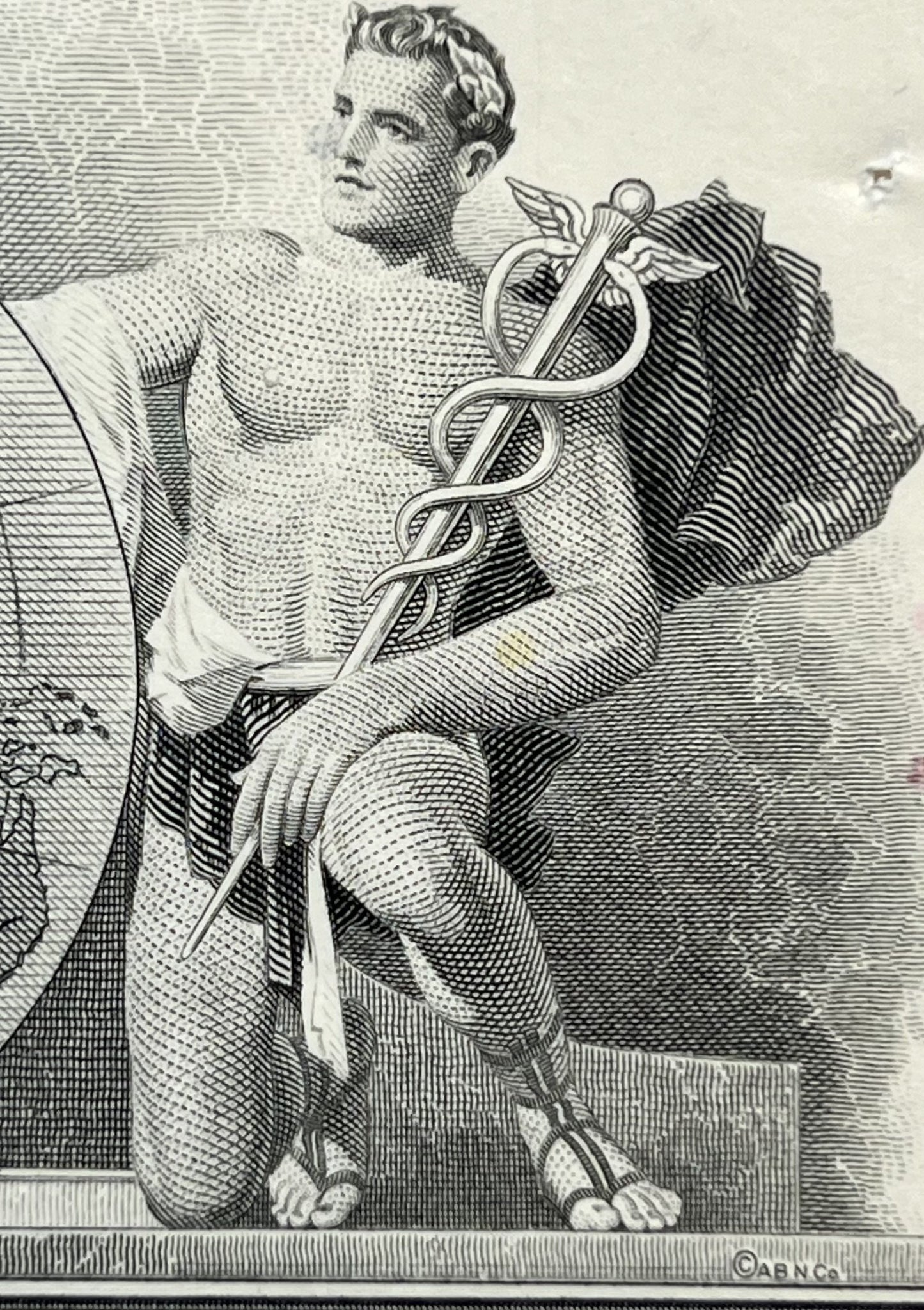
The artwork across the top of the certificate is a small masterpiece in itself: a bald eagle, wings fully spread, perches atop two facing globes — one showing the Americas, the other Europe and Africa — flanked on either side by classically rendered figures, one holding a laurel branch and torch, the other bearing the winged caduceus of Mercury, messenger god and patron of commerce and travel.

Bold serif lettering spells out "PAN AMERICAN WORLD AIRWAYS, INC." across a banner beneath the vignette, with ornate scrollwork corners, guilloché border patterns, and the formal share-registry language that marked every genuine capital stock issue of the era. Certificates from this run of Pan Am stock are documented by paper-collectible specialists in several engraved ink tones, each carrying the same design — a reminder that this was a company issuing shares by the hundreds of thousands, not a one-off keepsake.


🌎 The Airline That Made the World Feel Smaller

Pan American Airways was born in 1927, in the tangle of ambition and rivalry that marked the earliest days of commercial flight. Its roots trace to a shell company incorporated by U.S. Army Air Corps officers — including Henry "Hap" Arnold, who would go on to command the U.S. Army Air Forces in World War II — who worried that a German-backed carrier operating in Colombia might gain a foothold too close to American interests.

Around the same time, a young, relentlessly ambitious entrepreneur named Juan Trippe was building his own aviation venture out of Florida. In 1927, Trippe engineered a merger of Colonial Air and two smaller airlines into what became Pan American Airways, with himself installed as president. That October, the company's very first flight lifted off from Key West, Florida, bound for Havana, Cuba — a hired Fairchild floatplane on a route that would soon become one of the most storied air corridors in the world.

Old aviation hands still tell the story of how Charles Lindbergh himself, fresh off his transatlantic triumph and besieged with job offers from every corner of industry, chose to sign on with Trippe as a technical advisor — lending Pan Am instant credibility in an age when flying itself was still viewed with plenty of suspicion.

By 1930, Pan American was already the largest air-transport company on earth. In 1950, the company formally adopted the name printed on this very certificate: Pan American World Airways. Under Trippe's decades of leadership, Pan Am became a serial innovator — the first airline to order commercial jets, the launch customer for the Boeing 747 in 1966, and the operator of the first scheduled transatlantic jet flight in October 1958, when a Boeing 707 named Clipper America lifted off from New York's Idlewild Airport (today's JFK) bound for Paris. Pan Am's blue globe emblem — collectors and old-timers alike still call it "the Blue Meatball" — became one of the most recognized trademarks on the planet, second only to a handful of truly global brands. The "Clipper" name on every aircraft nose was a deliberate echo of the great sailing ships of an earlier golden age of travel, and Pan Am wore that connection proudly.


🗽 New York's Airline, Grown from a Florida Runway

While its first wheels left the ground in Key West, Pan Am became, in every meaningful sense, a New York company. Its headquarters occupied the Pan Am Building on Park Avenue, one of Manhattan's most recognizable skyscrapers, its name emblazoned in giant letters visible for blocks — a building that still stands today, though it's known now as the MetLife Building. Corporate lore holds that for decades, being based there was as much a symbol of prestige as the airline itself; Pan Am's executives, its stock transfers, and — fittingly — the bankruptcy filing that would eventually end the company's 64-year run, all passed through New York's federal courts and financial institutions. In its final, desperate months, the company even tried relocating operational headquarters south to Miami — a quiet echo back to its Florida origins — in a last attempt to relaunch as a smaller carrier. It wasn't enough.


🧑‍✈️ The People Behind the Globe Logo

Juan Trippe remains the name most inseparable from Pan Am's story — the founder whose facsimile signature appears on certificates of this type, and the man who steered the airline from a single Caribbean route to a genuine global empire before stepping down in 1968. Behind him stood the Army officers who first chartered the Pan American shell company, and Lindbergh, whose early advisory role gave the young airline an aura of aviation credibility no competitor could match. Later, as the industry deregulated and competition intensified through the 1970s and 80s, leadership changed hands several times, with Thomas G. Plaskett brought in from American and Continental Airlines to steer the company through its final, unsuccessful restructuring in the years before the 1991 bankruptcy filing.


📖 Lore, Legend, and the Long Shadow of the Golden Age

Few airlines have generated as much passed-down legend as Pan Am. Collectors and film buffs alike still tell the story of Frank Abagnale Jr., the young con man who spent years in the 1960s posing as a Pan Am pilot — deadheading in cockpit jump seats, staying at the airline's preferred hotels, and paying his way with bad checks — a saga later immortalized in the book and film Catch Me If You Can. Old-timers recall, too, that Pan Am sold advance tickets during the Apollo era for future flights to the Moon — a marketing flourish born of pure 1960s optimism that never resulted in an actual flight, but whose souvenir tickets are cherished collectibles in their own right today. And no account of Pan Am's cultural footprint is complete without The Beatles, whose famous 1964 arrival at JFK — stepping off a Pan Am Boeing 707 named Clipper Defiance into a wall of screaming fans and flashbulbs — became one of the defining images of the British Invasion and, by extension, of Pan Am itself.

The end, when it came, arrived in stages rather than all at once. Deregulation in 1978 opened the skies to fierce new competition Pan Am had never faced before. The costly 1980 acquisition of National Airlines was meant to finally give Pan Am a domestic network, but it saddled the company with debt instead. The Pacific routes were sold to United in 1985.

Then came December 21, 1988 — the bombing of Pan Am Flight 103 over Lockerbie, Scotland — a tragedy that shattered public confidence in the airline and triggered fines, lawsuits, and a collapse in bookings from which Pan Am never truly recovered. The 1990 Gulf War and the fuel-price shock that followed delivered the final blow.

Pan American World Airways filed for Chapter 11 bankruptcy on January 8, 1991, and ceased all flight operations on December 4, 1991, after 64 years of continuous service — its last flight touching down from Bridgetown, Barbados, into Miami. Around 7,500 employees lost their jobs that single day. Delta Air Lines purchased the surviving profitable routes and the famed Worldport terminal at JFK; and in 1993, the Pan Am name and its iconic blue globe trademark were auctioned off in bankruptcy court for $1.3 million — a symbolic final chapter for a brand that had once been the very picture of American ambition abroad.


💼 Why It Still Matters Today

To many who lived through it, Pan Am's disappearance genuinely marked the end of what people still call the golden age of air travel — a time when flying was an event, not an errand, and an airline's name could carry the same cultural weight as a great ocean liner or a national rail line. Original Pan Am ephemera — timetables, luggage tags, and stock certificates like this one — are among the last physical threads connecting today's collectors to that era. Certificates such as this survive today precisely because Pan Am's 1991 collapse meant its stock, once actively traded on American exchanges, was left worthless as a security — but priceless as a piece of aviation and business history, a genuine artifact of a corporation whose reach and reputation are rarely matched by any airline flying today.


🖼️ Display Ideas

  • ✈️ Frame it alongside vintage Pan Am route maps or timetables for an instant aviation-history gallery wall
  • 🗽 Pair it with other New York corporate ephemera for a study or office devoted to Manhattan's business history
  • 🌍 Hang it near a vintage world globe or atlas to echo the certificate's own double-hemisphere artwork
  • 🛋️ Mat and frame it as a conversation-starting accent in a mid-century modern living room or den
  • 🎁 Present it as a milestone gift for a retiring pilot, flight attendant, or lifelong aviation enthusiast
  • 📚 Add it to a collection of engraved American Bank Note Company securities as an example of the firm's finest commercial engraving

🎁 Who Collects These

Pan Am stock certificates draw a wonderfully varied crowd — scripophily collectors who prize American Bank Note Company engraving for its own artistic merit, aviation history buffs building out a Pan Am archive, retired airline employees and their families looking to reconnect with a career-defining chapter, and everyday nostalgia hunters who simply remember Pan Am as shorthand for glamorous travel. It's a favorite gift for pilots, travel agents, frequent flyers, and anyone who grew up watching those blue globe tails taxi across a runway.


❓ FAQ

Is this a real, usable stock certificate?

It's a genuine, issued capital stock certificate originally printed for Pan American World Airways, Inc. Since the airline ceased operations in 1991, the shares carry no financial or redemption value today — it's collected purely as a historical document and piece of engraved Americana.

What era is this certificate from?

These certificates were issued across the 1950s through the 1970s, spanning Pan Am's peak decades as the world's dominant international carrier.

Who printed it?

The American Bank Note Company, a firm long entrusted with producing engraved securities for major American corporations, printed these Pan Am certificates.

What's depicted in the artwork?

A spread-winged eagle perched above twin globes showing the Americas and Europe/Africa, flanked by two classical figures — one bearing a laurel torch, the other Mercury's caduceus — framed by ornate engraved scrollwork.

What size is the certificate?

Approximately 12" x 8" (about 30.5 x 20 cm).

Does the ink color or exact design vary between certificates?

Yes — Pan Am issued this stock certificate design across its run in more than one engraved ink tone, so the exact color of the piece you receive is representative of the type rather than a single fixed shade.

Why does Pan Am still matter to collectors?

Pan Am was the defining international airline of the 20th century — a pioneer of jet travel and the 747, a cultural icon from the Beatles' arrival to the Apollo-era moon ticket craze, and a company whose 1991 collapse is still remembered as the symbolic end of aviation's golden age.

These are issued instruments rather than blanks. Certificates of this type were filled in for a holder in ink, countersigned by the transfer agent and registered by the registrar, then punch- or cut-cancelled when they were redeemed and retired. Expect financial writings, markings, stamps, hole punches and staple holes as part of the life of the instrument: endorsements and signatures, transfer-agent and registrar stamps, revenue or documentary tax stamps, cancellation punches, staple holes from being bound into a transfer book, pencil ledger notations. That is the paper trail of a security that actually did its job, and it is what separates a document that lived from a blank that never did. No two are alike: holder details, serial numbers, dates, signatures, stamps and punch patterns vary from example to example, so the photographs show the type rather than the exact sheet that ships.

Shipping

🚚 Shipping & Handling

  • Shipping costs and timing are calculated at checkout.
  • Items curated and shipped directly by me include U.S. shipping at no additional cost, professionally packed to ensure safe arrival of your artifact.

Items from Vetted Pro Collectors
Shipping for items offered by vetted Pro Collectors is determined at checkout. All Pro Collector listings are reviewed to ensure fair, reasonable shipping practices.

For full details, please refer to our Shipping Policy.

Returns & Exchange

Take your time — you've got a full six months. If a piece isn't right for you, send it back the way it reached you and we're good.

In the first 30 days your money goes straight back the way you paid. After that it's store credit, so you can put it toward something you'd rather have.

Return shipping we sort out between us, case by case. I don't make this difficult.

If something arrives damaged, or it isn't what I said it was, send me a photo within 48 hours and I'll make it right.

Email info@vintageantiquesgifts.com or call 802-356-9872 — that's me answering, not a call center.

The only things I can't take back are custom or special-order pieces and gift cards.

View full details
  • 5 stars: 2 (100%)
  • 4 stars: 0 (0%)
  • 3 stars: 0 (0%)
  • 2 stars: 0 (0%)
  • 1 star: 0 (0%)
b
b***m (351)

Great item. Great seller. Great family and business.

2
2***2 (134)

A++++ seller. Answered all messages. Thx again.