Skip to product information
1 of 8

Vintage and Antique Gifts

Vintage 1961 TWA Trans World Airlines 1000 Dollar Bond Howard Hughes Era Jet Age Debenture 📜

Vintage 1961 TWA Trans World Airlines 1000 Dollar Bond Howard Hughes Era Jet Age Debenture 📜

Regular price 8.00 USD
Regular price Sale price 8.00 USD
Sale Sold out
Shipping calculated at checkout.
Quantity

What does it feel like to hold the paper that helped cost Howard Hughes his own airline? ✈️

There's a particular kind of thrill that comes from holding a piece of paper that once sat in the middle of a genuine corporate drama — not a reproduction, not a replica, but an actual financial instrument printed and dated in the thick of it. This TWA debenture is that kind of object. It was engraved and issued at the exact moment Trans World Airlines was refinancing itself into the jet age, and in the process, quietly easing its most famous shareholder out the door. Anyone who remembers TWA's red double-globe logo on the tail of a Boeing or a Lockheed Constellation, or who has ever heard the name Howard Hughes spoken with a mix of awe and suspicion, will feel the pull of this piece the moment they see it.

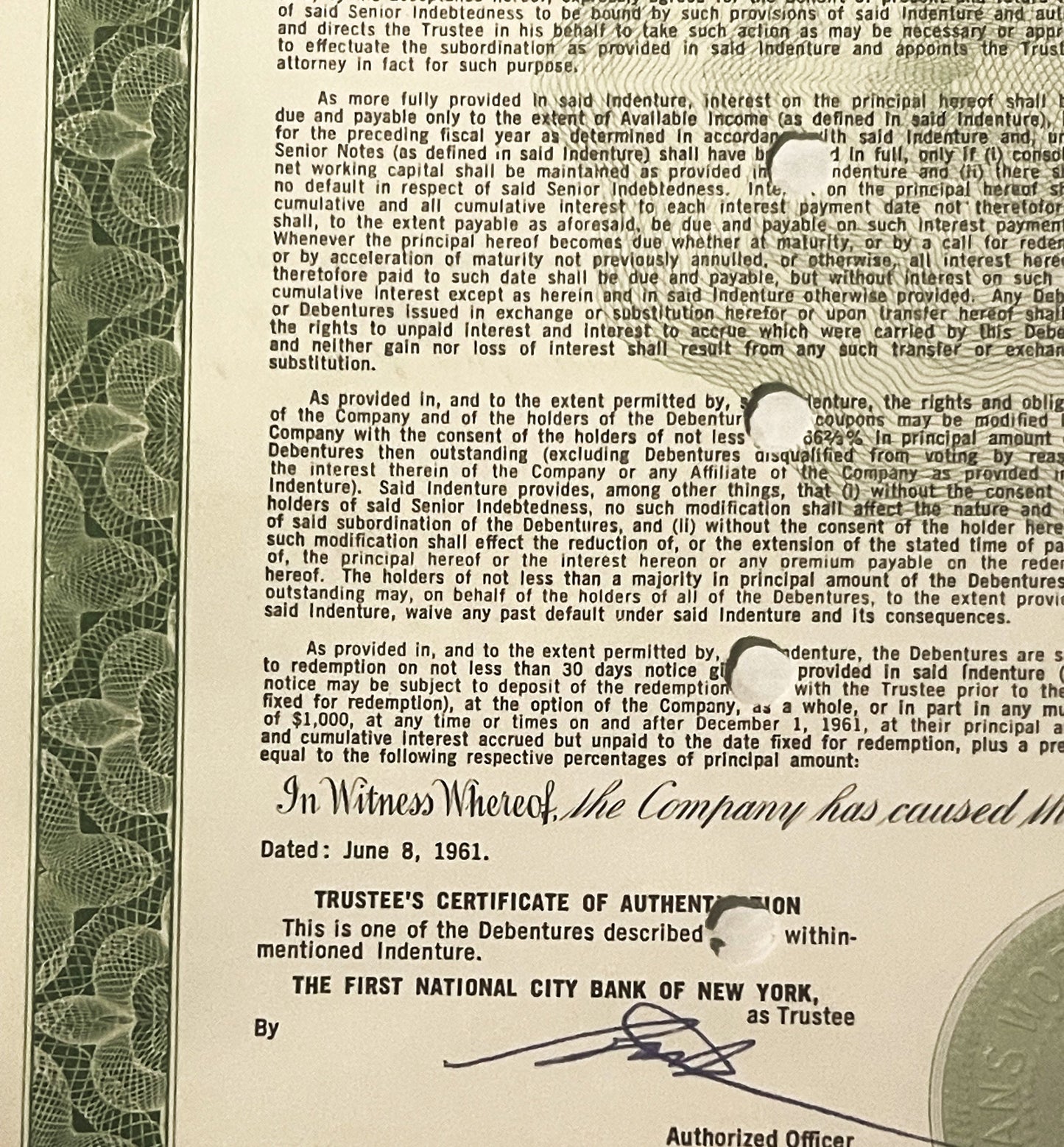
This is a $1,000 face-value 6½% Subordinated Income Debenture issued by Trans World Airlines, Inc., a Delaware corporation, dated June 8, 1961 and due June 1, 1978. It measures a substantial 13½" by 9½" and was engraved and printed by the De La Rue Banknote Company, Inc. — one of the great names in international security printing — using genuine intaglio engraving, fine-line guilloche border work, an allegorical central vignette, and an embossed corporate seal, all in the classic green, cream, black, and sepia palette of mid-century American financial engraving. The centerpiece artwork shows a classical female figure, robes flowing, seated on a bank of clouds beside the globe — the kind of timeless allegorical imagery banknote engravers of the era leaned on to signal permanence and trust, flanked here by hand-tooled acanthus leaf scrollwork in the corners. This example is offered as a genuine issued debenture from the original issue — executed under seal, authenticated in ink by the trustee, and cut-cancelled with punch holes when it was retired — presented here as a piece of paper history in its own right rather than as a graded or valued financial instrument.


💼 The Jet-Age Gamble That Cost Howard Hughes His Airline

To understand why this bond exists at all, you have to go back to the deal that reshaped Trans World Airlines just months before it was printed. Howard Hughes had built up a controlling interest in TWA starting in 1939, and by the mid-1940s he effectively ran the airline as his own. Through the 1950s he pushed TWA hard into the international arena and toward the jet age — but jets were staggeringly expensive, and by the end of the decade Hughes needed outside financing to make good on a fleet order for 45 new jet aircraft. The banking syndicate that agreed to arrange the money, led by Dillon, Read & Co., wanted control as their price. On December 30, 1960, a $165 million loan agreement was signed placing TWA's voting stock into a three-person trust — one seat for Hughes's own attorney, Raymond Holliday, and two seats representing the lending institutions, Ernest R. Breech and Irving S. Olds. For the first time in over two decades, Hughes no longer controlled the airline that bore his imprint everywhere.

This $1,000 debenture belongs to the separate public financing that accompanied that private loan — a roughly $100 million offering of 6½% Subordinated Income Debentures, issued to raise additional capital for the same jet-fleet buildout. "Subordinated income" meant exactly what it sounds like to a collector today: bondholders stood behind TWA's senior lenders in line for repayment, and interest was only payable to the extent the company actually had available income to pay it — a real financial gamble tied directly to whether the airline's expensive new jets could be made to pay off.

Litigation over the whole affair was filed just weeks later, on June 30, 1961, and dragged on for years as TWA and Hughes fought in court over control and damages. It wasn't resolved until 1966, when Hughes was finally forced to sell his TWA stock outright — a sale that netted him $546,549,771, one of the largest personal paydays in American corporate history to that point, even as it closed the book on his direct involvement in the airline he'd shaped for a generation.

Charles C. Tillinghast Jr., the executive brought in to steady the company under the new banking-controlled board, is the very name signed as President on certificates from this issue.


🛫 TWA's Golden Age: Constellations, In-Flight Movies, and the Battle for the Atlantic

Trans World Airlines traces its roots to 1930, when it was formed as Transcontinental & Western Air out of the government-brokered "Spoils Conference" that also created United, American, and Eastern — the "Big Four" that would define American commercial aviation for half a century. Under Hughes, the airline rebranded in 1950 to Trans World Airlines, and its sleek, triple-tailed Lockheed Constellations and Super Constellations became some of the most romantic aircraft silhouettes of the era, carrying TWA deep into Europe, the Middle East, Africa, and Asia and setting the airline up as Pan Am's fiercest rival across the Atlantic for decades.

1961, the very year this bond was dated, was a year of both hardship and innovation for TWA. The airline began flying its new Convair 880 jets that January, part of the very fleet this financing paid for, and would go on to post a net loss of $38.7 million for the year — real evidence of just how costly the jet-age transition was. Yet that same year, TWA quietly made aviation history by introducing the first regularly scheduled in-flight movies in the industry, turning the long transcontinental and transatlantic hauls its jets were built for into something closer to an event than a commute. The gamble paid off faster than anyone might have guessed at the time: TWA turned a $19.8 million profit by 1963, $37 million by 1964, and $50.1 million by 1965, with its stock climbing from around $7.50 a share in 1962 to $62 by 1965 — a recovery that would have made this very debenture, bought amid 1961's uncertainty, look like a shrewd bet in hindsight.


🏛️ Delaware on Paper, Kansas City and New York in Practice

The embossed seal on this certificate reads "TRANS WORLD AIRLINES CORPORATION SEAL 1934 DELAWARE" — 1934 marking the year the corporation itself was chartered, carried forward on every seal the company used for decades afterward, the way many American corporations of the era kept their founding-year seal in permanent use regardless of when a given document was actually printed. Delaware was simply where TWA was legally incorporated, as was common practice for large American corporations seeking a stable, business-friendly charter — it was never where the airline actually operated.

TWA's operational heart moved around the map through its history. For years the airline made Kansas City, Missouri its headquarters and major overhaul base, and there were serious plans at one point to build Kansas City International Airport into TWA's principal domestic and international hub — plans that were ultimately abandoned as the company's center of gravity shifted east. New York became the airline's public face in its later golden years, anchored by the strikingly modern TWA Flight Center at JFK Airport, the swooping, wing-like Eero Saarinen-designed terminal that became one of the most photographed buildings in American aviation and remains, to travelers who remember it, shorthand for the glamour TWA once represented.


🖋️ De La Rue: The Engravers Who Made Security Printing an Art

The name printed discreetly along the bottom border of this certificate — De La Rue Banknote Company, Inc. — belonged to one of the true giants of the security-printing world. Thomas de la Rue's firm began in the mid-19th century, printing postage stamps starting in 1855 and its first banknotes in 1860 for the island of Mauritius, and by the time this TWA debenture was engraved, De La Rue's American security-printing arm had long since been registered in New York as an official printer to the New York Stock Exchange. The company would go on to become the world's largest commercial printer of banknotes, producing secure currency and financial documents for governments and corporations across more than a hundred countries — the same engraving craft, fine-line guilloche work, and allegorical vignette artistry found on national currencies is exactly what gives this TWA bond its unmistakable banknote-grade presence.


🏦 The Trustee's Hand: First National City Bank of New York

Every debenture in this series carried the authentication of a trustee bank — here, The First National City Bank of New York, the institution formed in 1955 when National City Bank acquired the First National Bank of New York, and the direct ancestor of what the world knows today as Citibank. The bank was in the middle of its own transformation right around the time it stood behind this bond: its grand new headquarters at 399 Park Avenue opened its doors in March of 1961, and that same year the bank pioneered one of the most consequential financial innovations of the century, the negotiable certificate of deposit. It's a small but satisfying coincidence of history that this TWA bond and the modern CD — a fixture of nearly every American's savings account since — were both taking shape at the very same bank, in the very same year.


🌆 An Extinct Airline's Long Shadow Today

Under Tillinghast's leadership through the later 1960s and 70s, TWA's parent, Trans World Corporation, grew far beyond aviation — at one point taking in Hilton Hotels, Hardee's, Canteen Corporation, and Century 21 Real Estate, becoming a diversified giant with employment nearing 10,000. There's a certain irony collectors point to in the fact that this bond's own due date, June 1, 1978, landed the very same year Congress passed the Airline Deregulation Act — the law that unleashed the wave of competition, fare wars, bankruptcies, and consolidations that would eventually reshape the entire industry TWA had helped invent. TWA itself was spun back out as an independent airline in 1984, endured a leveraged buyout under Carl Icahn in 1988 that left it carrying heavy debt, weathered Chapter 11 restructurings in 1992 and 1995, and was further shaken by the loss of Flight 800 in 1996. In 2001, after 71 years flying under its own name, TWA was finally absorbed into American Airlines, closing out one of the defining stories of 20th-century American aviation.

Old-timers who flew TWA in its heyday still talk about the feel of boarding a Constellation or a 707 under that red twin-globe tail, and aviation enthusiasts today keep the memory alive in a very physical way — the old Saarinen-designed TWA Flight Center at JFK has been reborn as the TWA Hotel, its midcentury lounges and departure boards lovingly preserved for a new generation of travelers who never knew the airline firsthand but instantly recognize the name and the look. Pieces like this bond are part of that same living memory — tangible, signed, sealed paper from a company whose name still means something to anyone who ever loved the golden age of flight.


🖼️ Display Ideas

  • ✈️ Frame it solo, matted in cream or white, as the centerpiece of an aviation or travel-themed wall
  • 🗺️ Pair it with a vintage TWA route map or timetable for a "lost airline" vignette
  • 🏙️ Hang it in a home office or study alongside other mid-century Wall Street financial ephemera
  • 🛫 Group it with a photograph or model of a Lockheed Constellation or Boeing 707 for a jet-age display
  • 💼 Set it in a shadow box with period stock certificates to tell the story of 1960s corporate America
  • 🎬 Display it near vintage in-flight memorabilia — timetables, playing cards, wing pins — to evoke the era of TWA's in-flight movie debut

🎁 Who Collects These

Scripophily collectors — those who gather old stock and bond certificates for their artwork and history rather than any remaining financial value — are drawn to this piece for its engraving quality alone, but it also pulls in a wider circle: aviation historians and TWA enthusiasts building out a personal archive of the airline's golden age, Howard Hughes collectors chasing anything connected to his business empire, Citibank and Wall Street historians tracing the First National City Bank lineage, and design lovers who simply appreciate a beautifully engraved piece of mid-century Americana. It's also a favorite gift for anyone with a personal memory of flying TWA, or a family connection to the airline — a genuine, framable piece of a company that no longer exists but is far from forgotten.


❓ FAQ

What is a "subordinated income debenture," in plain terms?

It's a type of corporate bond where the company only had to pay interest to the extent it had sufficient earnings in a given year, and bondholders stood behind TWA's other senior lenders in the repayment order — a structure that reflected just how financially stretched the airline was during its jet-fleet buildout.

Is this bond still redeemable for cash or worth its printed face value?

No — its maturity date passed long ago and it carries no redeemable financial value today. Its worth today is entirely as a historical and decorative collectible, valued for its engraving, its corporate history, and its connection to a defining moment in TWA's story.

What do the small punch holes mean?

Cancellation perforations like these were the standard method trustee banks and transfer agents used to mark a certificate as retired from active financial use — a normal and expected feature of certificates from this era, not a defect.

Why does the seal say "1934" if this bond is dated 1961?

The corporate seal carries TWA's original 1934 Delaware incorporation date, which the company kept in continuous use on its official seal for decades afterward — it marks when the corporation was chartered, not when this particular certificate was printed.

What should I expect on a certificate like this?

It is a genuine issued debenture from the actual 1961 printing run rather than a modern reproduction — registered to a holder, authenticated by the trustee, and cancelled at the end of its life.

Who was Howard Hughes to Trans World Airlines?

Hughes controlled TWA from the late 1930s into 1960, shaping it into a major international carrier before a jet-financing deal forced him to cede control — a battle this very debenture issue was part of financing.

Is the certificate suitable for framing?

Yes — at 13½" by 9½" with rich engraved detail and a genuine embossed seal, it was designed in the banknote tradition specifically to hold up as an impressive, display-worthy piece of paper.

These are issued instruments rather than blanks. Bonds and debentures of this type were registered to a holder, authenticated by the trustee, and punch- or cut-cancelled when they were finally redeemed. Expect financial writings, markings, stamps, hole punches and staple holes as part of the life of the instrument: endorsements and signatures, trustee and registrar stamps, revenue or documentary tax stamps, cancellation punches, staple holes from being bound into a transfer book, pencil ledger notations. That is the paper trail of a security that actually did its job, and it is what separates a document that lived from a blank that never did. No two are alike: holder details, serial numbers, dates, signatures, stamps and punch patterns vary from example to example, so the photographs show the type rather than the exact sheet that ships.

Shipping

🚚 Shipping & Handling

  • Shipping costs and timing are calculated at checkout.
  • Items curated and shipped directly by me include U.S. shipping at no additional cost, professionally packed to ensure safe arrival of your artifact.

Items from Vetted Pro Collectors
Shipping for items offered by vetted Pro Collectors is determined at checkout. All Pro Collector listings are reviewed to ensure fair, reasonable shipping practices.

For full details, please refer to our Shipping Policy.

Returns & Exchange

Take your time — you've got a full six months. If a piece isn't right for you, send it back the way it reached you and we're good.

In the first 30 days your money goes straight back the way you paid. After that it's store credit, so you can put it toward something you'd rather have.

Return shipping we sort out between us, case by case. I don't make this difficult.

If something arrives damaged, or it isn't what I said it was, send me a photo within 48 hours and I'll make it right.

Email info@vintageantiquesgifts.com or call 802-356-9872 — that's me answering, not a call center.

The only things I can't take back are custom or special-order pieces and gift cards.

View full details
  • 5 stars: 7 (100%)
  • 4 stars: 0 (0%)
  • 3 stars: 0 (0%)
  • 2 stars: 0 (0%)
  • 1 star: 0 (0%)
s
s***3 (111)

Excellent service with a valuable treasure—thanks. Will do additional purchases.

W
William (Canton, US)
I love it

Wonderful piece of history. Can’t wait to hang it on the wall

t
tedw0qmlyb39fo9r

This is a great antique item!

3
3***a (2095)

Great add to my collection. Highly recommended.

m
m***r (14)

Fast shipping....well packed and what I ordered. Highly recommend this seller.

j
j***j (86)

Item was shipped with great care, arrived quickly!

t
t***m (109)

Cool