Skip to product information
1 of 6

Vintage and Antique Gifts

Vintage 1966 Baltimore Transit Company $1,000 Bond 🚋 Streetcar & Bus History, 6 2/3% Income Debenture

Vintage 1966 Baltimore Transit Company $1,000 Bond 🚋 Streetcar & Bus History, 6 2/3% Income Debenture

Regular price 17.00 USD
Regular price Sale price 17.00 USD
Sale Sold out
Shipping calculated at checkout.
Quantity

🚋 What Did It Feel Like to Hold a Stake in Baltimore's Streetcars, Right as the Rails Were Going Quiet?

Picture Baltimore in the mid-1960s. The streetcars have already gone silent — the last one rolled to its barn on November 3, 1963 — and the city's transit fleet is now all rubber tires and diesel exhaust where there used to be steel wheels humming on steel rails. Somewhere in an office downtown, a registered bondholder is handed a crisp, orange-and-brown engraved certificate: a promise from The Baltimore Transit Company to pay back a thousand dollars, with interest, a decade down the road. It's a piece of paper, but it's also a snapshot of a company — and a city — caught between what transit used to be and what it was about to become. This certificate is that snapshot, preserved in ink on cream stock, and it still carries every bit of that in-between moment in its design.

This is The Baltimore Transit Company 6⅔% Cumulative Income Subordinated Debenture, a $1,000 registered bond certificate issued out of Baltimore, Maryland, and dated to December 1, 1966, with a stated maturity of January 1, 1977. It measures a substantial 15 x 10 inches (38 x 25.4 cm) — large enough that the engraving reads like a small poster rather than a scrap of paperwork.

The certificate was engraved and printed by the Security Banknote Company, using true intaglio steel-plate engraving: the kind of raised, finely-lined printing once reserved for currency, stock certificates, and other documents where forgery had to be made nearly impossible. The palette is classic security-paper orange and brown set against black typeset text and cream paper, with a dense guilloche border of interlocking geometric lines running the full perimeter — the same kind of hypnotic, hard-to-copy patternwork you'll find bordering old currency and railroad bonds.

Centered at the top is the certificate's signature vignette: a spread-wing eagle, talons gripping a branch, framed inside an oval medallion, flanked on the left by an electric streetcar loaded with passengers and on the right by an early motor bus, also full of riders, with trees and period rooflines sketched into the background behind both.

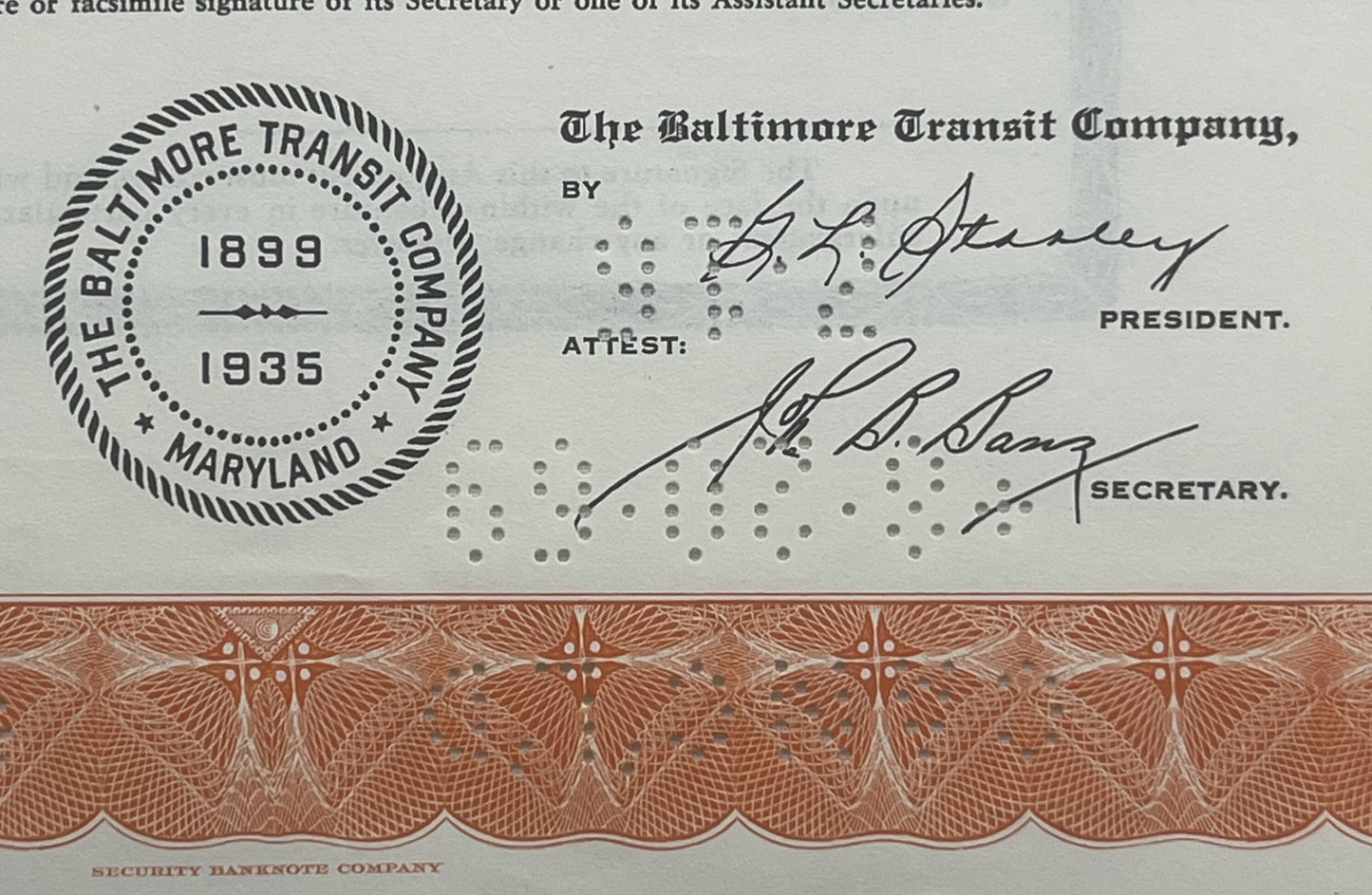
At the base of the document sits the company's own corporate seal, reading "The Baltimore Transit Company — 1899 — 1935 — Maryland." Interest on debentures in this series was payable each January 15 and July 15, with Maryland National Bank named as trustee overseeing the indenture. This listing describes the issue as a whole — the design, the company, and the history behind it — since certificates from this series naturally carry their own certificate numbers and registered names unique to each individual bond.


🦅 Reading the Vignette: An Eagle Between Two Eras of Transit

Look closely at that central image and you're looking at the whole story of mid-century American transit compressed into one engraving. The eagle was standard iconography on American financial paper of this kind — bank notes, bonds, stock certificates — meant to signal trust, permanence, and the weight of a legally binding promise. But the choice to flank it with a streetcar on one side and a motor bus on the other wasn't generic decoration. It's a company literally illustrating its own transition. By the time this bond was engraved, Baltimore's streetcars were already gone from the streets, replaced entirely by the buses shown rolling alongside them in the very same picture. The engraver gave the company a way to honor where it came from and show where it was headed, all in a single oval frame — trolley wire and rubber tire, side by side, for good.


🚃 From Horsecars to High Voltage: The Baltimore Transit Story

Baltimore's claim to transit history runs deep, and it runs early. Long before this bond was ever engraved, the city was already making national headlines in the transportation world: Baltimore is credited with hosting the first commercially operated electric streetcar line in the United States, running in 1885, and with operating the nation's first elevated electric streetcar line not long after. For a city its size, that's an extraordinary distinction — Baltimore wasn't just riding the wave of the electric streetcar revolution, it was one of the places the wave started.

The company whose name appears on this very certificate traces back to that pioneering era. The United Railways and Electric Company took over and consolidated Baltimore's streetcar lines starting in 1899 — the very date stamped into the corporate seal at the bottom of this bond. For decades, "URE" cars were Baltimore's transit backbone, carrying shipyard workers, shopkeepers, schoolchildren, and commuters across a city that was rapidly industrializing. Then, in 1935 — the second date on that same seal — the company reorganized and re-emerged under a new name: The Baltimore Transit Company. Every certificate in this series carries both of those dates baked right into its corporate seal, a quiet little timeline of the company's own reinvention stamped in wax-seal form on every bond it ever issued.


📉 The Great Streetcar Scandal and the Last Trolley Home

By the middle of the 20th century, streetcar systems across the entire country were being dismantled in favor of motor buses, a nationwide shift so widespread and so consistent from city to city that it's remembered by transit historians and old-timers alike as the "Great American Streetcar Scandal." Baltimore, despite its pioneering place in electric streetcar history, followed the same national trend. Rail after rail was pulled up, trolley wire after trolley wire came down, and the fleet of streetcars that had once defined the sound and rhythm of Baltimore's streets was steadily replaced by diesel buses. The final streetcar routes in Baltimore made their last runs on November 3, 1963 — just three years before this bond was dated. If you rode a Baltimore streetcar as a kid, this piece of paper was printed right in that narrow window of memory, back when the tracks were freshly quiet and buses were still the "new" way to get across town.

This is exactly why a bond like this one exists in the first place. A "cumulative income subordinated debenture" is not the kind of security a thriving, cash-rich company issues — it's the kind of instrument a company turns to when it's reorganizing its finances during a difficult stretch. "Debenture" means the debt is backed only by the company's general credit rather than by any specific property. "Subordinated" means that, in the event of trouble, this debt sits behind more senior obligations — the certificate itself references the company's earlier Series "A" First 4% and Series "A" First 5% debentures as senior in line for payment. And "cumulative income" means interest was tied to what the company actually earned each year: if the money wasn't there, the interest didn't disappear, it simply accumulated and carried forward, unpaid but still owed, until the company could make good on it. Taken together, this certificate is a candid financial document of a transit company navigating the tail end of the streetcar era and the costly transition into an all-bus operation — a company hanging on, restructuring its obligations, and asking its bondholders for patience.


🏛️ The Fine Print: Maryland National Bank, Sinking Funds, and a Decade-Long Countdown

The certificate itself is dense with the kind of legal detail that makes old financial paper so fascinating to read decades later. The debentures in this series were issued under an indenture dated as of January 1, 1957, between The Baltimore Transit Company and Maryland National Bank, acting as trustee, authorizing an aggregate issue of $3,345,200 in these particular 6⅔% cumulative income subordinated debentures.

The company built in a sinking fund arrangement — committing to pay the trustee $125,000 every July 1st from 1958 through 1964, then stepping that commitment up to $200,000 every July 1st thereafter for as long as any of these debentures remained outstanding, all specifically earmarked to buy back and retire debentures over time.

There was also a sliding redemption premium written into the terms: if the company chose to redeem the bonds early, it owed bondholders a premium that started as high as 10% for early redemption and stepped steadily downward in the years approaching the 1977 maturity, disappearing entirely for any bond called after July 1, 1976.

It's the kind of careful, cascading structure a company builds when it's trying to reassure creditors that it has a real plan — and reading it today gives you a genuine window into how a mid-century American transit company managed its debt while the ground was shifting under its entire industry.


🏙️ Baltimore in Transition: A City Watching Its Transit Change Twice

By 1970, private urban transit in Baltimore came to its own end. The Baltimore Transit Company was absorbed into what would go on to become the Maryland Transit Administration, folding a privately run, century-old transit lineage into public ownership. Between the last streetcar in 1963 and that 1970 absorption, this bond sat right in the middle of the company's final chapter as an independent, privately operated business — a company that had once run the first electric streetcars in the country, now issuing subordinated debt to keep its all-bus operation afloat in its last years before the public sector took the wheel. For Baltimore residents who lived through it, that stretch of the 1960s marked the true end of an era that had begun back in the 1880s — the sound of steel wheels on rail replaced first by rubber tires on asphalt, and then by an entirely different kind of ownership altogether.


💼 Why Pieces Like This Still Matter Today

Certificates like this one survive today as tangible artifacts of a chapter in American transit and financial history that mostly exists now only in old timetables, faded photographs, and city archives. Very few everyday objects capture both a transportation story and a financial one in a single piece of paper — but a bond like this does exactly that, recording not just what a company looked like, but what it owed, to whom, and under what terms, all rendered in genuine steel-plate engraving. For anyone drawn to Baltimore history, the golden age of the American streetcar, or the craft of old security printing, this certificate holds all three at once.


🖼️ Display Ideas

  • 🚋 Frame it alongside a vintage Baltimore streetcar photo or postcard for an instant "before and after" transit story
  • 🏛️ Pair it with other Maryland or Baltimore financial ephemera for a regional history shadow box
  • 🦅 Highlight the eagle-and-vignette engraving as a standalone piece of graphic art, matted to let the intaglio detail shine
  • 📜 Group it with other mid-century transportation bonds or stock certificates for a "transit industry" collection wall
  • 🖋️ Display it near a magnifying glass so visitors can appreciate the fine-line guilloette engraving up close
  • 🏙️ Set it in a Baltimore-themed collectible corner alongside city memorabilia spanning streetcar to modern transit eras

🎁 Who Collects These

This certificate speaks to several overlapping collector interests at once. Scripophily collectors — those who collect antique stock and bond certificates specifically for their engraving, history, and financial storytelling — prize pieces like this for the combination of an eagle vignette, transportation imagery, and a named, dated Maryland corporation. Transit historians and streetcar enthusiasts value it as a rare financial artifact from a company whose operating history stretches back to the birth of American electric transit. Baltimore history collectors and Maryland ephemera collectors look for pieces tied directly to the city's own institutions and corporate names. And collectors of security printing and bank note engraving art appreciate it simply as a well-preserved example of the intaglio engraver's craft, from a printer whose work was built to resist forgery and built to last.


❓ FAQ

What exactly is a "cumulative income subordinated debenture"?

It's a type of corporate bond that's unsecured (backed by the company's credit rather than specific property), ranks behind more senior debt in repayment priority ("subordinated"), and ties its interest payments to the company's actual income each year — with any unpaid interest accumulating rather than disappearing ("cumulative").

Is this the same company as today's Maryland transit system?

The Baltimore Transit Company was the private predecessor. It was absorbed into what became the Maryland Transit Administration in 1970, marking the shift from private to public ownership of Baltimore's transit system.

Why does the certificate show both a streetcar and a bus?

The vignette reflects the company's own transition — Baltimore's streetcars had already stopped running by the time this bond was issued, with buses fully in place, and the engraving honors both chapters of the company's operating history side by side.

What do the "1899" and "1935" dates on the seal mean?

1899 marks the formation of United Railways and Electric Company, Baltimore's streetcar predecessor; 1935 marks its reorganization into The Baltimore Transit Company, the name that appears throughout this certificate.

Does this bond still hold any active financial value?

No — it holds historical and collectible value as a piece of Baltimore transit and financial history, not as a redeemable financial instrument.

How was this certificate printed?

It was produced using genuine intaglio steel-plate engraving by the Security Banknote Company, the same painstaking process used for currency and other high-security financial documents of the era.

What size is the certificate, and how should I display it?

It measures 15 x 10 inches, a substantial size that displays beautifully framed on its own or matted alongside other Baltimore or transit-themed pieces.

An issued certificate picks up the marks of its working life: endorsements and signatures on the reverse, transfer-agent and registrar stamps, revenue or documentary tax stamps, punch or cut cancellations at redemption, staple holes from being bound into a transfer book, and pencil ledger notations. Those marks are the paper trail of a financial instrument that actually did its job.

Shipping

🚚 Shipping & Handling

  • Shipping costs and timing are calculated at checkout.
  • Items curated and shipped directly by me include U.S. shipping at no additional cost, professionally packed to ensure safe arrival of your artifact.

Items from Vetted Pro Collectors
Shipping for items offered by vetted Pro Collectors is determined at checkout. All Pro Collector listings are reviewed to ensure fair, reasonable shipping practices.

For full details, please refer to our Shipping Policy.

Returns & Exchange

Take your time — you've got a full six months. If a piece isn't right for you, send it back the way it reached you and we're good.

In the first 30 days your money goes straight back the way you paid. After that it's store credit, so you can put it toward something you'd rather have.

Return shipping we sort out between us, case by case. I don't make this difficult.

If something arrives damaged, or it isn't what I said it was, send me a photo within 48 hours and I'll make it right.

Email info@vintageantiquesgifts.com or call 802-356-9872 — that's me answering, not a call center.

The only things I can't take back are custom or special-order pieces and gift cards.

View full details