
Skip to product information
1 of 9

Vintage and Antique Gifts

Vintage 1990s-2000s RC Cola Bottle Cap 🥤 Peruvian Bottling by TECNOIMPORT, Juliaca, Royal Crown Licensed

Vintage 1990s-2000s RC Cola Bottle Cap 🥤 Peruvian Bottling by TECNOIMPORT, Juliaca, Royal Crown Licensed

Regular price $10.00 USD
Regular price Sale price $10.00 USD
Sale Sold out
Shipping calculated at checkout.

Size: 1 1/4"

🚚 Free US Shipping — ships within one business day. International shipping calculated at checkout.

Quantity

How Did a Georgia Cola End Up Bottled on Peru's Altiplano? 🥤 A Vintage 1990s-2000s RC Cola Bottle Cap, TECNOIMPORT S.A., Juliaca, Peru

Size: 1 1/4" ~ NOS unused stock, little to no storage wear.

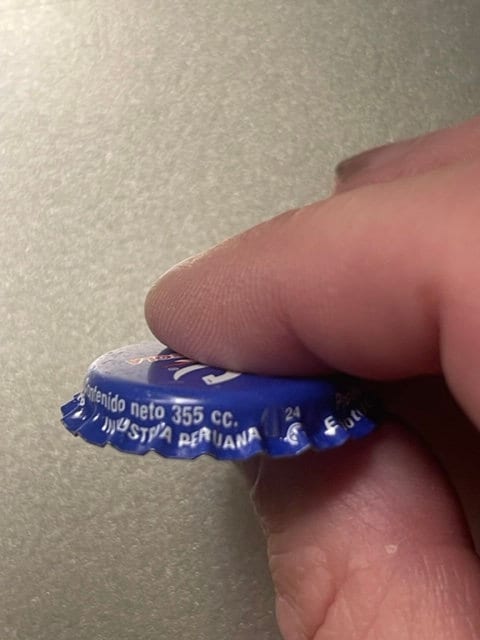
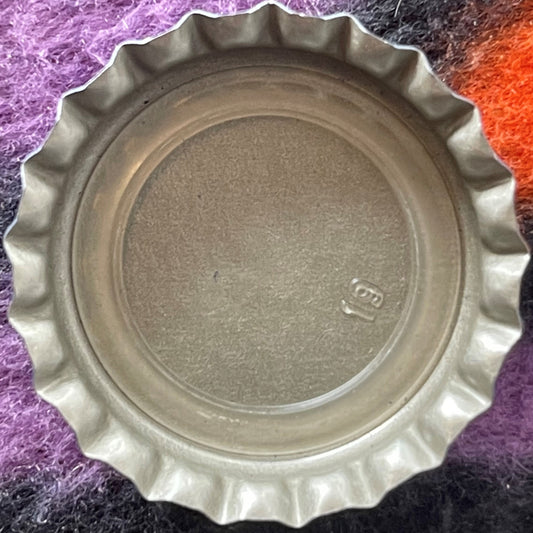
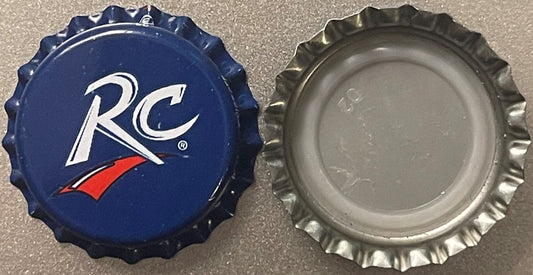
From the top this is pure Royal Crown: the white RC script with its ®, a red swoosh and COLA on a deep blue crown. Turn it over and the skirt is all Peru. It reads Producido bajo licencia de ROYAL CROWN COMPANY, INC. U.S.A., Contenido neto 355 cc., INDUSTRIA PERUANA, and Embotellado por TECNOIMPORT S.A. Juliaca - Perú, followed by a sanitary registration number. In plain English that's made under license from Royal Crown, 355 cc net, a Peruvian industry product, and bottled by TECNOIMPORT in Juliaca. Inside is a plain gray liner, no cork. These were never put on a bottle.

🔎 Reading the skirt

I love a cap that tells you where it's been, and this one has its whole passport printed around the edge. That 355 cc is the old American 12-ounce serving in metric - 12 U.S. fluid ounces comes to just under 355 milliliters - so the Juliaca bottle held the same pour as a bottle or can of RC back home in Georgia. Royal Crown Company, Inc. is the name the RC company itself went by in those years; it was incorporated in Delaware in 1978, and by 1997 RC had bottlers in 64 countries outside the United States.

The "Reg. San." is Peru's sanitary registration, the health ministry number every food and drink sold there has to carry. Peru's health office built those codes from a food-group letter, a five-digit file number, an N for national, and then letters taken from the maker's own name - and if you look at the end of the code on this skirt, the letters read TCIP, the first and third letters of TECNO and IMPORT. Next to it there's a little "24" over a small circled-arrow mark. It's a lot of paperwork for something you pry off and toss, and that's exactly why I like it.

🏔️ Juliaca, high on the Altiplano

Juliaca is the capital of San Román Province in Peru's Puno Region, up on the Altiplano at about 12,549 feet. It's the biggest city in the region, with 276,110 people at the 2017 census, and the largest trade center in the Puno region, the place where business for miles around gets done. Lake Titicaca is a short way to the southeast. The Spanish founded it as the Pueblo de Santa Catalina de Juliaca, and the town's founding is dated to 1630. A soda bottler there had a whole region of customers to serve.

The Jesuits started its big church, Santa Catalina, in 1649, and it took another 125 years to finish. The railroad station came in 1873 and changed the whole economy of the Altiplano, and Juliaca was formally incorporated in 1908. Trade is still what the town runs on: by 2008 it counted 15,439 businesses, about 41% of all the trade in the Puno Region, and it's known as the region's financial capital. Folks there call it the Ciudad de los Vientos, the City of the Winds, because the wind blows across the plain most of the year. Even the name comes with a story - local historians trace it to old Quechua words, one reading it as "it had drizzled," another as dew on the rocks.

🌎 RC in Peru

RC was a Lima brand for years. Peruvian nostalgia sites still post its old 1970s television commercial and the big family-size bottle. The way Peruvians tell it in the comment threads, RC stopped being made in Lima in 1994 and carried on in the provinces. First came Huánuco, then Arequipa, where people remember Socosani bottling it from about 1995 to 2000, and finally the south, made by the Juliaca bottler named on this skirt. That's the provincial chapter this cap comes from. One reader writing in 2009 said RC was still being sold in Puno and Juliaca.

👑 Where RC started

RC began in Columbus, Georgia. Pharmacist Claud A. Hatcher started his Royal Crown line of drinks in 1905 to sell in the family grocery store, and the first one was a ginger ale. Columbus was one of the South's earliest and biggest mill towns, sitting right on the Chattahoochee River, which powered the mills. The story goes that Hatcher's family grocery business was buying Coca-Cola syrup in large amounts, and when the local salesman wouldn't budge on the price, he swore off Coca-Cola and started mixing his own drinks in the store's basement. His Chero-Cola grew to about 700 franchise bottling plants by 1920. Then Coca-Cola sued over the word "cola," and with the legal bills piling up the company dropped it from its name in 1923. It became the Nehi Corporation in 1928.

Hatcher died in 1933. H. R. Mott took over, and in 1934 a new cola worked up by company chemist Rufus Kamm came out under the name of Hatcher's first drink, Royal Crown. It was a hit. By 1940 it was sold in nearly every state. In 1944 the courts let the company use "cola" again, and in the 1950s it became the Royal Crown Cola Company. In 1954 RC was the first beverage company to sell soft drinks in cans nationwide. In the 1950s RC also brought out Diet Rite, counted as the first diet cola on the market.

Down South, an RC and a MoonPie was the working man's lunch. In the Depression both cost about a nickel and came in bigger servings than the competition, which is the leading theory for why they became a pair. Big Bill Lister even sang about it in 1951. Folks in Chicago will tell you RC found a second home there in the old pizzerias.

🌎 From Georgia to the world

The company changed hands over the years. Cadbury Schweppes bought RC in October 2000, and Canada's Cott Corporation took over the licenses outside the United States. RC has been bottled under license everywhere from Manila to Juliaca. Keurig Dr Pepper finished buying the U.S. business in 2018, and Macay Holdings, a Philippine bottler, took the international operations in 2023.

🧢 The crown cap itself

The crown cap is an American invention too. William Painter of Baltimore patented it on February 2, 1892, and started the Crown Cork and Seal Company to make them. His first caps had 24 teeth; the 21-tooth crimp you see on caps today became the standard later on. For decades the seal inside was a disc of cork, and plastic liners took over from the 1960s on, which is why this one has that smooth gray liner instead of cork.

📅 How old is it?

The cap tells on itself. The white RC with the red swoosh underneath is the logo RC used around the turn of the century, which logo-history collectors date to 1998-2009. The licensor is printed as Royal Crown Company, Inc., the company's name in the late 1990s, and the sanitary code is the older style without a year in it. All of that puts it right at the end of the 1990s and into the 2000s.

🥤 About these

Every one I have is the same unused 1 1/4 inch crown with the Peruvian skirt. It's a fun one for a cap collector who wants an international RC, an RC fan, or anybody from Puno. The supply is finite. This licensee's caps were made for the bottling line, not for collectors, and once these last unused ones are gone, they'll be very difficult to acquire.

Shipping

🚚 Shipping & Handling

  • Shipping costs and timing are calculated at checkout.
  • Items curated and shipped directly by me include U.S. shipping at no additional cost, professionally packed to ensure safe arrival of your artifact.

Items from Vetted Pro Collectors
Shipping for items offered by vetted Pro Collectors is determined at checkout. All Pro Collector listings are reviewed to ensure fair, reasonable shipping practices.

For full details, please refer to our Shipping Policy.

Returns & Exchange

Take your time — you've got a full six months. If a piece isn't right for you, send it back the way it reached you and we're good.

In the first 30 days your money goes straight back the way you paid. After that it's store credit, so you can put it toward something you'd rather have.

Return shipping we sort out between us, case by case. I don't make this difficult.

If something arrives damaged, or it isn't what I said it was, send me a photo within 48 hours and I'll make it right.

Email info@vintageantiquesgifts.com or call 802-356-9872 — that's me answering, not a call center.

The only things I can't take back are custom or special-order pieces and gift cards.

View full details
  • 5 stars: 1 (100%)
  • 4 stars: 0 (0%)
  • 3 stars: 0 (0%)
  • 2 stars: 0 (0%)
  • 1 star: 0 (0%)
b
brittanyflogel

The vintage bottle caps were perfect for the project I was working on! Thank you!

Rescuing American History Since 2007

— Travis & the Kids