
Skip to product information
1 of 3

Vintage and Antique Gifts

Vintage 1960s FEZ Brand Crate Label 🏷️ Tamouzian Bros. Cutler California Lithograph Collectible

Vintage 1960s FEZ Brand Crate Label 🏷️ Tamouzian Bros. Cutler California Lithograph Collectible

Regular price $8.00 USD
Regular price Sale price $8.00 USD
Sale Sold out
Shipping calculated at checkout.

Size: 13" x 4"

🚚 Free US Shipping — ships within one business day. International shipping calculated at checkout.

Quantity

🏷️ When Did a Hat From the Ottoman Empire End Up on a California Crate Label — and Why Can't You Stop Looking at It?

Size: 13" x 4"

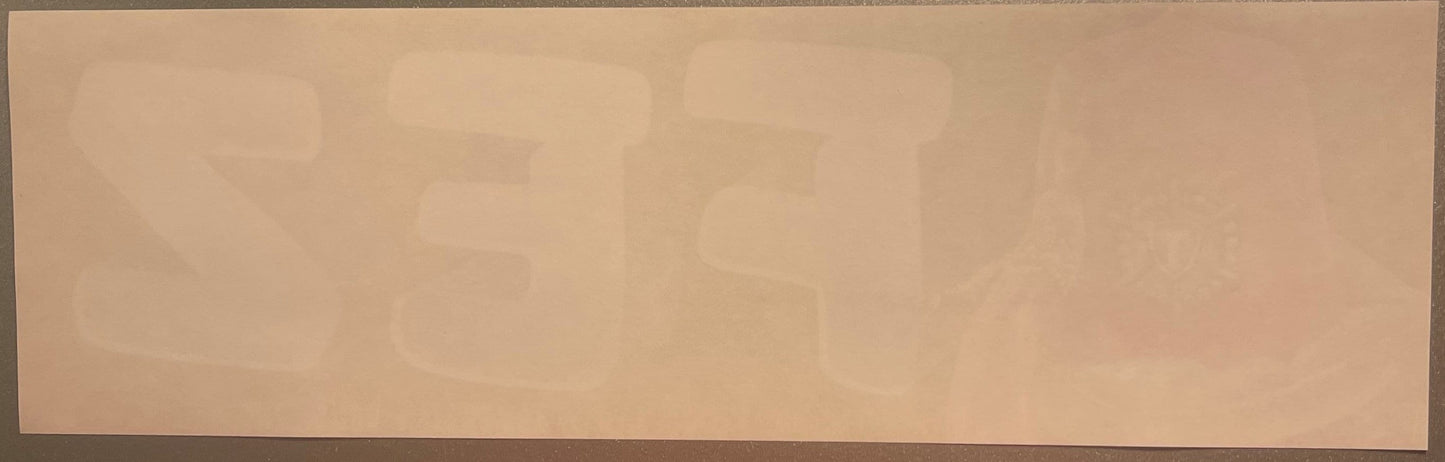
There's a moment every serious crate-label collector knows well: you're flipping through a stack of old paper, half-expecting another orange grove or mountain sunrise, and then — this. A brilliant red fez, plush and rakish, resting on a green velvet cushion, its gold-and-orange tassel draping to the side with an almost theatrical confidence. A jeweled emblem centered on the crown, a shield bearing the letter T surrounded by a starburst of green and pearls. The whole thing printed in colors so saturated — crimson, forest green, warm gold, deep black, and the cool blue shadow behind the bold white letters — that it looks like it was pulled off the press yesterday. This is the FEZ brand crate label from Tamouzian Bros, Inc. of Cutler, California, and it is one of the most visually arresting pieces of mid-to-late twentieth-century American agricultural graphic art I have ever had the pleasure of adding to this collection.

This is a New Old Stock (NOS) original lithographed paper crate label — never applied, never glued to a wooden box, never rolled in a warehouse crate that met a fork lift. It measures approximately 13 inches wide by 4 inches tall, the classic box-end lug-label proportion used on grape and fruit shipping crates across the San Joaquin Valley for generations. The label text is unambiguous: "FEZ — BRAND — PRODUCE OF U.S.A. — GROWN & PACKED BY TAMOUZIAN BROS., INC. — CUTLER, CALIF. 93615." That five-digit ZIP code — 93615 — tells us something important right away: ZIP codes were introduced in the United States in 1963, which means this label was designed and printed no earlier than 1963. A dealer copy of this same ZIP printing is dated to the 1980s, and an earlier printing of the same art, with no ZIP and no INC., to the 1970s. Anyone offering a 1950s date for a label carrying a ZIP code is working from a guess; the ZIP code itself settles the question.

The printing is lithography — the same labor-intensive, stone-and-plate color-registration process that made California crate labels the poster art of the agricultural world. Each color layer was laid down separately, requiring meticulous alignment to achieve the kind of crisp color breaks and dimensional shadow you see in those massive white FEZ letters receding against the dark background. This was skilled commercial art, executed by trained lithographers working at high volume for the fruit-packing industry. The result, as our owner has said for years, is unparalleled — museums and art institutes have mounted galleries around exactly this tradition, and collectors continue to seek these labels out precisely because the original print runs were finite. Once they're in frames on collector walls, they don't come back to market.


🏭 Tamouzian Bros, Inc. — A Family Name Carved Into the Valley's History

The business began in 1953, when brothers George and Sark Tamouzian started a farming partnership. In 1954 the partnership built its packing house on Avenue 384, followed in 1956 by a cold storage facility, and shortly afterwards the business became known as Tamouzian Brothers.

There's a family story behind that packing house, and to me it's the best part of this label. The Tamouzians were part of the Valley's Armenian community. The family fled Turkey, came in through Ellis Island, and settled in the Yettem community, just down Route 201 from Cutler. George was born in the family home in Cutler on October 5, 1930, to Arshag and Pepron Ananian Tamouzian, and he lost his father when he was only five. He went to Yettem Elementary School and helped his older brother Sark on the family farm whenever he could, and by 1953 the two of them were partners. George was an active member of St. Mary Armenian Apostolic Church in Yettem, and that's where he was married in 1959. Yettem is a story all by itself: a group of Armenians from Fresno founded it in 1901, and the name is how Western Armenians say the Armenian word for Eden.

If you want to dig further into the Armenian farm families of this corner of the Valley, I'd start with the Armenian Studies Program at Fresno State, founded in 1977, and the old Dinuba Sentinel, the local paper a few miles west of Cutler in Dinuba, which ran from 1909 until it merged into the Mid Valley Times in 2019.

The "Bros." and "Inc." of the company name sketch the corporate biography in shorthand: this was a family business, formally incorporated, run by brothers who built it large enough to warrant the legal structure of a corporation. The firm operated as a grower and packer — meaning the Tamouzians didn't just broker other people's fruit; they farmed the land themselves and ran the packing operation under their own roof and their own brands. That vertical integration was the mark of a serious agricultural enterprise.

What makes the Tamouzian operation particularly interesting to label collectors is the breadth of their brand portfolio. A single packing house rarely put all its fruit under one name — different grades, different markets, and different buyers called for different labels. Tamouzian Bros. brands include T-Way and Tambro. The FEZ brand is arguably the most visually memorable of the group.

The T on the shield emblem at the center of the fez illustration is almost certainly the Tamouzian family initial — a grower's mark embedded in the brand imagery itself, the kind of quiet personal signature that family operations worked into their graphics. The starburst of green spokes and pearl-like beads surrounding it elevates what could have been a simple monogram into something that reads like a heraldic device, a crest, a mark of pride. It's personal in a way that corporate branding rarely manages to be.

What I can say with confidence is that the company operated long enough, and packed well enough, to build a multi-brand identity and leave a paper trail in the label-collector market that remains active today.


🌄 Cutler, California — Where the Valley Meets the Foothills and Fruit Moves by Rail

Set in Tulare County, California, on the eastern edge of the San Joaquin Valley where the flatland begins its long rise toward the Sierra Nevada, Cutler is the kind of place whose name most Americans would never recognize — and whose agricultural output has fed much of the country for well over a century. The community takes its name from John Cutler, born in Indiana in 1819, who earned his medical degree before making the overland journey to California in 1849 and eventually became one of Tulare County's most venerated pioneers. A doctor turned pioneer turned namesake: that's a California story in miniature.

The event that made Cutler a working agricultural hub rather than a quiet rural crossroads was the arrival of the railroad. In 1897, the San Francisco and San Joaquin Valley Railroad established a manned depot at Cutler, offering both passenger and freight service. For growers and packers in the area, that depot was everything — it meant a cold-chain connection to markets in San Francisco, Los Angeles, and eventually the entire national rail network. Crates of table grapes, citrus, peaches, and vegetables could move from a Cutler packing house to a distant city produce market in days rather than weeks.

In its prime packing-house years Cutler was a town whose rhythm was set by harvest seasons, whose air in late summer carried the sweet-sharp smell of ripening grapes, and whose working population moved between the fields and the packing houses as the crops came in. Agriculture was not a peripheral part of life in Cutler; it was life. Well over half the families in the community worked in agriculture-related jobs, either in the fields or on the packing-house floor, and the crops that defined the area — citrus, grapes, dairy, and peaches — were the same crops that gave California crate labels their subject matter and their romance.

Cutler's packing tradition did not fade when paper labels gave way to stickers and barcodes. The large packing facility in town was most recently operated by Prima Wawona before passing to Jireh Packing Company, and the work itself continues, which is more than can be said for most of the packing houses whose labels now end up in collector frames.


🎨 The Art of the Label — Lithography, Color, and the Crate-Label Golden Age

It is worth saying plainly what a crate label actually is as an art object, because the medium shapes everything about why these pieces matter to collectors and decorators alike. A crate label was commercial advertising produced to the highest available printing standard of its era — not because packers were patrons of the arts, but because in a competitive produce market, your label was your brand, and your brand had to catch a buyer's eye across a crowded dock or warehouse floor. The result, almost accidentally, was a body of American graphic art that rivals anything produced for the fine-art market of the same period in terms of color boldness, compositional confidence, and sheer visual impact.

The lithographic process used to produce the FEZ label — and essentially all California crate labels of the mid-to-late twentieth century — required artists to separate the image into individual color layers, each printed from its own plate or stone, each requiring precise registration to land exactly on top of the layers before it. Look at the FEZ label: the shadow behind the white block letters, the gradient from warm gold to cooler ivory on the tassel strands, the way the red of the fez reads as fabric rather than flat color, the jeweled depth of the emblem. Each of those effects required a separate pass through the press. This was not automated. It was craft, executed at commercial scale, and the skill required to produce results like this consistently was considerable.

The FEZ label, with its bold figure-ground contrast, its almost heraldic central image, and its theatrical color palette, fits comfortably in any survey of mid-century American commercial graphic design.

Museums agree. Regional California museums have mounted exhibitions around crate-label art, and the scholarly literature on the subject has grown steadily. The market has followed: labels that once papered the inside of junk drawers now hang in galleries, restaurants, offices, and living rooms.


📜 The Fez Itself — Symbol, History, and Why It Works So Well as a Brand Image

The fez — the red felt hat with a flat top, a tassel, and no brim — has one of the more complicated histories of any piece of headwear in the world. Associated broadly with the Ottoman Empire and the wider Islamic world of the nineteenth and early twentieth centuries, the fez was actually a modernizing fashion when it was adopted as standard dress in the Ottoman reforms of the 1820s, replacing an older turban tradition. It spread across North Africa and the Middle East, became a symbol of cultural identity, was banned in Turkey by Atatürk in 1925 as part of his sweeping secularization and Westernization program, and paradoxically became, in the Western imagination, the very emblem of exotic Eastern-ness precisely as it was disappearing from everyday use in its countries of origin.

As a brand image the fez is distinctive, visually bold, and immediately recognizable. The label artist — whoever held the brush at the lithography house — rendered the fez with genuine affection and detail. The cushion beneath it is plush and green. The tassel hangs with the weight of real silk. The emblem at the crown is not a rushed monogram but a composed heraldic design. This is a brand image built with care.

It is certainly among the more culturally layered brand images in the crate-label canon, and that depth is part of what makes it so enduringly interesting to look at.


🖼️ Display Ideas

  • 🍇 Kitchen or dining room gallery wall — the deep red, green, and gold palette pairs beautifully with warm wood tones, terracotta tile, and the casual elegance of a farmhouse or Mediterranean kitchen aesthetic.
  • 🏛️ Framed under UV-protective glass as a standalone artwork — at 13" × 4", this label suits a long, narrow frame that emphasizes its horizontal composition; a simple black or aged-gold frame lets the color do all the work.
  • 📚 Home library or study grouping — pair with other travel-themed or culturally evocative vintage graphics for a salon-style arrangement that sparks conversation about history, geography, and design.
  • 🌾 California agriculture or San Joaquin Valley heritage display — alongside other Tulare County, Fresno County, or Central Valley crate labels, this piece anchors a regional collection with strong visual authority.
  • 🎨 Restaurant or bar décor — the fez's association with the exotic and the convivial makes this label a natural fit for a bar, tapas restaurant, or any hospitality space that leans into global visual references.
  • 🏡 Office or creative studio accent piece — graphic designers, art directors, and creative professionals often collect crate labels precisely as reference and inspiration; the FEZ label is a masterclass in limited-palette, high-contrast commercial composition.

🎁 Who Collects These

Crate-label collectors are a broad and passionate community, and the FEZ label draws from several overlapping corners of that world. California agricultural history collectors seek out labels from specific counties, towns, or packing houses as primary documents of an era when the Central Valley was quite literally feeding the nation. Graphic design and commercial art enthusiasts prize crate labels as the vernacular poster art of mid-century America, and the FEZ label's bold composition and rich color register as high quality even by that exacting standard. Vintage advertising collectors appreciate the label as a complete package — brand, image, company, town, and era, all on a single sheet of lithographed paper.

And then there are the decorator-collectors, the people who simply want beautiful, authentic, conversation-starting art on their walls — people who understand that a piece with a real story behind it rewards looking at in a way that a reproduction never quite can.

Museums and art institutes have validated this instinct. The crate-label tradition is now firmly established as a legitimate chapter in American visual culture, and the original NOS labels that survive are the primary documents of that chapter. Framed and displayed, the FEZ label doesn't just decorate a wall — it preserves a piece of Cutler, California, of the Tamouzian family, and of the San Joaquin Valley's grape-packing heritage that would otherwise exist nowhere at all.


❓ FAQ

Is this an original label or a reproduction?
This is an original New Old Stock (NOS) lithographed paper crate label — produced during the active commercial life of the FEZ brand by Tamouzian Bros, Inc. It was never applied to a crate. It is not a modern reprint, a digital reproduction, or a facsimile of any kind.

What exactly was packed in the crate this label came from?
The label names no produce. Tamouzian Brothers grew tomatoes, peppers, squash, grapes and cotton, and later became known as the largest vine-ripening tomato operation in the region. The label dimensions — approximately 13" × 4" — are standard for a box-end lug label used on grape and fruit crates.

How old is the label?
The label carries ZIP code 93615, which places its printing no earlier than 1963, when the ZIP code system was introduced. A dealer dates this exact ZIP printing to the 1980s and an earlier no-ZIP printing of the same art to the 1970s. Any estimate placing it in the 1950s conflicts with the ZIP code evidence and should be set aside.

What does the "T" emblem on the fez mean?
The shield bearing the letter T, centered in the jeweled starburst emblem on the crown of the illustrated fez, almost certainly represents the Tamouzian family initial — a grower's mark worked into the brand imagery, a practice common among family-owned packing operations that wanted their personal identity embedded in their commercial graphics.

Who ran Tamouzian Bros.?
Brothers George and Sark Tamouzian, whose 1953 farming partnership grew into the business.

How should I frame and preserve a crate label like this?
Collectors and conservators consistently recommend UV-protective glazing (UV-filtering glass or acrylic) to prevent color fading from light exposure over time. Acid-free matting and backing materials protect the paper from off-gassing and contact deterioration. At 13" × 4", this label suits standard frame sizes or custom framing in a long, narrow horizontal format that honors its original crate-end proportion.

Did Tamouzian Bros. pack under other brands?
Yes. The company used several brand names, FEZ, T-Way and Tambro among them.

📋 What Is Printed On This Label

  • FEZ
  • BRAND
  • PRODUCE OF U.S.A.
  • GROWN & PACKED BY TAMOUZIAN BROS., INC.
  • CUTLER, CALIF. 93615

A packing-house brand. Labels like this were printed for the packing house rather than for one crop, so no fruit or vegetable is named on it. The trade knew what was in the box.

BRAND is printed on this label. It is set in dark blue on the black ground at the lower right, beside the Z — very low contrast, easily missed, but there. The jewelled starburst emblem on the fez carries a central shield charged with the letter T, the Tamouzian initial.

The ZIP code is the dating evidence on the object. CUTLER, CALIF. 93615 is printed on the sheet. Five-digit ZIP codes were introduced in July 1963, so this sheet cannot have been printed before then.

Shipping

🚚 Shipping & Handling

  • Shipping costs and timing are calculated at checkout.
  • Items curated and shipped directly by me include U.S. shipping at no additional cost, professionally packed to ensure safe arrival of your artifact.

Items from Vetted Pro Collectors
Shipping for items offered by vetted Pro Collectors is determined at checkout. All Pro Collector listings are reviewed to ensure fair, reasonable shipping practices.

For full details, please refer to our Shipping Policy.

Returns & Exchange

Take your time — you've got a full six months. If a piece isn't right for you, send it back the way it reached you and we're good.

In the first 30 days your money goes straight back the way you paid. After that it's store credit, so you can put it toward something you'd rather have.

Return shipping we sort out between us, case by case. I don't make this difficult.

If something arrives damaged, or it isn't what I said it was, send me a photo within 48 hours and I'll make it right.

Email info@vintageantiquesgifts.com or call 802-356-9872 — that's me answering, not a call center.

The only things I can't take back are custom or special-order pieces and gift cards.

View full details

Preserving History: Authentic Objects Across Eras

— Curated by Travis Weigel